
Only 29% of HR leaders believe their performance processes help employees deliver their best work. This means many organizations have KPIs in place, but don’t have a consistent process for reviewing and acting on them.
Metrics are often set at the start of the quarter, revisited at the end, and rarely used to make decisions. As a result, teams can stay busy without knowing whether their efforts are contributing to the outcomes that matter most.
This guide explains how to define, implement, and refine KPIs so performance tracking becomes an ongoing part of how your team operates.
| TL;DR: KPI implementation succeeds when metrics are tied to business goals, owned by specific individuals, backed by reliable data, and reviewed on a fixed cadence. Organizations that treat KPIs as ongoing management tools rather than quarterly reporting exercises are more likely to improve performance, accountability, and decision-making. |
| Table of Contents 1. KPI Implementation: Key Steps for Successful Execution 2. 4 KPI Examples for Different Business Functions 3. How to Develop Effective KPIs for Your Business 4. Good vs Bad KPI Examples: What Effective KPIs Look Like 5. How to Choose the Right Software for KPI Implementation 6. Final Takeaway 7. Frequently Asked Questions |
KPI Implementation: Key Steps for Successful Execution
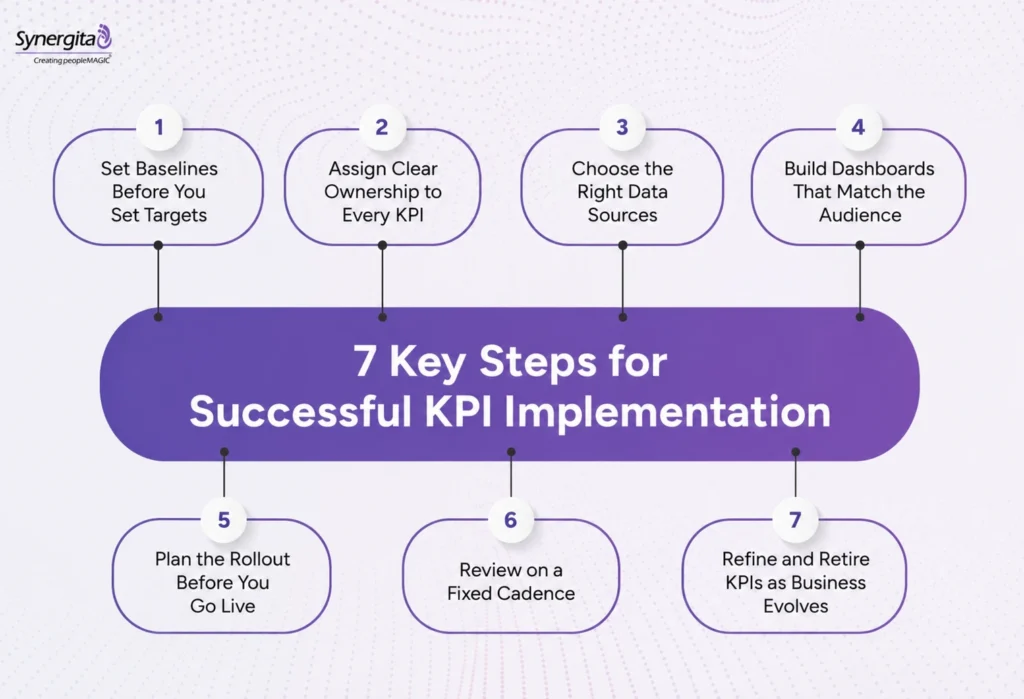
Successful KPI implementation requires a structured approach that connects business goals with measurable outcomes. The following steps can help you establish, track, and refine KPIs that support long-term performance improvement.
1. Set Baselines Before You Set Targets
Before deciding what you want to achieve, measure where you currently are. A baseline gives you a starting point for comparing progress and makes your targets defensible rather than arbitrary.
For example, if your customer support team currently resolves 60% of tickets within 24 hours, a target of 80% within two quarters seems realistic. A target like “achieve industry best practice” gives teams nothing concrete to work toward.
Where possible, compare your baselines against industry benchmarks to understand whether you are behind, on par, or ahead of competitors.
2. Assign Clear Ownership to Every KPI
Every KPI should have a designated owner responsible for tracking performance, reporting on results, and raising concerns when trends move in the wrong direction. Ownership does not mean one person is solely responsible for achieving the outcome. It means the person is accountable for keeping the team informed and driving the review conversation.
3. Choose the Right Data Sources
Identify exactly where the data for each KPI will come from before rolling it out. Unreliable data sources impact the trust in the metric itself. Where possible, automate data collection by connecting your KPI tool directly to your CRM, finance system, or project management platform.
4. Build Dashboards That Match the Audience
A dashboard built for a CEO should look different from one built for a frontline team manager. Senior leadership typically needs a high-level view of strategic KPIs across the business. Team leads need granular, operational data they can act on week to week.
Moreover, limit each view to the 5-7 metrics most relevant to that audience and use visual cues like:
- Color coding
- Trend lines
- Threshold alerts
This helps to make performance gaps immediately visible.
5. Plan the Rollout Before You Go Live
Implementing new KPIs on teams without context can create resistance. Before rollout, communicate:
- Why each KPI was chosen
- How it connects to broader business goals
- What good performance looks like
Run a short onboarding session for each team, walk them through how to read and interpret their dashboards, and allow them to ask questions. Teams that understand the purpose behind a metric are more likely to engage with it consistently.
6. Review on a Fixed Cadence
KPI reviews only work if they happen on a predictable schedule. A common cadence most organizations use includes:
- Weekly: Operational KPIs such as call resolution time, daily sales, or ticket volume
- Monthly: Tactical KPIs such as lead conversion rate or customer satisfaction scores
- Quarterly: Strategic KPIs such as revenue growth, market share, or employee retention
Reviews should not just be status updates. Use them to discuss what is driving performance, what is getting in the way, and what the team will do differently before the next review.
7. Refine and Retire KPIs as Business Evolves
KPIs have a lifespan. A metric that was critical during a growth phase may become irrelevant once that goal is achieved or the strategy shifts. Holding on to outdated KPIs creates confusion and dilutes focus on what is most critical.
Schedule a formal KPI audit at least once a year. Ask:
- Does this KPI still reflect a current business priority?
- Is it driving decisions and meaningful action?
- Is the underlying data source still accurate and reliable?
Retire metrics that no longer serve a purpose and replace them with ones that reflect where the business is headed.
4 KPI Examples for Different Business Functions
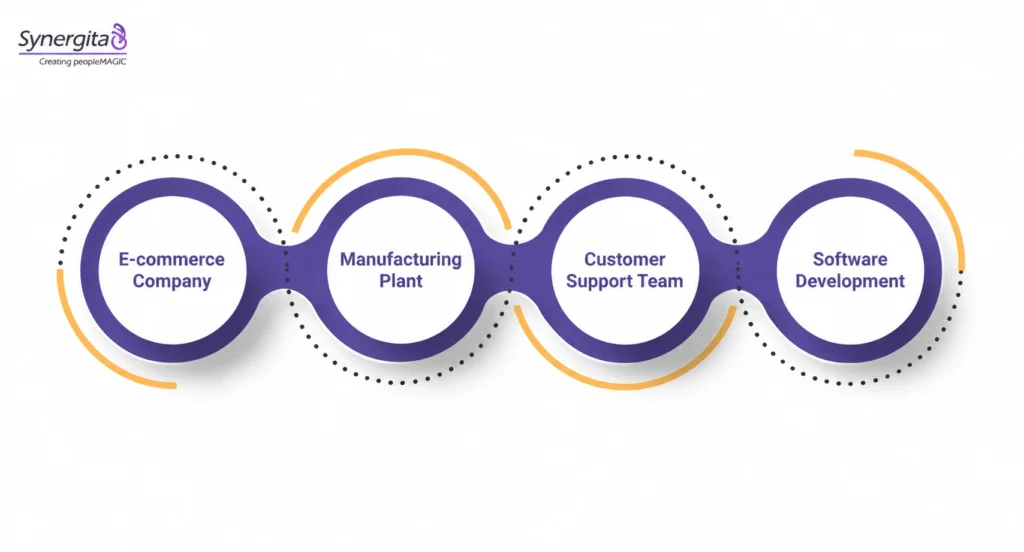
To illustrate, here are some practical KPI examples that organizations use:
- E-commerce Company: Average order value, cart abandonment rate, website traffic.
- Manufacturing Plant: Units produced per hour, downtime percentage, safety incident frequency.
- Customer Support Team: First contact resolution rate, average handling time, customer feedback rating.
- Software Development: Sprint velocity, bugs resolved, deployment frequency.
These examples can serve as a starting point for creating KPIs that align with your business goals.
How to Develop Effective KPIs for Your Business
Successful KPI implementation starts with a clear understanding of what your organization is trying to achieve. By linking KPIs to strategic goals and reviewing them consistently, businesses can gain better visibility into performance and make more informed decisions.
1. Align KPIs With Business Objectives
Effective KPI implementation starts with a clear understanding of your organization’s strategy. Before selecting KPIs, focus on defining your core business goals, such as:
- Increasing market share
- Improving customer experience
- Enhancing operational efficiency
KPIs must reflect progress toward these strategic objectives. According to McKinsey research, organizations that align employee goals with business priorities are nearly three times more likely to report effective performance management than those that do not.
Remember to prioritize a focused set of KPIs that highlight what is important. Measuring too many indicators dilutes attention and complicates analysis.
2. Involve Stakeholders Early
Include team members, department heads, and key stakeholders in the KPI selection process. Their input helps ensure KPIs are relevant, aligned across teams, and supported by the people responsible for achieving them. This also strengthens ownership and accountability.
3. Select KPIs That Are SMART
To ensure effectiveness, KPIs should be SMART:
- Specific: The KPI should be clear and easy to understand.
- Measurable: Quantifiable with available data, enabling tracking over time.
- Achievable: Realistic and attainable with the available resources.
- Relevant: Directly aligned with critical business goals.
- Time-bound: Defined within a specific timeframe for assessment.
For example, “Increase customer retention by 5% in the next quarter” is more actionable than “Improve customer retention.”
Avoid using KPIs that are too vague or broad because they confuse rather than clarify.
Good vs Bad KPI Examples: What Effective KPIs Look Like
Ineffective KPIs can create confusion about what teams are trying to achieve. The table below highlights the difference between well-defined KPIs and vague metrics.
| KPI Attribute | Good KPI Example | Bad KPI Example |
| Specific | Increase retention by 5% in Q3 | Improve retention |
| Measurable | Achieve an NPS of 60+ by year-end | Make customers happier |
| Actionable | Resolve 90% of support tickets in 24 hours | Address support tickets quickly |
| Relevant | Reduce downtime by 10% for the production team | Post more updates on social media |
| Time-bound | Generate 500 qualified leads this month | Get more leads |
Reviewing your KPIs against these criteria can help ensure they are actionable, measurable, and aligned with the outcomes your organization is working to achieve.
How to Choose the Right Software for KPI Implementation
The right KPI tool makes implementation and ongoing management significantly easier, but the tool should follow the framework, not replace it.
When evaluating platforms for KPI implementation, look for a tool that offers:
- Goal Alignment: Align individual, team, and organizational KPIs with broader business objectives.
- Real-Time Dashboards: Provide up-to-date visibility into KPI performance and progress.
- Automated Data Collection: Integrate with existing systems to reduce manual data entry and improve accuracy.
- Alerts and Notifications: Highlight performance gaps and potential risks before targets are missed.
- Review and Feedback Support: Enable regular performance reviews, feedback discussions, and accountability tracking.
An AI-powered performance management system helps turn performance data into actionable insights, making it easier to monitor progress and support informed decision-making.
Final Takeaway
Effective KPI implementation is about choosing the right metrics, assigning clear ownership, and reviewing them consistently so teams can act on what the data is telling them. When KPIs become part of regular conversations and decision-making, they are more likely to drive meaningful performance improvements.
Synergita’s performance management system simplifies KPI implementation with goal alignment, real-time dashboards, and continuous feedback that keep teams focused and informed. It provides the structure needed to monitor progress and take action when it matters most.
Start a free trial of Synergita performance management system and see how it helps in successful KPI implementation.

Frequently Asked Questions
KPI implementation is the process of selecting, defining, rolling out, and reviewing key performance indicators connected to business goals. It includes setting baselines, assigning ownership, and building a review cadence so the metrics drive action.
To set up KPIs for a team, define a focused set of metrics, (usually 3–7) that align with the team’s strategic objectives. Apply the SMART criteria, assign an owner to each KPI, establish baselines and targets, and review regularly.
A KPI improvement plan is a structured action plan designed to close the gap between current performance and the desired target. Organizations usually create it when a KPI consistently falls short of expectations.
You can start by identifying the root cause of the issue, whether it’s a process gap, resource constraint, skills deficiency, or data problem. Then implement targeted changes, monitor the results, and adjust your approach based on what works.
You need to start with the organization’s strategic goals and identify the outcomes each department owns. Then define KPIs that measure those outcomes and focus on results that each team can directly influence.
No, you can’t. While top-level KPIs like revenue growth or NPS apply organization-wide, team-level KPIs should reflect the specific outcomes each team controls. Implementing KPI frameworks correctly means cascading organizational goals into team-specific metrics, not copying the same list across departments.
Operational KPIs should be reviewed weekly, tactical KPIs monthly, and strategic KPIs quarterly. The right review cadence depends on how quickly the metric can change.
Yes, KPIs can be customized to measure individual contributions, team outcomes, and overall organizational performance. The key is to ensure individual KPIs connect to team KPIs, which connect to organizational goals.