
Managers spend hours in performance reviews debating effort instead of outcomes. Employees stay busy, yet leadership struggles to answer a simple question: Is everyone’s work actually contributing to business goals?
This disconnect is exactly the problem that management by objective was designed to solve. Rather than relying on vague expectations or annual reviews, the framework creates clear, measurable objectives that connect individual performance directly to organizational success.
In this guide, we will explore what management by objectives (MBO) is, how it works, the key benefits it offers, and common mistakes to avoid in MBO implementation.
| TL;DR: MBO aligns individual, team, and organizational goals to ensure everyone works toward the same business outcomes.Successful MBO implementation requires clear objectives, measurable success criteria, and regular progress reviews.Organizations that use MBO effectively can benefit from stronger accountability and more structured feedback.Common implementation mistakes like unclear goals, irregular reviews, and limited employee involvement, can be avoided through consistent goal management and the right tools. |
| Table of Contents 1. What Is Management by Objectives (MBO) in Business? 2. Process of Management by Objectives: Step-by-Step Implementation Guide 3. MBO Examples Across Business Functions 4. What Are the Benefits of Management by Objectives 5. Common Mistakes to Avoid in MBO System Implementation 6. How Technology Supports MBO Implementation 7. Final Takeaway 8. Frequently Asked Questions |
What Is Management by Objectives (MBO) in Business?
The meaning of management by objectives is aligning employee performance with organizational goals through measurable objectives. It is a performance management approach in which managers and employees collaborate to set specific, measurable goals and use those goals to guide work, evaluate progress, and assess results.
MBO shifted the conversation from “what are you doing?” to “what are you trying to achieve?” That reframe is what makes it powerful.
Process of Management by Objectives: Step-by-Step Implementation Guide
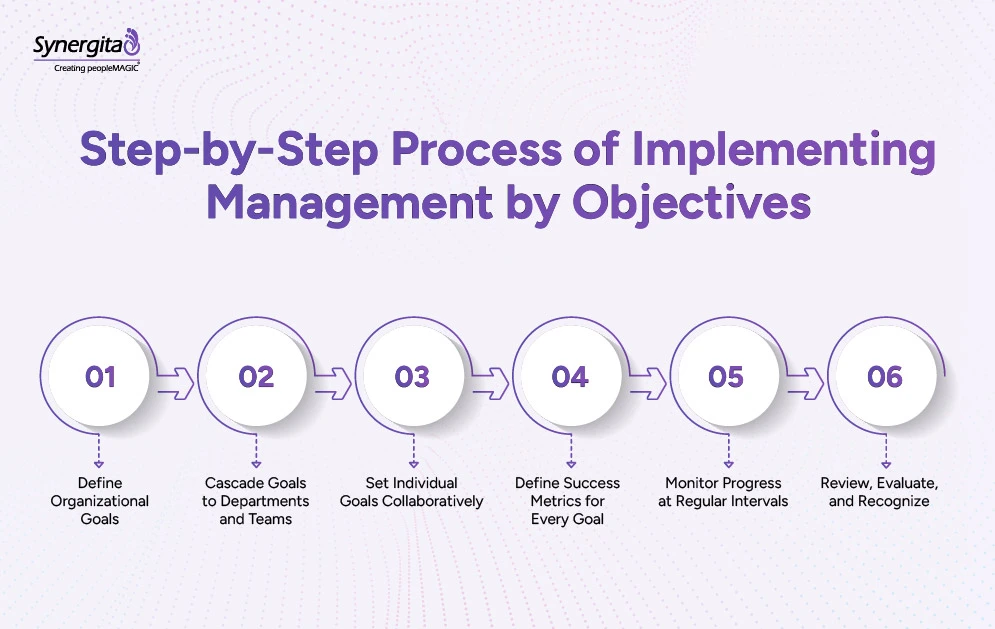
Management by Objectives (MBO) follows a continuous cycle of goal setting, tracking, and performance evaluation. Its effectiveness depends not just on defining objectives but also on regularly reviewing progress and making adjustments when needed. The following steps explain how the MBO process works.
Step 1. Define Organizational Goals
Leadership defines 3–5 strategic objectives for the business, outcomes the company needs to achieve this quarter, half-year, or year. These should be specific and outcome-driven, not directional platitudes like “grow the business.”
For example, instead of setting a goal to “increase revenue,” a business should aim to increase annual recurring revenue by 15% by the end of the fiscal year.
Step 2. Cascade Goals to Departments and Teams
Each department turns the company goals into specific goals for its team. Whether it’s Marketing, Sales, HR, or Product, every team should clearly understand how its work contributes to the company’s success.
This is where alignment either happens or breaks down.
Step 3. Set Individual Goals Collaboratively
Managers and individual employees define role-specific objectives together. This collaboration is what separates MBO from traditional top-down goal-setting. Gallup study found that employees who participate in setting their goals are 2.3 times more likely to view those goals as realistic.
The study also found that 76% of employees involved in goal setting understood what was expected of them, compared to 47% who were not involved.
Step 4. Define Success Metrics for Every Goal
Once a goal is defined, organizations need a way to measure progress. For example, if the objective is to improve customer satisfaction, a success metric should be increasing NPS from 40 to 50 by Q3.
Research shows that only 45% of U.S. employees agree they know what is expected of them at work. This shows why measurable objectives are critical for alignment and accountability.
Step 5. Monitor Progress at Regular Intervals
Don’t wait until the end of the review period to discuss progress. Regular check-ins, monthly reviews, or quick one-on-one meetings help keep goals on track and identify challenges before they become bigger problems. This step includes continuous feedback through regular check-ins, helping employees and managers to:
- adjust priorities
- remove blockers
- stay aligned with goals
Suggested Reading: Steps to Build Continuous Feedback Culture
Step 6. Review, Evaluate, and Recognize
At the end of the cycle, review results based on the agreed goals and metrics. Celebrate achievements, identify areas that need improvement, and use those learnings to set better goals for the next cycle.
This final review step helps organizations learn from results and continuously improve performance over time.
Management by Objectives MBO Examples Across Business Functions
Understanding MBO becomes much easier when you see how it works in real business situations. Here are MBO goals examples and management by objectives examples across key functions:
| Function | Organizational Goal | Team Objective | Individual Goal |
| Sales | Grow ARR by 25% this year | Increase new logo acquisition by 30% in Q3 | Close 8 new accounts by September 30 |
| HR | Reduce attrition by 15% | Launch structured onboarding by Q2 | Complete onboarding redesign and pilot with 2 cohorts |
| Marketing | Drive 40% more pipeline | Increase MQLs by 35% this quarter | Publish 6 SEO-optimized blog posts and hit 500 organic visits |
| Product | Reduce churn by 10% | Ship 3 retention-focused features this half | Complete discovery and spec for in-app nudge feature by month 2 |
| Customer Success | Improve NPS from 35 to 50 | Reduce first-response time to under 4 hours | Resolve 90% of tickets within SLA this quarter |
These managing by objectives examples show how company goals are connected to team goals across all departments, so everyone works toward the same outcome.
What Are the Benefits of Management by Objectives?
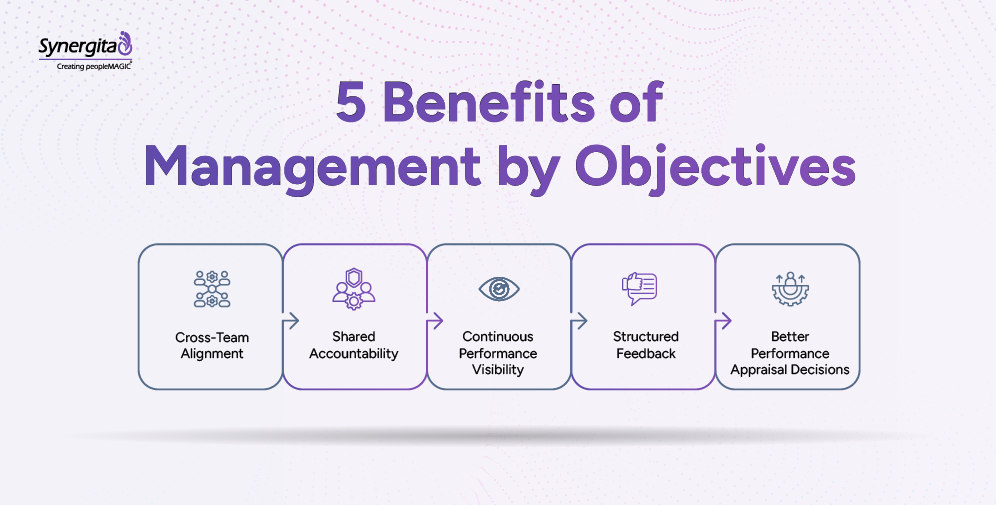
When the management by objectives (MBO) system is implemented effectively, it helps organizations achieve alignment, accountability, and performance visibility. Let’s look at the key benefits.
1. Cross-Team Alignment
Every team understands how their work connects to the company strategy, with clear priorities and no conflicting goals across teams. According to McKinsey, 91% of companies with effective performance management systems confirm that employees’ goals are directly linked to business priorities.
2. Shared Accountability
MBO shifts accountability from something imposed by managers to something co-created with employees. This difference has a significant impact on employee engagement. Self-Determination Theory, developed by Deci and Ryan (1985), identifies autonomy as one of three core psychological needs driving intrinsic motivation.
3. Continuous Performance Visibility
One of the important advantages of MBO is that it makes performance legible throughout the year, not just at the annual review. When goals are specific and time-bound; for example, “increase qualified pipeline by 30% by end of Q2”, managers can assess progress at any check-in without waiting for a formal evaluation cycle.
4. Structured Feedback
When goals are specific and measurable, feedback becomes clearer and more useful. Instead of unclear comments like “you’re doing great,” managers can point to exact results, such as “you closed 7 out of 8 accounts this quarter, and here’s where the gap is.”
5. Better Performance Appraisal Decisions
When performance is tracked against documented objectives over multiple cycles, you can find useful information. It provides you with a record of who delivers, under what conditions, and where the gaps are. This allows you to make performance appraisal decisions based on evidence.
Suggested Reading: 7 Modern Performance Appraisal Methods for 2026
5 Common Mistakes to Avoid in MBO System Implementation
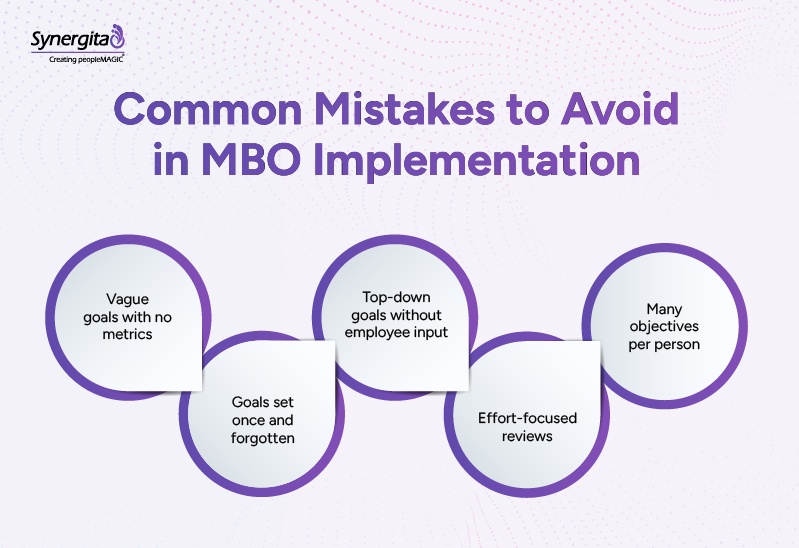
Failures in MBO are usually linked to execution gaps rather than the model itself. Here are the patterns that cause breakdowns:
- Vague goals with no metrics: “Improve sales” is not an MBO objective. If you can’t measure it, employees have no clear target and managers won’t have a criteria to evaluate performance.
- Goals set once and forgotten: MBO requires ongoing tracking. Without check-ins, it becomes a documentation exercise rather than a performance system.
- Top-down goals without employee input: Skipping the collaboration step removes the ownership that makes MBOs work. Assigned goals get compliance. Agreed goals get commitment.
- Effort-focused reviews: MBO focuses on what was achieved, not how much effort was put in. Mixing the two weakens the framework.
- Many objectives: Giving more than five goals per person reduces focus and creates confusion instead of clarity.
How Technology Supports MBO Implementation
The real challenge in implementing MBO is maintaining consistency as goals, teams, and review cycles grow. Relying on spreadsheets, emails, and manual follow-ups makes it difficult to track progress, maintain alignment, and ensure performance conversations happen at the right time.
Performance management software helps organizations streamline these processes, giving managers and employees the right system to set goals, monitor progress, exchange feedback, and conduct reviews throughout the performance cycle.
The key benefits of using a performance management tool include:
- Stronger alignment between employee goals and business objectives
- Better visibility into progress against measurable outcomes
- More frequent and meaningful feedback conversations
- Greater accountability across teams and individuals
- More consistent and objective performance reviews
- Less time spent on manual tracking and administrative tasks

Final Takeaway
Management by Objectives is an effective way to align individual performance with business goals. When implemented properly, MBO helps employees understand what is expected of them, and enables managers to measure outcomes more accurately. However, success of MBO implementation depends on manager-employee collaboration, and ongoing feedback throughout the performance cycle.
Synergita Performance management tool supports every stage of the MBO implementation process, from tracking progress and conducting regular check-ins to reviewing performance against measurable outcomes.
Start your free 14-day trial and see how structured goal management can improve accountability, alignment, and performance across your organization.
Frequently Asked Questions
MBO stands for Management by Objectives. It’s a goal-setting and performance management framework where managers and employees collaboratively define objectives, then use those objectives to track performance and evaluate outcomes.
Best practice is to review MBO goals at least monthly, not just at the end of the cycle. Monthly or bi-weekly check-ins allow managers to identify blockers early, adjust where needed, and keep goals relevant. Waiting for an end-of-year review is one of the most common reasons MBO implementations fail.
Yes, remote and hybrid teams can use MBO. MBO gives managers of a remote team a structured way to stay aligned with their teams without micromanaging.
MBO goals define what you want to achieve. KPIs are the metrics used to measure whether you’re achieving them. For example, the MBO goal might be “expand market share in the enterprise segment.” The KPI that tracks it might be “close 15 enterprise accounts this half.” MBO sets direction; KPIs confirm progress.
The main objectives of MBO are to create clear goals, improve alignment across teams, strengthen accountability, and connect individual efforts to business outcomes.
A Sales rep’s MBO goal: close 10 enterprise accounts by Q3. An HR manager’s MBO goal: reduce time-to-hire from 45 to 28 days. Both are specific, measurable, and tied to a business priority.
MBO helps organizations improve performance and alignment in four major ways:
aligning individual effort with strategy
creating shared accountability
making performance measurable
giving managers a consistent framework for evaluation.
A management by objectives (MBO) goal is a specific, measurable, and time-bound target that supports a broader business objective. For example: “Increase customer retention rate from 78% to 85% by the end of Q4 by implementing a structured onboarding program.”