
Your annual review cycle is actively damaging your business agility and employee retention. Relying on a once-a-year conversation to correct behavior or align goals is a strategic failure.
This outdated model leaves your organization reacting to twelve-month-old data while competitors pivot instantly. You cannot fix January’s performance issues during a December appraisal meeting. High-performing organizations understand that valuable feedback has a limited shelf life.
Delayed intervention allows bad habits to calcify and causes good employees to disengage silently. Consider this: only 2 in 10 employees say their performance is managed in a way that motivates them to do outstanding work.
This guide outlines the transition to an agile model where performance management is a continuous process. We provide the framework to replace administrative compliance with real-time coaching and measurable growth.
Key Takeaways
- Shift focus to future growth: Move from judging past performance to coaching future potential through real-time feedback.
- Abandon the “set and forget” mentality: Goals must be dynamic, adjustable, and reviewed quarterly or monthly.
- Manager capability is the bottleneck: Success depends entirely on training managers to be coaches, not just inspectors.
- Data precision improves: Continuous tracking eliminates recency bias, providing a fair and accurate year-end picture.
- Technology is non-negotiable: You cannot scale continuous feedback using spreadsheets; dedicated software is required.
What Is Continuous Performance Management?
Continuous performance management is an ongoing cycle of goal setting, feedback, and coaching throughout the year. It replaces the static annual event with a dynamic workflow of regular check-ins and real-time alignment.
This approach prioritizes immediate course correction and development over retrospective judgment. It ensures that employees always know where they stand and what they must achieve next.
How Is Continuous Performance Management Different From Traditional Methods?
The traditional method is a static, compliance-driven event focused on documenting past failures for HR files. In contrast, the continuous model is a prospective, development-driven process focused on improving future outcomes. Traditional reviews rely on recency bias and surprise; continuous management relies on real-time data and transparency.
Example Scenario: The Missed Deadline
- Situation: An employee struggles with a new software tool in February, causing a project delay.
- Traditional Method: The manager waits until the December annual review to bring it up. Sarah is blindsided by the negative feedback on an event from 10 months ago. She feels demoralized, and the project suffered for the entire year.
- Continuous Method: The manager notices the delay in the weekly check-in during February. They immediately assign a quick training session. Sarah masters the tool by March, and the project finishes on time and under budget.
Also read: Complete Guide to Performance Management Approaches
Understanding the fundamental difference between the static and continuous models clarifies the strategic necessity of this transformation.
The Benefits of Continuous Performance Management
Adopting a continuous model is a strategic investment in workforce productivity, not just a cultural initiative. Considering that only 14% of employees strongly agree that their performance reviews inspire them to improve, the traditional system is clearly failing to motivate your workforce.
It directly impacts your bottom line by reducing wasted effort and increasing execution speed. Here are the concrete business benefits of this shift:
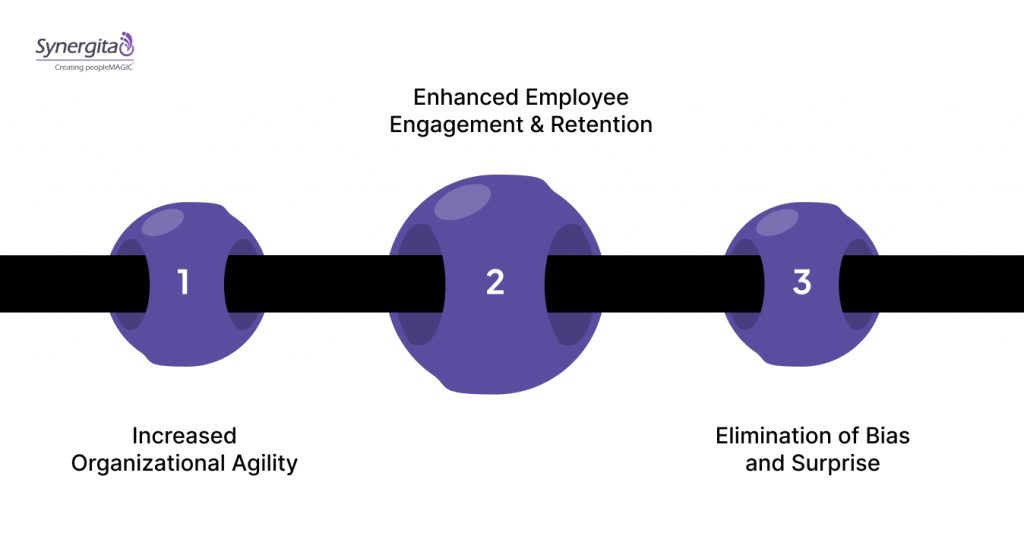
1. Increased Organizational Agility
Continuous cycles allow you to realign employee goals instantly when company priorities shift due to market changes. You no longer wait for the next fiscal year to redirect your workforce’s focus. This speed ensures resources are always allocated to the most critical current objectives.
2. Enhanced Employee Engagement and Retention
Employees crave feedback and clarity on their career trajectory, which annual reviews rarely provide effectively. Regular coaching conversations validate their contribution and signal that the organization invests in their development. This connection significantly reduces voluntary turnover among high performers.
3. Elimination of Bias and Surprise
Collecting data points throughout the year creates a comprehensive, objective record of performance. This eliminates the “recency effect” where managers only remember the last month of work. It ensures performance ratings are defensible, fair, and based on a full year of evidence.
Also read: How to Handle a Performance Review Effectively
Are your performance data and goal updates too slow to deliver the Increased Organizational Agility you require? Synergita integrates OKRs, feedback, and performance data into a single, real-time platform designed for instantaneous course correction. Book a demo now.
Realizing these benefits requires a structural change, relying on specific, non-negotiable architectural pillars to sustain the process.
5 Key Pillars of Continuous Performance Management
You cannot simply demand more meetings and call it a continuous process. You must build a supportive infrastructure that makes ongoing performance conversations sustainable and effective.
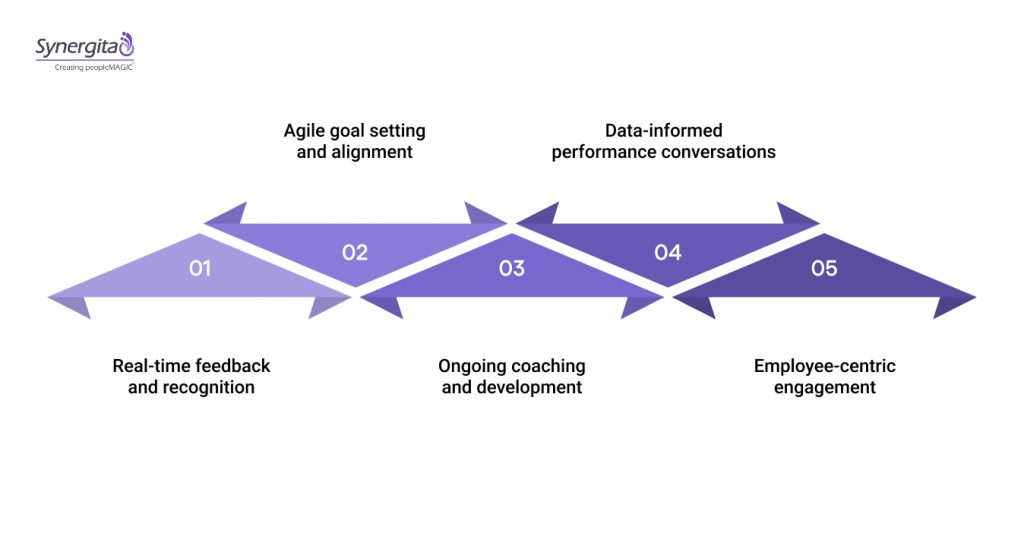
These five pillars form the foundation of a successful continuous strategy:
1. Real-time feedback and recognition
This pillar moves beyond annual surveys to embed feedback into daily operations. Instant recognition and constructive coaching help maintain momentum and correct issues before they escalate.
2. Agile goal setting and alignment
Goals must be dynamic. Using frameworks like OKRs (Objectives and Key Results) ensures everyone understands how their work ladders up to top-level business priorities, fostering cross-team alignment and focus.
3. Ongoing coaching and development
Continuous learning is central to employee growth. Managers should regularly discuss career aspirations and skill development, turning every check-in into an opportunity for mentoring and support.
4. Data-informed performance conversations
Replace subjective opinions with objective data. Using people analytics and performance metrics helps managers and employees have more productive, fact-based discussions about progress and potential.
5. Employee-centric engagement
This process should be a dialogue, not a monologue. Prioritizing employee voice through surveys and check-ins ensures the system is driving engagement and not just adding administrative tasks.
Also read: How to Make Performance Reviews Without Bias: A Leader’s Guide to Fair Evaluations
Defining the pillars is the first step; next, you must execute a deliberate change management strategy to implement them effectively.
Steps To Effectively Implement Continuous Performance Management
Transitioning from a traditional model requires a deliberate change management strategy to avoid overwhelming your managers. You must operationalize the shift with specific actions rather than vague mandates.
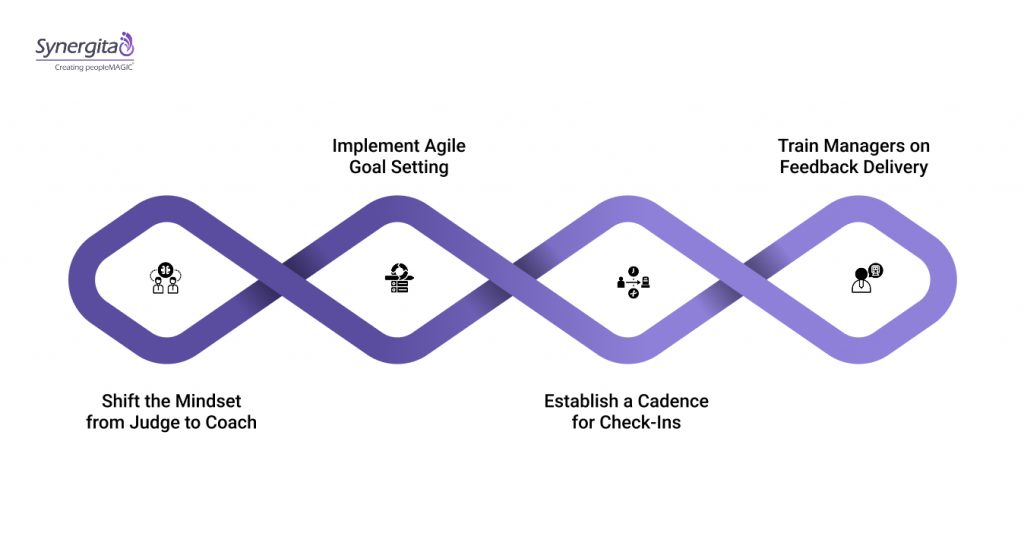
Follow these steps to execute the transformation:
1. Shift the Mindset from Judge to Coach
You must redefine the role of the manager from an evaluator of past work to a performance coach. This cultural pivot is essential; otherwise, managers will treat check-ins as mini-interrogations. Success relies on psychological safety and support.
Key actions to take:
- Rebrand “performance reviews” to “development check-ins” in all internal communications.
- Hold town halls where executive leadership explicitly endorses the new “growth-first” philosophy.
- Remove the link between check-ins and immediate disciplinary action to build trust.
2. Implement Agile Goal Setting (OKRs)
Replace annual KPI lists with quarterly Objectives and Key Results (OKRs) to maintain focus. Shorter cycles keep goals relevant and allow teams to celebrate wins more frequently. This keeps the workforce aligned with the company’s immediate strategic direction.
Key actions to take:
- Set company-level OKRs first to provide a “North Star” for all teams.
- Limit individuals to 3-5 key objectives per quarter to ensure focus.
- Review goal progress formally at the end of every quarter before resetting.
Also read: Top 8 Performance Review Software in 2025
3. Establish a Cadence for Check-Ins
Mandate a specific frequency for 1:1 meetings, typically bi-weekly or monthly, to ensure consistency. Provide a loose structure for these meetings so they remain productive and do not devolve into chit-chat. Consistency is more important than duration.
Key actions to take:
- Require managers to schedule recurring calendar blocks for all direct reports.
- Provide a simple 3-question agenda: “What went well? What was hard? How can I help?”
- Track check-in completion rates to identify managers who are neglecting the process.
4. Train Managers on Feedback Delivery
Most managers lack the soft skills required to deliver constructive feedback without causing defensiveness. You must invest in specific training that teaches them how to have difficult conversations effectively. Without this skill, the continuous model will fail.
Key actions to take:
- Conduct role-playing workshops where managers practice delivering negative feedback.
- Provide “feedback scripts” or templates for common performance scenarios.
- Create a peer-support group for managers to discuss challenges in the new system.
Do your managers lack the system to efficiently track check-ins, goal changes, and development notes without administrative chaos? Synergita automates the entire check-in workflow and training documentation, ensuring manager time is spent coaching, not logging. Book a demo now.
Even with a solid plan, many organizations fail by succumbing to predictable implementation traps that destroy momentum and adoption rates.
Common Pitfalls And How To Avoid Them
Even with good intentions, implementation often fails because organizations underestimate the operational load. Awareness of these traps allows you to design a more resilient process.
Avoid these specific errors to ensure long-term adoption:
1. Lack of Executive Buy-In
If the CEO and executive team do not model continuous feedback, the rest of the organization will ignore it. HR cannot drive this change alone; it requires visible participation from the top. Leaders must publicly share their own goals and feedback experiences.
- Pro Tip: Treat the C-suite as the pilot group. Conduct their continuous check-ins first and use their positive testimonials and goal progress as the internal marketing campaign.
2. Overcomplicating the Process
Creating complex forms or requiring lengthy documentation for every check-in will cause manager burnout. The process must be lightweight and fast, or employees will find ways to bypass it. Keep administrative requirements to an absolute minimum.
- Pro Tip: Limit mandatory check-in documentation to three key points for the manager: one developmental highlight, one coaching action, and one resource request.
3. Disconnecting Performance from Recognition
If you ask employees to improve constantly but only recognize them once a year, motivation will drop. Continuous effort requires continuous recognition and reward mechanisms. You must align your praise systems with the new feedback cadence.
- Pro Tip: Implement a monthly “Micro-Bonus” or spot recognition program tied directly to the successful completion of short-term Key Results (KRs) or specific behavioral changes noted in check-ins.
4. Absence of Manager Accountability
Managers often revert to old habits when under pressure, neglecting the required check-ins and documentation. The entire system collapses if managers are not held accountable for their coaching frequency. Poor managerial discipline destroys the process’s credibility.
- Pro Tip: Integrate check-in completion rate as a measurable Key Result (KR) within the manager’s own quarterly performance plan. Non-compliance should impact their rating.
Also read: How to Improve Employee Performance: Effective Strategies
Successfully avoiding these pitfalls requires a modern technology solution designed to automate the process and unify your performance data.
Continuous Performance Management With Synergita
HR leaders often struggle to implement continuous performance management because they lack the right infrastructure. Managing quarterly OKRs, monthly check-ins, and 360 feedback via spreadsheets creates data silos and administrative chaos.
This fragmentation makes it impossible to visualize real-time progress or identify at-risk employees. Synergita solves this by providing a unified, cloud-based platform that integrates OKRs, continuous feedback, and performance appraisals.
Our modular system allows you to automate check-in workflows, visualize goal alignment, and capture 360-degree feedback in one interface. Here’s more:
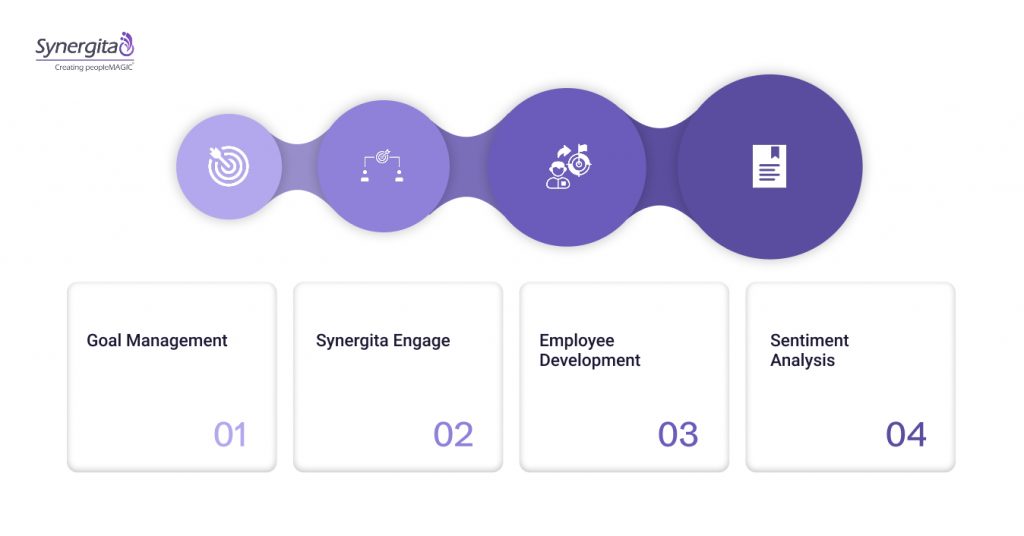
- Goal Management: Set and track OKRs with full organizational alignment. Our visual dashboards show real-time progress and goal trajectories for every team and individual.
- Synergita Engage: Foster a culture of continuous recognition. This module provides tools for peer-to-peer feedback, e-communication, and measuring employee engagement.
- Employee Development: Move beyond annual reviews with continuous 360-degree feedback and individual development plans. Identify skill gaps and track career aspirations systematically.
- Sentiment Analysis: Leverage AI-powered analytics to gauge the tone and sentiment of written feedback. Proactively identify potential issues and foster a positive workplace culture.
Shift your organization to a culture of continuous growth with tools designed for agility.
Conclusion
Treating performance management as a continuous process is the only way to maintain alignment in any business environment. It transforms your HR function from a compliance police force into a strategic driver of talent development.
By implementing agile goals, regular coaching, and the right technology, you ensure your workforce is always ready to execute. Synergita provides the essential digital framework to make this transition successful and sustainable.
We combine the structure of OKRs with the flexibility of continuous listening to drive high-performance cultures.
Book a demo to see how Synergita operationalizes continuous performance management for your organization.
FAQs
Q. What are the most important HR metrics to track in a continuous performance management system?
Focus on leading indicators that reflect the health of the process itself. Key metrics include the frequency of manager-employee check-ins, goal progress and alignment rates, employee engagement scores from pulse surveys, and participation rates in feedback and recognition tools.
Q. How do you measure the success of continuous performance management?
Success is measured through business outcomes. Track improvements in employee retention rates, internal promotion rates, productivity metrics, and employee engagement scores. A successful system will show positive trends in these areas over time.
Q. What is the role of a manager in continuous performance management?
A manager’s role shifts from evaluator to coach. They are responsible for facilitating regular check-ins, providing timely and constructive feedback, helping employees align their goals with business priorities, and supporting their team’s professional development and career growth.
Q. How often should performance check-ins occur?
While the exact cadence can vary by organization, most successful continuous models operate on a bi-weekly or monthly cycle. The key is consistency and ensuring the conversations are focused on development and support, not just status updates.
Q. What are the biggest challenges when shifting to a continuous model?
The most common challenges are overcoming cultural resistance to change, training managers to become effective coaches, ensuring consistent organization-wide adoption, and selecting the right technology to enable, rather than hinder, the process. A clear change management strategy is essential to address these.