
Key Takeaway
- Traditional goal-setting creates a major execution gap in growing businesses, with 67% of well-designed strategies failing at the implementation stage, often due to misalignment and unclear priorities.
- Overreliance on spreadsheets limits visibility and slows execution, as 58% of companies still track performance using spreadsheets and lack real-time OKR tracking.
- OKRs help drive alignment, focus, and accountability at scale, with 48% of organizations reporting improved accountability and clarity after adopting OKRs.
- Effective OKR adoption depends on the right mindset and tools, avoiding common pitfalls such as vague key results, excessive objectives, and a lack of leadership involvement.
Most organizations know what they want to achieve, but few consistently translate strategy into action. In fact, research shows that 67% of well-designed strategies never get fully implemented. This shows there is a significant execution gap that limits performance and growth.
This gap is a result of poor alignment, unclear priorities, and ineffective OKR tools that make it difficult for teams to stay focused on what truly matters. As businesses scale, these challenges grow in magnitude, slowing progress and decision-making.
This is where OKRs in business become essential. OKRs (Objectives and Key Results) provide a structured framework for goal alignment and continuous OKR tracking, helping organizations connect high-level strategy to day-to-day execution.
In this blog, we explore why traditional goal-setting fails in growing businesses, the key benefits of adopting OKRs, and common challenges of adopting OKRs and their solutions.
| Table of Contents 1. Why Traditional Goal-Setting Fails in Growing Businesses 2. What Are the Key Benefits of OKRs in Business 3. How to Implement OKRs in a Small Business Common Challenges and Solutions 4. Conclusion 5. Frequently Asked Questions |
Why Traditional Goal-Setting Fails in Growing Businesses
The following challenges highlight why conventional goal-setting approaches often fail to support execution in growing businesses.
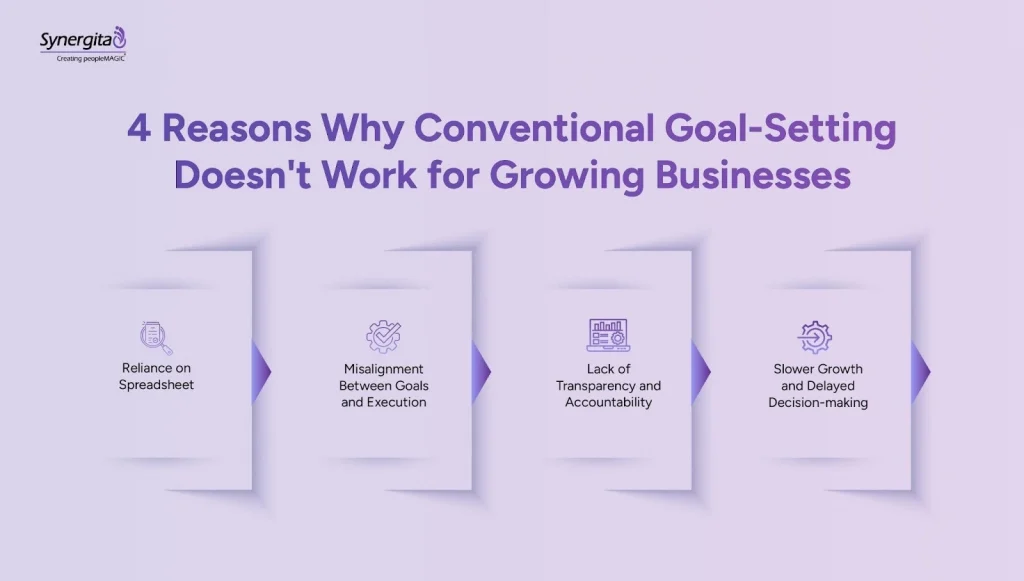
1. Reliance on Spreadsheets
Heavy reliance on spreadsheets and disconnected tools instead of OKR management software slows progress. These tools cannot provide real-time OKR tracking or cross-team collaboration.
According to a recent report, 58% of companies still use spreadsheets to track performance, limiting visibility and real-time insights into goal execution.
2. Misalignment Between Goals and Execution
For many growing businesses, strategic goals defined at the leadership level fail to translate into clear, actionable priorities for teams. This disconnect creates a gap between planning and execution, where day-to-day work does not consistently support broader business objectives.
3. Lack of Transparency and Accountability
When goals and progress are not visible across teams, employees struggle to understand how their work connects to broader business objectives. This lack of transparency weakens accountability, makes ownership unclear, and increases the risk of teams working in silos rather than toward shared outcomes.
Suggested Reading: Accountability in Workplace – How Employees and Managers Practice It in Real-life
4. Slower Growth and Delayed Decision-making
When you set and track goals manually, you often lack real-time visibility into progress. As a result, you spend time on updates and clarifying ownership instead of evaluating performance and making strategic decisions. This reactive approach slows execution, delays course correction, and limits a company’s ability to respond quickly to market changes.
What Are the Key Benefits of OKR in Business
OKRs help businesses move from scattered goal-setting to focused execution. By clearly defining priorities and measuring outcomes, OKRs create a shared direction across teams while maintaining flexibility as business needs evolve. Let’s look at the key benefits of OKRs in business.
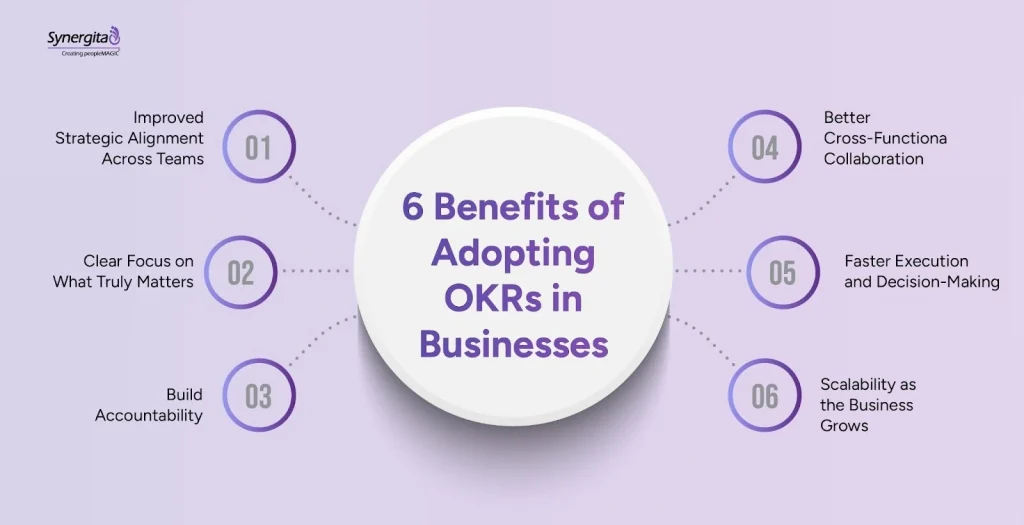
1. Improved Strategic Alignment Across Teams
One of the biggest benefits of OKR in business is goal alignment. OKRs connect company-level objectives with team and individual goals, helping align the workforce with strategy and ensuring everyone works toward the same outcomes. It enables the team to understand how their work contributes to business priorities. Here is how OKR helps in goal alignment and reduces siloed decision-making:
- Leadership goals are clearly translated into team-level execution.
- Team leaders align their objectives with the company’s priorities.
Also Read: How Adopting OKRs Helps in Creating Company-Wide Alignment
2. Clear Focus on What Truly Matters
OKRs help leaders prioritize tasks that are the most important at a particular point in time. Instead of spreading effort across too many initiatives, OKRs encourage teams to focus on a limited number of high-impact objectives. This prioritization helps the team support business goals by:
- Helping businesses avoid goal overload
- Ensuring resources are directed toward strategic outcomes
- Keeping teams focused on results, not just activities
3. Build Accountability
Another core benefit of OKRs in business is accountability. By assigning ownership to every key result, OKRs give clarity on who is responsible for outcomes. This clarity reduces ambiguity, improves follow-through, and ensures commitments are taken seriously across the organization.
In fact, nearly 48% of companies report that OKRs significantly improve accountability and clarity across teams, helping everyone understand who owns what and how outcomes are measured.
4. Better Cross-Functional Collaboration
OKRs help teams collaborate more effectively by making shared goals and dependencies visible across the organization. When teams understand how their objectives connect with the work of other departments through cascading OKRs, misalignment is reduced, and coordination improves. This shared visibility enables collaboration in the following ways:
- Encourages alignment between departments such as marketing, sales, and product
- Reduces duplicate or conflicting initiatives
- Builds a culture of shared responsibility
5. Faster Execution and Decision-Making
Clear priorities and measurable outcomes help teams move from discussion to execution more quickly. When goals are well defined, making decisions becomes simpler and more consistent across teams. Leaders and team members can evaluate choices against shared objectives, adapt faster when priorities shift, and focus reviews on results rather than assumptions.
6. Scalability as the Business Grows
As organizations expand, informal goal-setting breaks down. OKRs provide a structured framework that scales with growth. It supports consistent goal-setting across the business and enables leadership to maintain visibility without micromanagement.
How to Implement OKRs in a Small Business: Common Challenges and Solutions
Adopting OKRs can improve alignment and execution, but many organizations struggle during the initial rollout. In most cases, the problem is execution, not the OKR framework. Here are the most common challenges and practical tips on how to implement OKRs in a small business.
1. Treating OKRs as a Performance Evaluation Tool
Many teams have misconceptions about OKR and resist its adoption as they feel it is linked directly to appraisals or compensation. This often makes teams averse to risks and discourages ambitious goal-setting.
How to overcome it: Position OKRs as a learning and alignment framework, not a scoring mechanism. Keep OKRs separate from performance ratings, especially in the early stages.
2. Setting Too Many Objectives or Key Results
Overloading teams with excessive OKRs dilutes focus and reduces execution quality. Many times, teams end up tracking activity rather than the tasks that drive real outcomes.
How to overcome it: Limit objectives to three to five per cycle, with a small number of measurable key results. Prioritization is essential for OKRs to work effectively.
3. Writing Vague or Activity-based Key Results
Poorly defined key results make progress subjective and difficult to track, which leads to confusion and inconsistent reviews.
How to overcome it: Ensure every key result is measurable, outcome-driven, and time-bound. Use clear success criteria so progress can be evaluated objectively.
For example:
Vague key result: Improve product usability
Outcome-driven key result: Reduce user drop-off on the onboarding flow from 35% to 25% within 60 days
4. Lack of Leadership and Ownership
When leadership does not actively participate in OKR setting and tracking, OKRs lose credibility and become a routine exercise.
How to overcome it: Leaders must model OKR discipline by setting their own objectives, regularly reviewing progress, and reinforcing alignment across teams.
5. Insufficient Visibility and Follow-through
OKRs often fail when they are reviewed only at the end of a quarter, rather than being used as a continuous execution tool.
How to overcome it: Establish regular check-ins and transparent progress tracking to help teams identify risks early and adjust priorities as needed.
Conclusion
Businesses often struggle with execution. As this blog highlights, traditional goal-setting methods frequently fail to scale, leading to misalignment, limited visibility, and slower decision-making. Without a structured approach to connect strategy with execution, even well-defined goals lose momentum over time.
OKRs in business help close this execution gap by driving alignment, focus, and accountability across teams. But to set OKRs correctly and track them without any hassle, you need the right system. Synergita OKR software enables teams to implement OKRs with clarity by offering structured goal-setting, real-time tracking, and leadership-ready insights.
Try Synergita with a 14-day trial to see how it transforms OKR goal-setting.
Frequently Asked Questions
OKRs are a goal-setting framework that helps businesses define clear objectives and track measurable outcomes, ensuring strategy translates into execution.
As businesses scale, informal goal-setting breaks down. OKRs provide the structure, alignment, and visibility needed to manage growth without losing focus or accountability.
KPIs measure ongoing performance, while OKRs focus on achieving specific outcomes within a defined period, driving change and progress rather than status reporting.
Yes, OKRs are highly adaptable and help small and mid-sized businesses prioritize effectively, align teams early, and build execution discipline as they grow.
Synergita provides a structured platform for goal-setting, alignment, tracking, and reviews, making it easier to implement OKRs consistently across teams.
Yes, Synergita offers a 14-day trial, allowing teams to experience structured OKR planning and tracking before making a decision.