
Employees across every department struggle with unclear or shifting goals, which leads to misalignment and inconsistent performance. Research shows that organizations with strong goal-setting systems are 4.2 times more likely to outperform peers (McKinsey, 2024), underscoring the impact of clarity on results.
OKRs help solve this by turning broad priorities into specific, measurable targets that keep employees focused and accountable. They improve visibility, support continuous progress, and create a shared understanding of what success looks like.
This guide includes 21 OKR examples for employees across multiple roles to help set clearer goals and achieve better outcomes.
Before we begin:
- OKRs provide clarity and direction. They help employees understand priorities, stay focused, and align their work with organizational goals.
- Examples make OKRs easier to apply. Seeing role-specific OKRs helps employees translate abstract goals into practical, measurable outcomes.
- A well-crafted OKR has clear objectives and quantifiable key results. This ensures progress can be tracked reliably throughout the quarter.
- Avoiding common mistakes strengthens execution. Issues like vague goals, activity-based metrics, and misalignment can weaken the effectiveness of OKRs.
- Strong OKRs are essential for performance. They improve accountability, guide decision-making, and help teams deliver consistent, high-impact results.
What Makes a Good OKR?
OKRs, or Objectives and Key Results, are a goal-setting framework that helps employees and teams stay aligned, focused, and accountable. An Objective defines what you want to achieve, while Key Results outline the measurable outcomes that indicate progress.
Characteristics of effective OKRs:
- Clear and Concise: Objectives should be simple enough to understand and communicate quickly.
- Measurable: Key Results must define success in terms of specific metrics, targets, or timelines.
- Aligned: OKRs should directly connect employee, team, and organizational priorities.
- Ambitious but Realistic: Targets should stretch performance without being unattainable.
- Time-Bound: Each OKR needs a clear cycle, such as quarterly or annual.
- Outcome-Focused: The emphasis should remain on measurable outcomes rather than tasks.
Before going into function-specific goals, it is important to understand what strong company-wide OKRs look like. This is outlined in the next section.
Useful Resource: E-Book: OKR Examples and Templates
Organization-Wide OKR Examples
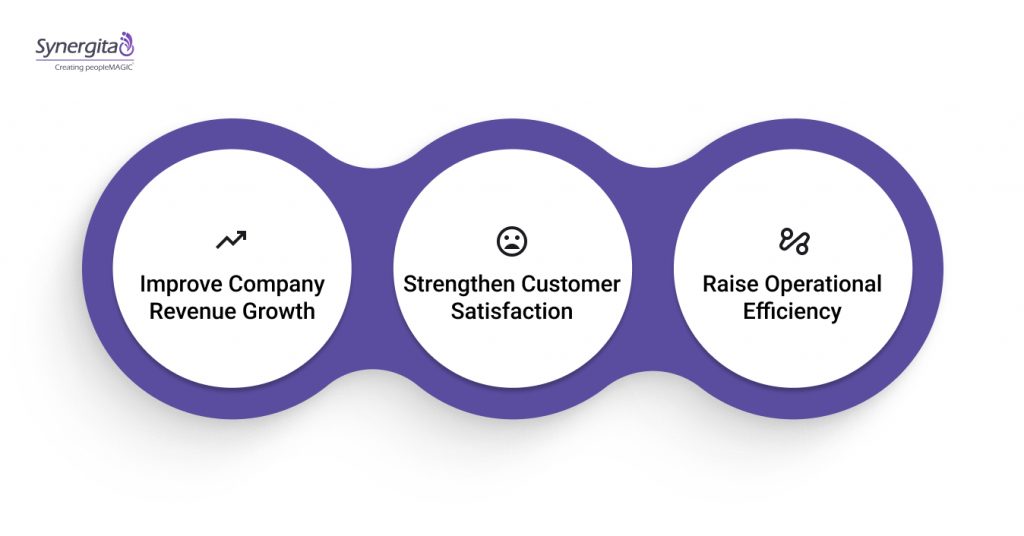
These OKRs establish the strategic direction for the entire company. They ensure every department is working toward the same priorities and help maintain alignment. They typically focus on areas such as revenue, customer satisfaction, operational efficiency, product innovation, and employee experience.
These three effective OKR examples can help the leadership inspire:
1. Improve Company Revenue Growth
Objective: Achieve consistent, sustainable revenue growth this quarter.
Key Results:
- Increase quarterly revenue by 18% compared to the Q2 baseline.
- Expand into two new customer segments in the Singapore market.
- Improve upsell and cross-sell rates by 12%.
2. Strengthen Customer Satisfaction
Objective: Improve customer satisfaction scores across all service channels this quarter.
Key Results:
- Increase Net Promoter Score (NPS) from 45 to 55 by the end of Q1.
- Reduce quarterly customer churn rate from 8% to 5%.
- Lower average first‑response time for support tickets from 10 hours to 8 hours.
3. Raise Operational Efficiency
Objective: Drive operational efficiency by optimizing processes to increase productivity and lower costs.
Key Results:
- Shorten average cycle times by 15% through the reduction of operational bottlenecks.
- Lower company‑wide operating expenses by 8% this quarter.
- Deploy three new process automations that deliver quantifiable productivity improvements.
With company-wide OKRs in place, each department can translate these priorities into actionable goals. The following section explores how this looks within the marketing function through practical, role-specific examples.
Marketing OKR Examples
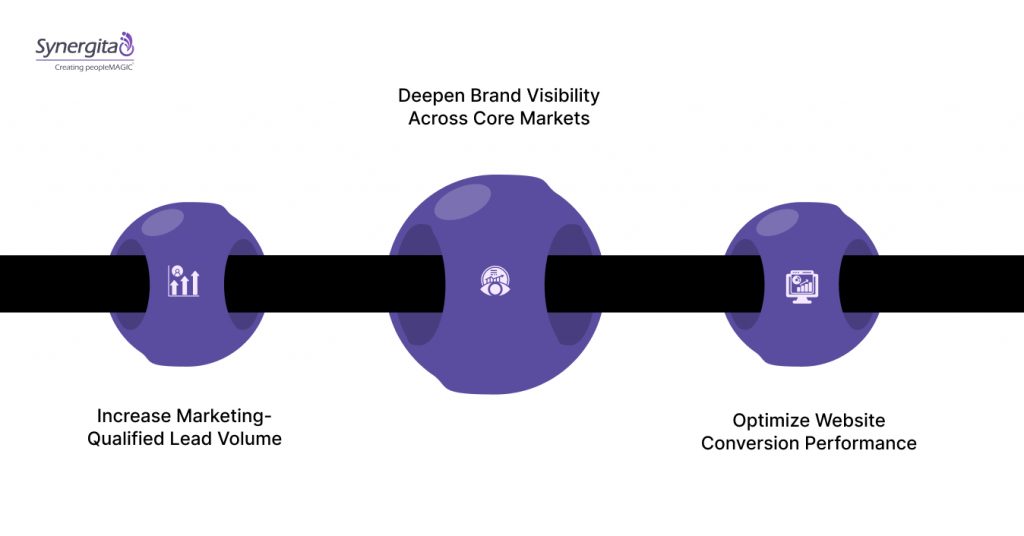
Clear OKRs help marketing ensure every campaign, channel, and initiative contributes to brand visibility, lead generation, and revenue growth. Marketing OKRs typically center on brand awareness, demand generation, conversion rates, content effectiveness, and customer engagement.
The illustrations below show how these objectives can be applied:
1. Increase Marketing-Qualified Lead Volume
Objective: Increase the volume and quality of inbound MQLs to strengthen the pipeline.
Key Results:
- Increase quarterly MQLs by 25% in Q2.
- Improve MQL-to-opportunity conversion rate from 12% to 18% by the end of Q2.
- Launch three persona-specific demand-generation campaigns targeting high-intent segments.
2. Deepen Brand Visibility Across Core Markets
Objective: Increase brand awareness and authority in key target segments.
Key Results:
- Grow social engagement by 20% in Q2 across LinkedIn, X, and Instagram.
- Secure five earned media placements in top-tier industry publications this quarter.
- Publish eight thought-leadership articles aligned with our quarterly content themes.
3. Optimize Website Conversion Performance
Objective: Optimize website experience to drive higher-quality conversions.
Key Results:
- Increase organic traffic by 30% in Q2 through SEO and content expansion.
- Improve homepage conversion rate from 1.8% to 2.5% by the end of Q2.
- Reduce bounce rate by 10% through targeted UX improvements and optimized page load speeds.
The following section outlines practical objectives for the sales team that support both growth and pipeline efficiency.
Suggested Read: How to Set Effective OKRs for Startups: Examples & Strategies
Sales OKR Examples
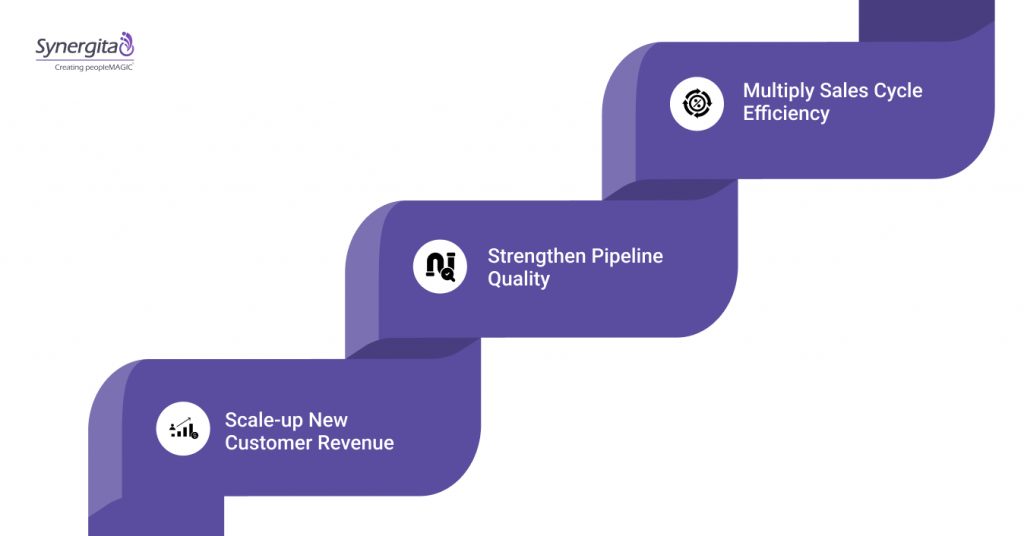
As Peter Drucker said, “What gets measured gets improved.” This idea sits at the core of OKRs, helping sales teams focus on the metrics that drive pipeline quality, deal velocity, and revenue growth.
The following OKR examples give sales teams practical ways to sharpen execution and achieve predictable results.
1. Scale-up New Customer Revenue
Objective: Accelerate net-new revenue growth in the target market.
Key Results:
- Increase new customer revenue by 20% in Q2.
- Close 12 new deals in the mid-market segment.
- Improve win rate from 22% to 28% by the end of Q2.
2. Strengthen Pipeline Quality
Objective: Improve pipeline accuracy and deal quality for more reliable forecasting.
Key Results:
- Increase SQL-to-opportunity conversion from 30% to 40% in Q2.
- Implement a revised qualification framework and train 100% of AEs by week 4.
- Reduce stalled deals over 45 days by 15% this quarter.
3. Multiply Sales Cycle Efficiency
Objective: Shorten the sales cycle to accelerate deal closures.
Key Results:
- Reduce average sales cycle length from 52 days to 45 days by the end of Q2.
- Increase demo-to-proposal conversion rate from 55% to 65%.
- Automate two key steps in the proposal workflow to improve speed and consistency.
The next priority is ensuring customers remain engaged, satisfied, and successful after the sale. The following section covers Customer Success OKRs designed to maximize long‑term customer value.
Suggested Read: 14 Best DevOps OKR Examples with Initiatives
Customer Success OKR Examples
Clear OKRs help customer success prioritize the actions that strengthen adoption, reduce churn, and improve customer health. These illustrative OKRs focus on high-impact activities that directly influence recurring revenue and overall customer satisfaction.
1. Improve Customer Retention
Objective: Strengthen retention performance by reducing risk across high-value accounts.
Key Results:
- Reduce gross churn from 8% to 5% in Q2 through proactive risk management.
- Conduct QBRs with 100% of strategic accounts to reinforce value realization.
- Increase the percentage of accounts in “green” health status from 62% to 75% by quarter-end.
2. Accelerate Product Adoption
Objective: Expand product penetration to improve customer lifetime value and renewal probability.
Key Results:
- Increase weekly active usage across key modules by 25% in Q2.
- Achieve 90% onboarding workflow completion within the first 30 days for all new accounts.
- Drive adoption of two new features to 50% of the customer base by the end of Q2.
3. Intensify Customer Satisfaction
Objective: Upgrade existing customer experience to improve retention and reduce support operating costs.
Key Results:
- Increase NPS from 45 to 55 by EoQ through improved service touchpoints.
- Reduce average first-response time from 6 hours to 4.5 hours.
- Lower support escalations by 15% by optimizing root-cause workflows and resolution playbooks.
The following section lists OKR examples designed to strengthen hiring, development, and organizational culture.
Suggested Read: OKR vs KPI: Key Differences and How to Use Both
Human Resources OKR Examples
HR teams drive organizational scalability by improving talent acquisition, workforce capability, and employee experience. With measurable targets, HR can align people strategy with business goals.
These are three examples of applying a data-driven approach to hiring, performance, and engagement.
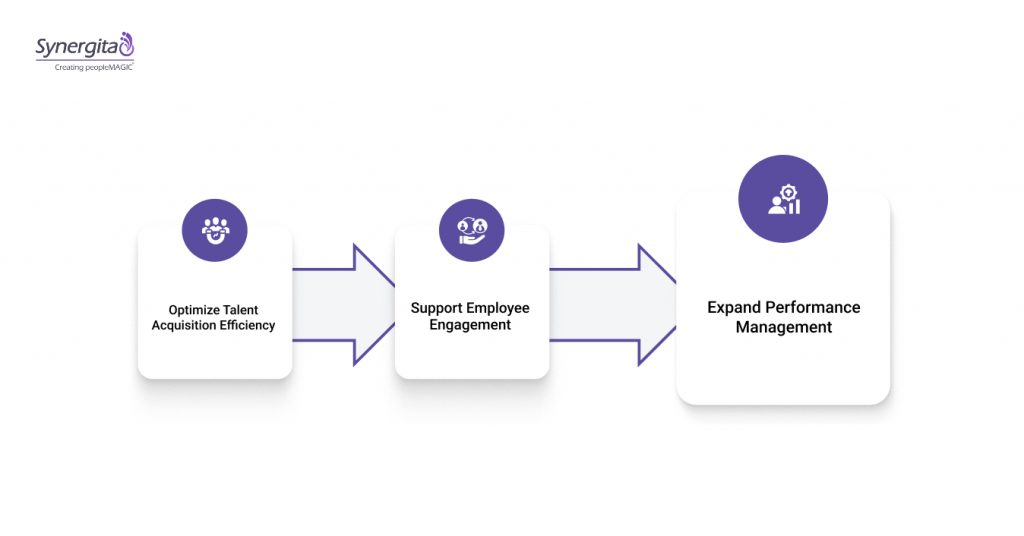
1. Optimize Talent Acquisition Efficiency
Objective: Strengthen hiring velocity and talent quality to support business growth.
Key Results:
- Reduce time-to-fill from 45 to 30 days in Q2.
- Increase the offer acceptance rate from 70% to 85% by improving the candidate experience.
- Build a pipeline of 200 pre-qualified candidates across priority roles.
2. Support Employee Engagement
Objective: Enhance engagement and alignment to reduce attrition risk.
Key Results:
- Increase engagement survey score from 64% to 75% by EoQ.
- Implement a quarterly recognition program with 80% participation.
- Improve internal mobility applications by 10% to support career development.
3. Expand Performance Management
Objective: Upgrade performance frameworks to increase accountability and execution.
Key Results:
- Achieve 100% completion of quarterly goal-setting across all teams.
- Train 90% of managers on effective feedback and coaching practices.
- Reduce low-performance incidents by 15% through structured development plans.
With HR initiatives grounded in measurable results, the next focus is improving technical execution and product delivery.
Engineering OKR Examples
Engineering teams drive product reliability, delivery speed, and technical scalability. Without clear OKRs, priorities can become fragmented across feature requests, technical debt, and operational demands.
These OKRs can help engineering teams focus on outcomes that improve product performance.
1. Build Up System Reliability
Objective: Strengthen platform stability to reduce downtime and improve customer trust.
Key Results:
- Decrease system downtime to <0.5% in Q2.
- Reduce critical production defects by 40% through improved QA workflows.
- Achieve 90% automated test coverage across core services.
2. Accelerate Development Velocity
Objective: Increase delivery speed while maintaining engineering quality standards.
Key Results:
- Improve sprint predictability from 78% to 90% by EoQ.
- Reduce average PR review cycle from 2.8 days to 1.8 days.
- Deliver three major feature releases by quarter-end.
3. Reduce Technical Debt
Objective: Improve long-term scalability by addressing structural code and infrastructure inefficiencies.
Key Results:
- Retire or refactor 15% of legacy components in Q2.
- Improve service response times by 20% through architecture optimizations.
- Complete dependency upgrades across 100% of core microservices.
The following section outlines OKR examples for the finance department.
Finance OKR Examples
Finance teams are responsible for translating organizational strategy into financial clarity, discipline, and scalability. OKRs help finance leaders align forecasting, budgeting, and cost controls with business goals.
These OKRs make sure that investment decisions support growth while maintaining operational efficiency.
1. Improve Forecasting Accuracy
Objective: Strengthen financial planning reliability to support strategic decision-making.
Key Results:
- Reduce forecasting variance from 12% to under 5% in Q2.
- Implement an automated reporting workflow covering 70% of monthly outputs.
- Improve revenue prediction accuracy by 10% through refined data models.
2. Optimize Operational Costs
Objective: Increase cost efficiency across departments without reducing performance.
Key Results:
- Reduce non-essential operating expenses by 8% by quarter-end.
- Renegotiate top vendor contracts to achieve 10% savings.
- Cut invoice processing cycle times from 14 days to 9 days.
3. Consolidate Cash Flow Management
Objective: Improve liquidity and cash discipline across the organization.
Key Results:
- Reduce DSO from 48 to 40 days in Q2.
- Increase on-time collections to 95%.
- Implement enhanced cash-flow monitoring with weekly visibility across all business units.
Synergita helps organizations set clearer OKRs and track progress continuously. Its OKR dashboards, automated check-ins, and progress analytics make it easier to identify blockers, course-correct early, and drive target achievement. Sign up for a free trial to assess how Synergita can improve OKR alignment and execution across your organization.
Why Are OKRs Critical to Strategic Goal Setting?
OKRs turn strategy into measurable execution. As John Doerr explains, “Then come the four OKR superpowers: focus, align, track, and stretch.” These principles show why strong OKR examples are essential when creating effective goals.
These are a few reasons to care about setting up OKRs within your organization:
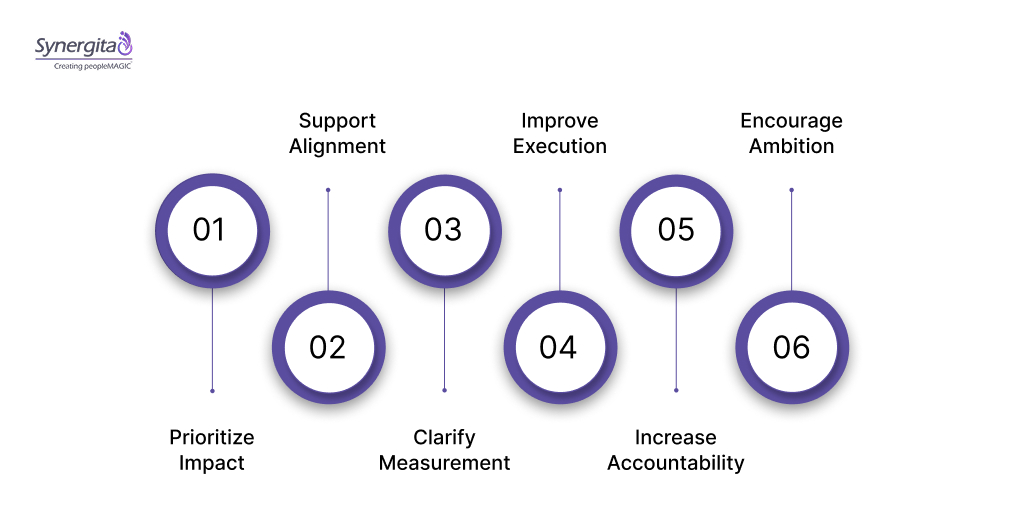
- Prioritize Impact: Identify goals that meaningfully advance revenue, customer value, or operational efficiency, ensuring teams focus on initiatives that deliver measurable business results.
- Support Alignment: Connect departmental goals to the broader company strategy, so teams work cohesively toward shared outcomes rather than operating in isolated silos.
- Clarify Measurement: Define success through specific, quantifiable results that eliminate ambiguity and make performance easier to track and evaluate.
- Improve Execution: Provide a structured way to monitor progress, identify blockers, and adjust quickly, enabling teams to deliver outcomes more predictably.
- Increase Accountability: Establish clear ownership for objectives and key results, ensuring responsibility is distributed effectively across teams and roles.
- Encourage Ambition: Set targets that challenge teams to increase performance while remaining achievable, inculcating innovation, and continuous improvement.
OKRs only work when drafted correctly. The next section lists the common mistakes you need to avoid when building a strong system.
Suggested Read: An Ultimate Guide to OKR Tracking
Top Errors to Avoid When Drafting OKRs
Clear and measurable OKRs help teams understand expectations and make informed decisions during performance appraisals.
When OKRs fall into the common traps below, organizations lose alignment, visibility, and execution momentum.
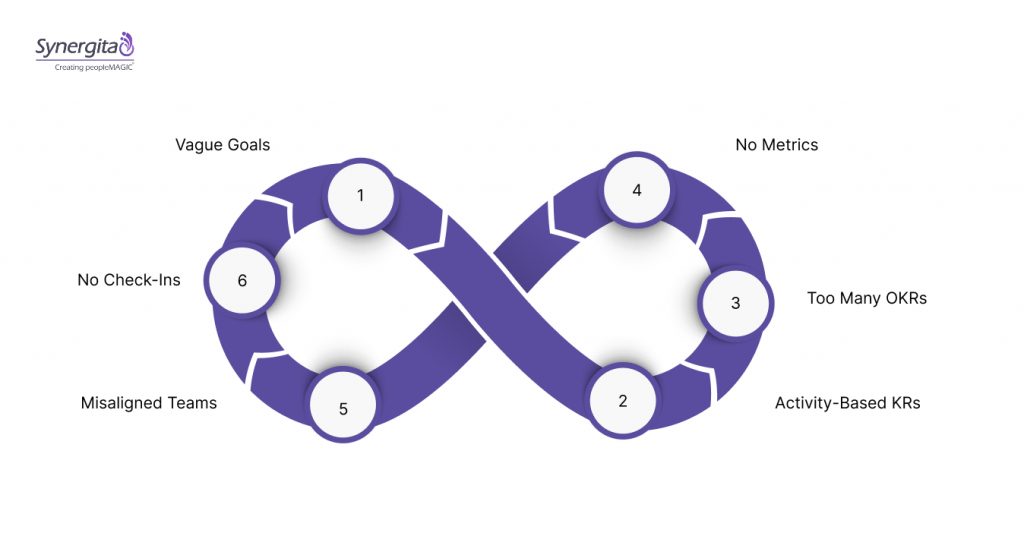
- Vague Goals: Broad goals weaken execution. Adding scope and outcomes makes objectives specific enough for teams to act on.
- Activity-Based KRs: Tasks measure effort, not impact. Replacing activities with results clarifies the business value being created.
- Too Many OKRs: Excessive goals scatter focus. Limiting OKRs to essentials improves execution quality and resource allocation.
- No Metrics: Without numbers, progress is subjective. Adding numeric targets enforces accountability and removes ambiguity.
- Misaligned Teams: When OKRs do not tie to strategy, teams drift. Strategic alignment ensures unified movement toward company goals.
- No Check-Ins: Infrequent reviews hide issues. Weekly cadence keeps teams on track and enables early course correction.
By avoiding these common errors, you create a stronger OKR framework that supports clarity and consistent execution. Synergita helps teams maintain alignment, track progress, and manage OKRs effectively across the organization.
How Does Synergita Help Organizations Build Strong OKRs
Synergita is a comprehensive performance and OKR platform designed to help organizations translate strategy into measurable execution. It provides the structure, visibility, and alignment needed for teams to set meaningful goals, track outcomes in real time, and maintain accountability across the business.
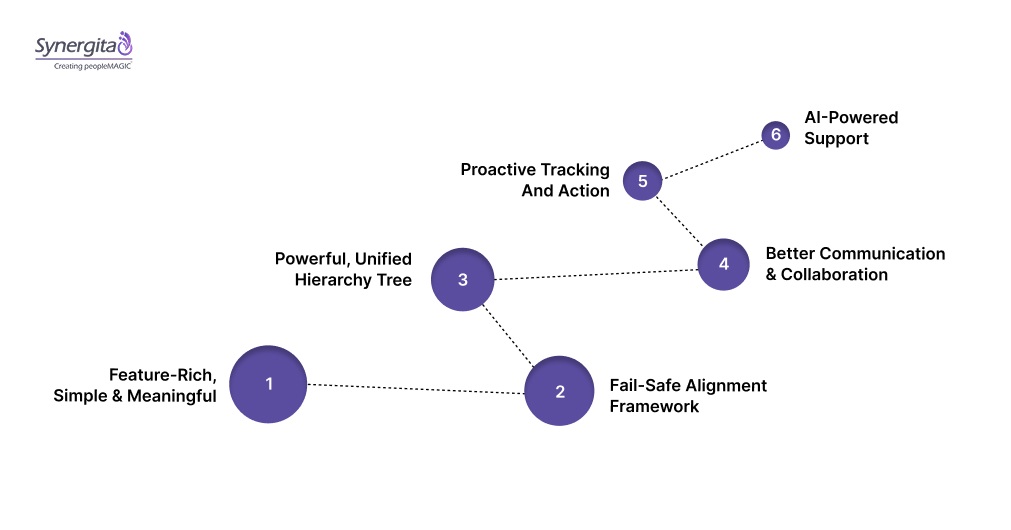
With an intuitive interface and powerful analytics, Synergita makes OKR adoption smooth for both first-time users and experienced teams. This is what you get when you choose Synergita:
1. Feature-Rich, Simple & Meaningful
Synergita OKR offers a clean, intuitive workflow that makes it easy for teams to set structured goals, define measurable outcomes, and stay focused throughout the quarter.
2. Fail-Safe Alignment Framework
Synergita’s top-down and bottom-up alignment models ensure every individual, team, and department stays connected to company-wide priorities, eliminating misalignment and duplicated efforts.
3. Powerful, Unified Hierarchy Tree
The hierarchy tree visualizes how goals connect across the organization, highlighting real-time progress, lead/lag indicators, and deviations from expected trajectories.
4. Better Communication & Collaboration
Synergita strengthens coordination by centralizing goals, updates, and progress insights so cross-functional teams can stay aligned and informed at every stage of execution.
5. Proactive Tracking and Action
The platform provides continuous visibility into OKR performance, enabling teams to flag bottlenecks early, adjust priorities, and stay on track without waiting for end-of-quarter reviews.
6. AI-Powered Support
Synergita provides clear, data-driven insights that help teams analyze OKR trends, accurately measure performance, and avoid vanity metrics that do not reflect real progress.
Organizations that successfully implement OKRs consistently outperform their peers, with research showing that companies aligned around clear, measurable goals achieve 58% faster growth. Synergita gives teams the structure and visibility needed to realize this advantage by turning strategy into focused, trackable execution.
Conclusion
Clear, well-structured OKRs help teams stay aligned, focused, and accountable. The examples in this guide provide a practical foundation for setting measurable goals across functions.
Synergita makes the OKR process even easier by reducing manual effort and giving teams a simple way to set, track, and review goals. With features such as OKR alignment frameworks, real-time progress dashboards, automated check-ins, AI-powered insights, and flawless Jira sync, Synergita centralizes OKR management and keeps everyone working toward the same outcomes.
Synergita can help your organization strengthen alignment, improve execution, and optimize performance workflows. Book a 30-minute free demo to experience Synergita in action and optimize your goal-setting process.
Frequently Asked Questions
1. What are the five SMART goals examples for employees?
The following are widely used SMART goals across industries:
- Improve customer response time by 20% in Q2.
- Complete a certification relevant to the role within 60 days.
- Increase sales outreach volume by 15% this month.
- Reduce project turnaround time by 10% this quarter.
- Achieve a 95% task completion rate in weekly sprint cycles.
2. What are examples of goals and objectives for employees?
Common employee objectives include improving productivity, enhancing technical skills, strengthening communication, increasing customer satisfaction, and contributing to revenue or cost efficiency. Specific examples might include closing more deals, improving product knowledge, reducing errors, or delivering projects on time.
3. How often should OKRs be reviewed?
OKRs should be reviewed weekly or biweekly. Frequent check-ins help teams assess progress, surface blockers early, and recalibrate efforts before the quarter ends.
4. How many OKRs should an employee have?
Most employees should have 3–5 OKRs per quarter. This ensures focus on high-impact priorities without overwhelming workloads or diluting effort.
5. What is the difference between OKRs and KPIs?
OKRs define what you want to achieve and how you will measure progress; they drive strategic change. KPIs measure ongoing performance in specific areas. KPIs track health, while OKRs create movement and improvement.