
Writing OKRs that truly drive alignment and results is more complicated than it looks. A significant number of OKR implementations falter not because the framework is flawed, but because the OKRs themselves are poorly crafted. This means unclear, vague, or detached from real outcomes.
Around 70% of OKR initiatives fail to deliver expected focus and alignment, often due to unclear goal design and execution gaps. For leaders and teams, learning how to write OKRs effectively matters because well‑written OKRs become a shared language of execution that connects strategy with measurable impact.
In this blog, you’ll learn how to write OKRs with clear examples and best practices that ensure your goals are both actionable and aligned. This will help the teams stay focused and produce real results.
Key Takeaways
- Clear OKRs Drive Real Results: Good OKRs should be specific, measurable, and aligned with business goals to ensure they drive meaningful outcomes.
- Balance Ambition with Realism: Ambitious OKRs push teams to perform, but should remain achievable. Aim for 70% success to maintain motivation and drive growth.
- Focus on Outcomes, Not Tasks: Always write OKRs around outcomes (e.g., increased revenue or improved user satisfaction), not activities (e.g., completing a report).
- Limit OKRs to 3–5 per Cycle: To avoid distraction, limit each cycle to 3–5 OKRs to ensure focus and clarity across teams and departments.
- Regular Check-ins Keep OKRs Relevant: Implementing regular check-ins (weekly or biweekly) ensures OKRs stay adaptive to change and aligned with shifting priorities.
What Makes a Good OKR?
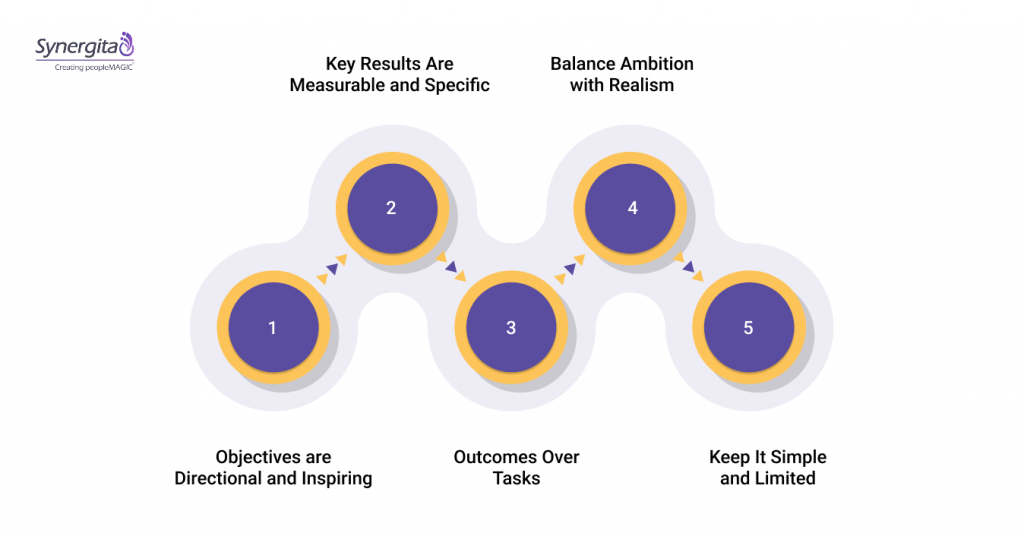
To write, you need first to understand what separates a good OKR from a vague target. At its core, a good OKR isn’t just a task list. It’s a focused, measurable statement that directs the team toward meaningful outcomes. OKRs combine a clear objective with quantitative key results that tell you when you’ve succeeded.
Here’s what makes a strong OKR:
- Objectives are Directional and InspiringObjectives define where you want to go and should be clear, actionable, and motivational. They guide decision‑making and energize teams to move in the same direction. Clear objectives give teams purpose and prevent confusion about priorities.
- Key Results Are Measurable and SpecificKey Results make your progress tangible. They should be quantifiable, time‑bound, and verifiable so you can objectively say whether you’ve achieved them or not. For example, rather than “improve customer support,” a measurable result would be “reduce first‑response time from 24h to 8h.”
- Outcomes Over TasksIt’s crucial to write OKRs around outcomes, not activities. Deliverables like “complete training” or “write documentation” are tasks, not results. A good Key Result reflects the impact of that work, such as “increase user satisfaction from 80% to 90%.”
- Balance Ambition with RealismGood OKRs push teams beyond comfort zones but remain achievable within the time frame. Too easy, and they don’t drive growth; too hard, and they become demotivating. Keeping this balance helps teams stay motivated and focused.
- Keep It Simple and LimitedTrust the power of focus. Typically, an OKR set includes 3–5 key results per objective to avoid dilution of effort. Overloading dilutes focus and complicates tracking.
When objectives are inspiring and key results are specific and measurable, OKRs become tools teams use to drive outcomes, not just checkboxes to complete.
Are your OKRs struggling to align with broader strategic goals? Synergita ensures that your objectives are clear, inspiring, and measurable, making them actionable across your entire team. Book a demo now to see how Synergita helps you write OKRs that truly drive performance.

The OKR Formula: How to Write an Effective OKR
Writing OKRs effectively isn’t guesswork; there’s a simple, repeatable structure that separates thoughtful, outcome‑focused goals from vague statements. At its core, a strong OKR has two parts:
- Objective: What you want to achieve — clear, ambitious, and qualitative.
- Key Results: How you’ll measure success — specific, quantifiable outcomes.
This formula turns abstract aspirations into measurable progress.
1. Objective — What You Want to Achieve
Your objective should answer the question: Where are we going? It’s a concise statement that conveys intent and direction without metrics. A well‑written objective is motivational and focused on impact, not activity.
- Good: “Improve the customer onboarding experience by the end of Q3.”
- Weak: “Work on onboarding materials.” → This fails because it describes a task rather than an outcome.
2. Key Results — How You’ll Measure Success
Key Results turn the objective into measurable outcomes. Each should be specific, numeric, and time‑bound so you can unambiguously assess success. Aim for 3–5 key results per objective to maintain focus without overwhelming the team.
- A strong Key Result follows this pattern: Metric + Baseline → Target + Timeframe.
- Formula: Start Value → Target Value by Timeframe
Additionally, using precise, outcome‑driven language matters because it ensures everyone interprets the goal the same way. Avoid subjective words like “improve,” “optimize,” or “enhance” without a metric.
Use verbs tied to results (e.g., increase, reduce, achieve, complete). Tie key results to business impact, not tasks. When you follow this pattern, you ensure that your OKRs are not only well‑structured but meaningful and measurable.
Understanding the formula is just the beginning. Let’s now explore the best practices that help turn your OKRs from good to great.
7 Best Practices for Writing Valuable OKRs
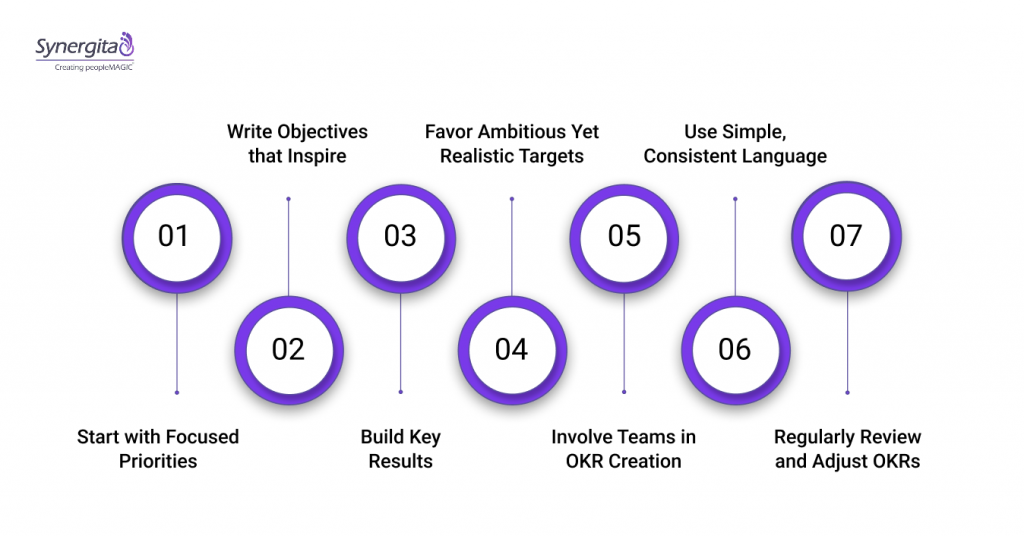
Writing OKRs effectively is about thinking strategically, prioritizing focus, and using language that drives measurable outcomes. The best OKRs guide teams toward alignment with company goals while remaining actionable and easy to track.
Below are proven practices based on research and expert frameworks for crafting impactful OKRs.
1. Start with Focused Priorities
Good OKRs begin with clarity about what matters most. Before writing any objective, ask: Which 2–3 priorities will make the most significant difference this cycle?
Narrowing the focus prevents overloading teams and ensures effort goes toward high‑impact outcomes rather than busywork.
2. Write Objectives that Inspire and Direct
Objectives should be concise, action‑oriented, and motivational. They describe a clear outcome worth pursuing, not a list of tasks. Remember, a purpose is what you want to achieve. Quality language here boosts team engagement and clarity.
- A good example can be something like this: “Increase product reliability to boost customer trust by Q4.”
3. Build Key Results That Are Measurable and Outcome‑Focused
Key Results should be specific, time‑bound, and quantifiable. They turn the objective into measurable milestones and should reflect outcomes, not activities. Activities like “conduct meeting” don’t measure progress; outcomes like “achieve 99% uptime” do.
- Here’s a thumb rule: Use roughly 3–5 key results per objective to keep measurement meaningful without overwhelming tracking.
4. Favor Ambitious Yet Realistic Targets
OKRs should stretch the team without being demotivating.
- Legendary OKR coach John Doerr recommends aiming for a 70% success rate on ambitious key results. If 100% of the key results are consistently met, they should be reevaluated.
This balance ensures teams push their limits while still making measurable progress, a sweet spot that maintains momentum and morale.
5. Involve Teams in OKR Creation
OKRs aren’t meant to be dictated top‑down without context. Collaborating with teams while drafting OKRs ensures:
- Shared understanding of why a goal matters
- Greater ownership of outcomes
- Better alignment with how work is actually done
Starting with a conversation about core priorities helps teams write more relevant objectives and measurable key results.
6. Use Simple, Consistent Language
Effective OKRs avoid ambiguity.
- Good: “Increase newsletter open rate from 15% to 25% by Q2.”
- Bad: “Improve newsletter engagement.”
Clear, measurable language ensures all stakeholders interpret progress the same way. Avoid vague words like “support,” “assess,” or “help” that describe activities rather than outcomes.
7. Regularly Review and Adjust OKRs
Best OKR practices include short, routine check‑ins (weekly or biweekly) to assess progress and adjust KRs as needed. This keeps OKRs from becoming outdated and ensures the team stays adaptive to change. Regular reviews help OKRs stay tied to actual performance rather than static plans.
Implementing these best practices ensures your OKRs unify teams around outcomes and create measurable progress toward strategic goals.
Are your OKRs getting lost in the shuffle, or not delivering the expected results? With Synergita, you can implement best practices with full organizational alignment, ensuring every team’s goals are linked to the bigger picture. Schedule a call now to see how Synergita helps you manage OKRs effectively across your entire organization.
Writing Good OKRs: Step‑by‑Step Examples
Seeing how OKRs translate into real work makes writing them much easier. Below are step‑by‑step examples you can model when drafting your own. These go beyond theory, showing how to write OKRs that are both measurable and meaningful, moving you from abstract planning to actionable outcomes.
Example 1: Customer Satisfaction OKR
Step 1 — Define the Objective (What you want to achieve). This objective focuses on a clear outcome that matters to the business:
Objective: Improve customer satisfaction with support services by the end of Q3
- This doesn’t mention tasks like “update FAQ”; it states the intended outcome.
Step 2 — Write 3–5 Measurable Key Results (How you measure success). Good key results are numeric and time‑bound:
- Increase Net Promoter Score (NPS) from 50 to 65 by Sept 30
- Reduce average first‑response time from 24h to 8h
- Achieve 90% positive feedback on support interactions
Why this works: Each Key Result includes a baseline, target, and timeframe, making progress easy to see and grade at the end of the quarter.
Example 2: Product Quality OKR
Step 1 — Craft the Objective. Aim for a meaningful improvement that resonates with engineering and product teams:
Objective: Raise product reliability to enhance user trust by Q4
Step 2 — Attach Clear Metrics as Key Results. Instead of listing tasks like “run tests,” these metrics focus on end results:
- Reduce the crash rate to <1% per release
- Increase automated test coverage from 40% to 65%
- Decrease the average bug reopen rate from 15% to 5%
Why this works: These measures reflect customer impact and technical excellence, not just internal activity.
Example 3: Team Efficiency OKR
Step 1 — Set a Strategic Objective. Focus on team performance outcomes:
Objective: Boost engineering team efficiency without sacrificing quality
Step 2 — Translate Into Measurable Results. Key results should show real improvement, not effort:
- Increase sprint velocity from 40 to 55 story points
- Reduce review cycle time from 48h to 24h
- Lower average production defects by 30%
Why this works: These results give engineering teams a straightforward way to measure output vs. outcome and decide where to invest effort.
There you go. If you put it all together, here’s how the process flows when you sit down to write your OKRs:
- Start with business or team priorities. Ask yourself: What real impact are we aiming for?
- Draft a short, inspiring objective. This becomes the outcome your team rallies around.
- Brainstorm measurable indicators. Think SMART: Specific, Measurable, Attainable, Relevant, Time‑bound.
- Refine with stakeholders. Continuous feedback ensures OKRs are relevant and owned by the team.
This step‑by‑step process, which starts with the why and ends with measurable results, makes OKRs a shared roadmap, not just a checkbox exercise.
Also Read: Implementing OKRs Successfully: Hassle-Free Tips for Smooth Sailing
Examples are helpful, but knowing what not to do is just as crucial. Let’s see some mistakes teams make when writing OKRs and how to avoid them.
Common Mistakes to Avoid When Crafting OKRs
When teams think they know how to write OKRs, they often fall into subtle traps that undermine effectiveness, even if the structure seems correct. These aren’t basic errors like vague wording or too many goals; they’re deeper, context‑sensitive pitfalls that trip up even experienced teams and derail OKR impact.
Understanding these helps you write OKRs that actually work in practice rather than check a formatting box.
Mistake 1: Confusing Aspirational and Committed OKRs
Many teams mix up aspirational stretch goals with committed deliverables. Aspirational goals should stretch thinking and encourage innovation, while committed OKRs reflect deliverables the team must achieve. Blurring these two leads to confusion around expectations and prioritization; teams don’t know whether to try hard or deliver reliably.
- How to avoid it:
Label aspirational and committed OKRs separately, and reinforce expectations in planning discussions.
Mistake 2: Letting OKRs Become “Business As Usual” Tasks
Some teams write OKRs that read like routine operational tasks rather than strategic goals. Setting OKRs based on what the team does every day defeats the purpose of driving outcomes or strategic progress.
- How to avoid it:
Translate recurring tasks into impactful outcomes that move business metrics.
Mistake 3: Overemphasizing Historical Success as a Template
A common mistake is assuming that if an OKR structure worked once, it will always work. Many teams copy formats (or even literal metric targets) from previous cycles or another company’s OKRs, without questioning whether the context has changed.
- How to avoid it:
Reassess the relevance of OKRs each cycle against current priorities and team capabilities before reuse.
Mistake 4: Writing OKRs in Isolation from Operational Reality
Some organizations write OKRs without meaningful input from the people doing the work. This leads to goals that sound good on paper but don’t reflect what’s actually feasible or impactful.
- How to avoid it:
Involve practitioners early in drafting. Blend strategic vision with operational insights.
Mistake 5: Treating OKRs as Scorecards Instead of Alignment Tools
OKRs are often misused as enforcement scorecards, a list of things to judge performance on, rather than tools to align work with outcomes. This shift turns OKRs from a collaborative growth mechanism into a compliance checklist.
- How to avoid it:
Position OKRs as learning and alignment tools. Emphasize progress discussions over performance policing.
Understanding these deeper pitfalls helps teams write OKRs that actually drive results, rather than satisfy formatting rules. These insights reflect real implementation challenges organizations face and help you advance from correct OKRs to transformational OKRs.
How Synergita Enhances OKR Writing and Tracking for Teams
Many organizations struggle to write and track OKRs due to fragmented systems, misalignment, and inconsistent feedback. Synergita solves these challenges by offering a unified, cloud-based platform that simplifies OKR creation, tracking, and alignment into one seamless system.
Here’s how Synergita empowers organizations:
- OKR ManagementWith Synergita, you can easily set and track OKRs across teams and departments. The platform’s visual dashboards offer real-time progress updates and goal trajectories for every team and individual.
- Synergita EngageCreating a feedback‑rich environment is essential for teams to stay aligned with their OKRs. Synergita Engage provides a powerful toolset for peer-to-peer feedback, continuous recognition, and employee engagement tracking, enabling a culture of transparency and improvement.
- Employee DevelopmentMove beyond traditional performance reviews with Synergita’s 360-degree feedback system integrated directly into the OKR framework. This allows for continuous development tracking, linking performance reviews to OKR progress.
- Sentiment AnalysisUsing AI-powered sentiment analysis, Synergita analyzes written feedback to gauge employee morale and identify potential areas of concern. This tool helps managers ensure that feedback on OKRs remains constructive and aligns with the broader team culture.

Whether you’re looking to refine your OKR process or create a more agile performance management system, Synergita provides the tools you need to get there.
Conclusion
Writing effective OKRs isn’t just about setting goals; it’s about creating clear, measurable outcomes that align teams, drive performance, and move the business forward. By following best practices and ensuring alignment with broader objectives, you can maximize the impact of your OKRs.
With Synergita, teams can ease the OKR process, ensuring real‑time tracking, feedback integration, and organizational alignment. This helps organizations stay focused, agile, and performance-driven at all levels.
Ready to transform your OKR writing process and achieve measurable results? Book a demo today to see how Synergita can help you write and track OKRs that drive success in 2026 and beyond.
FAQs
1. Should OKRs be used for every type of goal?
OKRs are best for strategic and outcome‑focused goals rather than routine tasks or maintenance activities. Routine work should be tracked with operational KPIs, while OKRs drive change and growth.
2. How many OKRs should a team realistically set per cycle?
Most teams find that 3–5 objectives per cycle, with 3–5 key results each, keeps focus high. Too many goals dilute attention and make it harder to measure impact.
3. How do you decide at what level to write an OKR (company vs team)?
Start at the company or strategic level, then cascade into team and individual OKRs that support those goals. This helps ensure alignment and that daily work ladders up to broader objectives.
4. What’s the ideal cadence for setting and reviewing OKRs?
Quarterly OKRs strike a good balance for most organizations: stable enough to focus on outcomes but short enough to adapt to change. Weekly or bi‑weekly reviews help keep progress visible.
5. Are OKRs and KPIs interchangeable when defining goals?
Not exactly. KPIs measure ongoing performance, while OKRs are strategic, time‑bound targets designed to drive improvement or change. However, KPIs can inform key results when tied to broader outcomes.