
Most organizations struggle not because they lack ambition, but because they lack clarity around what success actually looks like. The OKR framework “Objectives and Key Results” solves this by pairing a clear, qualitative goal (the Objective) with measurable indicators of progress (the Key Results).
The model is widely adopted for a reason: 83% of companies using OKRs report meaningful benefits, including stronger alignment and improved performance.
At the center of all this impact are the Key Results. They translate ambition into evidence. Yet teams often get them wrong, confusing tasks with outcomes, listing activities instead of measurable progress, or choosing metrics they can’t influence. This article breaks down how Key Results work, why they matter, and how to write them so they actually drive results.
Key Highlights
- Key Results turn ambition into measurable progress by defining success with numbers, not opinions, so teams always know exactly where they stand.
- Strong KRs follow a proven structure (metric, baseline, target, timeline), ensuring goals are specific, evidence-based, and tied to real business outcomes.
- KRs drive alignment, focus, and accountability by eliminating ambiguity, prioritizing what matters most, and enabling faster, data-driven decisions.
- Avoiding common pitfalls is essential; teams that confuse tasks with outcomes, choose vague metrics, or overload KRs lose clarity and dilute impact.
- Real-world examples show the power of measurable OKRs, as seen in Eruvaka’s transformation and Synergita’s OKR platform, which turn scattered efforts into aligned, results-driven execution.
What Are Key Results?
Key Results (KRs) are the quantifiable measures that indicate whether you’re making progress toward an Objective. If the Objective is the destination, Key Results are the mile markers that show how far you’ve actually traveled. They remove ambiguity by forcing teams to define success in concrete, measurable terms, not opinions, not activity, but evidence.
Characteristics of Effective Key Results
High-quality Key Results share a few essential traits:
- Specific: They pinpoint exactly what will change, no vague language or broad categories.
- Measurable: They rely on numbers, not interpretations. If you can’t score it, it’s not a Key Result.
- Time-bound: They include a clear timeframe, usually quarterly, to create urgency and focus.
- Outcome-focused: They reflect results, not the busywork required to get there. Activities may support progress, but the KR measures the impact of that effort.
- Controllable: Teams should be able to influence the outcome through their actions; unrealistic or external-only metrics undermine accountability.
How Key Results Differ From Other OKR Components
To write effective OKRs, it’s critical to distinguish between Objectives, Key Results, and Initiatives; each plays a different role:
Objectives vs. Key Results
- Objectives describe what you want to achieve. They’re inspirational, qualitative, and direction-setting.
- Key Results define how you’ll know you achieved it. They’re quantitative, precise, and success-verifying.
Example:
- Objective: Deliver an excellent onboarding experience for new customers.
- Key Result: Increase onboarding completion rate from 62% → 85%.
Key Results vs. Initiatives / Tasks
- Key Results measure the outcome, the movement of a metric.
- Initiatives or tasks are the actions taken to influence those metrics.
Example:
- Key Result: Reduce customer support response time from 12 hours → 4 hours.
- Initiative: Implement a new ticket routing system and train agents on triage workflows.
This distinction matters: teams often confuse tasks for KRs, which leads to “activity-based OKRs” that don’t reflect real-world impact. True Key Results should always answer: What measurable change will prove we succeeded?
Purpose of Key Results
Key Results exist to turn ambition into clarity. Without them, Objectives risk becoming inspirational statements with no measurable path to success. Strong KRs give teams the structure and visibility they need to execute effectively. Their purpose can be distilled into five core functions:
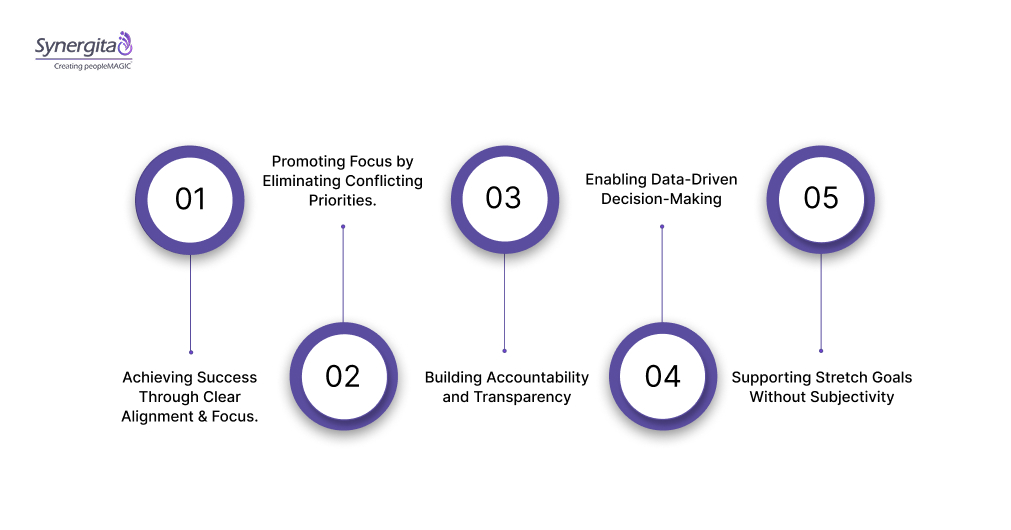
1. Making Success Unambiguous Through Clarity and Alignment
Key Results define exactly what success looks like. By translating high-level Objectives into measurable outcomes, they eliminate differing interpretations across teams. Everyone knows what the target is, how progress will be measured, and what “done” actually means, creating alignment across functions and levels.
2. Encouraging Focus by Reducing Vague or Competing Priorities
Because Key Results force specificity, they naturally reduce noise. Teams must choose the metrics that matter most, which means deprioritizing the initiatives that don’t contribute directly to measurable progress. This sharp focus helps prevent the common trap of spreading effort too thin or chasing unrelated goals.
3. Building Accountability and Transparency
Key Results make performance visible. When progress is quantified, it becomes easier to understand who owns what, how the team is performing, and where support may be needed. This transparency fosters accountability, not in a punitive sense, but as a shared commitment to delivering meaningful outcomes.
4. Enabling Data-Driven Decision-Making and Course Correction
Because KRs are tracked regularly, they give teams real-time feedback on whether their actions are working. If a metric is lagging, teams can adjust strategy before the quarter ends. Key Results transform goal setting from a “set it and forget it” exercise into an iterative, data-informed process.
5. Supporting Stretch Goals Without Subjectivity
Stretch Objectives are intended to push teams beyond their comfort zones. Key Results make those stretch ambitions grounded and fair by defining the measurable thresholds for success. Teams don’t rely on opinions or gut feelings to decide whether they “did well”, they rely on numbers. This removes ambiguity and encourages healthy ambition.
Structure of Effective Key Results
Writing effective Key Results requires more than choosing a metric, it demands a clear structure that ensures the KR is measurable, actionable, and aligned with the bigger Objective. A strong KR follows a predictable anatomy, adheres to sound goal-setting principles, and fits into one of several types that shape how progress is tracked.
Anatomy of a Key Result
Every Key Result should contain four core elements that make it measurable and trackable:
• Metric or Measurable Indicator
This is the specific data point that reflects progress. It might be revenue, churn rate, response time, engagement score, conversion rate, etc. The metric must be objective and consistently trackable.
• Baseline (Starting Point)
Where are you today? Establishing a baseline prevents inflated expectations and gives the team clarity about the gap they must close.
Example: Current activation rate: 28%
• Target (Desired Measurable Outcome)
Where do you want to be by the end of the cycle? This target should be specific, numeric, and meaningful, not arbitrary.
Example: Increase activation rate to 45%
• Timeline (Typically Quarterly)
Most OKR cycles run quarterly, so the Key Result should be achievable within that period. Shorter timelines create urgency and allow for faster feedback loops.
Put together, a well-formed KR might look like:
“Increase activation rate from 28% → 45% by the end of Q2.”
SMART + OKR Principles
Effective KRs blend classic SMART goal logic with the OKR philosophy of ambition and clarity.
• Specific and Measurable
Ambiguity is the enemy of good OKRs. KRs must define exactly what will change and by how much.
• Numerically Defined
All Key Results should include quantifiable measures, growth percentages, reduction targets, quality metrics, completion rates, or capacity measures.
Examples:
- Reduce churn from 5.2% → 3%
- Improve NPS from 45 → 60
- Decrease average cycle time from 14 days → 7 days
• Inspiring but Realistic Stretch Targets
OKRs are known for ambition. Aiming high drives innovation, but the target must still be within the realm of possibility with focused effort.
• Aligned With Business Strategy and Team Capabilities
A Key Result is only useful if it supports a real strategic priority and the team can influence it directly. Misaligned or uncontrollable metrics lead to frustration and wasted effort.
Types of Key Results
Understanding the different categories of Key Results helps teams choose the right metrics for each Objective.
1. Input Key Results
These measure the activities or resources put into achieving the Objective.
They’re less ideal because they track effort rather than outcomes, but they can be useful when outcomes are hard to measure or take longer to materialise.
Example: Conduct 20 customer discovery interviews.
2. Output Key Results (Preferred)
These measure the results or impact produced by the work.
Output KRs are more powerful because they reflect change in the real world, not just activity.
Example: Increase customer adoption rate from 20% → 40%.
3. Leading vs. Lagging Key Results
- Leading KRs: Predictive indicators that move early and signal future performance.
Example: Increase weekly active users (leading indicator for retention). - Lagging KRs: End-state results that confirm final impact.
Example: Improve quarterly retention rate to 92%.
A balanced OKR set often includes a mix of both, leading indicators to guide action and lagging indicators to confirm success.

How to Write High-Quality Key Results: Step-by-Step Guide
Writing great Key Results is a disciplined process. It requires clarity, focus, and an understanding of how outcomes, not activities, should be measured. Use the following step-by-step approach to craft Key Results that drive meaningful progress.
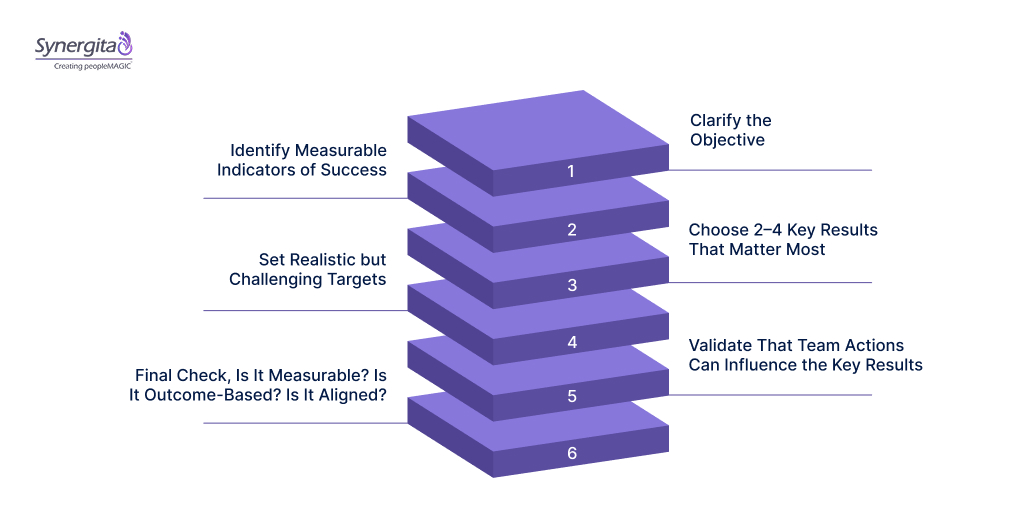
Step 1: Clarify the Objective
Start with a well-defined Objective. It should be qualitative, inspirational, and directional. A strong Objective answers:
- What do we want to achieve?
- Why does it matter?
If the Objective isn’t clear, the Key Results will be scattered or irrelevant.
Example Objective:
Deliver an outstanding onboarding experience for new customers.
Step 2: Identify Measurable Indicators of Success
Ask yourself: What evidence would prove that we achieved this Objective?
Identify metrics that reflect real progress. These might include:
- performance metrics
- user behavior changes
- efficiency improvements
- customer satisfaction measures
- financial outcomes
The key is to define numeric indicators that reflect meaningful change.
Possible success indicators:
- onboarding completion rate
- customer satisfaction score
- time-to-value.
Step 3: Choose 2–4 Key Results That Matter Most
Focus is essential. The best OKRs have no more than 2–4 Key Results per Objective.
Choose Key Results that:
- represent the highest-leverage outcomes
- can be clearly tracked
- directly influence the Objective
Avoid the temptation to measure everything. Measure what matters.
Example Key Results:
- Increase onboarding completion rate from 62% → 85%
- Improve onboarding satisfaction score from 4.1 → 4.7.
Step 4: Set Realistic but Challenging Targets
OKRs should push the team slightly beyond its comfort zone; this is what makes them motivating.
A strong Key Result target:
- is ambitious (stretch)
- is achievable with focused effort
- avoids sandbagging or unrealistic leaps
- has a clear timeline (often quarterly)
Example:
Raise activation rate from 28% → 45% in one quarter.
The target is substantial but not impossible.
Step 5: Validate That Team Actions Can Influence the Key Results
A common mistake is choosing metrics the team cannot control.
Ask:
- Do we directly influence this metric?
- Do we have the tools, authority, and resources to impact it?
- If this fails, will we know why?
If the team cannot influence the outcome, it’s not a good Key Result.
Choose leading indicators if lagging indicators are too removed from team influence.
Step 6: Final Check, Is It Measurable? Is It Outcome-Based? Is It Aligned?
Before finalising, run each Key Result through this checklist:
✔ Is it measurable?
Every Key Result must have a number and a clear definition of success.
✔ Is it outcome-based (not a task)?
It should measure impact, what changed, not the activities completed.
✔ Is it aligned?
The Key Result should clearly contribute to the Objective and support organizational priorities.
If the answer is “yes” to all three, you’ve written a high-quality Key Result.
How to Evaluate Key Results
Evaluating Key Results is essential to ensuring that OKRs aren’t just written but used to drive real progress. Effective evaluation helps teams understand whether they’re on track, what needs to change, and how efforts translate into impact.
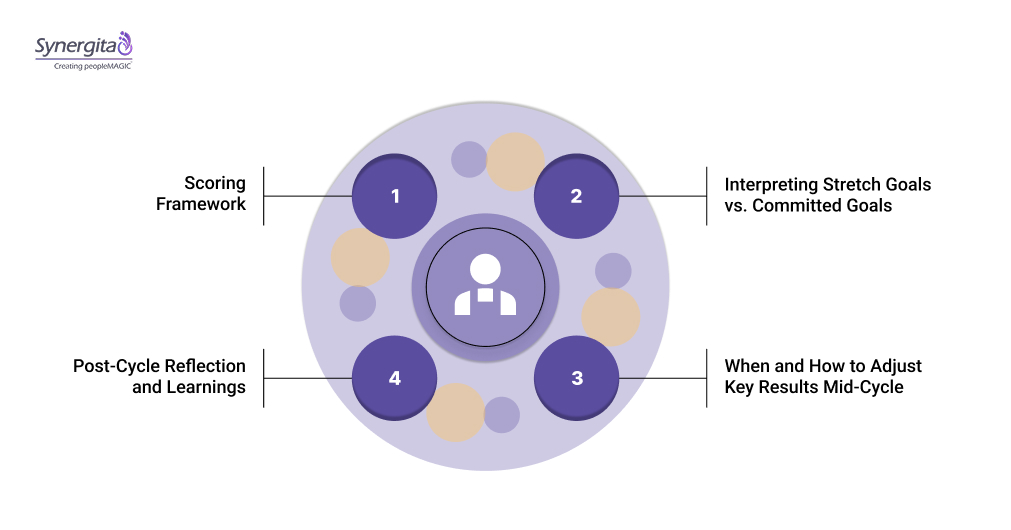
1. Scoring Framework (0.0–1.0 or Percentage Completion)
Most OKR systems use a 0.0–1.0 scoring range, where:
- 1.0 (or 100%) = fully achieved
- 0.7 (or 70%) = strong progress, typical for stretch goals
- 0.4–0.6 = partial progress
- 0.0–0.3 = little to no progress
This scoring is quantitative, but should be paired with contextual explanations, why the team hit or missed targets, and what influenced performance.
Example scoring:
- KR: Increase activation rate from 28% → 45%
- Achieved: 39%
- Score: 0.78 (solid result against a stretch target)
Scoring isn’t about judgment; it’s a tool for learning and focus.
2. Interpreting Stretch Goals vs. Committed Goals
Not all Key Results are created equal. Understanding the intent behind each type matters:
Committed Goals (Baseline Expectations)
- Expected to be fully achieved (≈1.0)
- Often tied to operational performance
- Missing them may indicate execution or resource issues
Stretch Goals (Aspirational Targets)
- Designed to push teams beyond comfort zones
- A score of 0.6–0.7 is considered strong performance
- Achieving 1.0 is rare and signals exceptional performance
This distinction prevents teams from feeling “punished” for not hitting ambitious stretch targets while still encouraging innovation and higher performance.
3. When and How to Adjust Key Results Mid-Cycle
While OKRs are typically fixed for a quarter, real-world conditions sometimes require thoughtful adjustments.
When to adjust:
- A key assumption changes (market shift, customer feedback, technical constraint)
- The KR becomes irrelevant due to a strategic pivot
- The metric proves unmeasurable or outside team control
- A dependency fails and makes the original target impossible
How to adjust responsibly:
- Maintain the original Objective whenever possible
- Update the metric or target while keeping it measurable
- Document the reason for the adjustment, so learnings are preserved
- Communicate changes across teams to preserve alignment
Adjustments should be exceptions, not the norm; over-editing undermines focus and accountability.
4. Post-Cycle Reflection and Learnings
Evaluation is incomplete without a structured review at the end of each OKR cycle. The purpose isn’t to assign blame, but to drive continuous improvement.
A strong post-cycle reflection asks:
- What worked? Which initiatives clearly moved the metrics?
- What didn’t work? Where did effort fail to translate into outcomes?
- Were the Key Results well-defined? Did measurement issues arise?
- What should we change next cycle? Targets, metrics, processes, or ownership?
- What did we learn about execution patterns?
(e.g., slow starts, resource gaps, bottlenecks, unrealistic assumptions)
Great OKR teams are defined not by perfect execution, but by disciplined learning based on measurable results.
Common Mistakes in Writing Key Results
Even teams that understand the OKRs conceptually often struggle to write strong Key Results. Most issues stem from unclear thinking, a lack of measurement, or confusing activity with impact. Here are the most common pitfalls, and why they weaken your OKRs.
1. Creating Tasks Instead of Measurable Outcomes
One of the biggest mistakes is turning Key Results into a to-do list. Tasks (like “launch campaign” or “build feature”) describe activity, not success. They say nothing about whether the work created value.
Bad KR: “Hold weekly team training sessions.”
Good KR: “Improve team competency score from 72 → 85.”
KRs must answer What measurable change will prove we succeeded?
2. Setting Too Many Key Results
More KRs doesn’t equal more clarity. When teams list six or eight metrics, focus disappears and priorities blur. The OKR method is built on disciplined concentration, typically 2–4 Key Results per Objective.
Too many KRs lead to:
- diluted effort
- scattered decision-making
- difficulty tracking progress clearly
Fewer, sharper KRs produce better results.
3. Writing Vague, Non-Metric Phrases
Statements like “improve customer experience” or “enhance platform performance” sound good but offer no measurable meaning. Vague language allows subjective interpretation, and subjective judgment leads to inconsistent execution.
A strong KR must be quantifiable. Otherwise, teams can’t assess progress or provide accountability.
Replace vague phrases with:
- percentage changes
- numeric targets
- time-based improvements
- quality metrics
- completion rates tied to outcomes
4. Selecting Metrics Teams Cannot Influence
A Key Result is only useful if the team can impact the metric through their work. If the outcome relies heavily on external factors, like market conditions, pricing set by another department, or executive decisions, it becomes demotivating and unmanageable.
Good OKRs balance ambition with ownership.
Ask: “Do we directly influence this number?”
If not, reconsider the KR or choose a leading indicator that the team can drive.
5. Confusing Business-as-Usual Metrics with Strategic Outcomes
Not every routine KPI belongs in an OKR. OKRs should represent meaningful change, improvement, or strategic movement, not maintenance. Metrics like “maintain 99.9% uptime” or “keep churn below 5%” may be important, but they don’t reflect forward progress if they’re already stable.
Business-as-usual keeps the lights on.
OKRs are about moving the business forward.
Choose KRs that change behavior, stretch capability, or unlock value.
Case Study: Eruvaka Technologies, Achieving Clarity Through Measurable Outcomes
Eruvaka Technologies, an aquaculture automation company, relied on manual performance processes that lacked consistency, transparency, and measurable goals, leading to subjective reviews and heavy administrative effort.
Key Challenges
- Subjective and inconsistent performance measurement
- Lack of transparency for employees
- No data-driven insights for managers
- Time-consuming manual reviews
- No standardized goal-setting structure
- Limited visibility into individual contributions
- Delayed and biased feedback cycles
Solution: Synergita Perform + OKR Framework
Eruvaka adopted Synergita Perform, integrated with OKRs, to automate processes, standardize goal-setting, enable real-time performance tracking, and support continuous, data-informed feedback. This aligned individual goals with company objectives and strengthened accountability.
Key Outcomes
- Clear, measurable goal-setting: Employees created KR-aligned goals with consistent templates.
- Greater transparency: Real-time evaluation visibility improved trust and engagement.
- Reduced admin workload: Automation saved weeks of manual consolidation time.
- Data-driven decisions: Managers used real-time metrics instead of subjective recall.
- Fair, objective evaluations: Bias was reduced, and success metrics were clearly defined.
Eruvaka’s shift from subjective assessments to measurable OKR-driven outcomes highlights how clear Key Results improve alignment, accountability, and overall performance, turning ambiguity into actionable progress.

What Synergita Brings to an OKR-Driven Organization?
Synergita positions itself as more than a performance tool; it’s a system built to help organizations turn strategic goals into measurable outcomes. Its OKR and performance management platform reinforces the very principles this blog emphasises: clarity, alignment, continuous tracking, and outcome-driven execution.
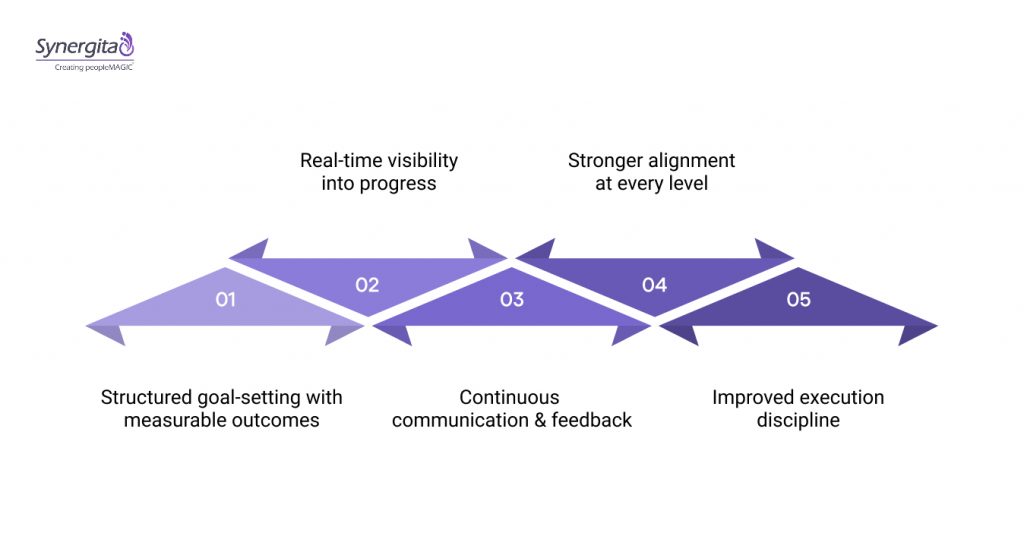
- Structured goal-setting with measurable outcomes: Synergita helps teams create Objectives supported by quantifiable Key Results, ensuring alignment across departments.
- Real-time visibility into progress: Dashboards and analytics make it easy to track KR movement and identify what needs attention.
- Continuous communication & feedback: Built-in check-ins and feedback loops ensure teams don’t wait until quarter-end to adjust.
- Stronger alignment at every level: Synergita connects individual goals to company-wide priorities, reducing ambiguity and helping everyone understand how their work matters.
- Improved execution discipline: With clear metrics and automated tracking, teams stay focused on outcomes rather than activities.
Want OKRs that actually drive results? Synergita can help turn measurable intent into measurable impact.
Conclusion
Clear, focused, and measurable Key Results are what make OKRs genuinely effective. When teams define success with precision, they stay aligned, make better decisions, and work toward outcomes that truly matter. And because business goals evolve, OKRs should evolve too. Each cycle is an opportunity to refine targets, improve metrics, and strengthen execution.
Ultimately, strong Key Results drive impact, not busywork. They shift teams from tracking activities to measuring real progress, the core of a results-driven culture.
Want to put measurable OKRs into action?
Book a demo with Synergita and see how their OKR platform helps teams achieve clarity, alignment, and meaningful results.
FAQ
1. Should Key Results always be numeric?
Yes. If a result can’t be quantified, it becomes subjective. Strong KRs rely on numbers, percentages, counts, time reductions, quality scores, etc.
2. How many Key Results should each Objective have?
Aim for 2–4 Key Results per Objective. Fewer creates focus, while too many dilute priority and make execution harder to manage.
3. What’s the difference between a Key Result and a task?
A Key Result measures an outcome (e.g., increase conversions), while a task reflects an activity (e.g., launch a campaign). Tasks support Key Results, not replace them.
4. How often should Key Results be reviewed?
Teams typically review them weekly or bi-weekly. Regular check-ins help identify roadblocks early and ensure timely adjustments.
5. What scoring system is used to evaluate Key Results?
Most OKR frameworks use a 0.0–1.0 or 0–100% scoring scale. A score around 0.7 often indicates strong progress for stretch goals.