
Do you ever feel like your team is always busy, but real progress is hard to see? Many tech teams move quickly and release new features often. But speed alone doesn’t guarantee results. Sometimes the work gets done, but the real problems stay unsolved.
That’s where Objectives and Key Results (OKRs) can help.
OKRs give your team a clear focus. They connect everyday work to real goals. Instead of counting tasks or releases, you track what actually changes because of the work you do.
In this guide, you’ll find 12 practical OKRs made for agile teams. They’re easy to understand and simple to use. You can put them into action right away to help your team stay focused, aligned, and moving in the right direction.
At a glance:
- Agile teams often struggle with five critical challenges: disconnected strategy and execution, unclear accountability, tracking the wrong metrics, fear-based cultures, and departmental silos that slow innovation
- OKRs solve these challenges by creating transparent alignment from leadership vision to sprint planning, empowering autonomous teams with clear outcomes instead of micromanagement
- Effective OKRs measure business impact (customer adoption, revenue growth, satisfaction scores) rather than activity (features shipped, story points completed, velocity metrics)
- Successful implementation requires quarterly cycles, psychological safety for ambitious goal-setting (70% achievement is the target, not 100%), and tools like Synergita that integrate OKRs with your agile workflows through Jira, Slack, and Teams
How OKRs Help Teams Fix Common Problems
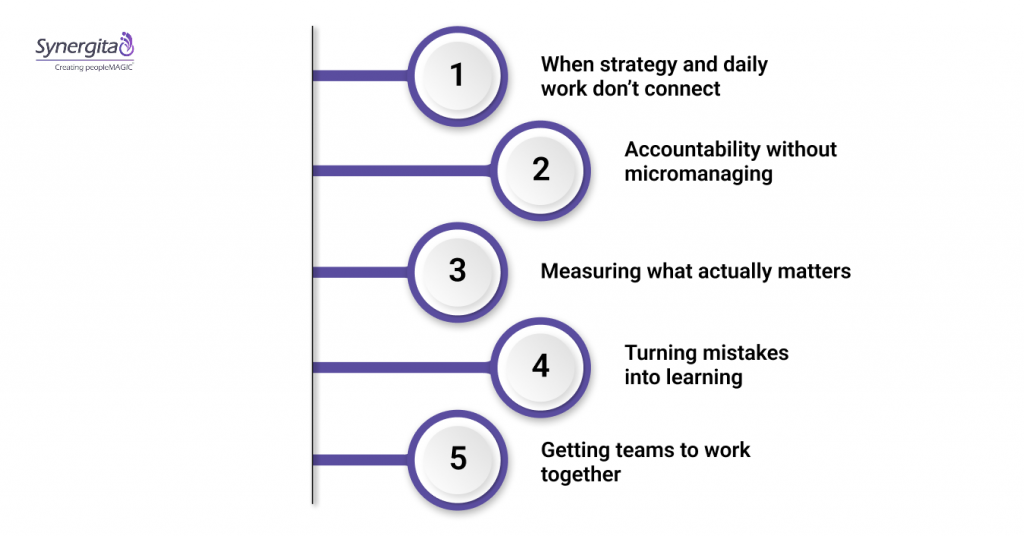
Most tech teams work hard. They run sprints, ship features, and stay busy. But the results don’t always match the effort. This is where OKRs help. They bring structure without slowing teams down.
Here’s how they solve five common problems.
1. When strategy and daily work don’t connect
Teams often don’t know how their tasks connect to company goals. Leaders struggle to see how day-to-day work moves the business forward. OKRs close that gap.
They take a big goal and break it into clear, short-term targets. So instead of guessing priorities, teams make choices that support the bigger picture. Leaders can see progress without checking every task.
2. Accountability without micromanaging
Too much control kills motivation. Too little direction creates chaos. OKRs balance both.
Leaders set the outcome. Teams decide how to reach it. So, instead of saying, “Build these five features,” the focus shifts to, “Improve user engagement by 30%.”
This builds trust. Teams feel ownership. Leaders stay informed without hovering.
3. Measuring what actually matters
OKRs change the focus from activity to impact. Instead of asking, “How much did we build?” teams ask, “Did this help users or the business?”
That shift changes behavior. Teams stop chasing output and start solving real problems. Progress becomes easier to understand and easier to improve.
4. Turning mistakes into learning
OKRs encourage a healthier mindset. Goals are meant to stretch teams, not trap them. Hitting 70% of a goal is often a good result. It means the team aimed high.
When something doesn’t work, the focus shifts from blame to learning. What did we try? What did we learn? What should we do next?
This creates a rhythm of testing, learning, and improving. Over time, teams get smarter and more confident. Progress speeds up.
5. Getting teams to work together
As companies grow, teams drift apart. Each group focuses on its own tasks. OKRs help teams move in the same direction.
When different teams share the same goal, they have to talk, plan, and coordinate. They see how their work affects others.
Also Read: 10 Best OKR Examples for Operations
OKRs help teams focus, learn faster, and move together. And when that happens, real progress finally starts to show.
12 High-Impact OKRs for Agile Teams Driving Innovation
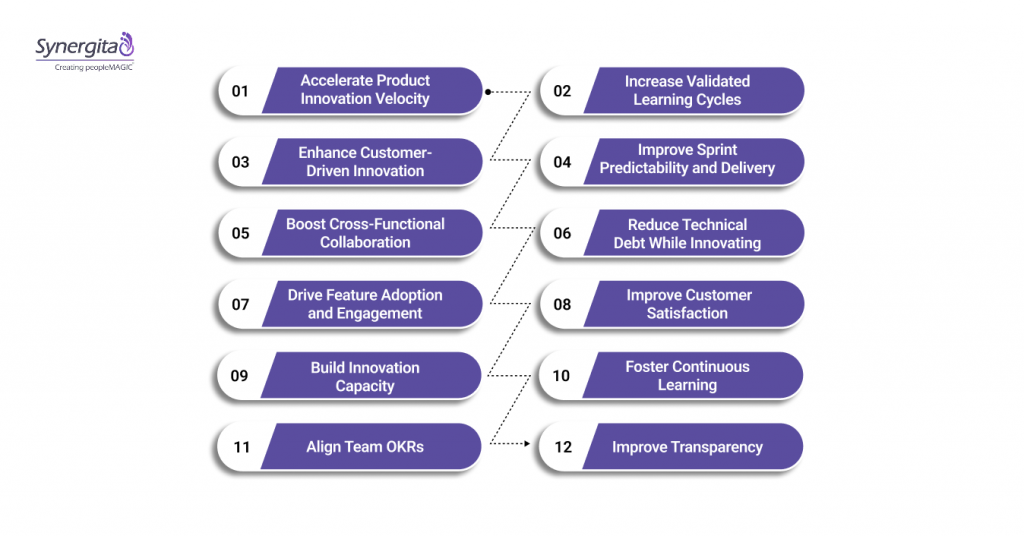
Theory matters, but you need practical examples to implement OKRs effectively. The following 12 OKRs represent proven frameworks that agile teams use to drive measurable innovation.

1. Accelerate Product Innovation Velocity
Objective: Cut time from validated idea to customer feedback in half
Key Results:
- Reduce MVP development cycle from 90 days to 45 days
- Achieve 80% of experiments reaching customer testing within 2 sprints
- Increase successful feature adoption rate (30-day active usage) from 35% to 55%
Why This Drives Innovation: Speed matters in competitive markets. Faster learning cycles mean you discover what works before competitors do. This OKR removes bottlenecks without sacrificing quality.
Agile Integration: Review experiment progress in sprint retrospectives. Identify process friction that slows validation. Adjust sprint scope to protect innovation capacity.
For Decision-Makers: Monitor average cycle time monthly. If velocity stalls, investigate whether process overhead or technical constraints cause delays.
2. Increase Validated Learning Cycles
Objective: Build experimentation into our innovation culture
Key Results:
- Conduct 24 customer discovery interviews per quarter (up from 8)
- Launch 6 A/B tests monthly with clear success metrics
- Document and share learnings from failed experiments within 48 hours
Why This Drives Innovation: Most product ideas fail. Organizations that test assumptions quickly outlearn competitors. This OKR formalizes continuous experimentation.
Agile Integration: Reserve 20% of sprint capacity for experiments. Include “experiment review” as a standing retrospective agenda item.
For Decision-Makers: Track learning velocity, not just success rate. Teams that run more experiments (even failed ones) build stronger product instincts.
3. Enhance Customer-Driven Innovation
Objective: Make customer feedback central to product decisions
Key Results:
- Implement customer feedback loop with 72-hour response time
- Increase NPS from 32 to 50 through feedback-driven improvements
- Close feedback loop: 90% of users who report issues receive resolution updates
Why This Drives Innovation: Customers tell you what problems need solving. Teams that listen closely build products people actually want.
Agile Integration: Include customer feedback review in sprint planning. Prioritize backlog items based on customer pain severity.
For Decision-Makers: Customer-driven innovation reduces market risk. Monitor how often product decisions reference customer data.
4. Improve Sprint Predictability and Delivery
Objective: Build stakeholder confidence through consistent execution
Key Results:
- Achieve 85% sprint commitment completion rate (currently at 60%)
- Reduce unplanned work from 30% to 15% of sprint capacity
- Maintain sprint burndown within 10% of plan by day 3
Why This Drives Innovation: Predictable teams earn autonomy. When leadership trusts execution, they support bolder experiments.
Agile Integration: Track commitment vs. completion ratio. Analyze variance causes in retrospectives. Adjust estimation practices based on data.
For Decision-Makers: Predictability enables better resource planning. Consistent delivery builds credibility for larger innovation investments.
5. Boost Cross-Functional Collaboration
Objective: Eliminate handoff delays between teams
Key Results:
- Reduce average cross-team request resolution time from 8 days to 3 days
- Increase cross-functional pair programming sessions from 5 to 20 per month
- Achieve 100% attendance at bi-weekly cross-team sync meetings
Why This Drives Innovation: Complex innovation requires diverse expertise. Teams that collaborate effectively ship faster and learn more.
Agile Integration: Create shared sprint goals across teams. Rotate team members for knowledge transfer. Use joint retrospectives to identify collaboration friction.
For Decision-Makers: Measure handoff delays as innovation blockers. Fast collaboration multiplies team effectiveness.
6. Reduce Technical Debt While Innovating
Objective: Maintain velocity without accumulating system fragility
Key Results:
- Allocate 25% of sprint capacity to technical debt reduction (currently 10%)
- Reduce production incidents by 40% through proactive fixes
- Improve code quality score from 6.2 to 8.0 on automated review tools
Why This Drives Innovation: Technical debt slows future innovation. This OKR balances building new features with maintaining system health.
Agile Integration: Make debt reduction visible on sprint boards. Include technical work in velocity calculations. Celebrate debt reduction wins in retrospectives.
For Decision-Makers: Short-term feature pressure creates long-term innovation drag. Protect technical investment capacity explicitly.
7. Drive Feature Adoption and Engagement
Objective: Ensure shipped features create measurable customer value
Key Results:
- Increase feature activation rate from 40% to 65% within first week
- Achieve 70% monthly active usage for new features (currently 45%)
- Reduce feature abandonment rate from 35% to 20% after 30 days
Why This Drives Innovation: Shipping features means nothing if customers don’t use them. This OKR connects development effort to actual adoption.
Agile Integration: Define adoption metrics before sprint planning. Include usage analytics review in sprint demos. Iterate based on adoption data.
For Decision-Makers: Track adoption trends across all releases. Low adoption signals misaligned product strategy.
8. Improve Customer Satisfaction Through Agile Iterations
Objective: Use rapid iteration to exceed customer expectations
Key Results:
- Increase NPS from 42 to 60 through quarterly improvements
- Reduce customer-reported bugs by 50% through better testing
- Achieve 90% positive sentiment in post-release surveys
Why This Drives Innovation: Satisfied customers provide honest feedback, forgive mistakes, and advocate for your product. This OKR makes satisfaction measurable.
Agile Integration: Survey customers after major releases. Include satisfaction metrics in sprint reviews. Adjust priorities based on sentiment data.
For Decision-Makers: Customer satisfaction predicts retention and growth. Monitor trends quarterly to catch problems early.
9. Build Innovation Capacity Through Autonomy
Objective: Empower teams to self-organize and make decisions
Key Results:
- Increase team decision-making authority score from 5.2 to 8.0 (10-point scale)
- Reduce manager approval bottlenecks from 15 to 5 per quarter
- Achieve 80% team confidence in autonomous execution (via quarterly survey)
Why This Drives Innovation: Autonomous teams move faster and innovate more boldly. This OKR measures empowerment systematically.
Agile Integration: Document decision rights clearly. Let teams choose implementation approaches. Celebrate autonomous problem-solving in retrospectives.
For Decision-Makers: Autonomy requires clear guardrails and trust. Set boundaries, then step back. Monitor outcomes, not activities.
10. Foster Continuous Learning and Skill Development
Objective: Build team capabilities that compound over time
Key Results:
- Ensure 100% of team members complete one technical certification per quarter
- Conduct 12 internal knowledge-sharing sessions quarterly (currently 4)
- Allocate 10% sprint capacity to learning and skill development
Why This Drives Innovation: Better skills enable better solutions. Teams that invest in learning stay ahead of technology trends.
Agile Integration: Include learning time in sprint planning. Share new knowledge in sprint reviews. Rotate learning facilitation across team members.
For Decision-Makers: Skill development is strategic investment, not overhead. Measure how learning translates to innovation capacity.
11. Align Team OKRs with Company Strategic Priorities
Objective: Ensure every team contributes to organization-wide goals
Key Results:
- Achieve 100% team OKR alignment with company objectives (currently 65%)
- Reduce OKR conflicts requiring leadership arbitration from 12 to 3 per quarter
- Improve team understanding of company strategy from 6.5 to 9.0 (survey score)
Why This Drives Innovation: Aligned teams multiply each other’s impact. Misaligned teams waste effort on conflicting priorities.
Agile Integration: Review company OKRs during sprint planning. Make alignment visible on team boards. Adjust priorities when strategy shifts.
For Decision-Makers: Alignment prevents local optimization at global expense. Audit team OKRs quarterly for strategic fit.
12. Improve Transparency and Communication Across Teams
Objective: Make progress and blockers visible to all stakeholders
Key Results:
- Achieve 95% weekly status update completion rate (currently 70%)
- Reduce communication-related delays from 8 days to 2 days average
- Increase stakeholder satisfaction with transparency from 6.0 to 8.5
Why This Drives Innovation: Visibility enables coordination. Teams that communicate well avoid duplicate work and share insights faster.
Agile Integration: Use shared dashboards for real-time status. Standardize communication formats. Include communication health in retrospectives.
For Decision-Makers: Transparency prevents surprises. Invest in tools and practices that make progress visible effortlessly.
Also Read: How to Build a Successful OKR Culture for Teams
You can use these OKRs as templates, then customize them to match your organization’s context. However, setting big goals is the easy part. But, keeping them visible and on track is where most teams struggle.
Transform Your OKR Management with Synergita
OKRs often start strong, then fade once the sprint work begins. Updates get missed. Progress becomes unclear. Teams lose sight of what matters. Spreadsheets can’t fix that.
You need a simple system that keeps OKRs front and center every week, not just during planning. One that helps teams see progress, spot problems early, and stay focused on the goals that matter.
Synergita‘s OKR platform helps agile teams:
- Align objectives across company, team, and individual levels with visual cascading
- Track progress in real-time with integrations to Jira, Slack, and Microsoft Teams
- Get AI guidance through OKR Buddy for writing better objectives and key results
- Maintain transparency with dashboards that show everyone’s contributions
- Adapt quickly with quarterly cycles designed for agile environments
Whether you’re launching OKRs for the first time or scaling across multiple teams, Synergita provides the structure that keeps innovation focused and measurable.
Start with the free OKR Starter plan (no credit card required) and experience how the right tool transforms goal-setting from admin overhead into strategic advantage.
Also Read: Essential OKR Dashboard Examples for Goal Tracking

Final Words
OKRs work because they solve a fundamental problem: connecting what matters strategically to what happens tactically. For agile teams, this connection is critical.
Remember that OKRs succeed through iteration, not perfection. Start small, measure honestly, and improve continuously. That’s the agile mindset applied to goal-setting itself.
Synergita integrates seamlessly into your agile workflow. The AI-powered OKR Buddy helps you write better objectives and suggests key results based on industry benchmarks. Real-time dashboards show progress without requiring manual updates.
Most importantly, the quarterly cycle framework matches your agile rhythm.
Ready to align your agile teams around outcomes that matter? Book a demoand turn strategic vision into measurable results.
FAQs
1. How do OKRs differ from KPIs in agile environments?
KPIs measure ongoing business health like uptime or retention. OKRs set time-bound goals for change. Think of KPIs as vital signs and OKRs as fitness goals. Agile teams use both: KPIs ensure stability while OKRs drive innovation.
2. Should individual contributors have their own OKRs?
Start with team-level OKRs. Individual OKRs work when team objectives are mature. Many agile teams skip individual OKRs entirely, letting members contribute flexibly to shared goals without creating siloed ownership.
3. How often should agile teams update OKR progress?
Review progress weekly in sprint retrospectives. Update metrics whenever data changes. Hold formal reviews monthly. Quarterly OKR cycles align well with most agile planning rhythms.
4. What happens when we miss OKR targets consistently?
Missing targets reveals valuable information. Check if key results measure right outcomes. Assess whether objectives are realistic. Identify systemic blockers, not individual performance issues. Consistent misses often signal unrealistic expectations or misaligned strategies.
5. Can OKRs work with Scrum, Kanban, and other frameworks?
Yes. OKRs sit above framework practices. Scrum teams use them for sprint planning. Kanban teams use them for flow optimization. SAFe implementations align Program Increments with OKRs. The framework doesn’t matter—OKRs provide the “what” while agile provides the “how.”
6. Should OKRs link to compensation or performance reviews?
No. Linking OKRs to compensation destroys innovation value. People set safe goals instead of ambitious ones. Use OKRs for alignment and learning. Use separate criteria for performance evaluation. This separation creates psychological safety for bold goal-setting.