
Most OKR review cycles follow a familiar and frustrating pattern: unclear key results lead to subjective scoring, which then turns reviews into defensive conversations and unproductive leadership meetings. When every team has its own interpretation of what “70% done” means, execution slows down, and real risks remain unnoticed.
At a time when efficiency is a requirement for survival, you cannot rely on a scoreboard that’s open to interpretation. You need a consistent way to translate raw progress data into decisions leaders can stand behind.
In this guide, you’ll get a free OKR scoring template that removes ambiguity from the process. You’ll learn how to score for ambition instead of easy completion, recognize safe goals versus stretch goals, and run reviews that actually move work forward.
At a Glance
- OKR scoring works only when key results are outcome-based, consistently scored, and reviewed weekly, mid-quarter, and end-quarter.
- A clear OKR scoring template standardizes progress tracking using numeric scores, confidence signals, and review notes.
- Scores between 0.7 and 0.8 indicate healthy ambition, while extreme scores reveal goal-setting or execution issues.
- Interpreting scores correctly helps leaders spot risks early, reallocate effort faster, and make informed planning decisions.
What is an OKR Scoring Template?
An OKR scoring template is a structured framework used to measure the achievement of your objectives by assigning numerical values to key results. Unlike a standard goal-setting sheet, a scoring template standardizes how progress is calculated, ensuring that every team’s “70%” means the same thing. It turns subjective updates into objective data, making it easier for leaders to identify which goals are healthy and which are at risk.
Why OKR Scoring is Critical for Meaningful Reviews?
OKR scoring matters because it turns goal updates into clear signals that guide focus, priorities, and leadership decisions. Here’s why structured OKR scoring changes how teams operate and review progress:
- Removes subjectivity from reviews by applying the same scoring logic across teams, roles, and quarters.
- Highlights risk early when key results stall mid-cycle, giving leaders time to intervene before outcomes slip.
- Shifts focus from effort to outcomes, preventing teams from rewarding activity that does not move results.
- Improves cross-team alignment by making OKR progress visible, comparable, and easy to interpret.
- Supports faster decision-making during planning and retrospectives using consistent OKR scoring data.
Also read: Get off to a flying start with Synergita OKR templates
Understanding why scoring matters sets the stage for choosing the right scoring method for your team.

Common OKR Scoring Methods Used by Real Teams
Different teams use different OKR scoring methods, and choosing the right one depends on how goals are set and reviewed. Here are the most widely used OKR scoring systems and how they work in real scenarios.
1. 0.0–1.0 OKR Scoring Method
This method scores each key result on a 0.0 to 1.0 scale based on actual outcome completion. A score around 0.7 reflects strong progress, while a consistent 1.0 often signals goals were set too safely. Using this OKR scoring system encourages ambition, learning, and stretch outcomes without penalizing teams for thoughtful risk-taking.
2. Percentage-Based OKR Scoring
Percentage-based OKR scoring tracks progress from 0% to 100%, making updates instantly clear during reviews. Teams often prefer this approach when using an OKR scoring template inside spreadsheets or shared tracking dashboards. This method works best when key results measure outcomes clearly, not activities that inflate progress without real impact.
3. Confidence-Based or Qualitative Scoring
Confidence-based scoring adds qualitative signals alongside numbers to explain progress beyond surface-level percentages. It clarifies whether a key result is truly on track, at risk, or blocked despite similar numeric scores. Combining confidence signals with an OKR scoring template improves review clarity and reduces misaligned expectations.
4. Weighted Key Result Scoring
Weighted OKR scoring assigns different importance levels to each key result based on business impact. Progress calculations reflect contribution value, helping leaders prioritize efforts during reviews and resource planning discussions. This approach suits complex OKRs where some results influence outcomes far more than others.
Knowing the scoring approaches is helpful, but applying them consistently requires a clear, reusable template.
Free OKR Scoring Template
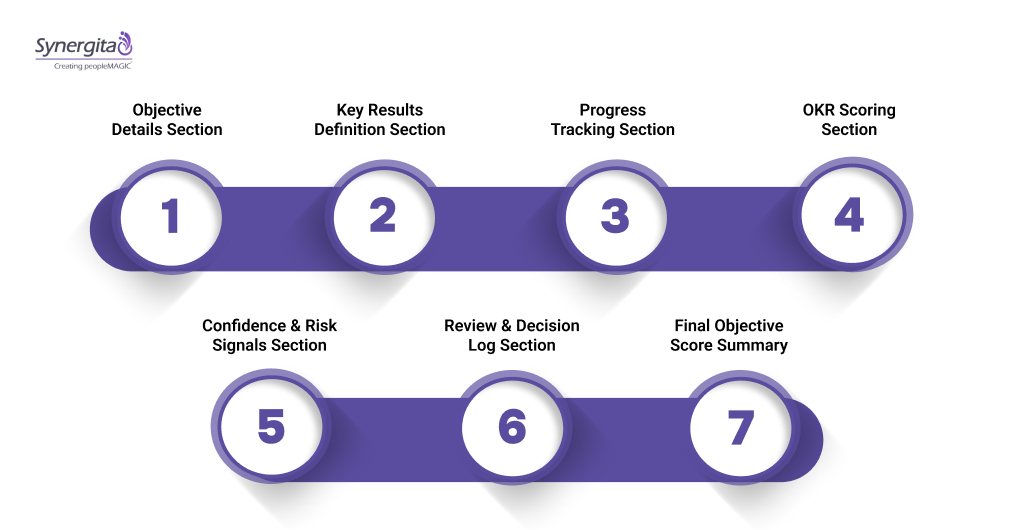
This OKR scoring template is designed to help you track progress, score outcomes accurately, and run confident, data-driven reviews.
1. Objective Details Section
This section defines the purpose of the OKR and ensures every key result aligns with a single strategic outcome.
- Objective ID: Assign a unique identifier to track objectives across quarters, teams, and review cycles.
- Objective Statement: Write a clear, outcome-driven objective that describes what success looks like by quarter-end.
- Owner: Specify the accountable owner responsible for updates, progress discussions, and final outcome ownership.
- Timeframe: Define the OKR cycle clearly, such as quarterly or monthly, to avoid review and alignment confusion.
2. Key Results Definition Section
This section captures measurable outcomes that determine whether the objective has been achieved successfully.
- Key Result ID: Use a unique reference number to track individual key results consistently across reviews.
- Key Result Description: Define a measurable outcome that reflects impact, not effort or task completion.
- Baseline Value: Record the starting point to measure true progress rather than perceived improvement.
- Target Value: Set a clear success threshold that defines when the key result can be considered achieved.
3. Progress Tracking Section
This section tracks ongoing updates and ensures progress discussions remain factual and outcome-focused.
- Current Value: Update the latest measurable progress to reflect real movement toward the target outcome.
- Progress Percentage: Automatically calculate progress based on the current value versus the target value for clarity.
- Last Updated Date: Record update frequency to maintain accountability and avoid outdated review discussions.
4. OKR Scoring Section
This section standardizes how progress converts into scores, enabling fair and comparable evaluations.
- Scoring Method: Specify whether the OKR uses 0.0–1.0 scoring, percentage scoring, or weighted scoring.
- Raw Score: Calculate the numeric score based on progress percentage or predefined scoring logic.
- Weighted Score: Apply weightage when key results differ in business impact or strategic importance.
5. Confidence and Risk Signals Section
This section explains the performance context that numbers alone cannot fully communicate during reviews.
- Confidence Level: Mark each key result as on track, at risk, or blocked based on current execution realities.
- Risk Notes: Document blockers, dependencies, or external factors affecting progress or final outcome delivery.
- Support Needed: Highlight leadership support, cross-team collaboration, or resources required to recover progress.
6. Review and Decision Log Section
This section captures learning, decisions, and adjustments to improve execution and future OKR cycles.
- Mid-Cycle Review Notes: Record insights, corrections, or priority shifts identified during weekly or monthly check-ins.
- End-Cycle Review Summary: Summarize outcome quality, execution gaps, and lessons learned from the completed cycle.
- Decision Taken: Log follow-up actions such as continuing, modifying, or retiring objectives based on results.
7. Final Objective Score Summary
This section rolls up all key results into a single objective-level performance view.
- Average Objective Score: Calculate the final objective score using weighted or unweighted key result scores.
- Outcome Assessment: Classify the objective as achieved, partially achieved, or missed based on scoring thresholds.
- Carry-Forward Indicator: Decide whether the objective should continue, evolve, or close in the next cycle.
Also read: 7 Smart Moves of OKR Software that Outshine OKR Spreadsheets
Having the template in place is only part of the work; how often you review scores changes what they reveal.
Tracking OKR Scores Week by Week vs Mid Quarter vs End Quarter
Tracking OKR scores at different stages helps you shift from reactive reporting to proactive decision-making across the entire cycle. Here’s how OKR score tracking changes purpose and impact at each review stage.
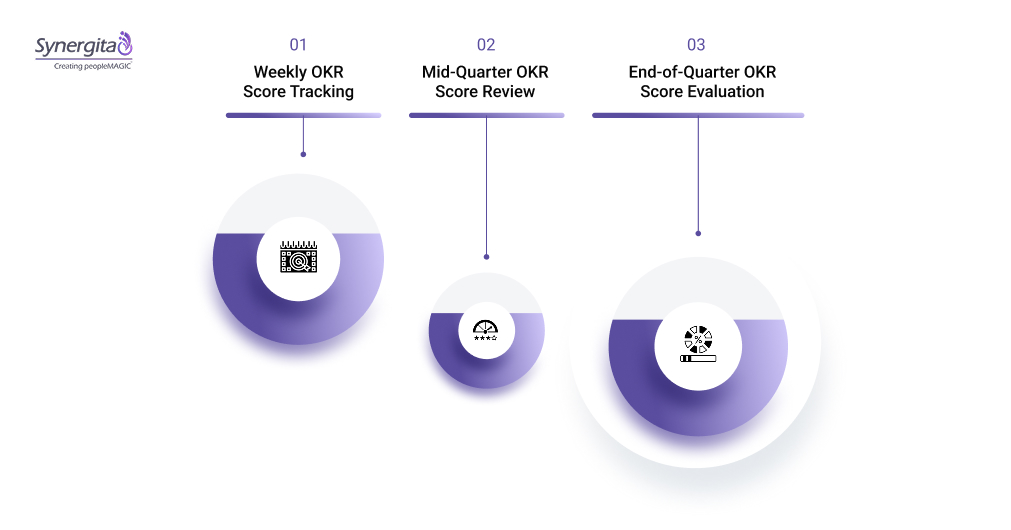
1. Weekly OKR Score Tracking
Weekly OKR score tracking focuses on momentum, helping you spot stalled key results before they become end-of-quarter surprises. Scores act as early signals, showing whether execution speed, ownership, or dependencies need immediate attention. At this stage, consistency matters more than precision, keeping teams aligned and accountable without overanalyzing small fluctuations.
2. Mid-Quarter OKR Score Review
Mid-quarter OKR scoring evaluates trajectory, helping you decide whether objectives remain realistic or require course correction. Scores highlight which key results need reprioritization, added support, or scope adjustment to protect final outcomes. This review prevents wasted effort by redirecting focus while enough time remains to influence results meaningfully.
3. End-of-Quarter OKR Score Evaluation
End-quarter OKR scoring assesses outcome quality, learning value, and execution discipline rather than perfection alone. Scores guide decisions on carry-forward objectives, resource allocation, and confidence in future goal-setting accuracy. This stage turns OKR scores into inputs for planning, coaching, and improving the next cycle’s strategic alignment.
Tracking cadence shows progress patterns, but interpretation is what turns scores into real decisions.
How Do OKR Scores Translate Into Leadership Decisions?
What does a 0.4 actually mean for your team’s roadmap? OKR scores are designed to be a ‘health check’ for your strategy. Instead of debating the math, use these ranges to trigger the right leadership conversations at the right time:
| OKR Score Range | What the Score Indicates | Decisions It Should Trigger |
|---|---|---|
| 0.0 – 0.3 | Progress is significantly off track, with major execution gaps or unresolved dependencies affecting outcomes. | Reassess objective relevance, remove blockers urgently, or pause the OKR to prevent wasted effort. |
| 0.4 – 0.6 | Partial progress shows effort, but execution speed or strategy is insufficient to reach desired outcomes. | Reprioritize key results, adjust scope, or provide additional resources and leadership support. |
| 0.7 – 0.8 | Strong progress indicates healthy execution, realistic ambition, and effective ownership across teams. | Reinforce current approach, capture best practices, and maintain momentum through consistent tracking. |
| 0.9 – 1.0 | Goals were fully achieved, often suggesting targets may have been too conservative. | Increase ambition next cycle and challenge teams to focus on more outcome-driven key results. |
Also read: Best OKR Software for Small Businesses 2026: Top Tools to Achieve Goals Faster
Even with clear interpretation, scoring can fail if common mistakes creep into the process.
Common OKR Scoring Mistakes That Undermine Results
Scoring OKRs is easy; scoring them honestly is where most teams struggle. When the scoring process breaks down, data turns into noise, and reviews turn into routine meetings with no real outcomes. Avoid these common mistakes that quietly turn OKR programs into spreadsheet rituals instead of decision-making tools:
- Scoring activities instead of outcomes shifts focus to effort, masking whether key results actually delivered business impact.
- Waiting until quarter-end to score OKRs removes the opportunity to course-correct early and recover slipping objectives.
- Treating a 1.0 score as the goal every time encourages safe targets and discourages ambition or meaningful stretch.
- Ignoring context behind the score leads to poor decisions when risks, dependencies, or external factors remain undocumented.
- Using different scoring logic across teams creates confusion, weakens alignment, and makes cross-team comparisons unreliable.
- Overweighting every key result equally hides which outcomes truly mattered most to achieving the objective.
- Using OKR scores for performance ratings discourages honesty and inflates numbers to avoid negative individual consequences.
Avoiding mistakes is easier when you see how proper scoring plays out in a real scenario.
Real-World Example: How OKR Scores Drive Better Outcomes
This example shows how structured OKR scoring turns routine updates into clearer decisions and stronger execution outcomes.
Here’s a simple scenario that illustrates how scoring changes behavior and results across a quarter:
- Objective: Improve customer onboarding completion for a SaaS product within one quarter.
- Key Result 1: Increase onboarding completion rate from 62% to 80% by quarter end.
- Key Result 2: Reduce the average onboarding time from five days to three days.
During weekly tracking, Key Result 1 scored 0.45, signaling stalled progress despite consistent activity. Mid-quarter scoring revealed dependencies on product changes, prompting leadership to reallocate engineering support immediately. By quarter end, the objective scored 0.72, reflecting improved outcomes and informed adjustments driven by timely OKR scoring.
Examples show impact, but consistency over multiple quarters is what builds lasting discipline
How to Use Your OKR Scoring Template Quarter After Quarter
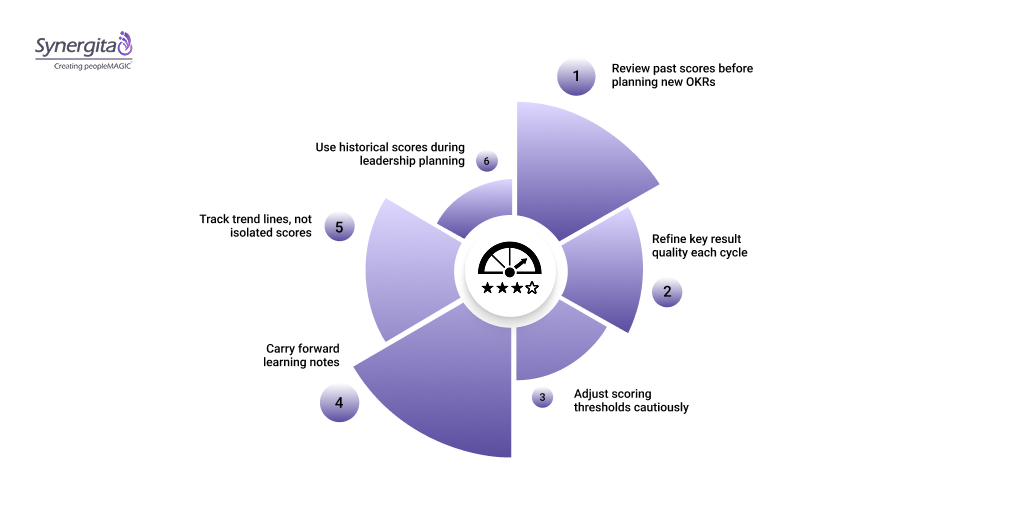
Using the same OKR scoring template every quarter builds consistency, improves judgment, and strengthens goal-setting discipline over time.
Here’s how to reuse your OKR scoring template effectively across multiple quarters without losing relevance or clarity:
- Review past scores before planning new OKRs to identify patterns in ambition, execution gaps, and recurring dependencies.
- Refine key result quality each cycle by replacing activity-based metrics with clearer, outcome-driven measurements.
- Adjust scoring thresholds cautiously to maintain comparability while reflecting changes in business complexity or maturity.
- Carry forward learning notes intentionally so teams apply insights instead of repeating the same execution mistakes.
- Track trend lines, not isolated scores, to understand whether performance is improving, stagnating, or declining over time.
- Use historical scores during leadership planning to set realistic ambition levels and allocate resources more confidently.
Also read: OKR Analytics Mastery: Turbocharging Company Growth with Synergita
At scale, manual tracking becomes harder, which is where purpose-built tools start to matter.

Make OKR Scoring & Tracking Easier with Synergita
When manual scoring and spreadsheet tracking slow you down or cloud your insights, Synergita brings clarity, automation, and context to every step of the OKR process.
Here’s how Synergita helps you score and track OKRs more effectively:
- Real-Time OKR Dashboards let you view objective and key result scores instantly, making weekly and mid-quarter check-ins faster and more data-driven rather than guesswork.
- Pre-Configured OKR Templates embed scoring logic (e.g., percentage or 0.0–1.0 systems) into your process from day one, reducing ambiguity and manual setup.
- Automated Progress Sync via Jira Integration captures real work activity against key results, translating it into measurable progress to improve score accuracy.
- Slack & Microsoft Teams OKR Notifications remind teams to update scores on schedule and nudge action when key results fall behind trend lines.
- Confidence Indicators and Risk Flags add context to numeric scores, helping you understand why a result is trending up or down during mid-cycle reviews.
- Custom Review Workflows and Comment Logs allow teams to document decisions tied to scores, turning numbers into historical insights you can learn from next quarter.
With Synergita’s scoring and tracking capabilities, you spend less time reconciling data and more time turning OKR scores into confident decisions.
Wrapping Up
Clear OKR scoring turns progress updates into decisions, helping teams focus faster, course-correct earlier, and execute with confidence. Using a consistent OKR scoring template quarter after quarter builds alignment, transparency, and trust across leadership and teams. Synergita supports this by automating OKR scoring, tracking progress in real time, and adding context that spreadsheets cannot provide.
Book a demo to see how Synergita helps you score and track OKRs accurately, consistently, and without manual overhead.
FAQs
1. What is an OKR scoring template, and why do teams use it?
An OKR scoring template standardizes how you rate progress toward key results using consistent scoring scales, so reviews become objective and actionable.
2. How often should OKR scores be updated during a cycle?
Best practice is to update OKR scores weekly or during regular check-ins so you can spot execution gaps early and adjust priorities.
3. What scoring scale should I use for OKRs?
Common scoring scales include 0.0–1.0, percentage progress, and confidence levels. Choose the one that best reflects your team’s outcomes and review needs.
4. Can I score objectives differently from key results?
Objectives themselves are not scored directly; instead, you average key result scores to generate an objective score that reflects outcome achievement.
5. How do I interpret low OKR scores constructively?
Low scores signal a need to reassess key result definitions, dependencies, or execution plans so teams can adjust strategies before the next review.