
Your teams stay busy. Projects move forward. Meetings fill the calendar. Yet results still fall short. The issue isn’t effort, it’s direction. Many teams execute tasks efficiently without a shared understanding of what success actually looks like. This gap is widespread.
Gallup research shows that only 21% of employees strongly agree they understand their organization’s goals and strategy, which explains why activity often fails to turn into real outcomes. When priorities aren’t clear, teams focus on what’s urgent instead of what truly matters.
This is why leaders ask what is the purpose of OKRs is when goals already exist. OKRs bring focus, alignment, and early visibility into progress. Without them, teams work hard in different directions and discover misalignment only when it’s too late.
Key Takeaways
- The purpose of OKRs is alignment and focus: OKRs help teams prioritize outcomes that matter instead of tracking disconnected activities.
- Teams fail without OKRs due to poor visibility: Competing priorities, late reviews, and unclear ownership cause misalignment and missed results.
- Objectives and key results play distinct roles: Objectives set direction, while key results provide measurable proof of progress.
- Tasks don’t equal outcomes: OKRs connect daily work to business impact, closing the gap between effort and results.
- OKRs work best with regular reviews and the right system: Consistent check-ins and unified tools help teams stay aligned as they scale.
What Are OKRs?
OKRs focus on setting clear objectives and measurable outcomes that help teams align their daily work with long-term company goals, ensuring strategic progress toward key business priorities.
Typical structure:
- Objective: a clear statement of what the team aims to achieve within a set period.
- Key Results: 3–5 measurable outcomes that show whether the objective is being met.
For example:
- Objective: Improve customer satisfaction across digital channels.
- Key Results: Increase NPS from 45 to 60, reduce response time to under two hours, and achieve 90% resolution on first contact.
OKRs encourage focus and accountability. They are usually reviewed quarterly, allowing teams to realign quickly if goals drift or priorities shift.
Why Teams Fail Without OKRs?
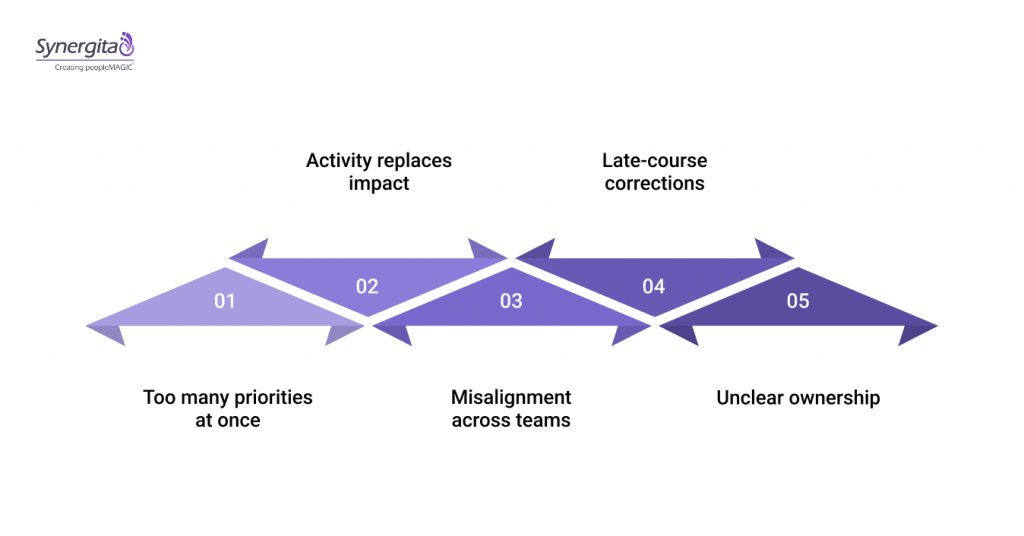
Teams rarely fail because they lack talent or effort. They fail because priorities compete, focus drifts, and progress stays invisible until it’s too late. Without OKRs, most teams operate on assumptions instead of shared direction.
Here’s what typically breaks down:
- Too many priorities at once: When everything feels important, teams spread effort thin and make little progress on what actually drives results.
- Activity replaces impact: Teams track tasks, meetings, and deliverables, but no one can clearly say whether those actions moved the needle.
- Misalignment across teams: Each department optimizes for its own goals, even when those goals pull the organization in different directions.
- Late-course corrections: Progress reviews happen at the end of the quarter, leaving no room to adjust when goals start slipping.
- Unclear ownership: When outcomes aren’t explicitly defined, accountability becomes vague, and results depend on individual interpretation.
Without OKRs, alignment relies on constant meetings and manager intuition. With OKRs, teams share a clear definition of success, see progress early, and course-correct before effort turns into wasted work.
Also Read: Top 10 OKR Software Features You Need for a Competitive Advantage
Objectives vs Key Results: Understanding the Key Differences
Many teams struggle with OKRs because objectives and key results get mixed up. When that happens, OKRs turn into task lists and lose their purpose. The table below shows the clear difference.
| Aspect | Objectives | Key Results |
|---|---|---|
| Purpose | Define what the team wants to achieve | Measure whether the objective is achieved |
| Nature | Qualitative and directional | Quantitative and measurable |
| Focus | Outcomes and impact | Evidence of progress |
| Format | Short, clear statements | Metrics, numbers, or thresholds |
| Timeframe | Set for a fixed period (often quarterly) | Tracked continuously during the period |
| Common mistake | Turning them into tasks | Listing activities instead of results |
In simple terms, objectives set the direction, while key results prove progress. Keeping this distinction clear ensures OKRs drive execution instead of becoming another planning document.
Tasks vs Outcomes: Where Most Teams Go Wrong
Most teams don’t struggle with execution. They struggle with mistaking activity for progress. For example, completing many tasks like meetings and reports might feel productive, but without linking these to outcomes such as increased sales or customer satisfaction, the true impact remains unclear.
Tasks describe what gets done. Outcomes describe what changes because the work was done. The gap between the two is where many teams lose focus.
| Tasks | Outcomes (OKRs) |
|---|---|
| Focus on activity | Focus on impact |
| Easy to complete | Harder but meaningful |
| Binary (done or not done) | Measurable progress over time |
| Useful for execution tracking | Essential for strategic alignment |
| Doesn’t show business value | Directly tied to results |
This is why task trackers alone don’t create alignment. Completing tickets, closing requests, or attending meetings doesn’t automatically move the organization forward.
OKRs connect daily work to outcomes, helping teams understand why their tasks matter and whether they’re actually driving results.
Types of OKRs Teams Actually Use
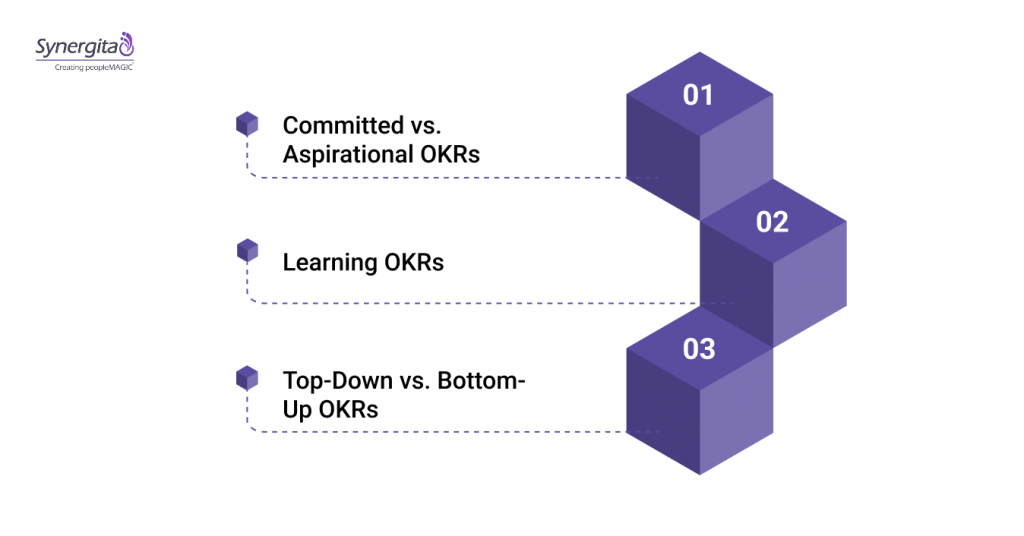
Not all OKRs serve the same purpose. Teams fail when they treat every objective the same, regardless of context or maturity. High-performing teams choose the right type of OKR based on what they’re trying to achieve.
Committed vs. Aspirational OKRs
- Committed OKRs represent must-achieve outcomes. Teams are expected to deliver these results within the set timeframe.
- Aspirational OKRs are stretch goals. They push teams beyond current capabilities and allow room for experimentation.
Using aspirational OKRs as commitments creates pressure and burnout. Treating committed OKRs casually leads to missed expectations. Clear separation prevents both.
Learning OKRs
Learning OKRs helps teams reduce uncertainty. They focus on gaining insights rather than hitting numeric targets.
These are useful when:
- Entering a new market
- Testing a new product or process
- Exploring customer behavior
Success here means learning quickly, not hitting a predefined metric.
Top-Down vs. Bottom-Up OKRs
- Top-down OKRs set strategic direction at the leadership level.
- Bottom-up OKRs allow teams to define how they contribute to that direction.
The strongest alignment happens when leaders define where the organization is headed, and teams decide how to get there.
How OKRs Align Teams at Every Level?
Alignment breaks when teams understand their own goals but not how those goals connect to the larger strategy. OKRs solve this by creating a clear line of sight between company priorities and individual effort.
At the top, leadership defines a small set of company-level OKRs that reflect strategic outcomes. These objectives set direction, not tasks. From there, teams create their own OKRs that directly support those priorities.
Here’s how alignment typically works:
- Company OKRs clarify what success looks like for the organization.
- Team OKRs translate strategy into department-level outcomes.
- Individual OKRs connect day-to-day work to measurable impact.
For example, if a company’s objective focuses on improving customer retention, a product team might own key results around feature adoption, while a support team tracks resolution quality and response time. Each team moves the same goal forward from a different angle.
This shared visibility changes how teams collaborate. Managers spot misalignment early, teams understand trade-offs better, and progress discussions focus on outcomes instead of opinions.
Benefits and Challenges of Using OKRs
OKRs create clarity and alignment, but only when they’re implemented correctly. When teams rush adoption or misunderstand the framework, the same system meant to improve focus can create friction.
The table below shows the real benefits, the common challenges, and practical solutions.
| Benefit | Common Challenge | Practical Solution |
|---|---|---|
| Clear priorities across teams | Too many objectives dilute focus | Limit to 3–5 objectives per level |
| Strong alignment to strategy | Teams don’t see how their work connects | Cascade OKRs from the company to the individual |
| Measurable progress | Key results track effort, not outcomes | Rewrite KRs to reflect impact, not activity |
| Early risk detection | Reviews happen too late | Introduce weekly or monthly check-ins |
| Higher accountability | Ownership is unclear | Assign a single owner to each OKR |
| Increased transparency | OKRs feel exposed or punitive | Separate OKRs from compensation and ratings |
| Better decision-making | Teams treat OKRs as static plans | Encourage mid-cycle adjustments |
Key takeaway: OKRs don’t fail because of the framework. They fail because teams skip the habits that make the framework work.
Writing Effective OKRs That Teams Actually Use
Well-written OKRs make the difference between alignment and confusion. Poorly written ones look fine on paper but get ignored in execution. Effective OKRs are clear, focused, and easy to review so teams actually use them in day-to-day decisions.
What Makes a Strong Objective
A strong objective sets direction without prescribing tasks. It should describe the outcome you want, not the work required to get there.
Strong objectives are:
- Clear and specific: Anyone should understand them without explanation.
- Outcome-oriented: They describe change or improvement, not effort.
- Ambitious but realistic: Stretching teams without setting them up to fail.
Weak objective:
“Improve marketing activities.”
Strong objective:
“Increase qualified inbound demand from mid-market customers.”
What Makes a Strong Key Result
Key results define how success will be measured. They remove ambiguity and replace opinions with data.
Effective key results are:
- Quantifiable: Numbers, percentages, or thresholds
- Time-bound: Tied to the OKR cycle
- Outcome-based: Measuring results, not tasks
Weak key result:
“Launch a new onboarding flow.”
Strong key result:
“Reduce time-to-first-value from 10 days to 5 days.”
When objectives set clear direction and key results prove progress, OKRs become a practical execution tool, not just another planning document.
Tracking and Reviewing OKRs Without Micromanagement
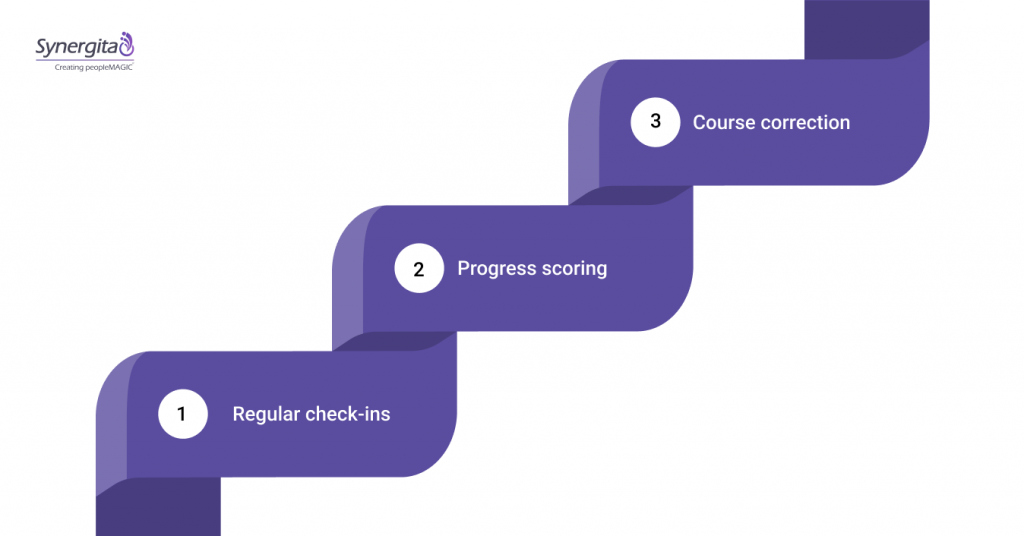
OKRs fail when teams treat them as quarterly documents instead of living priorities. The goal of tracking isn’t control, it’s early visibility.
Effective OKR tracking focuses on:
- Regular check-ins (weekly or biweekly) instead of end-of-quarter reviews
- Progress scoring that shows movement, not just completion
- Course correction when key results stall
When teams review OKRs consistently, problems surface early, and decisions improve. Without this rhythm, teams discover misalignment only after results are already missed.
How Synergita Helps Teams Make OKRs Work in Practice?
Understanding OKRs is one thing. Making them work consistently across teams is another. This is where execution usually breaks, visibility drops, reviews slip, and alignment fades as teams scale.
Synergita helps close that gap by turning OKRs into a system teams actually use, not just a quarterly exercise.
Here’s how it supports real-world OKR execution:
- Clear alignment across levels: Company, team, and individual OKRs stay connected, so everyone sees how their work contributes to larger goals.
- Ongoing progress visibility: Real-time dashboards replace manual updates, helping managers spot risks early instead of waiting for end-of-quarter reviews.
- Lightweight check-ins: Teams update progress without heavy admin work, keeping OKRs active throughout the cycle.
- Integrated execution signals: With integrations like Jira and collaboration tools, progress reflects actual work, not after-the-fact reporting.
- No disruption to existing workflows: Teams adopt OKRs without overhauling how they already plan, review, or collaborate.
The result is simple: less time managing goals, more time acting on them, and fewer surprises when it’s time to review outcomes.
Conclusion
Effective performance management depends on balance. OKRs provide direction, while KPIs maintain consistency. When both work together, teams stay focused on priorities and leaders gain a clear, reliable view of progress.
That balance is easier to sustain with a unified system. Synergita helps organizations set goals, track key metrics, and review outcomes in one place so accountability doesn’t get lost and growth stays measurable.
Explore how Synergita simplifies OKR and KPI management. Book a free demo to see how aligned goals turn into consistent results.
FAQs
1. What is the main purpose of OKRs?
The main purpose of OKRs is to align teams around clear priorities and measurable outcomes. They help organizations focus effort on what matters most and track progress before results drift off course.
2. How are OKRs different from KPIs?
OKRs define where you want to go, while KPIs measure how consistently you’re performing. OKRs are outcome-driven and time-bound; KPIs are ongoing metrics that monitor operational health. Used together, they provide both direction and stability.
3. Are OKRs only useful for startups?
No. While startups popularized OKRs, they work equally well for growing and large organizations. Any team that struggles with alignment, prioritization, or visibility can benefit from OKRs.
4. How often should OKRs be reviewed?
Most teams set OKRs quarterly, with weekly or monthly check-ins. Regular reviews help teams spot risks early and adjust priorities before goals slip.
5. Can OKRs be used for individual performance?
Yes but carefully. OKRs should guide focus and development, not act as performance ratings. Separating OKRs from compensation helps maintain trust and encourages ambition.