
In many organizations, teams miss strategic goals not because of a lack of effort, but because their work isn’t clearly connected to organizational goals. When OKRs are misaligned, employees don’t understand the strategy, and execution becomes difficult. This is where most OKR execution problems begin.
Quick Summary:
- OKR alignment issues arise when team and individual goals lack a clear connection to organizational strategy, leaving teams busy without driving meaningful business outcomes.
- Poor alignment leads to wasted effort, conflicting priorities, low trust in OKRs, and execution that delivers outputs but not strategic impact.
- Common alignment problems include siloed OKRs, overly top-down objectives, activity-based key results, weak strategy-to-execution linkage, and lack of visibility across teams.
- Organizations can achieve strong alignment through shared objective setting, outcome-driven key results, regular check-ins, and transparent visibility across the organization.
Why do teams stay busy but still miss strategic goals?
It’s a problem most organizations face, stemming from employees not understanding the strategy they are meant to support. According to Leadership IQ, only about 15% of employees fully understand the rationale behind their organization’s strategy. This means most employees operate without clear direction.
Without that understanding, connecting strategic objectives and key results (OKRs) to daily work becomes difficult, leading to misalignment. So, how to address this?
In this blog, we will explore how to align OKRs effectively, from defining shared objectives to tracking real impact, to ensure your teams know what they are aiming for and how their efforts contribute to meaningful outcomes.
| Table of Contents 1. What is OKR Alignment Issue? 2. Why Does Poor OKR Alignment Influence Results? 3. What Are the Common OKR Alignment Issues Businesses Face? 4. 5 Ways to Solve OKR Alignment Problems Effectively 5. Final Takeaway 6. Frequently Asked Questions |
What is OKR Alignment Issue?
OKR alignment issues arise when team or individual goals lack a clear connection to organizational objectives, or when their work does not meaningfully contribute to the organization’s strategic goals.
Without alignment, teams may execute tasks in isolation but fail to move the organization’s priorities. Alignment ensures the efforts translate into measurable progress.
Why Does Poor OKR Alignment Influence Results?
When OKRs are not aligned across teams, execution may continue, but the team can’t achieve the desired results. Teams remain busy, yet there is no real progress toward strategic goals.
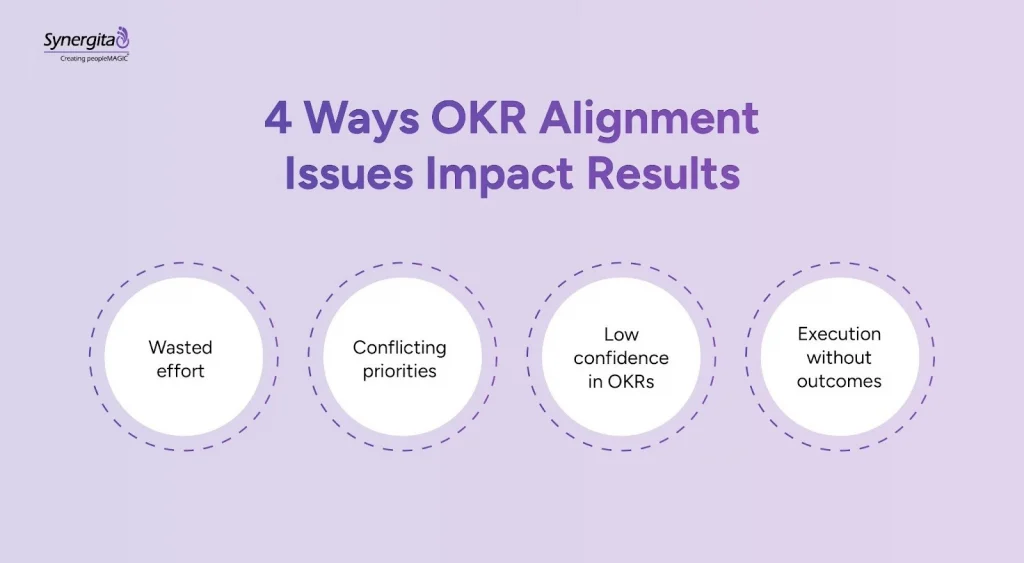
- Wasted effort: Teams invest time in work that looks productive but does not meaningfully contribute to the strategic objectives.
- Conflicting priorities: Goals set in isolation lead teams to optimize locally rather than move in the same direction.
- Low confidence in OKRs: OKRs feel disconnected from day-to-day work, eroding trust in the framework.
- Execution without outcomes: Tasks are completed, but the actual impact on business results remains unclear.
What Are the Common OKR Alignment Issues Businesses Face?
OKR alignment issues usually appear when teams begin execution. The team members look busy, but the progress feels stagnant. Here are the most common alignment problems organizations face as OKRs move from planning to execution.
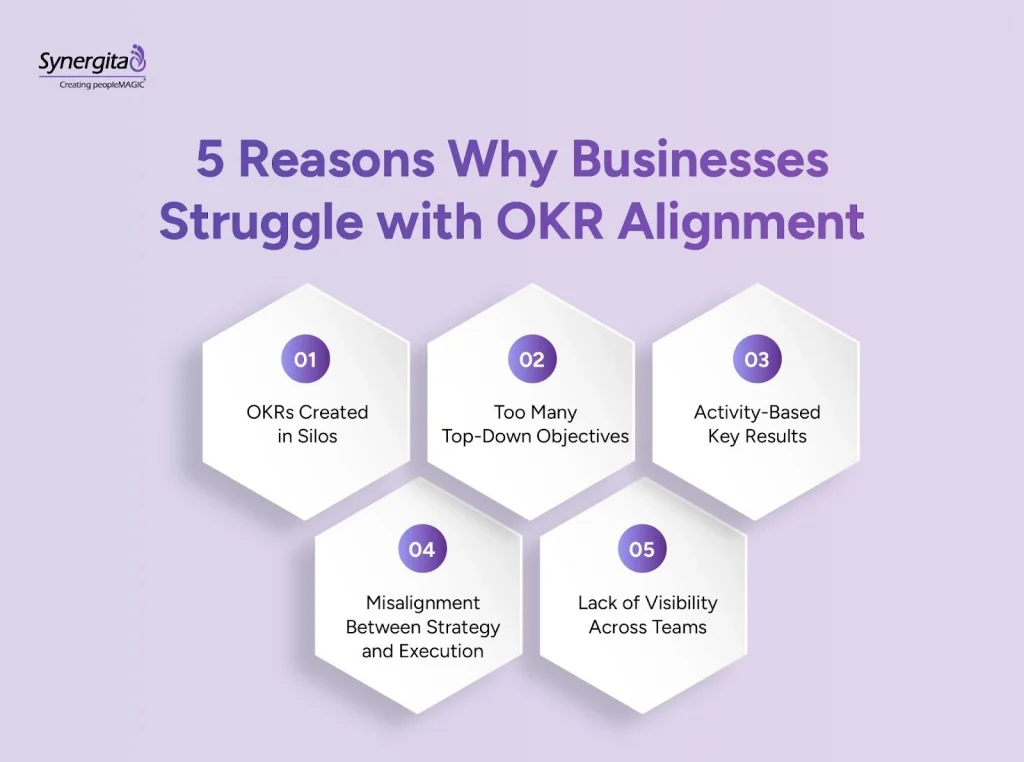
1. OKRs Created in Silos
In many organizations, teams set OKRs independently, often at different times and with limited context about broader priorities. The team’s goals may look good in isolation, but they don’t add up to a shared direction. This leads to duplicated effort and missed priorities.
Initiatives that move in different directions result in breaks in alignment, and it’s not because teams don’t care; it’s because they lack a clear understanding of how their OKRs contribute to the bigger picture.
Suggested Reading: How to Align Employee OKRs with Company OKRs
2. Too Many Top-Down Objectives
Top-down direction is necessary when creating objectives, but problems start when objectives are pushed down to the team and individual without their involvement. When you push a long list of predefined objectives, OKRs feel like assigned tasks rather than shared commitments.
This results in:
- Low ownership, because teams don’t feel responsible for defining success
- Poor engagement, as objectives feel imposed rather than meaningful
That’s why understanding OKR cascading vs alignment is so important, as it gives an idea which approach works better for your organization.
3. Activity-Based Key Results
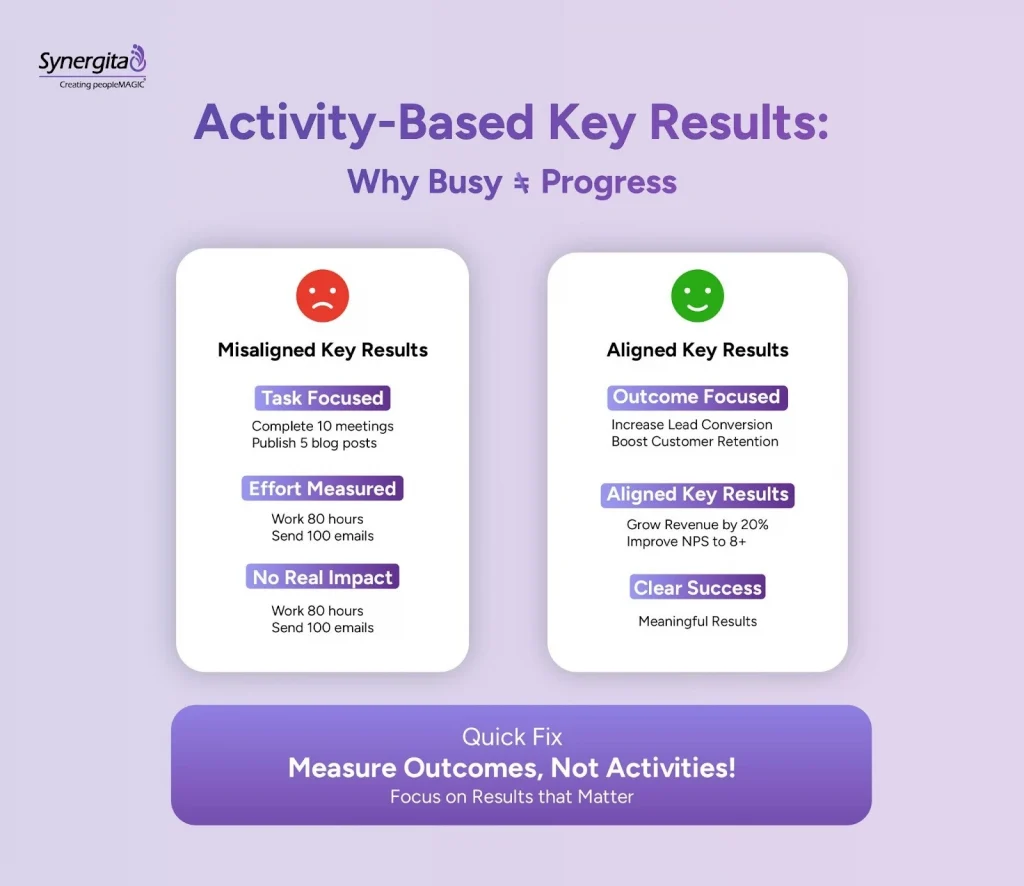
One of the most common OKR alignment issues is confusing activity with progress. When key results don’t clearly define success, teams may hit all their “targets” without actually moving the organization closer to its objectives.
This creates two problems:
- Outputs vs outcomes are blurred, making it hard to assess real impact
- Measurement confusion, where progress is tracked through task completion rather than business results
4. Misalignment Between Strategy and Execution
Leadership may set clear strategic priorities, but those priorities don’t always translate into meaningful team-level goals. The gap appears when teams struggle to map abstract objectives to concrete outcomes they can influence.
As a result:
- Leadership priorities stay at a high level
- Team OKRs focus on operational work with weak strategic linkage
This disconnect makes OKRs feel theoretical and limits their ability to guide day-to-day decision-making.
5. Lack of Visibility Across Teams
Can you maintain alignment between teams when one team can’t see what others are working on? When teams manage OKRs with disconnected documents or spreadsheets rather than structured OKR software, it affects progress tracking and makes it difficult to understand cross-team dependencies and overlapping priorities.
Without real-time alignment tracking:
- Conflicting priorities remain unnoticed
- Teams discover misalignment only when deadlines slip or results are not achieved
5 Ways to Solve OKR Alignment Problems Effectively
Fixing OKR alignment issues requires a structured approach. The following best practices help businesses align OKRs without slowing execution.
1. Align Objectives Before Cascading
OKR alignment problems usually arise when leadership teams begin writing key results before agreeing on the objective. Using collaborative workshops during the planning phase helps identify dependencies between teams and ensure they are moving in the same direction.
Before cascading anything, leadership and teams should align on:
- What success looks like at the company or business-unit level
- Which outcomes truly matter this cycle
- What trade-offs are acceptable, and what is explicitly out of scope
2. Balance Direction with Team Autonomy
OKR alignment breaks when goals are imposed from the top or are completely disconnected across teams. Effective alignment is the key to addressing these issues.
Leadership should clearly define the direction by setting:
- Strategic intent
- Priority outcomes
- Constraints and guardrails
Teams, on the other hand, should own how those outcomes are achieved. This includes choosing the key results they can directly influence. This balance ensures OKRs are aligned and not imposed on the team.
3. Use Outcome-Driven Key Results
One of the most effective ways to improve OKR alignment is to focus key results on outcomes rather than activities. Outcome-based OKR tracking helps you determine whether a team’s work is advancing the objective or simply consuming time. For example:
Misaligned key results often:
- Describe tasks or deliverables
- Track effort instead of impact
- Create confusion about success
Aligned key results:
- Measure change, not activity
- Reflect on business or customer impact
- Make progress easy to evaluate
4. Implement Regular Alignment Check-Ins
OKR Alignment is not a one-time activity during planning; rather, it should be an ongoing process. A brief weekly or biweekly check-in is essential for effective OKR tracking. It helps teams:
- Review movement on key results
- Surface blockers early
- Adjust priorities before misalignment grows
These reviews should focus on learning and course correction, not on reporting or justification.
5. Make Alignment Visible Across the Organization
Another essential step to improve OKR alignment is to ensure that progress is visible to everyone, not just a few. Shared dashboards and progress views help leaders and teams see how efforts contribute to broader goals, where gaps exist, and support is needed. This visibility reduces ambiguity and keeps everyone focused on the same outcomes.
Suggested Reading: Examples of OKR Dashboard for Goal Tracking
Final Takeaway
Leadership can improve OKR alignment by setting clear objectives, measuring real outcomes, and reviewing progress consistently during execution. When teams understand how their work supports broader priorities, OKRs become a part of everyday work rather than something reviewed only during planning.
However, to ensure OKRs are aligned across teams, you need the right system in place to connect objectives, track outcomes, and maintain visibility across the organization. If you are looking to solve OKR alignment issues and drive better results, explore how Synergita OKR software can support your teams in creating and executing aligned OKRs effectively. Start your free trial today.

Frequently Asked Questions
Yes, even strong OKRs may fail if they are not reviewed regularly. It may lack visibility across teams or be disconnected from execution and decision-making during the cycle.
Aligned OKRs focus on shared outcomes across teams, while cascaded OKRs often involve pushing goals from leadership to teams and individuals. Alignment emphasizes collaboration and context rather than hierarchy.
Yes, when teams can see how their OKRs connect to others, it clarifies dependencies and encourages joint ownership of outcomes.
Synergita connects company, team, and individual OKRs in one system, making it easier to see how goals relate and where alignment gaps exist during execution.
Synergita offers shared dashboards that allow leaders and teams to track OKRs across functions, making dependencies, overlaps, and alignment issues visible early.
Yes, Synergita provides clarity, structure, and guidance that helps teams learn proper OKR execution from the first cycle.