
Account managers frequently measure success by the absence of churn, not the presence of growth. This mindset locks you into a defensive posture, where maintaining the status quo becomes the primary goal.
The result is missed expansion potential and a failure to leverage your best accounts as strategic partners for advocacy and revenue. This defensive posture stems from a lack of strategic focus, leaving your team to prioritize urgent, low-impact tasks over long-term value creation.
Without a clear method to prioritize strategic initiatives, your team’s potential as a core revenue engine remains untapped.
This guide provides a strategic framework to change that dynamic. Using the OKR for account managers methodology, we outline twenty specific examples to shift your team from risk mitigation to proactive revenue growth and strategic influence.
Key Takeaways
- Expansion Over Maintenance: Shift the focus from simple renewals to measurable upsell and cross-sell metrics that drive net revenue retention.
- Executive Presence: Use OKRs to track the depth of relationships with C-suite stakeholders rather than just daily operational contacts.
- Adoption Analytics: Focus on “feature depth” as a key result to ensure customers are fully integrated into your product ecosystem.
- Commercial Efficiency: Reduce the cost of retention by automating renewal workflows and standardizing account planning rhythms across the team.
- The Aspiration Link: Align individual career goals with account growth to improve talent retention within your sales organization.
- AI-Driven Insights: Utilize sentiment analysis to identify “at-risk” accounts before they reach the critical renewal window.
Importance of OKRs for Account Managers
Traditional sales metrics often fail to capture the nuance of long-term relationship building and strategic account health. By adopting a formal framework, you provide your team with the “why” behind their daily interactions and quarterly plans.
This clarity is essential for maintaining consistency across a global team where account complexity varies significantly by region or tier.
Implementing this system provides several high-level advantages for your commercial organization:
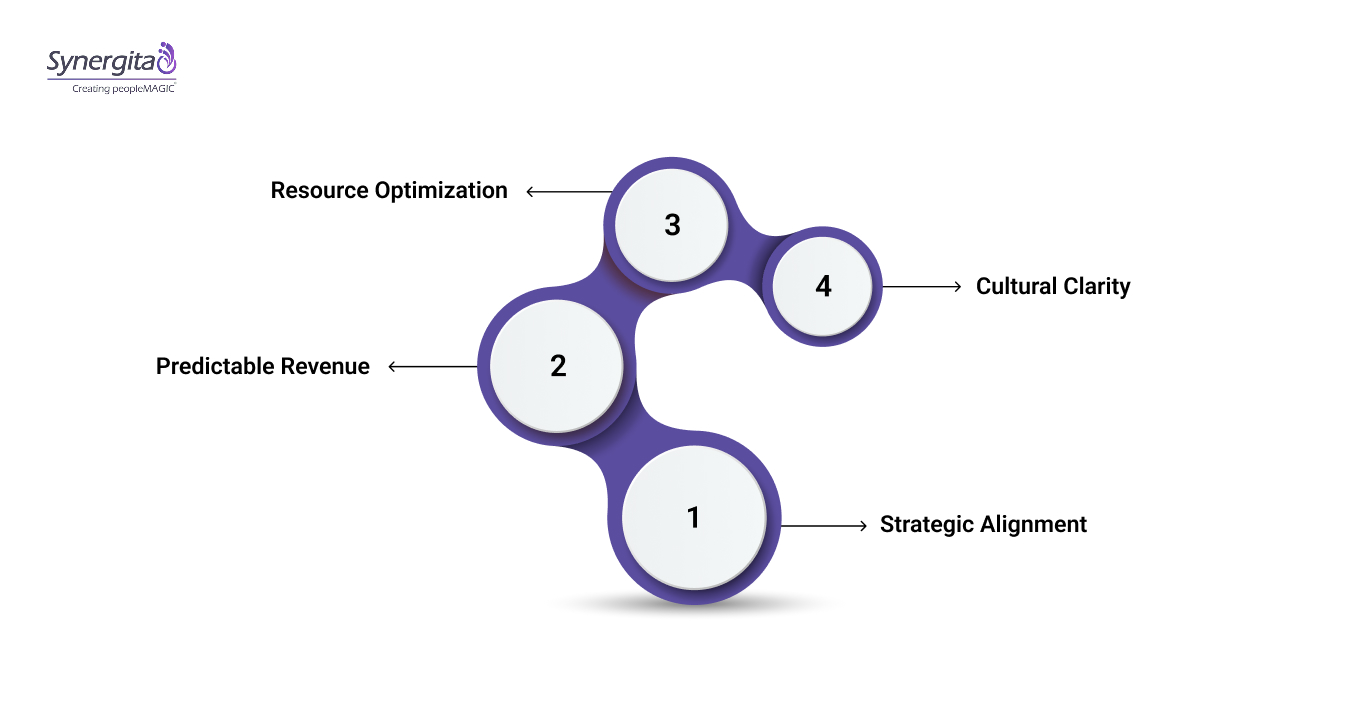
- Strategic Alignment: Connects individual account activities directly to the company’s overarching gross revenue retention and expansion goals.
- Predictable Revenue: Provides lead indicators like “product adoption scores” that offer a more accurate forecast than lagging renewal dates.
- Resource Optimization: Directs team energy toward high-value strategic accounts while automating the administration of lower-tier, high-volume customers.
- Cultural Clarity: Establishes a transparent standard for what constitutes a “high performer” beyond just hitting a static quota.
Moving from general importance to specific execution requires a framework that categorizes different types of account value.
Stop manual administrative tasks and automate your 2026 expansion cycles with Synergita. Book your demo today to see how our modular platform drives real talent growth and organizational alignment.
Also read:How to Make Better Strategic Decisions in 2025: Process, Tools & Examples
3 Core Account Manager Objective Categories
A balanced strategy ensures that your team does not sacrifice long-term relationship health for short-term commercial wins. You must categorize your objectives to cover the full spectrum of account management, from basic retention to high-level strategic influence.
This categorization helps managers identify where an individual might be underperforming in their specific book of business.
Focus your team’s efforts across these three critical pillars:
Category 1: Customer Success & Expansion
This category focuses on the measurable growth of an account’s financial footprint and the health of the partnership. It moves the needle on Net Revenue Retention (NRR) by identifying new use cases and increasing user seats.
Objectives here ensure that the customer is receiving maximum value from their current investment while exploring new modules.
Category 2: Strategic Partnership & Influence
These objectives track the “intangible” value of a relationship, such as executive alignment and brand referenceability. High-performing account managers use this framework to move from a “vendor” status to a “trusted advisor” role.
Success is measured by the frequency of C-level engagements and the willingness of the client to participate in case studies.
Category 3: Commercial Excellence & Efficiency
This pillar deals with the internal operations that make a team productive and the forecasting data accurate. It ensures that account plans are not just documents but active roadmaps that drive quarterly progress.
Objectives in this category often focus on reducing the “time to renewal” and improving the accuracy of expansion pipelines.
A strong framework is only effective if your team knows how to translate these categories into actionable goals.
Steps to Write Effective OKRs for Account Managers
Writing effective goals requires a deep understanding of the distinction between qualitative aspirations and quantitative yardsticks. Your objectives should provide the inspirational “what,” while your key results must provide the measurable “how” for every account.
This dual approach ensures your team stays inspired while remaining anchored to the reality of their current client bandwidth. Follow these specific steps to build high-impact goals for your team:
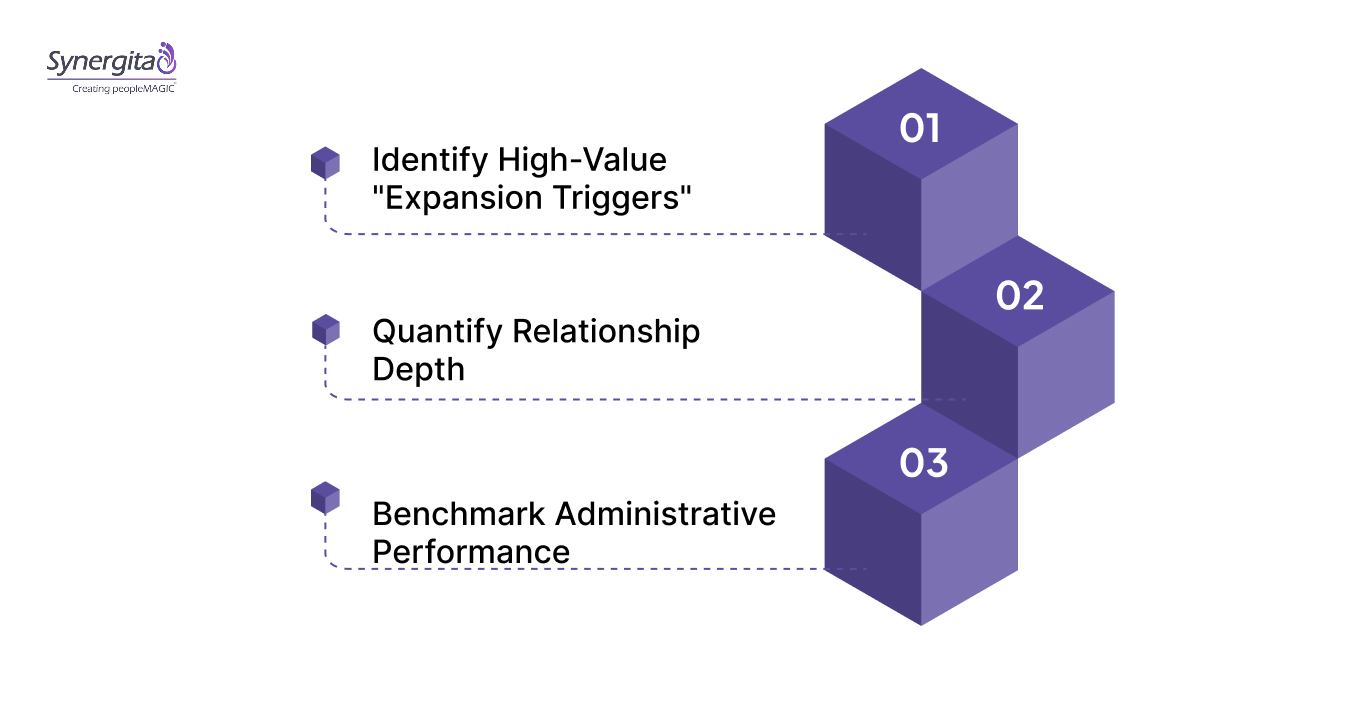
1. Identify High-Value “Expansion Triggers”
- Analyze historical data to find common milestones that lead to successful upsells or cross-sells.
- Set objectives that push account managers to reach these milestones within a specific quarter.
- Ensure key results are linked to “product usage depth” rather than just a subjective “customer happiness.”
2. Quantify Relationship Depth
- Move beyond counting “number of meetings” to measuring the seniority of the stakeholders involved.
- Set key results that require the addition of new departments or business units to the platform.
- Track the conversion of passive users into active brand advocates who provide public testimonials.
3. Benchmark Administrative Performance
- Define what a “perfect” account plan looks like and set completion targets for the entire book.
- Monitor the “health score” of accounts to ensure that no client is ignored due to high-volume workloads.
- Link operational efficiency to the reduction of churn risks through proactive, data-backed check-ins.
Translating these steps into daily reality is easier when you have a library of proven examples to reference.
Also read:Are You Tracking the Right Metrics for Employee Retention in 2025?
20 Actionable OKRs for Account Managers
Successful implementation depends on providing your team with concrete examples that they can adapt to their specific territory. The following tables provide a comprehensive playbook for setting objectives that cover every stage of the account lifecycle.
Use these examples to move away from vague qualitative goals toward precise, data-driven targets:
Category 1: Customer Success & Expansion
| Objective 1 | Key Results |
| Drive significant net revenue growth through account expansion | 1. Generate $250k in new upsell revenue from the Tier 1 cohort. |
| 2. Identify 5 cross-sell opportunities for the new AI module. | |
| 3. Increase average account seat count by 15% across all accounts. |
| Objective 2 | Key Results |
| Secure long-term commitment through proactive renewals | 1. Complete 100% of renewals scheduled for the quarter by Day 60. |
| 2. Convert 30% of annual contracts into multi-year agreements. | |
| 3. Maintain a Gross Revenue Retention (GRR) rate of 98%. |
| Objective 3 | Key Results |
| Maximize product utility through deep feature adoption | 1. Increase the usage of “Advanced Analytics” from 20% to 50%. |
| 2. Conduct 10 deep-dive training sessions for power users. | |
| 3. Achieve a 90% “Health Score” for the top 20 accounts. |
| Objective 4 | Key Results |
| Eliminate churn risks through early intervention | 1. Identify and create save plans for 100% of “at-risk” accounts. |
| 2. Reduce the number of accounts with zero activity for 30 days to 0. | |
| 3. Achieve a 10% improvement in the “Product Stickiness” ratio. |
Also read:How to Develop an Effective HR Strategy Framework
| Objective 5 | Key Results |
| Scale the success of the mid-market segment | 1. Increase average contract value (ACV) for mid-market by 20%. |
| 2. Launch a semi-automated “Success Webinar” with 100+ attendees. | |
| 3. Achieve a 4.5/5 satisfaction rating in mid-market surveys. |
| Objective 6 | Key Results |
| Accelerate time-to-value for newly onboarded clients | 1. Reduce the average onboarding time from 60 days to 45 days. |
| 2. Ensure 100% of new clients reach “First Value” within 14 days. | |
| 3. Conduct 30-day post-onboarding reviews for 100% of new accounts. |
Category 2: Strategic Partnership & Influence
| Objective 7 | Key Results |
| Elevate relationship status to a trusted executive advisor | 1. Secure quarterly business reviews (QBRs) with 5 C-level execs. |
| 2. Establish a “Customer Advisory Board” with 3 key stakeholders. | |
| 3. Increase executive “touchpoints” per account from 1 to 3. |
| Objective 8 | Key Results |
| Convert customer satisfaction into measurable advocacy | 1. Secure 3 new video case studies from enterprise clients. |
| 2. Generate 5 qualified referrals from the current account base. | |
| 3. Achieve 10 verified reviews on G2 or Capterra. |
| Objective 9 | Key Results |
| Expand the organizational footprint of the product | 1. Implement the product in 2 new departments of a Tier 1 client. |
| 2. Increase the number of “Internal Champions” per account to 4. | |
| 3. Conduct 3 “Lunch and Learn” sessions for non-user departments. |
| Objective 10 | Key Results |
| Align product roadmap with strategic client needs | 1. Submit 5 high-impact feature requests based on client feedback. |
| 2. Participate in 3 beta-testing cycles with key account partners. | |
| 3. Facilitate a 1:1 roadmap session between Product and a Top 5 client. |
| Objective 11 | Key Results |
| Become the industry benchmark for customer NPS | 1. Increase the overall Account Manager NPS from 60 to 80. |
| 2. Achieve a 100% survey response rate for the Top 50 accounts. | |
| 3. Close the feedback loop on 100% of “Detractor” responses. |
Also read:Best Tools for OKR Management and Visualization
| Objective 12 | Key Results |
| Drive brand loyalty through exclusive engagement | 1. Invite and secure 10 VIP clients for the annual summit. |
| 2. Conduct 5 personalized “Innovation Workshops” for top accounts. | |
| 3. Send 100% of personalized “Impact Reports” to key stakeholders. |
Category 3: Commercial Excellence & Efficiency
| Objective 13 | Key Results |
| Achieve 100% forecast accuracy and pipeline health | 1. Maintain a variance of less than 5% on quarterly forecasts. |
| 2. Ensure 100% of renewal opportunities have up-to-date close dates. | |
| 3. Scrub the expansion pipeline weekly to remove “stale” deals. |
| Objective 14 | Key Results |
| Standardize and execute elite account planning | 1. Complete comprehensive account plans for 100% of the book. |
| 2. Conduct 5 internal “Account Strategy Peer Reviews.” | |
| 3. Update 100% of “Competitive Threat” maps in the CRM. |
| Objective 15 | Key Results |
| Optimize the commercial contract lifecycle | 1. Reduce the “Legal Review” turnaround time by 20%. |
| 2. Implement 3 new “standardized” expansion contract templates. | |
| 3. Achieve 100% accuracy on initial billing and invoice setups. |
| Objective 16 | Key Results |
| Improve internal cross-functional collaboration | 1. Conduct 10 collaborative sessions with the Sales Engineering team. |
| 2. Launch a monthly “Account Insights” newsletter for the Product team. | |
| 3. Reduce average response time for “Support Escalations” by 30%. |
| Objective 17 | Key Results |
| Enhance the data integrity of the account base | 1. Reach 100% completion for all “Executive Persona” CRM fields. |
| 2. Audit and update 100% of “Contract End Dates” in the system. | |
| 3. Link 100% of expansion deals to specific “Client Pain Points.” |
| Objective 18 | Key Results |
| Master advanced negotiation and commercial skills | 1. Complete the “Value-Based Negotiation” internal certification. |
| 2. Role-play 3 “Difficult Renewal” scenarios with the VP of Sales. | |
| 3. Reduce the average discount rate for expansion deals by 5%. |
| Objective 19 | Key Results |
| Scale impact through proactive time management | 1. Automate 100% of monthly usage reporting for Tier 2 accounts. |
| 2. Reduce “Internal Meeting Hours” by 15% through async updates. | |
| 3. Reallocate 5 hours weekly to proactive high-value account outreach. |
| Objective 20 | Key Results |
| Drive organizational learning through client win-loss analysis | 1. Conduct 5 formal “Win-Loss” reviews for major expansion deals. |
| 2. Share 3 “Account Turnaround” case studies with the wider team. | |
| 3. Identify 2 key product gaps causing churn in the SMB segment. |
Understanding these goals is the first step toward building a high-performance culture.
Common Mistakes and How to Avoid Them
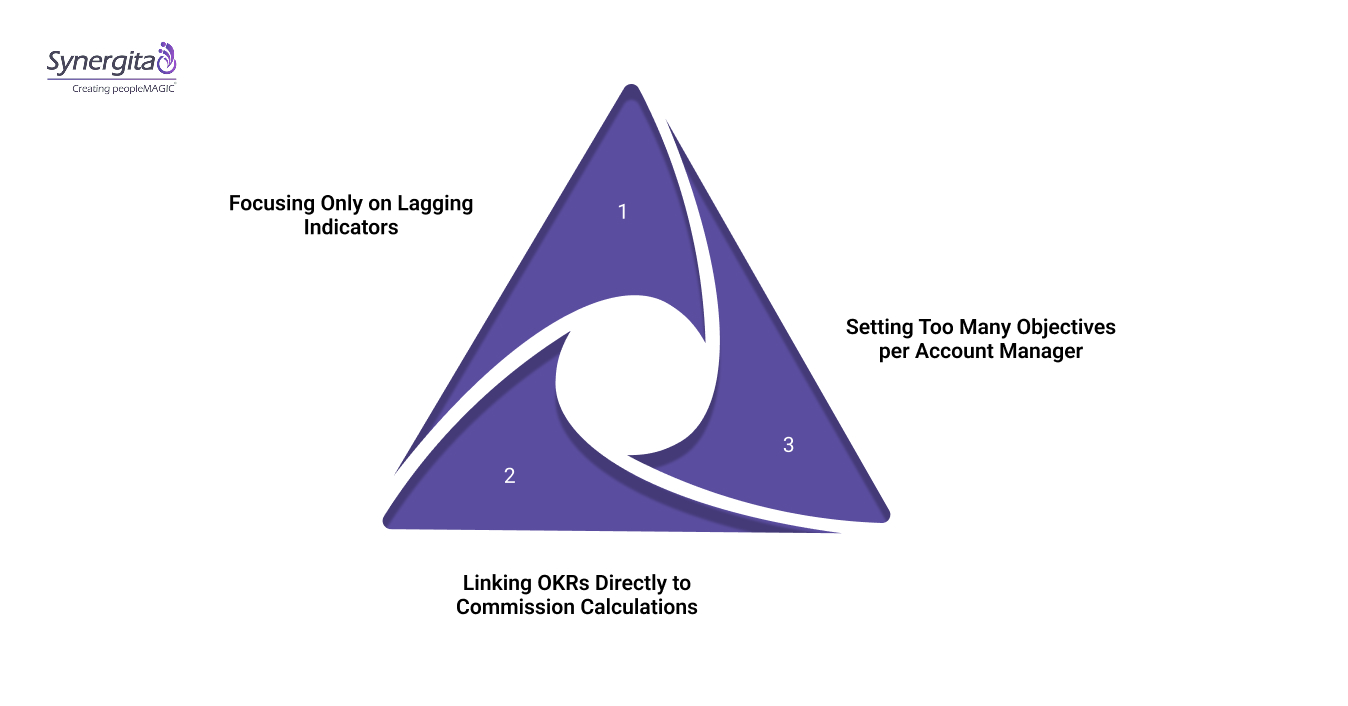
Implementing a new framework often reveals deep-seated cultural habits that can sabotage your progress if they are not addressed. Many organizations treat these goals as a static document rather than a dynamic management tool that informs daily decisions.
Recognizing these common pitfalls early allows you to build a more resilient and transparent organizational culture. Avoid these strategic errors to ensure your efforts lead to actual revenue growth:
1. Focusing Only on Lagging Indicators
Many teams set OKRs that only track the final renewal or upsell dollar amount. This provides no visibility into the health of the relationship until it is too late to intervene.
How to avoid:
- Include lead indicators like “number of logins” or “executive touchpoints” in every goal set.
- Balance commercial targets with adoption and satisfaction metrics.
- Review progress bi-weekly to identify “stalled” indicators before the quarter ends.
2. Linking OKRs Directly to Commission Calculations
When goals are tied directly to an individual’s paycheck, they will only set safe, easily achievable targets. This “sandbagging” prevents the organization from identifying true growth opportunities or stretching the team’s capabilities.
How to avoid:
- Keep compensation tied to quotas while using OKRs for strategic alignment and growth.
- Frame missing a “stretch” goal as a learning opportunity rather than a financial failure.
- Encourage ambitious target-setting by celebrating high-effort progress.
3. Setting Too Many Objectives per Account Manager
Overloading an individual with ten different objectives leads to a lack of focus and mediocre results across the board. The team becomes reactive, jumping between targets without making significant progress on any single one.
How to avoid:
- Limit every account manager to a maximum of 3 Objectives per quarter.
- Ensure every Key Result is truly “key” to the account’s long-term health.
- Use the “3×3 Rule” to maintain strategic clarity and operational focus.
Correcting these mistakes sets the stage for adopting the advanced techniques used by elite commercial organizations.
Stop wasting hours on manual appraisal letters and fragmented goal tracking that fails to drive results.Book your demo with Synergita to see how our features can transform your talent strategy.
Also read:Essential OKR Dashboard Examples for Goal Tracking
Best Practices for Effective OKR Implementation
Sustaining a high-performance culture requires more than just a good template; it requires a commitment to radical transparency. Your goal-setting process must be visible across the entire organization to ensure that Sales, Product, and Support are all moving in the same direction.
This openness creates a sense of shared ownership that is vital for surviving the inevitable challenges of enterprise account management.
Consider these advanced strategies to refine your organizational performance:
1. Foster Cross-Functional Visibility
Share your account OKRs with the Product and Engineering teams to highlight where technical roadblocks are hindering expansion. When the whole company sees the “Product Stickiness” goals, they are more likely to prioritize the features that drive retention.
Impact:
- Reduces friction between departments by aligning them to the same customer success metrics.
- Speeds up the resolution of technical issues for high-value strategic accounts.
- Ensures that product development is driven by actual revenue-generating feedback.
2. Implement Bi-Weekly “Confidence Scoring”
Instead of just tracking a percentage, ask your account managers to rate their confidence in hitting a Key Result on a scale of 1-10. This subjective data point often reveals hidden risks that hard numbers might miss until the very end of the quarter.
Impact:
- Provides an “early warning system” for accounts that are trending toward churn.
- Encourages honest communication between managers and their direct reports.
- Allows leadership to reallocate resources to at-risk goals while there is still time to pivot.
3. Align Individual Aspirations with Account Goals
Use your performance platform to track the career goals of your account managers alongside their commercial targets. If a team member wants to move into leadership, give them OKRs that involve mentoring junior staff or leading a strategic initiative.
Impact:
- Improves talent retention by showing a clear path for professional growth within the company.
- Increases engagement by making the work feel personally meaningful to the employee.
- Builds a leadership pipeline of experienced account managers who understand the strategic mission.
Maintaining this level of discipline is significantly easier when you have the right technical infrastructure in place.
Synergita: From Reactive Management to Strategic Execution
Account managers often manage their goals in disconnected tools, spreadsheets for OKRs, CRM for pipeline, and email for updates. This fragmentation makes it impossible to see the real-time connection between daily activities and strategic outcomes. Leaders lack visibility, and AMs waste time reconciling data instead of acting on it.
Synergita solves this by integrating goal management directly into a unified talent and performance platform. It provides the single system needed to execute the AM OKR framework with clarity and accountability.
- Visual Goal Alignment & Hierarchy: Cascade company revenue goals to the AM team and individual portfolios. Use Synergita’s hierarchy tree to show how each AM’s OKRs contribute to overall retention and growth targets.
- Real-Time Progress Tracking & Analytics: Move beyond static spreadsheets. Synergita’s dashboards visually highlight goal trajectories, lead/lag status, and confidence scores, giving leaders instant insight into portfolio health.
- Integrated Performance & Feedback: Connect OKR achievement directly to continuous feedback, 360° reviews, and performance conversations in the Synergita Perform module. This closes the loop between results and development.
- Centralized Check-Ins & Reporting: Automate and standardize weekly OKR check-ins within the platform. Generate straightforward analytical reports that filter out vanity metrics and focus on business impact.
This integrated approach ensures your okr for account managers strategy is a living engine for growth, not an administrative exercise.
Also read:Effective OKR Examples for Teams and Businesses
Conclusion
OKRs provide the essential framework for transforming account managers from support staff into strategic growth partners. They create focus on outcomes, alignment with business goals, and a clear path for career advancement. The 20 examples and structured framework in this guide offer a complete blueprint for implementation.
A dedicated platform like Synergita is critical for executing this strategy at scale without administrative chaos. It turns strategic goals into visible, aligned daily actions for every account manager.
Book your demo today with Synergita to see how a unified platform can operationalize this transformation for your AM team.
FAQs
Q. What is a good OKR for an account manager?
A good AM OKR has a strategic Objective and measurable Key Results. Example: O: Become a strategic partner for our top enterprise accounts. KRs: 1) Secure an executive sponsor meeting at 8 target accounts. 2) Increase product adoption of Module X by 30% in these accounts. 3) Generate 2 new case studies from this group.
Q. How are OKRs different from KPIs for account managers?
KPIs are health metrics you monitor continuously (e.g., daily login rate, ticket volume). OKRs are a goal-setting framework to achieve specific, ambitious outcomes quarterly (e.g., “Increase Net Revenue Retention by 5%”). OKRs often use KPIs as components but focus on improving them.
Q. How often should account managers review their OKRs?
Formal OKR cycles are quarterly. However, AMs should review progress in brief weekly check-ins (15-30 minutes) to discuss blockers and adjust tactics. This keeps goals agile and connected to real-time account developments.
Q. Should OKRs be tied to an account manager’s compensation?
Best practice is to separate them. Tying compensation directly can incentivize sandbagging (setting easy goals). Use OKRs for development, coaching, and alignment. Base compensation on overall performance, which includes but is not limited to OKR achievement.
Q. What’s the biggest challenge when starting AM OKRs?
The biggest challenge is shifting from activity-tracking to outcome-thinking. AMs are conditioned to report on tasks completed. Coaching them to define the business result of those tasks is the critical first step for writing effective Key Results.