
E-commerce leaders are overwhelmed with data but starved of clarity. Your team chases dozens of metrics, traffic, conversion, and AOV, without a unified strategy. This scattered effort dilutes focus and leaves significant revenue hidden within your existing operations.
You need a framework that cuts through the noise and aligns every action with profit. Implementing strategic OKRs for E-commerce provides this focus, turning isolated metrics into a cohesive growth plan.
This guide delivers the specific objectives and key results that create a measurable advantage. You will discover 15 targeted OKR examples built on a proven funnel framework. These examples help you move from reactive reporting to proactive, profit-focused execution.
Quick Look
- Shift from vanity traffic metrics to “Contribution Margin per Order” to ensure sustainable and healthy business growth.
- Coordinate your marketing and merchandising efforts to ensure you drive traffic that your site can actually convert.
- Use quarterly cycles to adapt quickly to retail shifts, ensuring your goals remain relevant during peak shopping periods.
- Prioritize retention objectives to reduce your reliance on expensive and volatile paid acquisition channels.
- Link fulfillment and customer service efficiency directly to your brand’s Net Promoter Score and repeat purchase rates.
- Centralize your goal tracking to eliminate departmental silos and ensure everyone moves toward a unified revenue mission.
Importance of OKRs for E-commerce
The digital retail environment moves too fast for traditional annual planning cycles to remain effective. A structured goal-setting system provides the agility needed to pivot your strategy as consumer behavior and platform algorithms change.
This discipline ensures that your budget is always allocated to the initiatives that promise the highest return on investment.
Implementing a formal framework provides several critical advantages for competitive retail brands:
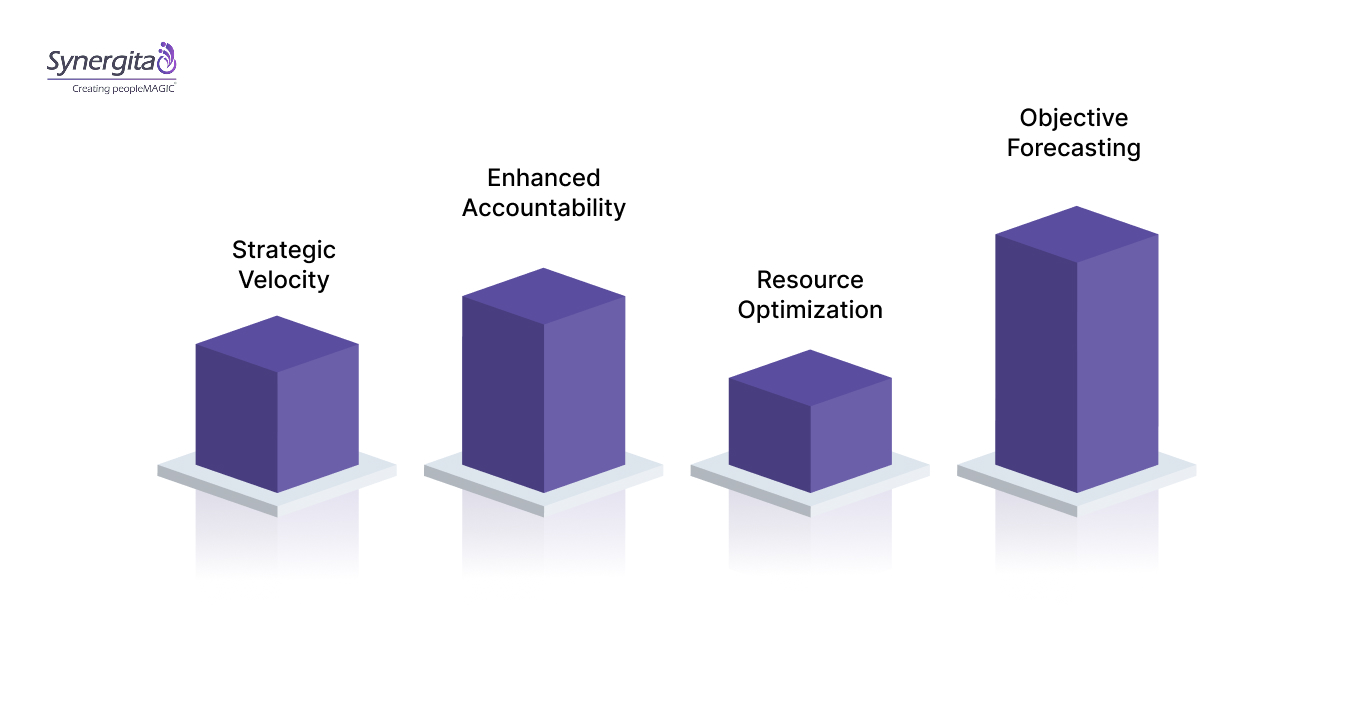
- Strategic Velocity: Short, ninety-day cycles allow your team to test new categories or channels without committing annual resources prematurely.
- Enhanced Accountability: Clearly defined key results eliminate confusion about which department owns specific outcomes like “cart abandonment” or “fulfillment speed.”
- Resource Optimization: Forcing teams to prioritize only the most impactful objectives prevents the “feature creep” that often slows down digital storefronts.
- Objective Forecasting: Using measurable data for goal setting provides a more accurate view of your future inventory and capital needs.
Stop manual administrative tasks and automate your 2026 promotion cycles with Synergita. Book your demo today to see how our modular platform drives real talent growth and organizational alignment.

Moving from high-level benefits to daily execution requires a framework that mirrors the customer journey.
4 Core E-commerce Objective Categories
A successful retail strategy depends on a balanced approach that covers every touchpoint of the consumer experience. You must categorize your objectives to ensure that you are not over-investing in acquisition while neglecting the operational backend.
This framework helps leadership identify where the “leaks” in the revenue funnel are currently occurring.
Category 1: Acquisition & Awareness
This category deals with the top of your funnel and focuses on bringing qualified traffic to your storefront. Objectives here measure the efficiency of your paid spend and the growth of your organic search presence.
Success is defined by reaching the right demographic at a sustainable cost that allows for healthy margins.
Category 2: Conversion & Monetization
These objectives focus on the on-site experience and the financial value of every visit. You track how well your product pages, search functionality, and checkout process turn browsers into paying customers.
This pillar is critical for maximizing the ROI of your acquisition efforts and increasing your average order value.
Category 3: Retention & Loyalty
The most profitable revenue comes from customers who return to your store without requiring additional paid ad spend. Objectives in this category focus on building long-term relationships through email marketing, loyalty programs, and subscription models.
You measure success by tracking repeat purchase rates and the growth of your customer lifetime value.
Category 4: Operational Excellence
This final pillar addresses the “final mile” of the E-commerce experience, from the warehouse to the customer’s doorstep. You focus on fulfillment speed, inventory accuracy, and the reduction of customer service inquiries through better self-service tools.
Operational excellence ensures that your growth does not outpace your ability to provide a high-quality experience.
A perfect framework is only effective if your team knows how to draft goals that are both ambitious and measurable.
Also read:The Secret to Hitting Bigger Goals Faster? Pairing OKRs with CFRs
How to Write E-commerce OKRs in 3 Simple Steps
Creating effective goals requires a deep understanding of the distinction between a metric and a strategic objective. Your objectives should describe a qualitative state of success, while your key results provide the numerical proof of that success.
Follow these steps to ensure your team remains focused on the outcomes that drive competitive advantage.
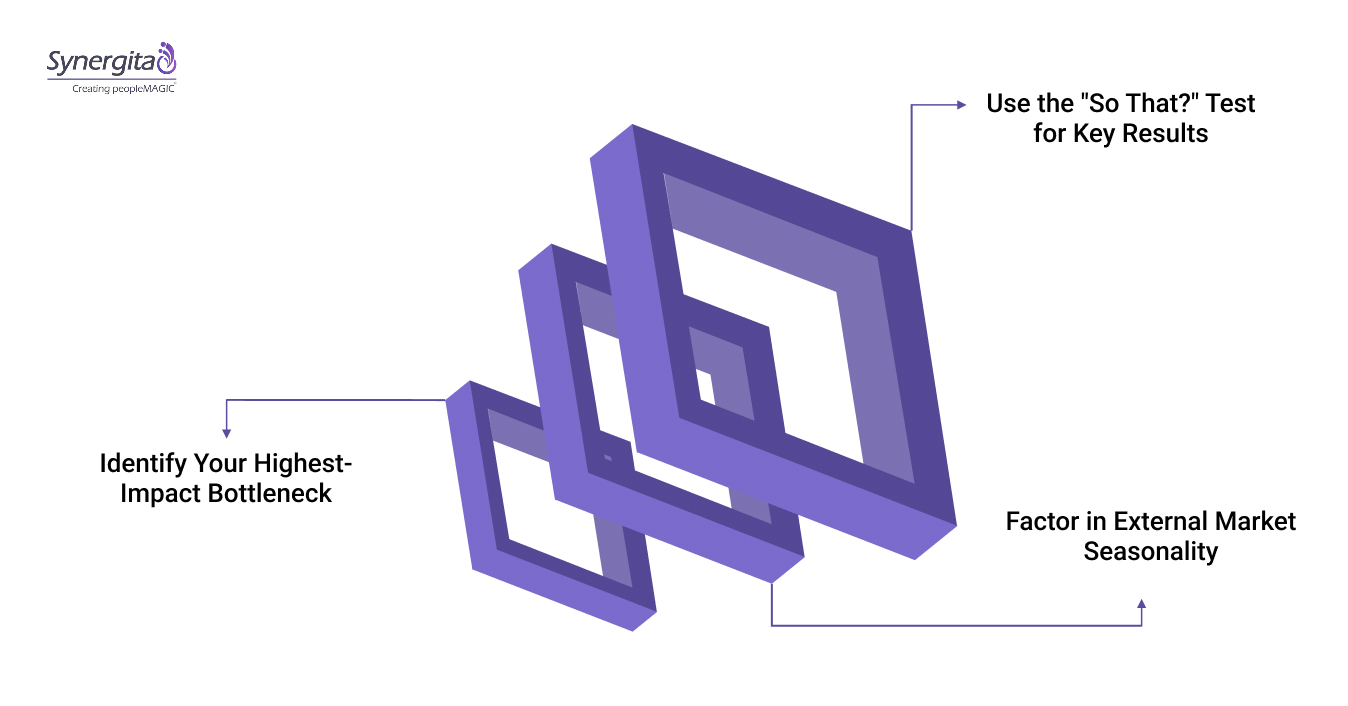
Step 1: Identify Your Highest-Impact Bottleneck
Start by analyzing your funnel data to find where you are losing the most potential revenue right now. Set your primary objective to address this specific friction point, whether it is high acquisition costs or low checkout completion.
This ensures that your team is solving the most urgent problem rather than just checking off minor tasks.
Step 2: Use the “So That?” Test for Key Results
For every metric you propose, ask how it directly contributes to the bottom line or the customer experience. A key result like “Publish 20 blog posts” fails the test unless it is linked to “Increased organic traffic.”
This prevents your team from mistaking being busy for being effective during busy retail quarters.
Step 3: Factor in External Market Seasonality
E-commerce is highly cyclical, so your key results must reflect the reality of the specific quarter you are entering. Setting the same growth targets for Q1 as you do for the peak holiday season leads to unrealistic expectations.
Adjust your numerical targets to account for historical trends and current market sentiment to maintain team morale.
Establishing this disciplined approach allows you to implement specific examples that turn projects into business wins.
15 Strategic OKR Examples for E-commerce Teams
Translating strategy into action requires concrete examples that your various departments can adopt and customize. The following tables provide a comprehensive playbook for setting goals that cover the entire digital retail lifecycle.
Use these as a starting point to build your 2026 strategic roadmap for growth and efficiency:
1. For Driving Acquisition & Awareness
| Objective 1 | Key Results |
| Improve paid acquisition efficiency to protect margins | 1. Reduce blended Cost Per Acquisition (CPA) from $25 to $18. |
| 2. Increase Return on Ad Spend (ROAS) on Meta from 3.0x to 4.5x. | |
| 3. Achieve 1,000 new customer acquisitions via TikTok shop integration. |
| Objective 2 | Key Results |
| Dominate organic search for high-intent product categories | 1. Increase organic traffic to the “Best Sellers” category by 40%. |
| 2. Rank in the top 3 for 10 new high-volume commercial keywords. | |
| 3. Grow the backlink profile from authoritative retail sites by 20%. |
| Objective 3 | Key Results |
| Launch the Influencer channel as a profitable revenue driver | 1. Secure 20 new long-term partnerships with niche-relevant influencers. |
| 2. Generate $50k in first-month revenue from influencer-coded sales. | |
| 3. Achieve an average engagement rate of 5% on sponsored content. |
2.For Boosting Conversion & Monetization
| Objective 4 | Key Results |
| Optimize site performance to capture more existing traffic | 1. Increase site-wide conversion rate from 1.8% to 2.5%. |
| 2. Reduce mobile page load time by 1.5 seconds across all devices. | |
| 3. Achieve a 95% Lighthouse performance score on product pages. |
Also read:How to Handle a Performance Review Effectively
| Objective 5 | Key Results |
| Remove friction from the mobile checkout experience | 1. Increase mobile checkout completion rate from 40% to 60%. |
| 2. Integrate Apple Pay and Google Pay for 100% of users. | |
| 3. Reduce average checkout steps from 5 to 3. |
| Objective 6 | Key Results |
| Increase Average Order Value through strategic bundling | 1. Increase AOV from $65 to $85 via “Buy More, Save More” offers. |
| 2. Achieve 15% attachment rate for new add-on protection plans. | |
| 3. Implement AI-driven “Frequently Bought Together” on 100% of SKUs. |
3. For Building Retention & Loyalty
| Objective 7 | Key Results |
| Turn one-time buyers into active brand advocates | 1. Increase repeat purchase rate within 90 days from 12% to 20%. |
| 2. Grow the active email subscriber list by 5,000 verified users. | |
| 3. Achieve a 30% click-through rate on personalized flow emails. |
| Objective 8 | Key Results |
| Launch a high-value subscription model for recurring revenue | 1. Enroll 500 active subscribers in the “Auto-Ship” program. |
| 2. Maintain a 90% retention rate for month-over-month subscribers. | |
| 3. Achieve 10% of total monthly revenue from recurring subscriptions. |
| Objective 9 | Key Results |
| Enhance post-purchase satisfaction to drive referrals | 1. Increase post-purchase NPS from 55 to 75. |
| 2. Collect 200 new 5-star product reviews with photo attachments. | |
| 3. Launch a referral program with a 5% customer participation rate. |
4. For Achieving Operational Excellence
| Objective 10 | Key Results |
| Reduce fulfillment costs through better warehouse efficiency | 1. Decrease fulfillment cost as a percentage of revenue by 5%. |
| 2. Reduce average order processing time to under 12 hours. | |
| 3. Achieve a 99.8% shipping accuracy rate for all outgoing orders. |
| Objective 11 | Key Results |
| Optimize inventory levels to prevent capital lock-up | 1. Improve inventory forecast accuracy from 70% to 90%. |
| 2. Reduce out-of-stock incidents for “Top 100 SKUs” to zero. | |
| 3. Decrease average days-on-hand for seasonal inventory by 15%. |
| Objective 12 | Key Results |
| Empower customers via a robust self-service ecosystem | 1. Reduce customer service contact rate per order by 25%. |
| 2. Automate 100% of tracking inquiries via a new AI chatbot. | |
| 3. Achieve an 80% “Helpful” rating on the new FAQ knowledge base. |
5. Additional Strategic E-commerce OKRs
| Objective 13 | Key Results |
| Optimize site search to turn intent into immediate revenue | 1. Increase search-to-purchase conversion rate from 3% to 6%. |
| 2. Reduce “No Results Found” queries by 40% via synonym mapping. | |
| 3. Achieve a 15% click-through rate on AI-suggested “Recommended Search” terms. |
| Objective 14 | Key Results |
| Minimize the “Profit Leak” through smarter returns management | 1. Reduce the overall return rate from 22% to 15% via better size guides. |
| 2. Decrease average “Return-to-Resale” processing time to under 48 hours. | |
| 3. Increase the percentage of “Exchange for Credit” over refunds by 10%. |
| Objective 15 | Key Results |
| Drive category growth through data-backed merchandising | 1. Increase the sell-through rate of “New Arrivals” within the first 30 days by 20%. |
| 2. Identify and clear 100% of “Dead Stock” (90+ days) via dynamic pricing. | |
| 3. Achieve a 12% lift in category revenue through cross-category bundling. |
Stop manual administrative tasks and automate your promotion cycles with Synergita. Book your demo today to see how our modular platform drives real talent growth and organizational alignment.

Correcting your goal-setting structure is the first step toward outperforming your competitors.
Also read:The Strategic Purpose of Performance Management: Boost Growth & Engagement
Top 4 OKR Mistakes for E-commerce Teams
Even with a strong library of examples, retail teams often fall into traps that sabotage their strategic progress. These errors usually stem from a lack of focus or a failure to align departmental goals with the actual bottom line.
Recognizing these pitfalls early allows you to build a more resilient and profitable organizational culture.
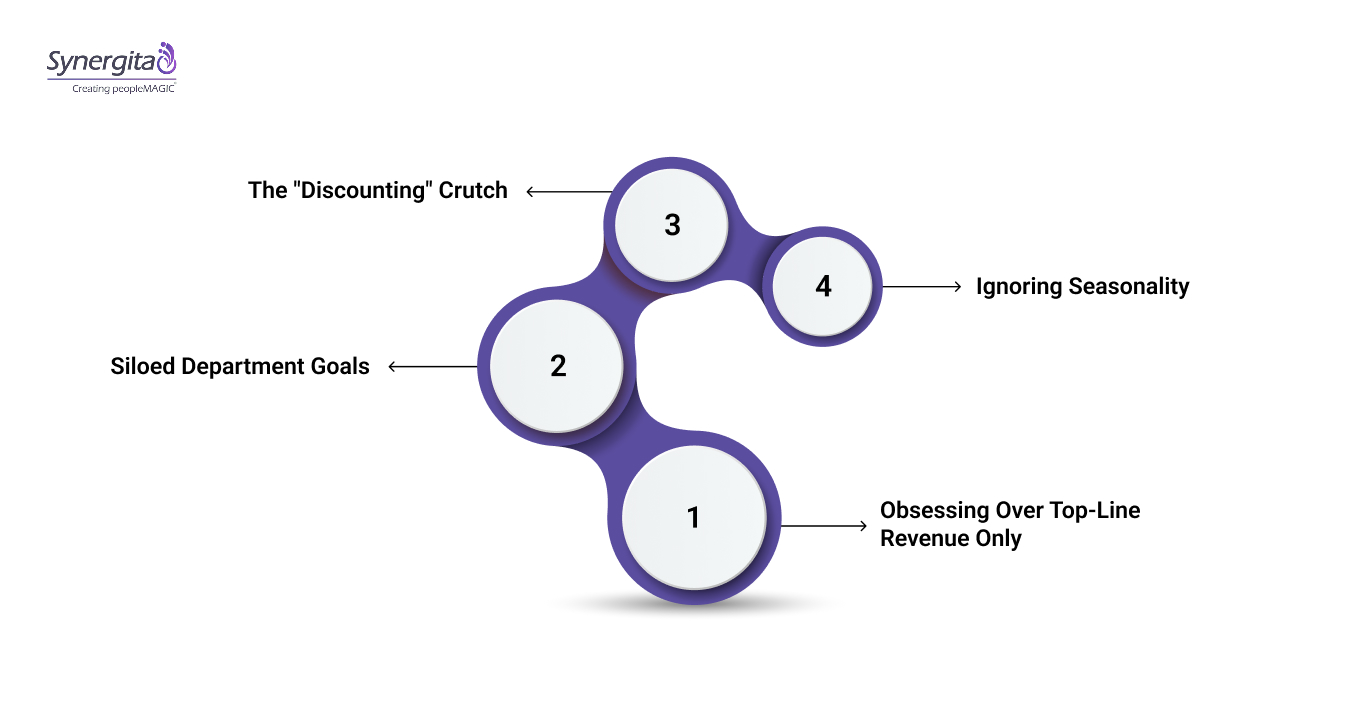
1. Obsessing Over Top-Line Revenue Only
Many teams celebrate record-breaking sales numbers while ignoring that their margins are being destroyed by high returns and shipping costs. Revenue is a vanity metric if it does not lead to a healthy contribution margin for the business.
Solution:
- Include “Gross Profit Margin” or “Contribution Margin” in your primary key results.
- Track the “Cost of Returns” alongside your sales growth targets.
- Ensure your marketing spend is always measured against net revenue, not just gross.
2. Siloed Department Goals
This occurs when the marketing team drives a massive amount of traffic for a product that the operations team hasn’t stocked yet. Silos create a disjointed customer experience that leads to frustration and high bounce rates.
Solution:
- Create “Shared OKRs” that require collaboration between marketing and supply chain teams.
- Conduct cross-functional planning sessions before the start of every new quarter.
- Use a centralized dashboard where every department can see the others’ active goals.
3. The “Discounting” Crutch
Teams often rely on massive sitewide sales to hit their quarterly revenue targets, which erodes brand value and trains customers to never pay full price. While you might hit the number, you are damaging the long-term health of the brand.
Solution:
- Set key results for “Full-Price Sell-Through” rates on new arrivals.
- Limit the frequency of sitewide promotions within your strategic planning.
- Focus on value-add retention strategies rather than just price-based acquisition.
4. Ignoring Seasonality
Setting flat targets for every quarter ignores the reality of the retail calendar and leads to either unearned praise or unfair criticism. A goal that is easy in Q4 might be impossible in a quiet Q2 without significant strategic shifts.
Solution:
- Use year-over-year (YoY) comparisons rather than just month-over-month (MoM) data.
- Build “Seasonal Confidence Scores” into your goal planning for every quarter.
- Adjust numerical targets based on historical peak periods and promotional calendars.
Refining these areas sets the stage for adopting the advanced techniques used by the world’s leading E-commerce brands.
Also read:15 Effective Feedback Models: Definition and Examples
Best Practices for Effective OKR Implementation
Sustaining a high-performance culture in retail requires more than just a good list of targets; it requires a commitment to transparency. Your goal-setting process must be visible to everyone, from the digital marketing manager to the warehouse supervisor.
This openness creates a sense of shared ownership that is vital for surviving the high-pressure environment of digital commerce.
Consider these advanced strategies to refine your organizational performance:
1. Prioritize “Confidence Scoring” for Key Results
Ask your team to rate how likely they are to hit a specific result on a scale of 1 to 10 every two weeks. This subjective data point often reveals operational risks that hard numbers might miss until it is too late.
Impact:
- Provides an early warning system for failing initiatives.
- Encourages honest communication about resource gaps.
- Allows leadership to reallocate budget to high-potential areas.
2. Link Individual Aspirations to Business Outcomes
Use your performance platform to track how an employee’s career goals align with the store’s growth objectives. If a staff member wants to master data analytics, give them KRs related to conversion rate optimization.
Impact:
- Improves talent retention in a high-turnover industry.
- Increases employee engagement through personal relevance.
- Builds a more skilled workforce that can handle future scaling.
3. Standardize Your “Win-Loss” Review Rhythms
Conduct a formal review at the end of every quarter to analyze why specific goals were missed or exceeded. Use these insights to refine your planning for the next cycle, ensuring that you never repeat the same mistake twice.
Impact:
- Creates a culture of continuous organizational learning.
- Improves the accuracy of future financial and inventory forecasts.
- Prevents the team from becoming discouraged by missed stretch goals.
Maintaining this level of discipline is significantly easier when you have the right technical infrastructure in place.
Also read:Easy 360 Degree Appraisal Sample You Can Start Using Today
Synergita: Connecting Retail Strategy to Daily Execution
E-commerce leaders often manage their strategic plans in static spreadsheets that quickly become outdated. This lack of a unified source of truth makes it impossible to get a real-time view of organizational health or team performance.
Managers find themselves wasting hours on manual updates instead of analyzing the data to drive future growth. Synergita provides a modular, cloud-based solution that specifically addresses the unique challenges of fast-moving retail organizations.
Our platform consolidates your goal tracking, continuous feedback, and performance analytics into a single interface that helps you move at the speed of the market.
- Lightweight OKR Module: Deploy your strategic framework across marketing, tech, and operations in days.
- AI-Powered Analytics: Access distraction-free insights into goal trajectories and team sentiment through configurable dashboards.
- Culture Score: Ensure your team remains aligned with your brand values even during high-pressure peak seasons.
- Perform Plus Module: Automate the entire promotion lifecycle and digital appraisal letter distribution for your top retail talent.
By unifying your talent and goal management, you can ensure that your E-commerce strategy is always moving in the right direction.
Conclusion
OKRs provide the essential framework for transforming E-commerce teams from metric-chasers to disciplined executors of a profitable growth strategy. They create focus on the full customer funnel, alignment between departments, and a clear method for prioritizing profit over mere revenue.
The 15 examples and structured funnel framework in this guide offer a complete playbook for immediate implementation.
A dedicated platform like Synergita is critical for executing this strategy at scale without administrative overhead. It turns strategic goals into visible, aligned daily actions for every team member, from marketing to merchandising to operations.
To see how a unified platform can operationalize this transformation for your E-commerce business, schedule a demo with Synergita today.

FAQs
Q. What is a good OKR for an E-commerce team?
A good E-commerce OKR has a clear profit or value-focused Objective and measurable Key Results. Example: O: Increase profitability from our core customer segment. KRs: 1) Increase Average Order Value by 15% through bundling. 2) Improve the Gross Margin of this segment by 5 percentage points. 3) Grow the repeat purchase rate to 40%.
Q. How are OKRs different from standard E-commerce KPIs?
KPIs are health metrics you monitor continuously (daily traffic, bounce rate). OKRs are a goal-setting framework used to achieve specific, ambitious outcomes quarterly (e.g., “Reduce cart abandonment by 30%”). OKRs often use KPIs as components but focus on systematically improving them.
Q. How often should E-commerce teams review their OKRs?
E-commerce OKRs should follow a quarterly cycle for setting strategic goals. However, progress must be reviewed weekly in a focused “Funnel Health” meeting. This rapid cadence is essential for adapting to real-time data in the fast-paced digital commerce environment.
Q. Should OKRs be tied to the E-commerce team’s bonuses or commissions?
Best practice is to separate them. Use team OKRs to align work and measure collective impact on company goals. Individual compensation should be based on a mix of factors: contribution to OKRs, role-specific performance, and professional behaviors. This prevents counterproductive actions taken just to hit a bonus metric.
Q. What’s the biggest challenge when starting with E-commerce OKRs?
The biggest challenge is breaking the “revenue-only” mindset and getting teams to think in terms of profit and the full customer funnel. The first planning session should start with a deep analysis of Gross Profit and Customer Lifetime Value, forcing a shift from top-line vanity to sustainable value creation.