
Have you ever spent more time figuring out how to say something in a performance review than deciding what needs to be said?
Giving negative feedback is one of the most challenging parts of performance management. Many managers avoid difficult conversations because they fear hurting employee morale, creating conflict, or damaging workplace relationships.
But avoiding negative feedback is not a solution. According to Quantum Workplace’s study of 1,500 U.S. employees, those who receive frequent feedback are 2× more engaged, 3× less likely to look for another job, and 1.4× more likely to stay with their organization.
When negative feedback is delivered with clarity and specificity, it helps employees understand what needs to change and how to improve. The 40+ examples below are organized by workplace situations, so you can find the right language for the right problem, and deliver feedback accordingly.
| TL;DR Access to over 40 ready-to-use feedback phrases structured to address poor performance without damaging morale.Mastery of the “Behavior-Impact-Expectation” method to turn vague critiques into clear, measurable growth plans.Phrasing templates categorized by distinct workplace issues like communication, teamwork, professionalism, and leadership.Insights into how performance management software transforms uncomfortable annual reviews into an easy, continuous feedback loop. |
| Table of Contents 1. 40+ negative feedback examples categorized by workplace situation 2. What is negative feedback? How to give negative feedback without demotivating employees 3. Poor performance review examples that require immediate action 4. How performance management software helps to create a feedback-driven culture 5. Final takeaway 6. Frequently asked questions |
40+ negative feedback examples categorized by workplace situation
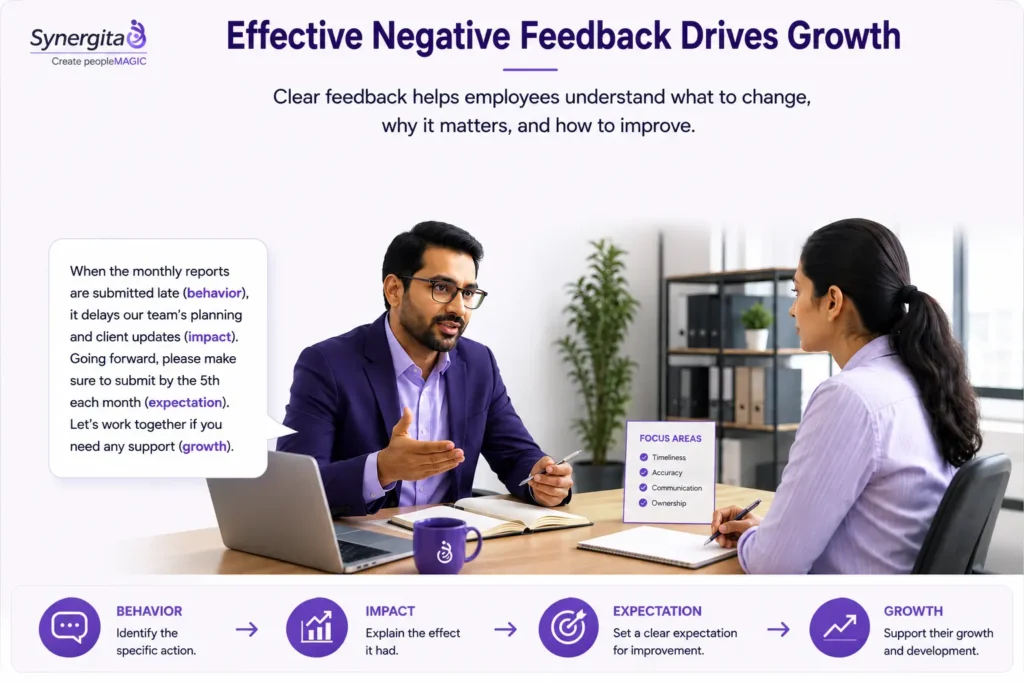
Here are 40+ specific examples of negative feedback for employee performance reviews, grouped by the workplace issues they address. Each example follows a behavior-impact-expectation structure, so the feedback is clear and actionable.
Performance issues
According to Gallup, only 14% of employees strongly agree that performance reviews inspire them to improve, underscoring the need for well-written feedback that brings meaningful change.
These examples of negative feedback address output quality, accuracy, and goal attainment. To be effective, feedback must be specific and actionable.
1.Missing targets consistently
You missed your quarterly sales target by 22% for two consecutive quarters. I would like to understand whether the challenge is lead quality, conversion, or something else so we can build a clear plan to improve results.
2. Low output volume
Your task completion rate has averaged 60% over the past six weeks. The team’s timelines are affected when deliverables are delayed without notice. Going forward, please flag any risks early so we can address them before deadlines are missed.
3. Repeated errors in deliverables
Three of your last five reports contained calculation errors that required correction before client submission. Accuracy checks need to be part of your process before any document leaves your desk.
4. Failure to meet deadlines
You submitted the project brief four days past the agreed deadline. This pushed back the entire launch schedule and required overtime from other team members.
To avoid this in future:
- Flag potential delays as early as possible.
- Break large deliverables into smaller milestones.
5. Dependence on others for basic tasks
You frequently escalate tasks to senior colleagues that fall within your role’s scope. Part of your development this quarter needs to focus on resolving these independently.
6. Incomplete work submissions
Some of your deliverables this cycle were submitted as drafts when final versions were expected. This creates rework and slows down approval cycles.
If you are unsure whether a deliverable is ready, you should discuss it with your reporting manager and clarify any doubt before submitting it.
7. Low attention to detail
Your client-facing documents have contained formatting inconsistencies and typos in three of the last four submissions. This reflects on our team’s credibility and needs to improve.
8. Not meeting quality standards
The output you produced for the product launch fell below the quality standards we outlined in the brief. The design lacked alignment with the brand guide on multiple elements.
9. Underperforming against peers
Your weekly output is running about 30% lower than others with the same scope and experience level. Let’s identify whether this is a resource, skill, or workload issue and address it directly.
10. Failure to follow processes
You bypassed the approval workflow twice this quarter, which led to unapproved content going live. Following established processes is not optional; it protects the team and the client.
11. Poor prioritization of work
High-priority tasks are regularly sitting behind lower-impact work in your queue. We need to revisit how you are planning your week to ensure the critical deliverables are finished first.
12. Slow response to urgent tasks
On two occasions this quarter, you did not respond to urgent requests within the agreed four-hour window. This left the team waiting for critical information.
If you are unavailable or need additional time, inform the team as early as possible so the work can be continued without delays.
13. Not improving after previous feedback
We discussed improving your report accuracy in your last review, but the same errors have appeared this quarter. The issue needs to be treated as a priority, not a work in progress.
14. Difficulty managing workload
You regularly request scope reductions or extensions for standard-complexity tasks. Building your capacity to manage a full workload independently is an important goal for the next quarter.
15. Goals not clearly progressed
By mid-cycle, none of your three key goals had been updated or showed measurable progress. Regular check-ins are available to help, but the ownership for driving progress sits with you.
Communication issues
Poor communication is one of the most common issues flagged in performance reviews. In fact, research by the Project Management Institute (PMI) reveals that poor communication is a primary factor in 56% of failed projects, underscoring how critical clarity is to an organization’s bottom line. These examples of negative feedback address clarity, responsiveness, and listening habits.
16. Unclear written communication
Several of your project updates this quarter were difficult to follow because they lacked a clear structure. Your stakeholders need to understand status, blockers, and next steps quickly.
17. Delayed responses to colleagues
Your average response time on internal messages is more than 24 hours, even for time-sensitive queries. The team expects a same-day turnaround for anything flagged as urgent and critical for business interest.
18. Poor listening in meetings
Colleagues have noted that you often interrupt before others finish making their point. Active listening is a core expectation in our team meetings, you can make your point once after the speaker finishes.
19. Vague verbal updates
When you give verbal project updates, you often skip the key metrics. Please structure your updates around where things stand, what the blockers are, and what you need from others.
20. Not escalating issues in time
You were aware of the supplier delay two weeks before it became a crisis, but did not escalate it. This reduced the team’s ability to respond and minimize the impact. Please raise potential risks as soon as they become apparent so we have time to plan an appropriate response.
21. Talking over others in group settings
In three of the last five team calls, you spoke over other participants. This creates an environment where others may hesitate to share their perspectives. I want you to remember:
In future discussions, remember these points:
- Let others finish speaking before responding
- Pause briefly to ensure they have completed their point
- If you disagree, acknowledge their perspective before sharing your own view
22. Overpromising to stakeholders
You committed to a delivery date with the client without checking team capacity first. This created an expectation we could not meet and required a difficult conversation to reset. As professionals, we should commit to realistic timelines.
23. Unclear email communication
Several of your client emails required follow-up because the ask or update was not clearly stated. Before sending, check that the purpose, timeline, and required action are explicit.
24. Not documenting decisions
Verbal agreements made in your meetings are not being recorded anywhere. This has led to misalignment on scope and next steps twice this quarter.
To avoid this you should:
- Summarize decisions before ending the meeting.
- Share meeting notes with stakeholders.
25. Providing feedback too aggressively
The way you delivered criticism to a junior team member in last week’s meeting was too direct and left the person visibly uncomfortable. Feedback needs to be specific, calm, and constructive
Teamwork issues
Teamwork issues can be some of the most difficult topics to address in performance reviews, they involve group dynamics, not just individual behavior. These examples address the specific actions that erode collaboration without making the feedback feel personal.
26. Not contributing to group projects
On the last two cross-functional projects, your contributions were minimal compared to what was scoped for your role. This created additional pressure on your colleagues, who had to take on tasks beyond their own responsibilities.
27. Undermining team decisions
After the team aligned on a direction in last month’s planning session, you continued to push for an alternative approach in side conversations. This creates confusion and erodes trust in the team’s decisions.
28. Withholding information from the team
You have access to client updates that the wider team needs to plan effectively, but you are not sharing them consistently. Sharing important updates promptly helps the entire team plan effectively and avoid unnecessary rework.
29. Taking credit for shared work
The Q3 presentation was a team effort, but the summary shared with leadership did not fully recognize the contributions of others. Giving proper credit helps build trust and supports a positive team culture.
30. Avoiding collaborative tasks
You tend to avoid team initiatives or pass collaborative tasks to others. Taking a more active role in shared work is important for your growth and the team’s performance.
Professionalism issues
These examples of negative feedback address conduct, reliability, and workplace standards.
31. Attendance and punctuality
You have been late to 6 of the last 12 Monday team meetings without prior notice. This disrupts discussions and delays the start of the meeting. Please ensure you arrive on time or notify the team in advance if you expect to be late.
32. Inappropriate tone with colleagues
Two team members flagged that your tone in last week’s cross-team review came across as dismissive. Even in disagreement, we expect interactions to remain respectful and professional.
Here’s what we expect from you:
- Listen without interrupting.
- Acknowledge the other person’s perspective before responding.
- Keep feedback focused on ideas and outcomes, not individuals.
33. Dress code or conduct standards
Your appearance at the client meeting last month did not meet the professional standards expected for client-facing interactions. Please review our client-facing guidelines before future meetings.
34. Negative talk about colleagues
You have been involved in conversations that discuss other team members’ performance in a critical way outside of formal review settings. This type of communication damages team culture and trust.
35. Company time for non-work activities
Time-tracking data and observations show extended non-work activities during core hours on multiple occasions this quarter. This affects both productivity and workload distribution across the team.
Leadership issues
For managers and team leads, these performance feedback examples address delegation, accountability, and team development.
36. Micromanaging direct reports
Your team members have flagged that approval is required even for routine decisions within their role scope. This slows execution and signals a lack of trust in your team’s judgment.
37. Failing to develop direct reports
None of your team members have had a documented development discussion this quarter. Supporting your team’s growth is an important part of your role and should be a regular priority.
38. Avoiding difficult conversations
A performance issue in your team has been ongoing for six weeks without a formal conversation or documented feedback. Addressing issues early is part of your responsibility as a manager.
39. Taking decisions without team input
You made a significant process change without consulting the people it directly affects. Inclusion in decisions that impact their work increases team buy-in and surface important context.
40. Not holding the team accountable
Deadlines within your team are regularly extended without any documented rationale or consequence. Consistent accountability standards protect the team’s credibility with internal stakeholders.
What is negative feedback?
Negative feedback is specific, objective information that tells employees what they need to improve when their performance or behavior falls short of expectations.
In performance reviews, the goal of negative feedback is not to criticize or punish employees. Instead, it helps them understand what went wrong, why it matters, and what they should do differently to improve.
When given the right way, negative feedback helps employees understand exactly what they need to improve and why it matters. Without it, the same mistakes keep happening, expectations become unclear, and managers spend more time fixing problems than helping employees grow.
However, delivering negative feedback effectively can be challenging. Many managers find these conversations uncomfortable, which can lead to unclear feedback.
How to give negative feedback without demotivating employees
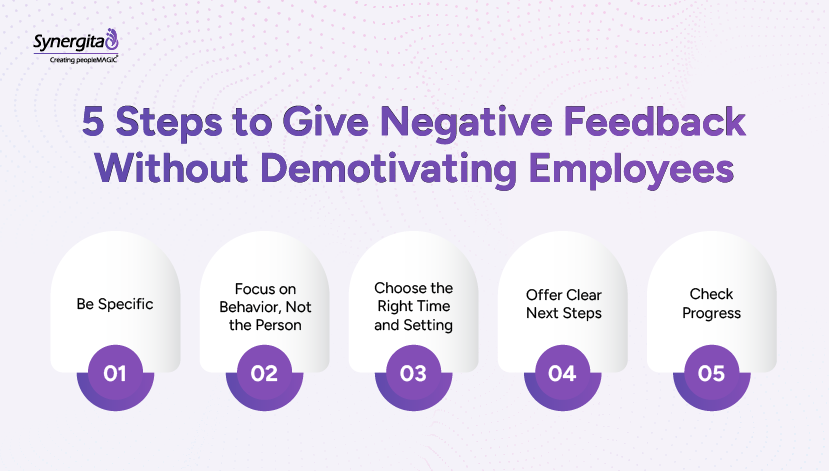
How you deliver negative feedback determines whether it drives change or creates disengagement. Gallup’s 2024 research found that just 1 in 4 U.S. employees strongly agree they receive valuable feedback from the people they work with Gallup & Workhuman, 2024. The problem is with the feedback quality.
A professional feedback example would be: “The project report was submitted after the agreed deadline, which affected the team’s timeline. Going forward, please communicate any potential delays as early as possible.
1. Be specific
Describe the exact action or behavior that needs to change instead of making general statements about the employee.
Specific feedback helps employees understand exactly what they need to improve.
Rather than saying, “Your communication needs improvement,” say, “During yesterday’s client meeting, you interrupted them several times before they finished speaking.”
2. Explain the impact
This helps employees understand why the behavior is important by explaining how it affects the team, customers, or business outcomes.
When employees see the consequences of their actions, they’re more likely to understand the importance of making a change.
For example, the client had to wait an extra day for a response because the support ticket wasn’t updated after your call.
3. Set clear expectations
This means telling employees exactly what is expected of them and what they should do differently moving forward. Clear expectations eliminate confusion and make it easier for employees to improve their performance.
4. Choose the right setting
Negative feedback should be delivered privately, not in group settings or on shared communication channels. Public criticism is one of the fastest ways to break trust between a manager and employee.
5. Agree on next steps and follow up
After discussing the issue, the manager and the employee need to agree on what to change and how progress will be reviewed. Also, a follow-up meeting should be scheduled within two to four weeks to discuss improvements, expectations, and provide support where needed. Consistent follow-up shows that feedback is intended to help employees improve and not to point out mistakes.
Poor performance review examples that require immediate action
Certain performance gaps require a structured improvement plan instead of waiting until the next performance review. These poor performance review examples signal situations where managers need to act fast.
The following poor performance review sample statements demonstrate how managers can address serious performance concerns in a clear and professional manner.
Immediate action is needed when
- Consistently misses critical deliverables that impact clients or business outcomes.
- Shows no improvement despite receiving the same feedback multiple times.
- Displays behaviors that negatively affect team performance or morale.
- Has attendance or conduct issues that violate company policies.
Here are examples framed for that level of urgency:
☐ “This is the third consecutive review in which [Name]’s work accuracy has fallen below expectations. A formal performance improvement plan will be initiated this quarter.”
☐ “[Name] has recorded 11 unplanned absences in the past six months, exceeding company policy limits. A formal discussion with HR is required.”
☐ “Feedback from multiple clients has highlighted concerns about [Name]’s responsiveness and professionalism. A structured improvement plan is needed to address these issues.”
☐ “Despite repeated coaching and adjusted responsibilities, [Name]’s performance against targets has not improved. A formal performance management plan will be the next step.”
Poor performance review examples like these should always be preceded by documented feedback conversations. The review itself should not be the first time an employee hears about a serious issue.
How performance management software helps to create a feedback-driven culture
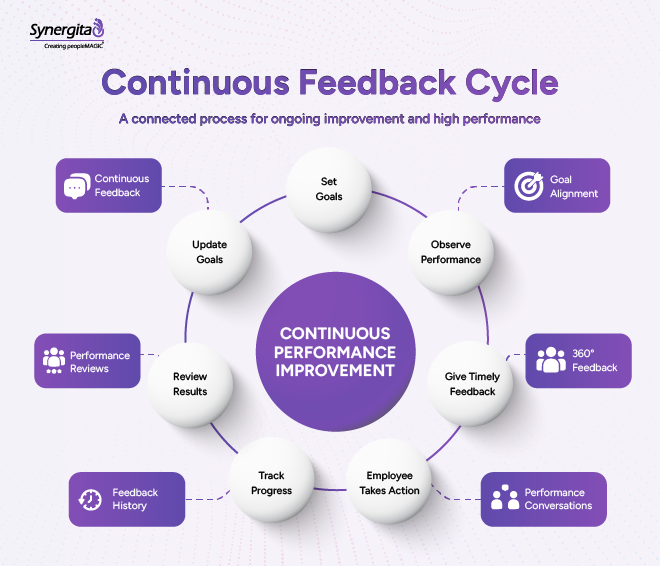
Performance management software like Synergita helps organizations build a feedback-driven culture by making feedback continuous, documented, and connected to employee development instead of limiting it to annual reviews.
1. Continuous feedback
Performance management helps managers and employees have regular performance conversations throughout the year instead of waiting for annual reviews, continuous feedback and structured 1-on-1 discussions make it easier to address performance concerns early, recognize achievements, and provide timely guidance for improvement.
2. Centralized feedback history
Synergita maintains a documented record of feedback, performance discussions, and review outcomes. Having a centralized feedback history helps managers track progress, identify recurring issues, and conduct more objective performance reviews.
3. Employee development and goal alignment
Feedback is most effective when it leads to action. Synergita connects feedback with employee goals and development plans, helping managers turn performance discussions into measurable improvement initiatives and long-term growth opportunities.
4. Structured performance reviews
The platform provides configurable review workflows that help managers conduct performance evaluations consistently across teams. This ensures feedback is documented, transparent, and aligned with organizational performance standards.
5. 360-Degree feedback
Synergita supports 360-degree feedback, enabling organizations to gather performance input from managers, peers, and other stakeholders. This provides a more balanced perspective and helps employees gain a deeper understanding of their strengths and areas for improvement.
6. Performance improvement plans (PIPs)
When recurring performance issues require formal intervention, Synergita helps organizations create and track Performance Improvement Plans (PIPs). Managers can define improvement goals, monitor progress, and document outcomes through a structured process that supports employee development and accountability.
This modern approach directly addresses a major workforce gap: data from the Society for Human Resource Management (SHRM) shows that 55% of workers feel they lack the regular, constructive coaching necessary to maximize their performance potential.

Final takeaway
The managers who get feedback right are not the ones who find the perfect words in the moment. They are the ones who have a consistent system behind them. The 40+ examples in this guide provide practical ways to address performance concerns while maintaining trust, accountability, and professional growth.
The most successful organizations do not leave feedback to annual reviews or individual manager discretion. They use structured processes that make feedback consistent, actionable, and easy to track.
If your team is ready to build a culture of continuous improvement, explore Synergita’s performance management software. Synergita helps managers deliver better feedback and improve employee performance.
Start your free trial and see how Synergita simplifies performance management through continuous feedback, structured reviews, and measurable employee growth.
Frequently Asked Questions
A negative feedback example is a specific statement that highlights a performance or behavior issue that needs improvement. For example: “You missed three project deadlines this quarter, which delayed team deliverables and affected overall project timelines.”
“You missed three consecutive deadlines this quarter, which delayed the project launch by two weeks” is a negative feedback example. It names the behavior, states the impact, and gives the employee something specific to act on.
Negative feedback identifies a gap or problem in performance. Constructive criticism goes a step further by including a suggested path to improvement. The best performance feedback combines both: it names the issue and points toward the solution.
Common examples include missed deadlines, poor communication habits, low-quality output, resistance to feedback, and a lack of accountability. The most effective versions are behavior-specific and connected to business impact.
Good work feedback examples are specific, behavior-based, and linked to outcomes. Instead of “needs improvement,” use: “Three reports this quarter had errors that required revision before submission. Accuracy needs to become part of your pre-submission checklist.”
Yes. Gallup research shows employees who receive regular, meaningful feedback are significantly more likely to be engaged at work. The condition is specificity, vague feedback produces no measurable change. Feedback must explain the behavior, state the impact, and include a clear expectation.
The best constructive criticism examples follow a behavior-impact-expectation structure. Example: “Your client emails often lack a clear call to action, which leads to follow-up delays. Try closing each email with the specific next step you need from them.”
Common performance review feedback examples include: missing targets, poor time management, communication gaps, teamwork issues, and attitude or professionalism concerns. Each should be linked to a specific observed behavior, not a general trait.
Bad performance review examples include vague statements like “needs to do better,” personality-based comments like “has a bad attitude,” and public criticism delivered in group settings. These approaches create defensiveness without giving the employee anything actionable.
“You have missed the weekly status report deadline four times this quarter. This leaves the team without the visibility they need to plan the following week. Going forward, reports need to be submitted by 5 PM every Friday.” This is a strong example of negative comments because it is specific, factual, and sets a clear expectation.
Negative performance feedback examples in workplace means documented, specific input that identifies a gap between an employee’s current performance and the expected standard. When delivered correctly, it is a development tool, not a disciplinary action.
When giving feedback to a colleague, focus on specific behaviors and their impact. For example: “Important project updates were not communicated on time, which caused delays for the rest of the team. More proactive communication would improve collaboration.”
Bad criticism examples include unclear comments such as “You need to do better” or personal remarks like “You have a bad attitude.” Effective feedback should focus on observable behaviors and specific improvement areas.