



Many organizations adopt OKRs (Objectives and Key Results) and the Scaled Agile Framework (SAFe) with high expectations, only to find these powerful practices operating in parallel rather than in sync. Alignment gaps are common. About 65% of teams’ OKRs aren’t directly linked to company goals, which limits strategic clarity and the impact of execution.
At the same time, SAFe is widely used to scale agile ways of working across teams and departments, but it doesn’t come with a built‑in method for tying work back to strategic outcomes. When OKRs and SAFe aren’t aligned, teams can waste effort on outputs that feel agile but don’t drive real business results.
This blog gives you 5 proven strategies to align OKR and Scaled Agile Framework together, so you stay focused on outcomes that matter, maintain strategic alignment, and execute with agility throughout 2026 and beyond.
Key Takeaways
- Align OKRs with SAFe: Ensure strategic goals drive agile execution by linking day-to-day work to business outcomes.
- Cascade OKRs for Alignment: Break down high-level OKRs to program and team levels for precise alignment and focus.
- Sync OKRs with PI Planning: Integrate OKR reviews into PI cycles to ensure continuous alignment between strategy and agile execution.
- Use Real-Time Dashboards: Track OKR progress and identify issues early with visual, real-time metrics.
- Promote Continuous Feedback: Keep OKRs relevant and adaptive by embedding continuous feedback into the agile process.
The Challenge of Aligning OKRs with SAFe
SAFe is built to help large organizations scale agile practices across teams, programs, and portfolios, encouraging alignment, collaboration, and synchronized delivery across many agile teams. It does this through constructs like Strategic Themes, Lean Budgets, and Program Increment (PI) objectives that link strategy to execution.
However, by design, SAFe doesn’t prescribe a measurable, outcome‑focused goal‑setting system at the strategic level. Its focus is more on synchronizing work and managing workflow dependencies across multiple teams.
This creates a gap.
OKRs are inherently outcome‑driven. They compel teams to define what success looks like and how progress is measured. That outcome orientation is what makes OKRs valuable in modern organizations; without OKRs, agile teams may execute efficiently but lack a clear connection to strategic impact.
The result? Even teams that adopt both SAFe and OKRs can find that:
- Strategic goals don’t translate into measurable execution priorities.
- Agile teams focus on outputs (features, stories, PI objectives) without knowing if they move the needle on strategic outcomes.
- Leaders struggle to tie day‑to‑day agile delivery back to long‑term organizational goals.
This misalignment between SAFe’s execution focus and OKRs’ strategic focus is exactly what prevents many organizations from achieving true business agility and measurable outcomes, which is why intentional alignment strategies are critical.
Also Read: Cascading vs. Alignment: Which Approach Works Best for Your Organization?
Top 5 Strategies to Align OKR and Scaled Agile Framework
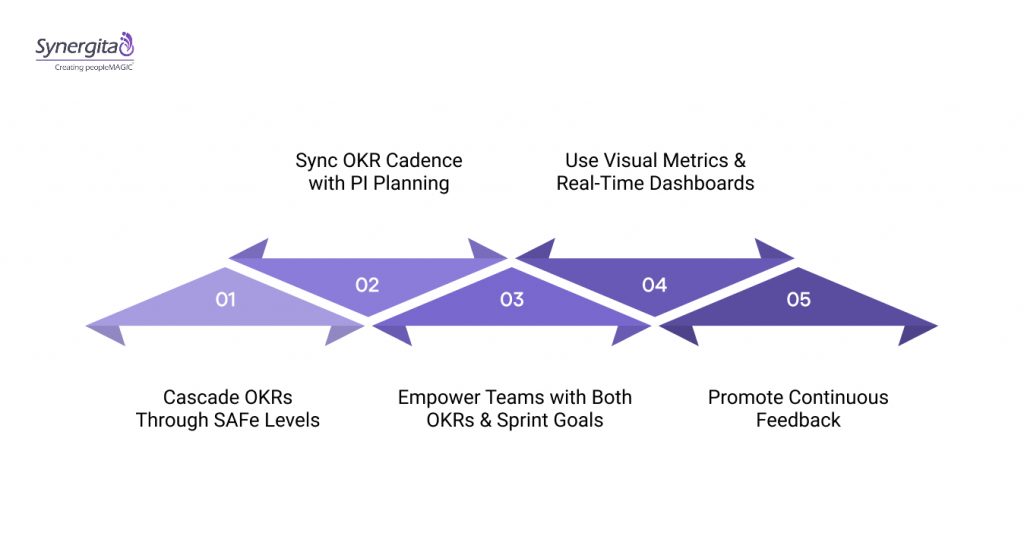
To make OKRs and SAFe work together effectively, you need more than just good intentions. You need intentional strategies that bridge strategic goals with agile execution.
Each strategy below has been successfully used in real organizations to create measurable alignment and drive better outcomes year after year.
Strategy 1: Cascade OKRs Through SAFe Levels
Cascading OKRs means taking high‑level objectives at the portfolio or executive level and translating them into aligned goals that resonate at program and team levels.
Why does it matter?
SAFe provides Strategic Themes and Portfolio Vision to connect strategy to delivery. OKRs can map directly to these constructs to ensure each team’s work supports measurable business outcomes, not just outputs.
For example, let’s say the Portfolio Objective (OKR) is to increase enterprise customer retention by 15% by Q3 2026.
- Program Level (OKR): Improve product reliability so core features have <1% critical bug rate
- Team Level (OKR): Reduce sprint regression incidents by 30%
So, rather than each team setting goals in isolation, everyone’s work connects back to a shared strategic outcome.
Are you also working with disconnected OKRs and strategic objectives? Synergita’s cascading OKR feature ensures that each department and team is aligned with your organization’s high-level goals. Book a demo now to see how Synergita eliminates silos and keeps everyone moving toward the same outcome.
Strategy 2: Sync OKR Cadence with PI Planning
Program Increment (PI) planning is the foundation of SAFe. By synchronizing OKR cycles with PI cycles, you ensure strategic objectives influence planning and execution cadences.
Why does it matter?
Traditional OKR cycles (quarterly) and PI cycles (typically 8–12 weeks) align naturally but are often not actively connected. Embedding OKR discussion into PI planning creates a shared rhythm between strategy and execution.
How it works:
- In the pre‑planning phase, communicate current OKRs to all teams.
- During PI planning, teams set iteration goals and draft objectives that map to those OKRs.
- After planning, do a weekly OKR check‑in tied to Agile stand‑ups.
Instead of treating OKRs as a quarterly check‑in exercise, you see them reflected in every sprint cycle, making measurable progress visible and actionable.
Strategy 3: Empower Teams with Both OKRs & Sprint Goals
Empowered teams take ownership of both their OKRs and sprint goals, ensuring work is purposeful and directly contributes to measurable results.
Why does it matter?
Agile teams are accustomed to planning at the sprint level but lack clarity on how their day‑to‑day work connects to larger strategic goals unless OKRs are explicitly part of planning and review.
Let’s assume:
- At a sprint planning meeting, a team identifies user stories and links them directly to team‑level OKRs (e.g., improving performance metrics that support a portfolio customer satisfaction objective).
- Teams then share their confidence scores on key results at the end of each sprint, not just completion status.
What would be the before vs after?
- Before: Teams deliver agile stories but can’t clearly explain how they impact strategic goals.
- After: Teams can articulate how each sprint contributes measurable alignment back up the OKR hierarchy.
Strategy 4: Use Visual Metrics & Real‑Time Dashboards
Agile and SAFe emphasize visibility; combining that with OKR dashboards and real‑time metrics turns abstract strategy into tangible progress tracking.
Why does it matter?
Performance indicators like velocity or sprint burndown tell you about delivery, not impact. OKRs add that outcome layer, and real‑time dashboards help teams see gaps early.
Here are some practical applications:
- Create dashboards that show OKR progress alongside key SAFe metrics, such as PI objectives and feature completion rates.
- Use visual cues (traffic lights, trend lines) to identify where adjustments are needed quickly.
- Conduct monthly reviews that update OKR statuses and link them to recent sprint outputs.
So, teams no longer guess how their work adds up.
Do you also feel tracking OKR progress like a guessing game? Synergita’s visual dashboards provide real-time insights into your OKRs, helping you track progress and identify issues before they impact delivery. Book a demo today to see how Synergita’s visual tools keep your goals on track and aligned with SAFe.
Strategy 5: Promote Continuous Feedback Between OKRs & Agile Execution
Continuous feedback means regularly revisiting OKRs, not just quarterly but throughout the agile cycle during sprint reviews, retrospectives, and backlog refinement.
Why does it matter?
Without frequent feedback loops, OKRs become irrelevant to teams’ current work. Agile principles emphasize incremental improvement; linking OKRs into that loop keeps strategy adaptable and actionable.
For instance, in every retrospective, include a brief OKR review segment:
- What progress did we make toward key results this sprint?
- What impediments are blocking progress?
- What action will we take in the next sprint to move the needle?
This structured reflection ensures OKRs inform future sprint planning rather than being an afterthought.
Individually, each strategy improves a specific aspect of alignment: cascading goals, synchronized planning, team ownership, visibility, and feedback. Collectively, these strategies improve alignment across the organization.
But when combined, they create a system in which strategic outcomes and agile execution reinforce each other, shifting your organization from focusing on outputs to driving meaningful outcomes.
How to Measure Success When Aligning OKRs with SAFe
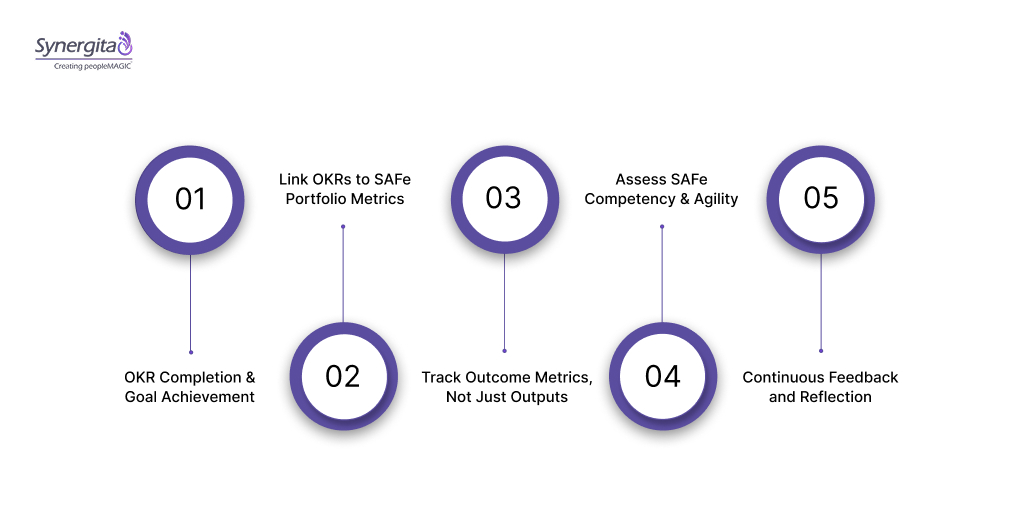
Successfully aligning OKR and Scaled Agile Framework isn’t just about setting goals but knowing when you’re actually making progress toward outcomes that matter. To do this, teams need clear, contextual success metrics that reflect both strategic value and agile execution.
To honestly assess alignment, track these key metrics:
- OKR Completion and Goal Achievement:Track Key Result scores (aim for 70% success – a good balance between ambition and realism). Measure objective completion rates and progress trends over time.
- Link OKRs to SAFe Portfolio Metrics:Tie OKRs directly to SAFe’s portfolio KPIs, such as customer satisfaction, product quality, or time-to-market. This guarantees that strategic outcomes are reflected in agile team delivery and decision-making.
- Track Outcome Metrics, Not Just Outputs:Focus on metrics like Lead Time, Cycle Time, and Feature Adoption rather than just sprint completion rates. These outcome metrics indicate whether delivered features add real value and support business objectives.
- Assess SAFe Competency and Agility:Track improvements in SAFe competencies, including Lean Portfolio Management and Agile Product Delivery. Measuring competency growth ensures the framework is driving sustainable agility across the organization.
- Continuous Feedback and Reflection:Regular OKR check-ins during retrospectives and sprint reviews, focusing on progress, impediments, and adjustments. Teams remain adaptable and aligned to strategic goals, course-correcting when necessary.
This integrated approach ensures your OKRs are not only being tracked but are actively driving business outcomes.
It shows whether agile execution is truly moving the needle on your strategic goals and whether the SAFe framework is maturing to meet your evolving needs.
Also Read: Implementing OKRs Successfully: Hassle-Free Tips for Smooth Sailing
How Synergita Enhances OKR and SAFe Alignment for Agile Teams
Aligning OKR and the Scaled Agile Framework is challenging for many organizations, particularly when systems are fragmented or siloed. Synergita solves these problems by offering a unified, cloud-based platform that integrates all necessary performance management features into one seamless system.
Here’s how Synergita empowers organizations to achieve successful OKR and SAFe alignment:
- OKR ManagementSynergita allows you to set, track, and manage OKRs with full organizational alignment. The platform’s visual dashboards provide real-time insights into goal progress, ensuring everyone across teams is moving in the same direction.
- Synergita EngageCreating a feedback-rich culture is made easy with Synergita Engage. This module fosters continuous feedback through peer-to-peer recognition, e-communication, and employee engagement tools that support agile teams working toward shared OKRs.
- Employee DevelopmentSynergita moves beyond traditional performance reviews with continuous feedback and development plans. With 360-degree feedback integrated into the OKR cycle, you can track employee progress on both individual development goals and agile sprint objectives.
- Sentiment AnalysisUsing AI-powered sentiment analysis, Synergita lets you gauge employee engagement and morale by analyzing the tone of written feedback. By linking sentiment data with OKR progress, you can identify and address potential issues early.
By centralizing OKR tracking and feedback in a single platform, Synergita helps you simplify the process of aligning strategic objectives with agile execution.
Conclusion
Aligning OKRs with SAFe is crucial for driving both strategic clarity and agile execution. By implementing the right strategies, you can ensure that teams are not only aligned with business objectives but are also empowered to execute them effectively.
With Synergita, you gain a unified platform that connects OKRs with agile practices, ensuring real-time alignment, continuous feedback, and measurable outcomes. Whether it’s cascading goals, syncing with PI planning, or promoting a feedback-rich culture, Synergita simplifies the process and drives performance.
Ready to streamline your OKR and SAFe alignment? Schedule a demo and see how Synergita can transform the performance management for 2026 and beyond.
FAQs
1. What role do OKRs play within the Scaled Agile Framework (SAFe)?
OKRs add measurable outcomes and strategic focus to SAFe’s alignment and execution practices. They help teams connect SAFe constructs, such as Strategic Themes and PI objectives, to clear, outcome‑based goals.
2. How often should OKRs be reviewed when used with SAFe?
Align OKR reviews with SAFe Program Increment (PI) cadence (often every 8–12 weeks). Reviewing at the end of each PI ensures goals stay relevant and are adjusted based on real progress.
3. Should OKRs replace PI Objectives in SAFe?
No. OKRs complement PI Objectives. PI objectives focus on delivery commitments for a specific increment, while OKRs measure strategic impact and outcomes over a broader timeframe.
4. Do all teams need to align their OKRs with higher‑level goals?
While strong alignment is ideal, flexibility can be beneficial. Teams can set some OKRs that support high‑level goals and others that drive critical team‑specific improvements, depending on context and priorities.
5. What’s the biggest challenge when combining OKRs and Agile execution?
The biggest challenge is bridging the gap between output‑focused Agile work and outcome‑focused OKRs. This ensures sprint tasks and PI commitments actually move strategic goals forward.