



Quick Summary
- Sales OKRs provide a structured, outcome-driven goal-setting framework that offers stronger alignment and clarity than traditional task-based sales targets.
- 20+ actionable Sales OKR examples across revenue, SDR/BDR, Account Executives, Sales Management, Channel Partners, Pipeline, Lead Generation, and Customer Success.
- Sales OKRs improve forecast accuracy, productivity, cross-functional alignment, and data-driven decision-making to drive predictable revenue growth.
- The common mistakes in Sales OKRs include activity-based KRs, unrealistic goals, misalignment, poor reviews, and unclear ownership.
Meeting expectations keeps you on track, but consistently exceeding them accelerates revenue growth.
For sales teams, outgrowing last quarter’s numbers requires more than just hitting monthly targets. It demands strategic thinking, alignment with the company’s broader vision, and a disciplined approach to sales execution. That is where Sales Objectives and Key Results (OKRs) come in.
According to a Demand Gen Report, aligned companies have up to 19% faster revenue growth and a 15% increase in profits compared to non-aligned ones. With the right OKRs, sales teams can turn aspirational goals into measurable outcomes. In this guide, we will explore 20+ high-impact sales OKR examples to help you build pipeline strength, close more deals, and scale revenue growth.
| Table of Contents 1. What Are Sales OKRs? 2. Best Sales OKR Examples to Boost Growth in 2026 3. Why Are Sales OKRs Important? 4. What Are the Common Mistakes to Avoid When Setting Up Sales OKRs? 5. Conclusion 6. Frequently Asked Questions |
What Are Sales OKRs?
Sales OKRs are a structured goal-setting framework that helps sales teams define what they want to achieve and how they will measure success. The Objective outlines a clear qualitative goal, while Key Results define specific, measurable outcomes that indicate progress toward that goal.
Unlike traditional goal-setting, which focuses only on tasks to be completed, OKRs emphasize real outcomes that help businesses achieve strategic objectives.
Suggested Reading: Difference between OKRs vs. Traditional Goal-Setting
How to Craft Killer Sales Goals?
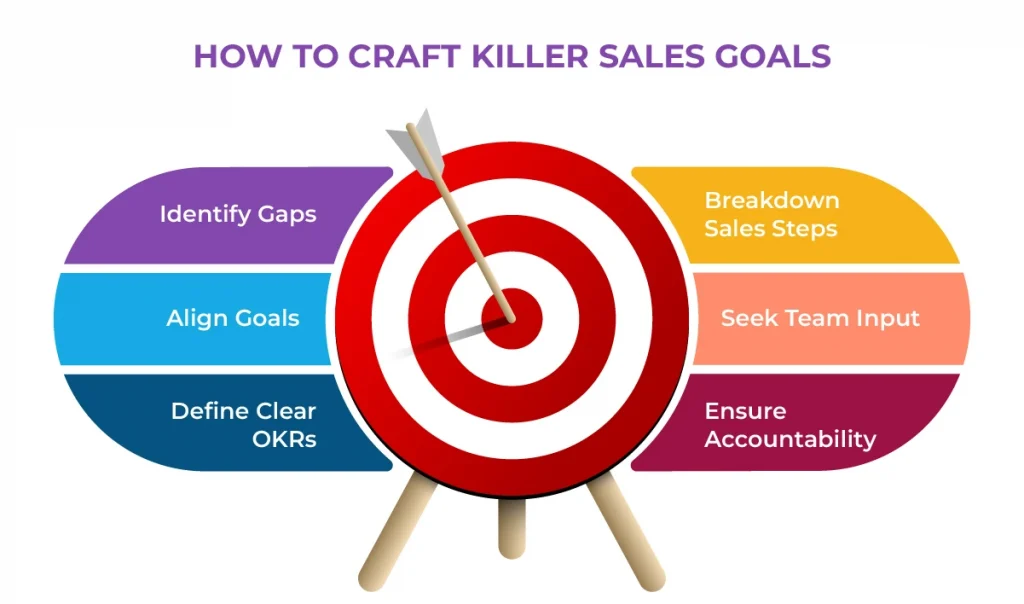
Well-defined sales goals provide teams with clarity, direction, and measurable targets that move the organization toward its revenue ambitions. Here is how to write a sales OKRs aligned with proven OKR recommendations.
1. Identify Gaps
Gap analysis helps sales leaders pinpoint performance bottlenecks, skill deficiencies, conversion leakages, and operational blind spots.
2. Align Goals
Goals are effective only when they align with the company’s strategic direction. It ensures that sales targets support revenue objectives, product priorities, and Go-to-Market (GTM) strategies.
3. Define Clear OKRs
Set specific, measurable sales OKRs that provide transparency on expected outcomes and make performance easy to track throughout the cycle.
4. Breakdown Sales Steps
Convert large revenue goals into achievable weekly and monthly milestones, so your team knows exactly what actions drive progress. Translate annual targets into quarterly, monthly, and weekly milestones.
5. Seek Team Input
Goal setting must not be a top-down exercise and requires contributions from everyone. Involve frontline reps in the planning process to ensure goals are realistic, data-backed, and widely supported across the team.
6. Ensure Accountability
Accountability ensures that goals remain on track and creates a culture of ownership. Use structured reviews, progress dashboards, and clear ownership to keep everyone aligned and responsible for hitting targets.
Best Sales OKR Examples to Boost Growth in 2026
Here is a list of high-impact OKR examples for sales covering every function within the sales domain.
1. Sales Revenue OKRs
These OKRs help revenue teams drive quarterly and annual sales growth, increase profitability, and strengthen unit economics.
Example 1
Objective: Hit the quarterly revenue target of USD 10 million.
- KR1: Close 200 new deals in the quarter.
- KR2: Increase sales conversion rate from 22 percent to 30 percent.
- KR3: Increase average deal value from USD 22,000 to USD 30,000.
Example 2
Objective: Strengthen year-round revenue predictability.
- KR1: Grow recurring revenue share from 62 percent to 75 percent.
- KR2: Increase annual contract adoption from 40 percent to 60 percent.
- KR3: Reduce quarterly revenue variance from 18 percent to less than 8 percent.
Example 3
Objective: Improve profitability in US regions.
- KR1: Reduce discounting by 20 percent across all new deals.
- KR2: Increase upsell contribution to 30 percent of total revenue.
- KR3: Boost gross margin by 12 percent through better deal structuring.
2. SDR / BDR OKRs
These OKRs support outbound prospecting, top-of-funnel generation, and pipeline consistency.
Example 4
Objective: Improve outbound prospecting effectiveness.
- KR1: Increase SQL-to-meeting conversion from 18 percent to 30 percent.
- KR2: Maintain 400 multi-channel touches weekly.
- KR3: Reduce first-touch reply time from 4 hours to 1 hour.
Example 5
Objective: Build a predictable pipeline engine.
- KR1: Add 250 ICP-aligned prospects per month.
- KR2: Achieve a 12 percent positive response rate across campaigns.
- KR3: Increase the number of qualified meetings booked per rep from 18 to 30 per month.
Example 6
Objective: Strengthen outbound personalization and quality.
- KR1: Improve personalized email open rate from 10 percent to 20 percent.
- KR2: Increase call-to-connect rate from 8 percent to 15 percent.
- KR3: Reduce no-shows for SDR-booked meetings by 25 percent.
3. Account Executive OKRs
These OKRs focus on deal progression, closing efficiency, and customer relationships.
Example 7
Objective: Increase closing efficiency.
- KR1: Reduce sales cycle from 62 days to 45 days.
- KR2: Improve proposal-to-close rate from 25 percent to 40 percent.
- KR3: Maintain 3X pipe coverage consistently.
Example 8
Objective: Strengthen multi-stakeholder selling.
- KR1: Increase multi-threaded opportunities from 30 percent to 70 percent.
- KR2: Conduct strategic stakeholder mapping for all deals above USD 20,000.
- KR3: Improve demo-to-close rate from 28 percent to 42 percent.
4. Sales Management OKRs
These OKRs help Sales Managers and Directors improve team performance, coaching, and operational consistency.
Example 9
Objective: Build a high-performance sales organization.
- KR1: Increase team quota attainment from 65 percent to 85 percent.
- KR2: Reduce new rep ramp time from 90 days to 60 days.
- KR3: Improve forecast accuracy from 55 percent to 75 percent.
Example 10
Objective: Improve sales coaching quality.
- KR1: Conduct 2 coaching sessions per rep monthly.
- KR2: Increase CRM hygiene score to 90 percent.
- KR3: Reduce rep churn from 18 percent to 8 percent.
5. Channel Partner Sales OKRs
Supports partner-led growth, ecosystem expansion, and more revenue streams.
Example 11
Objective: Expand and activate partner ecosystem.
- KR1: Add 15 strategic partners this year.
- KR2: Increase partner-driven revenue by 40 percent.
- KR3: Launch 12 co-marketing campaigns annually.
Example 12
Objective: Improve partner performance and engagement.
- KR1: Increase partner pipeline contribution from 15 percent to 30 percent.
- KR2: Achieve 90 percent certification completion among active partners.
- KR3: Improve partner deal registration rate by 25 percent.
Example 13
Objective: Strengthen partner enablement.
- KR1: Launch a partner portal with real-time analytics.
- KR2: Reduce partner onboarding time from 45 days to 25 days.
- KR3: Increase partner satisfaction score to 4.5/5.
6. Pipeline Development OKRs
Ensures healthy pipeline coverage and clean deal progression.
Example 14
Objective: Build a 4X qualified pipeline for next quarter.
- KR1: Increase qualified pipeline from USD 1.5M to USD 6M.
- KR2: Maintain pipeline hygiene score of 80 percent.
- KR3: Improve stage 2 to stage 4 conversion by 25 percent.
Example 15
Objective: Improve early-stage pipeline movement.
- KR1: Reduce stalled opportunities by 35 percent.
- KR2: Increase discovery completion rate from 60 percent to 80 percent.
- KR3: Boost opportunity creation by 30 percent.
7. Lead Generation OKRs
Helps marketing and demand gen teams build a predictable inbound lead flow.
Example 16
Objective: Increase high-quality inbound leads.
- KR1: Grow MQLs by 50 percent.
- KR2: Improve lead-to-SQL conversion from 12 percent to 20 percent.
- KR3: Launch 10 targeted campaigns for US-based ICP segments.
Example 17
Objective: Improve paid acquisition efficiency.
- KR1: Reduce CAC by 20 percent.
- KR2: Improve landing page conversion rate from 1.8 percent to 3.2 percent.
- KR3: Increase inbound opportunity value by 30 percent.
Example 18
Objective: Strengthen content-driven lead generation.
- KR1: Publish 24 high-intent assets for US buyers.
- KR2: Improve organic traffic by 35 percent.
- KR3: Increase demo requests by 25 percent.
8. Customer Retention and Expansion OKRs
Critical for SaaS companies focused on long-term value.
Example 19
Objective: Reduce churn and boost retention.
- KR1: Reduce churn from 8 percent to 4 percent.
- KR2: Improve NRR from 105 percent to 130 percent.
- KR3: Increase customer health score by 25 percent.
Example 20
Objective: Improve expansion revenue.
- KR1: Increase upsell opportunities by 25 percent.
- KR2: Grow cross-sell revenue by 30 percent.
- KR3: Conduct QBRs for 95 percent of enterprise accounts.
Example 21
Objective: Strengthen customer engagement.
- KR1: Increase product adoption score by 35 percent.
- KR2: Reduce inactive accounts by 40 percent.
- KR3: Improve customer satisfaction score to 4.7/5.
Why Are Sales OKRs Important?
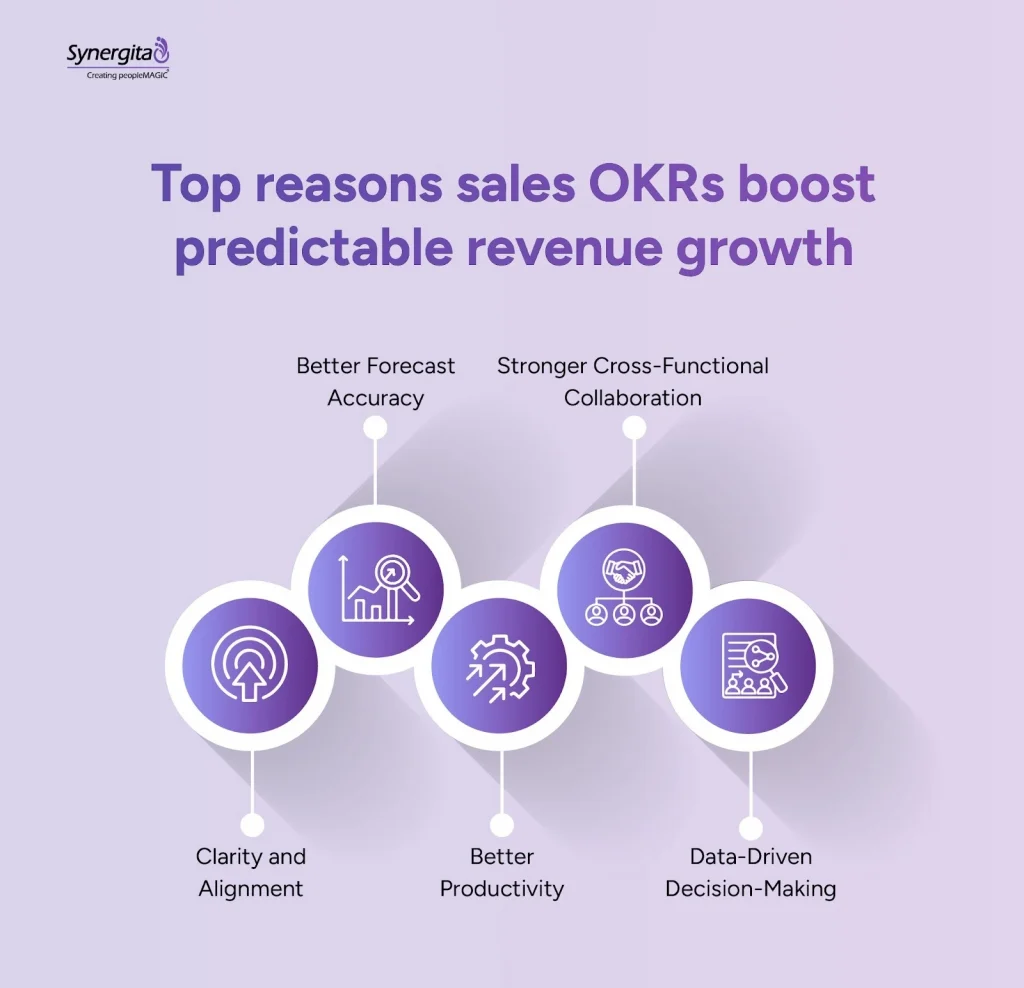
Strong Sales OKRs are important because they create transparency, improve forecasting accuracy, and help sales teams stay focused on outcomes rather than activities. They also bring alignment between marketing, sales, product, and customer success. This ensures that the entire growth engine moves in the same direction. Here are the key benefits of sales OKRs.
1. Clarity and Alignment
Sales OKRs keep every rep, manager, and team aligned on revenue goals, reducing effort on non-essential work and improving execution.
2. Better Forecast Accuracy
Clear, measurable Key Results help teams track sales, pipeline quality, conversion rates, and sales cycle speed, which improves forecasting accuracy.
3. Better Productivity
By defining success metrics for every sales role, OKRs help team members stay focused, increasing productivity and accelerating execution toward revenue targets.
4. Stronger Cross-Functional Collaboration
OKRs allow sales, marketing, customer success, and other teams to operate with shared metrics, improving collaboration and ensuring every team is working toward the same revenue goals.
5. Data-Driven Decision-Making
Regular OKR reviews help identify risks early, allowing sales teams to adjust territory plans and outreach strategies and make data-driven decisions.
Suggested Reading: 12 Reasons Why OKRs are Important for Business Success
What Are the Common Mistakes to Avoid When Setting Up Sales OKRs?
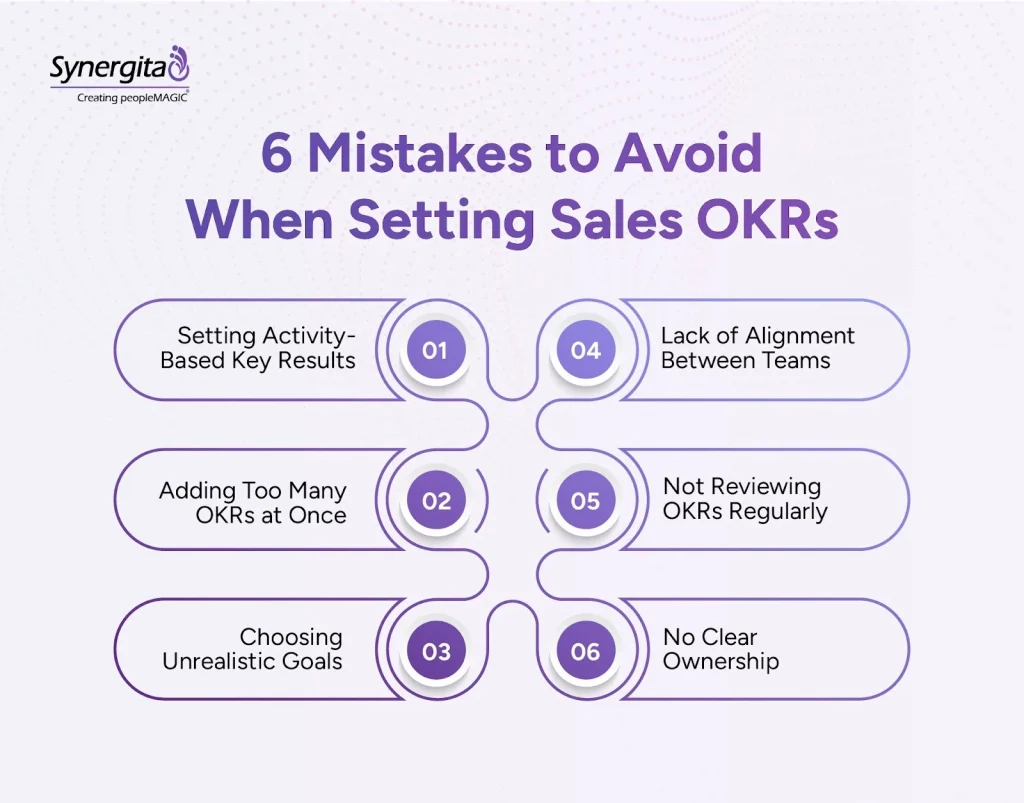
Many organizations struggle with Sales OKRs because of poor planning, misalignment, or unrealistic targets. Avoiding these common mistakes will ensure a strong, predictable OKR process that drives revenue performance.
1. Setting Activity-Based Key Results
Example of a poor KR: “Make 100 calls per day”
Better approach: “Increase qualified meetings from 40 to 65 per month.”
Activities do not guarantee results. Key Results must measure impact, not effort.
2. Adding Too Many OKRs at Once
Many sales teams add five to seven objectives per quarter, making it difficult to maintain focus. The Ideal range is 1–2 objectives per team, with 3–5 key results each.
3. Choosing Unrealistic Goals
Overly ambitious OKRs can demotivate teams and distort forecasting. OKRs should be aspirational, but not unattainable in current market conditions.
4. Lack of Alignment Between Teams
If marketing, SDRs, and AEs follow disconnected OKRs, pipeline flow breaks.
For example:
- Marketing focuses on vanity metrics (traffic)
- SDRs focus on meetings
- AEs focus on revenue
Without alignment, no one owns pipeline quality or conversions.
Suggested Reading: How to Overcome Misalignment of OKR Goals to Achieve Excellence
5. Not Reviewing OKRs Regularly
OKRs are not set-and-forget goals. To ensure high performance, sales teams must review OKRs weekly or bi-weekly to adjust strategies, refine outreach, and update forecasts.
6. No Clear Ownership
Every KR must have a dedicated owner who is responsible for execution. Shared ownership creates confusion and impacts accountability.
Conclusion
When objectives, targets, and execution are aligned, sales teams operate with better clarity and focus and achieve better outcomes. Sales OKRs provide that structure with a clear roadmap that defines where the team is headed and how progress will be measured.
This is exactly where the Synergita OKR tool offers the advantage. It helps revenue leaders set meaningful sales goals, track real-time progress, and keep SDRs, AEs, and managers aligned on the metrics. From forecasting accuracy to pipeline consistency, Synergita’s built-in AI supports smarter planning and execution across the sales function.
If you want to bring discipline, transparency, and measurable growth into your sales process, try Synergita OKR. Start your 7-day free trial and see how structured goal-setting can accelerate your sales performance.

Frequently Asked Questions
Sales targets measure output (for example, revenue closed), while OKRs link qualitative goals with measurable milestones such as win rate, pipeline quality, or deal velocity. OKRs give a fuller picture of sales performance.
Weekly or bi-weekly for progress checks, and formally at the end of each quarter. Regular reviews help teams adjust forecasts, refine outreach, and remove blockers early.
Some common examples of OKRs include:
Increase win rate from 25% to 35%
Reduce the sales cycle from 60 to 45 days
Grow qualified pipeline by 40%
Improve forecast accuracy from 55% to 80%
Synergita OKR gives sales teams a structured platform to define goals, assign ownership, track real-time progress, and stay aligned with revenue plans. It brings discipline and clarity to both top-down and bottom-up OKR processes.
Yes, Synergita integrates seamlessly with popular tools, including Slack, Microsoft Teams, and HRIS systems such as ADP Workforce, Alexis HR, Bamboo HR, and Hibob.