



Why do some teams consistently deliver on their goals while others struggle with misalignment and unclear priorities? In today’s fast-paced workplace, effective management depends less on effort and more on clarity, focus, and measurable outcomes.
This is where Objectives and Key Results (OKRs) make a difference. OKRs provide a simple yet powerful framework to define what needs to be achieved and how success will be measured, helping managers translate strategy into action.
The impact of structured goal-setting is well-documented. Research shows that organizations using OKRs are up to 39% more likely to achieve their strategic goals, while 83% of companies report clear benefits such as improved alignment, transparency, and prioritization after adopting OKRs.
In this blog, we’ll break down six effective management OKR examples and show how managers can use them to drive alignment, accountability, and consistent performance.
Key Highlights
- OKRs bring clarity and alignment to management: They link organizational strategy with team and individual goals, ensuring everyone works toward shared, measurable outcomes.
- Strong management OKRs focus on outcomes, not tasks: Clear objectives and measurable key results help managers track real impact instead of day-to-day activities.
- Six OKR examples address core management responsibilities: The examples cover productivity, alignment, engagement, skill development, decision-making, and continuous performance coaching.
- Regular reviews turn OKRs into a continuous improvement system: Frequent check-ins and feedback help managers course-correct early and keep teams aligned.
- Synergita enables effective OKR execution at scale: With centralized OKR tracking, real-time visibility, and integrated performance management, Synergita helps managers translate goals into measurable results.
Why OKRs Matter for Effective Management
In an increasingly complex and fast-changing work environment, managers need more than intuition to drive performance. OKRs provide a structured framework that helps leaders align teams, clarify priorities, and track progress consistently, making them a critical tool for effective, modern management.
1. Align Organizational, Team, and Individual Goals: Alignment is the foundation of strong execution. OKRs help connect company-wide strategy to team objectives and individual responsibilities. By cascading goals across levels, managers ensure everyone is working toward shared outcomes and understands how their efforts contribute to organizational success.
2. Create Clarity Around Priorities and Expectations: Clarity enables focus and accountability. OKRs help managers define what truly matters by limiting objectives and setting measurable success criteria. This approach reduces ambiguity, eliminates low-impact work, and ensures teams are aligned on expectations.
3. Enable Continuous Performance Tracking: Effective management requires ongoing visibility into progress. OKRs move performance management beyond annual reviews to continuous tracking and improvement. Regular check-ins allow managers to identify issues early, provide timely feedback, and adjust goals as business needs evolve.
4. Support Transparency and Focus Across Teams: Transparency strengthens collaboration and trust. OKRs make goals and progress visible across teams and departments. This shared visibility improves cross-functional coordination, reinforces accountability, and keeps teams focused on common priorities.
What Makes a Management OKR Effective
Effective management OKRs go beyond goal-setting; they translate strategy into clear priorities, ownership, and measurable execution across teams.
1. Clear, Outcome-Driven Objectives: Strong objectives define the business outcome to be achieved, not the activities to perform. This keeps managers and teams focused on impact rather than effort.
2. Specific, Measurable Key Results: Well-written key results remove ambiguity. They use clear metrics and deadlines, allowing managers to track progress and assess success objectively.
3. Consistent Progress Reviews: Regular check-ins turn OKRs into a living system. Managers can address blockers early, realign priorities, and maintain momentum throughout the cycle.
4. Alignment Across Teams: Effective OKRs connect team goals to organizational priorities. This visibility encourages collaboration, reduces duplicate work, and keeps everyone moving in the same direction.
5. Feedback-Led Improvement: High-performing teams use OKRs as a feedback loop. By pairing goal progress with performance insights and coaching, managers drive continuous improvement, not just end-of-cycle results.

6 Effective Management OKR Examples
These management OKR examples show how leaders can set focused objectives and measurable results that drive accountability, alignment, and execution.
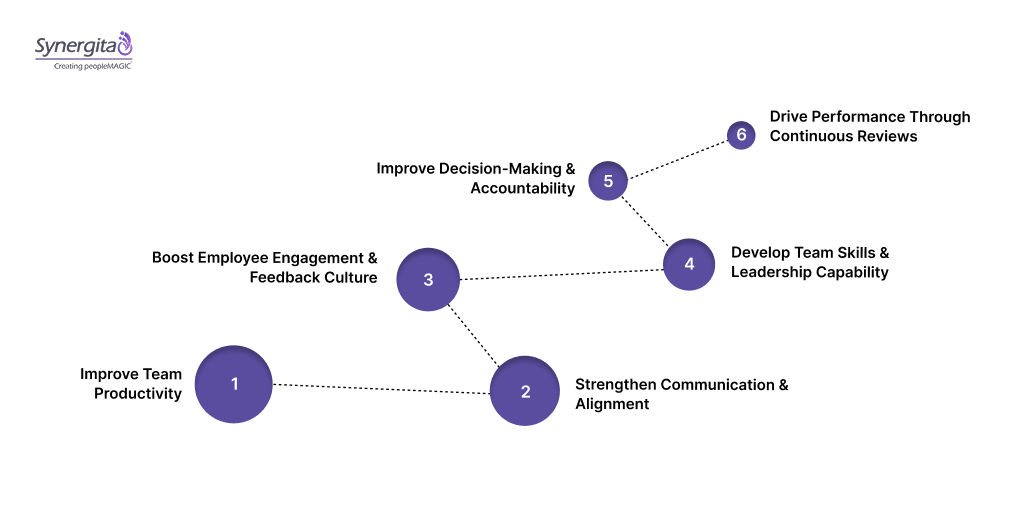
1. Improve Team Productivity
Improving productivity is a core responsibility of effective management. Productivity-focused OKRs help managers move beyond assumptions and identify where time, effort, or resources are being lost.
Objective: Increase overall team productivity and efficiency
Key Result Examples:
- Improve on-time project delivery rate from X% to Y%
- Reduce average task completion or cycle time by X%
- Identify and eliminate X recurring workflow bottlenecks
Why This OKR Works: Productivity-focused OKRs give managers clear visibility into how work is getting done. By measuring delivery timelines and workflow efficiency, managers can pinpoint delays, remove obstacles, and optimize processes, leading to more predictable outcomes and better use of team capacity.
2. Strengthen Communication and Alignment
Clear communication and strong alignment are essential for effective execution. When teams understand priorities and dependencies, managers can reduce confusion and improve coordination across the organization.
Objective: Improve clarity and alignment across teams
Key Result Examples:
- Increase participation in structured alignment or planning meetings to X%
- Reduce cross-team miscommunication incidents by X%
- Improve internal clarity and collaboration survey scores by X%
Why This OKR Works: Alignment-driven OKRs help break down silos by making goals and expectations visible across teams. When objectives and progress are shared, teams can coordinate efforts more effectively, reducing execution delays and minimizing rework caused by miscommunication.
3. Boost Employee Engagement and Feedback Culture
Employee engagement is a strong indicator of long-term performance and retention. Management OKRs focused on engagement help leaders build trust, motivation, and accountability through consistent feedback.
Objective: Build a more engaged and motivated workforce
Key Result Examples:
- Improve employee engagement survey scores by X%
- Increase the number of meaningful feedback or one-on-one conversations per quarter
- Reduce voluntary employee attrition by X%
Why This OKR Works: Engagement and feedback-focused OKRs enable managers to identify morale issues early and respond proactively. Regular feedback strengthens relationships, improves performance, and creates a culture where employees feel valued and supported, key factors in management success.
4. Develop Team Skills and Leadership Capability
Building skills and future leaders is a critical part of effective management. Skill-focused OKRs ensure teams are equipped to meet both current and future business demands.
Objective: Strengthen team skills and build future leadership capacity
Key Result Examples:
- Create individual development plans for 100% of team members
- Deliver X skill-building or leadership development sessions per quarter
- Improve proficiency levels in critical skill areas by X%
Why This OKR Works: This OKR helps managers systematically invest in growth and capability building. By tracking development progress, managers can identify skill gaps early, support career growth, and build a stronger leadership pipeline.
5. Improve Decision-Making and Accountability
Effective execution depends on timely decisions and clear ownership. Decision-focused OKRs help managers empower teams while maintaining accountability.
Objective: Enable faster and more accountable decision-making
Key Result Examples:
- Reduce average decision turnaround time by X%
- Clearly define and document ownership for key processes
- Reduce escalations and approval bottlenecks by X%
Why This OKR Works: This OKR clarifies who is responsible for what, reducing delays and confusion. Clear ownership and measurable outcomes help teams act decisively while ensuring accountability at every level.
6. Drive Performance Through Continuous Reviews and Coaching
Continuous performance management is essential for sustained improvement. This OKR helps managers move beyond annual reviews to ongoing development and performance optimization.
Objective: Build a high-performance culture through continuous performance management
Key Result Examples:
- Conduct regular one-on-one performance discussions with all direct reports
- Achieve X% completion rate for performance check-ins or reviews
- Improve individual and team performance outcomes quarter over quarter
Why This OKR Works: Continuous reviews and coaching allow managers to provide timely feedback, address performance gaps early, and reinforce positive behaviors. This approach drives consistent improvement and strengthens overall team performance.
5 Common Mistakes to Avoid with Management OKRs
While OKRs are a powerful management tool, they can lose effectiveness if implemented incorrectly. Avoiding these common mistakes helps managers maintain focus, accountability, and measurable impact.
1. Setting Too Many Objectives at Once: One of the most common mistakes managers make is trying to tackle too many objectives in a single cycle. Too many objectives dilute focus and overwhelm teams. Effective OKRs prioritize a small number of high-impact goals that teams can realistically achieve.
2. Writing Vague or Activity-Based Key Results: Key results should measure outcomes, not activities. When key results are vague or task-oriented, it becomes difficult to assess success objectively. Strong key results are specific, measurable, and clearly tied to meaningful results.
3. Treating OKRs as Task Lists or KPIs: OKRs are not meant to replace daily task management or static KPIs. Using OKRs as task lists limits strategic thinking, while treating them solely as KPIs removes flexibility. Effective OKRs focus on progress and learning, not just measurement.
4. Failing to Review and Adjust OKRs Regularly: OKRs are designed to be reviewed frequently, not set and forgotten.
Without regular check-ins, managers miss opportunities to course-correct, address challenges early, and keep teams aligned as priorities evolve.
5. Ignoring Feedback and Performance Insights: Feedback and data are essential for continuous improvement. Ignoring performance insights or employee feedback reduces the value of OKRs. Managers should use these inputs to refine objectives, support teams, and improve outcomes over time.
How Technology Supports Successful OKR Execution
Executing OKRs effectively requires more than well-written objectives; it requires the right systems to track, measure, and adapt them consistently. Technology plays a crucial role in helping managers operationalize OKRs and sustain performance over time.
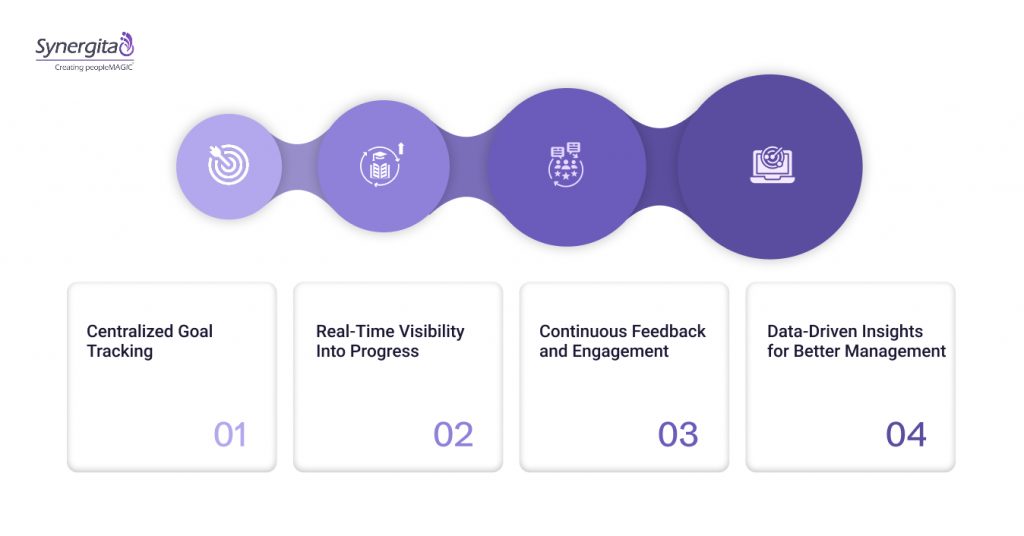
1. Centralized Goal Tracking
Centralized goal tracking ensures that organizational, team, and individual OKRs are managed in one place.
This eliminates fragmented spreadsheets and disconnected tools, making it easier for managers to monitor progress, maintain alignment, and ensure accountability across teams.
2. Real-Time Visibility Into Progress and Performance
Technology enables real-time tracking of OKR progress through dashboards and performance metrics.
With up-to-date visibility, managers can quickly identify risks, address delays, and keep teams focused on achieving key results without waiting for end-of-cycle reviews.
3. Continuous Feedback and Engagement Tracking
Modern OKR tools support ongoing feedback and engagement tracking alongside goal progress.
This allows managers to link performance conversations, coaching, and recognition directly to OKRs, helping teams stay motivated and engaged throughout the cycle.
4. Data-Driven Insights for Better Management Decisions
Technology transforms OKR data into actionable insights. By analyzing performance trends, completion rates, and engagement data, managers can make informed decisions, optimize resource allocation, and continuously improve execution strategies.
Implement Management OKRs Effectively with Synergita
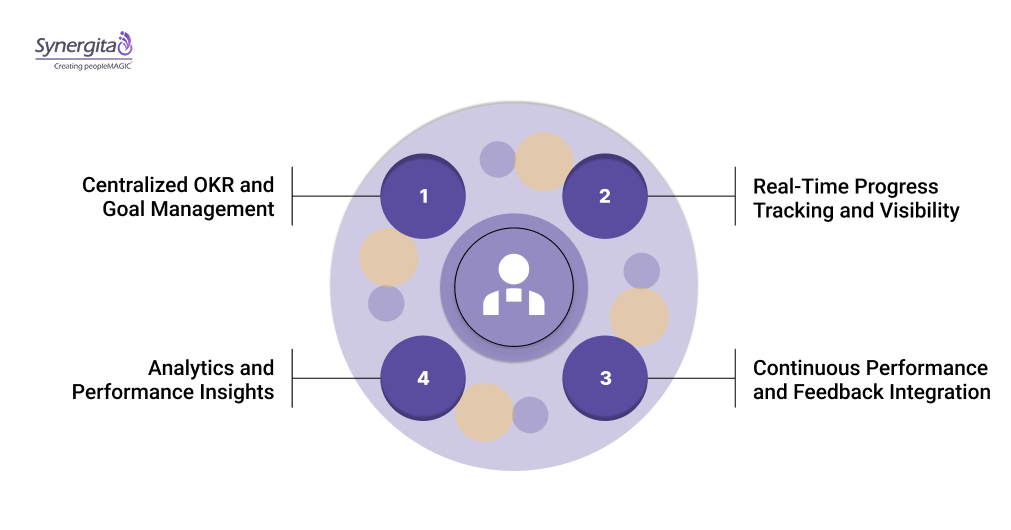
Defining strong OKRs is only the first step; successful execution requires consistent tracking, visibility, and performance support. Synergita provides an integrated platform designed to help organizations manage OKRs as part of a broader performance management process.
1. Centralized OKR and Goal Management
Synergita enables organizations to create, align, and cascade OKRs across organizational, team, and individual levels. By managing goals in a centralized system, managers can ensure alignment with business priorities while maintaining clarity and ownership at every level.
2. Real-Time Progress Tracking and Visibility
The platform provides real-time visibility into OKR progress through structured tracking and dashboards. This allows managers to monitor performance continuously, identify gaps early, and take corrective action without waiting for end-of-cycle reviews.
3. Continuous Performance and Feedback Integration
Synergita integrates OKRs with continuous performance management features such as regular check-ins, feedback, and performance conversations. This connection helps managers link goal progress with ongoing development and employee engagement, reinforcing accountability throughout the OKR cycle.
4. Analytics and Performance Insights
With built-in reporting and analytics, Synergita helps managers analyze goal progress, performance trends, and engagement data. These insights support informed decision-making and enable leaders to improve execution, alignment, and overall management effectiveness.
By combining OKR management with continuous performance tracking and feedback, Synergita supports organizations in turning management goals into measurable, sustainable outcomes.
Conclusion
Effective management requires clear priorities, measurable goals, and continuous alignment. When used well, management OKRs help leaders drive focus, accountability, and consistent execution across teams.
The examples in this blog show how OKRs can improve productivity, alignment, engagement, and performance. However, sustained success depends on how effectively these goals are tracked and supported over time.
By combining OKR management with continuous performance tracking and insights, Synergita helps organizations move from goal-setting to goal achievement.
Book a demo with Synergita to see how its OKR and performance management platform can help you build aligned, high-performing teams.
FAQ
1. Can OKRs replace performance reviews?
OKRs do not replace performance reviews but complement them. They support continuous tracking and feedback, making performance conversations more objective and ongoing.
2. How are management OKRs different from individual OKRs?
Management OKRs focus on team performance, alignment, and outcomes, while individual OKRs address personal responsibilities. Together, they ensure organizational goals cascade effectively across all levels.
3. Why are OKRs important for managers?
OKRs help managers clarify priorities, align teams, and measure success objectively. They replace assumptions with data-driven insights and support consistent performance tracking.
4. How many OKRs should a manager set per cycle?
Managers should typically set 3–5 objectives per cycle. Limiting OKRs helps maintain focus and ensures teams can realistically achieve meaningful outcomes.
5. How often should management OKRs be reviewed?
Management OKRs should be reviewed regularly, usually weekly or bi-weekly. Frequent check-ins allow managers to identify risks early and make timely adjustments.