
The strategy was right. The team was capable. And yet the execution failed. There were hundreds of small moments where culture impacted execution. So what goes wrong when execution starts to drift?
| TL;DR: The 30-Second Takeaway Problem: Around 70% of strategic transformations fail not because the strategy is wrong, but because the organization’s culture cannot execute it. (McKinsey) Shift: High-growth companies treat culture as a system that shapes decisions and execution. Fix: Ensure leadership actions, rewards and decisions all support your strategies. Keep reading to: Understand the impact of organizational culture on business strategy. |
A McKinsey research shows that 70% of strategic transformations fail, and 70% of those failures are directly linked to culture-related issues rather than flaws in the strategy itself. The same research identifies the most common barriers as employee resistance and insufficient management support.
A strong strategy alone is not enough to turn plans into results or bridge the gap between planning and execution. What makes the difference is developing an organizational culture that supports those goals.
While strategies may be documented on paper, culture is reflected in everyday actions, and when the two are misaligned, it impacts execution.
| Table of Contents 1. Why Do Most Business Strategies Fail in Execution 2. 4 Key Impacts of Organizational Culture on Strategy Execution 3. The Culture-Strategy Alignment Framework 4. How Strong Organizational Culture Transforms Business 5. Culture vs Strategy: Which is More Important 6. Culture–Strategy Alignment Audit 7. Final Takeaway 8. FAQs |
Why Do Most Business Strategies Fail in Execution?
Misalignment between corporate culture and strategy is one of the most common causes of execution failure. It happens in daily workflows, weekly meetings, and the moment someone decides not to escalate a problem.
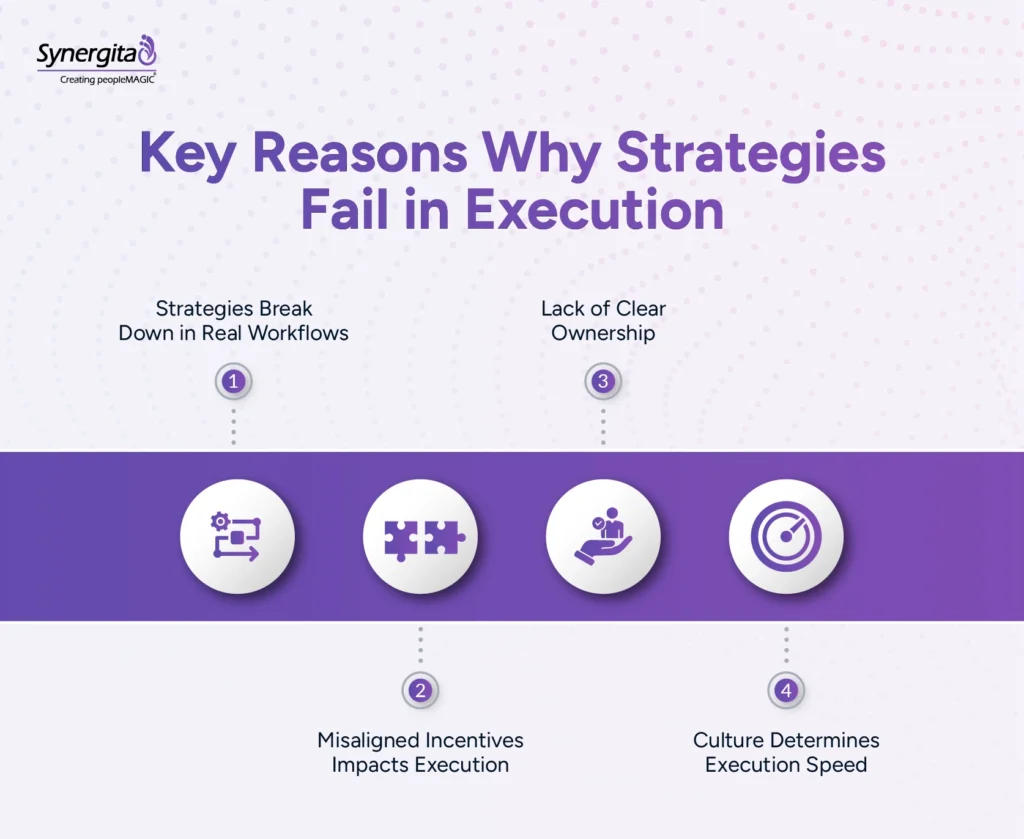
1. Strategies Break Down in Real Workflow
A strategy that depends on cross-team collaboration can’t be effective in a culture that rewards individual ownership. It means the strategy is not the problem; the way teams work does not support it.
This usually reflects in everyday work:
- Teams focus more on their own targets than the overall strategy
- Legal approvals slow down decisions that should move faster
- Middle management reshapes the message before it reaches front-line teams
2. Misaligned Incentives ImpactExecution
If rewards are given based on individual performance but the strategy needs teamwork, people will focus on their own goals. Incentives impact employee behavior that determines execution.
Here are the impacts:
- Short-term incentives shift focus from long-term account goals.
- Fear of failure discourages experimentation and new ideas
- Promotion criteria that ignore execution quality impacts accountability.
3. Lack of Clear Ownership
Most of the strategies fail because of a lack of ownership of the outcome. When accountability is distributed across multiple people, decision-making gets delayed and execution slows down.
The result is:
- Multiple stakeholders but no clear decision-maker.
- Teams assume “someone else” is responsible.
4. Culture Impacts Execution Speed
Execution speed reflects how decisions are made and how easily teams take action. Two companies can have the same strategy, but the one that acts faster will see results sooner.
4 Key Impacts of Organizational Culture on Strategy Execution
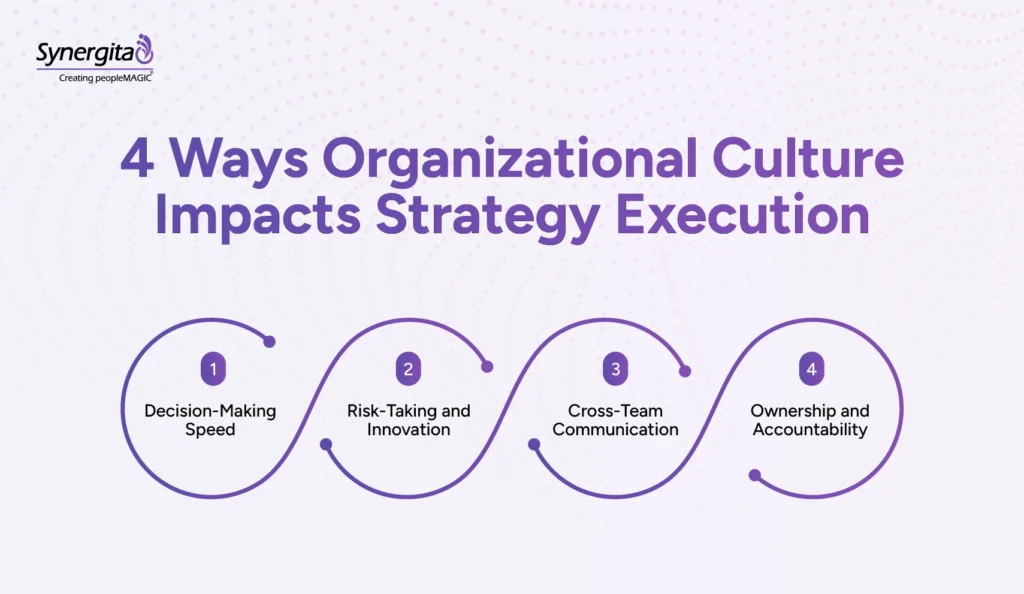
1. Decision-Making Speed
In high-ownership cultures, teams take better strategic decisions quickly because decision-making authority is clear and teams don’t need to wait for approvals at every step. In low-ownership cultures, every decision escalates, burning time and slowing strategy execution.
2. Risk-Taking and Innovation
A strategy may call for bold decisions and experimentation, but that only works when the workplace culture supports it. If mistakes are treated negatively, employees are more likely to choose safe, predictable actions, regardless of what the strategy encourages.
3. Cross-Team Communication
Strategies that require information sharing don’t work in cultures where knowledge is power. Poor communication culture directly impacts strategic alignment.
4. Ownership and Accountability
In a high-accountability culture, strategies are executed faster because ambiguity about ownership is low. When everyone knows what they are accountable for, they focus on completing the work instead of waiting for others.
The Culture-Strategy Alignment Framework
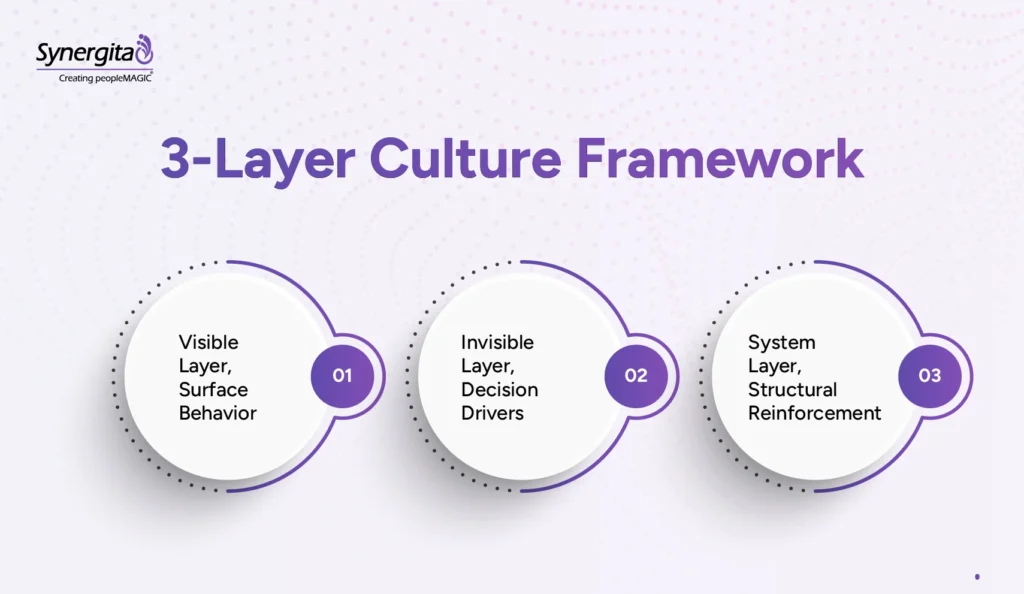
Most culture fixes focus on what is visible. The real issues are usually under the surface. Here is a simple model that helps you identify where your culture is actually affecting strategy execution.
1. Visible Layer, Surface Behavior
This is what anyone walking into the organization would notice first. How decisions are communicated, how conflicts are raised and addressed, how fast feedback moves between teams. It affects day-to-day execution speed but only fixing it will not fix the deeper problem.
2. Invisible Layer
This is where most strategy failures come from. Risk tolerance, approval dependency, and level of ownership can be tracked here. You cannot see them in a meeting but can feel them in how long decisions take and who makes them.
3. System Layer, Structural Reinforcement
Decisions related to incentives, promotion, hiring criteria, and leadership behavior come under this layer. It is the hardest layer to change because it is structural.
Key Insight: The functions of organizational culture are to guide behavior, align decision-making, and strengthen execution systems. If your strategy is failing consistently, the issue is mostly in Layer 2 or Layer 3, not Layer 1. Fixing the meeting cadence will not solve a decision-related problem.
Suggested Reading: How to Change Organizational Structure?
How Strong Organizational Culture Transforms Business
A strong organizational culture directly impacts how teams make decisions, work together, and deliver results.
1. Faster Execution Cycles
- Teams act faster because they don’t need approval for every decision
- They can act on insights as soon as they see them, instead of waiting
- When priorities change, teams adapt quickly without any delay
2. Higher Retention, Lower Hiring Costs
- A strong culture reduces the cost of replacing top performers, which is 50% to 200% of their annual salary.
- Cultural clarity attracts the right candidate, helping you hire people who fit the role.
3. Stronger Brand Positioning
- Employees in high-performance cultures solve customer problems faster.
- Customers get the same experience every time they interact with your team.
- Over time, this culture becomes an advantage that competitors can’t replicate.
Culture vs Strategy: Which is More Important?
Explore the table below to see how culture and strategy interact, where each one drives performance, and when one tends to outweigh the other in real‑world outcomes.
| Dimension | Strategy | Culture |
| Sets direction | Yes | No |
| Controls pace | No | Yes |
| Can override the other | Rarely | Almost always |
| Visible to competitors | Yes | Hard to replicate |
| Changed by a directive | Technically yes | Never |
Strategy is a choice. Culture is a consequence. You can copy a strategy overnight but you can’t copy 10 years of behavioral norms.
Quick Audit: Is Your Culture Supporting or Blocking Your Strategy?
Here is a quick checklist to confirm whether your organizational culture supports your strategy or creates blockers.
☑ Decisions are made quickly at the right level, not escalated by default.
☑ Teams take ownership of outcomes, not just activities.
☑ Your incentive structure rewards what your strategy actually requires.
☑ Bad news reaches leadership fast, without distortion or delay.
☑ Employees can describe the company strategy without prompting.
☑ Promotion decisions reflect cultural and strategic priorities.
☑ Change initiatives meet adoption, not passive resistance or performative compliance.
How OKRs Align Culture with Strategy Execution
Organizational culture can support strategy when it is reflected in everyday work. Objective and key results (OKRs) translate strategy into clear goals, define ownership, and connect work across teams. Let’s look at how OKRs ensure that what leadership sets as direction is implemented in teams’ day-to-day operations.
- Turn Strategy into Action: Company priorities are broken down into clear, measurable objectives that teams can execute.
- Ownership Becomes Clear: Every goal has an owner, which reduces ambiguity and delays in decision-making.
- Ensure Teams Stay Aligned: Teams can see how their work connects to larger business outcomes, ensuring every team works toward a common goal.
- Monitor Progress: OKRs help you track progress, identify gaps early, and course correct more effectively. An AI-powered OKR software automates tracking, detects risks early, and simplifies goal management.
Final Takeaway
Organizational culture controls the decision-making process, strategy execution speed, accountability, and how fast a company adapts to the changing business demands. Strategy without cultural alignment is just a document.
Successful organizations are the ones where culture supports strategy execution, and OKRs help align both. If you are looking to bring clarity, accountability, and faster execution, try Synergita OKR software.
Start a free trial of Synergita OKR to align your culture with your strategy and turn plans into measurable outcomes.
Frequently Asked Questions
Organizational culture in business is the shared set of values, beliefs, and behaviors that guide how people work and interact every day.
Organizational culture shapes how people behave, make decisions, and work together, directly affecting teams’ performance, innovation, and profitability.
A strong culture improves employee engagement, productivity, and retention, driving higher efficiency, innovation, and stronger financial results over time.
Culture sets shared norms and expectations, guiding how employees act, communicate, and respond to customers and colleagues.
Culture shapes decision‑making, execution speed, and alignment with strategy, thereby determining whether strategy actually works in practice.
Culture and strategy are deeply linked: culture supports or limits the implementation and sustainability of a strategy.