
Your strategy looks perfect on paper, and your team is working hard. But somehow, goals still get missed, priorities still drift, and nobody can explain why. The problem could be the framework your organization is using.
TL;DR- The 30-Second Takeaway
The Problem: Most organizations pick a strategy framework based on what sounds good, then struggle with adoption because the tool doesn’t fit how they actually work.
The Reality: OKR scores are built for speed and focus. The Balanced Scorecard (BSC) is built for breadth and stability. Using the wrong one is like navigating with the wrong map.
The Fix: Match your framework to your organization’s current stage, pace, and culture, or combine both with an OKR tool like Synergita that handles the scoring, tracking, and alignment for you.
According to Robert Kaplan and David Norton, the researchers behind the Balanced Scorecard, 90% of organizations fail to execute their strategies successfully.
When organizations don’t have a clear system to turn strategy into measurable outcomes, it becomes difficult for teams to stay aligned on priorities and goals. That’s where the OKRs vs balanced scorecard discussion becomes important.
Both goal setting frameworks solve this problem, but they approach it in different ways. In this guide, we will explain objective and key results (OKRs) vs balanced scorecards and help you choose the right one to turn strategy into action.
| Table of Contents 1. What Is an OKR Score and How Does OKR Scoring Work? 2. What Is the Balanced Scorecard Framework? 3. OKR vs Balanced Scorecard: Key Differences 4. OKR vs BSC: Which Framework Fits Your Organization? 5. How to Use OKRs and Balanced Scorecard Together Effectively 6. How OKR Management Software Simplifies OKR Scoring and Performance Tracking 7. Final Takeaway 8. Frequently Asked Questions |
What Is an OKR Score and How Does OKR Scoring Work?
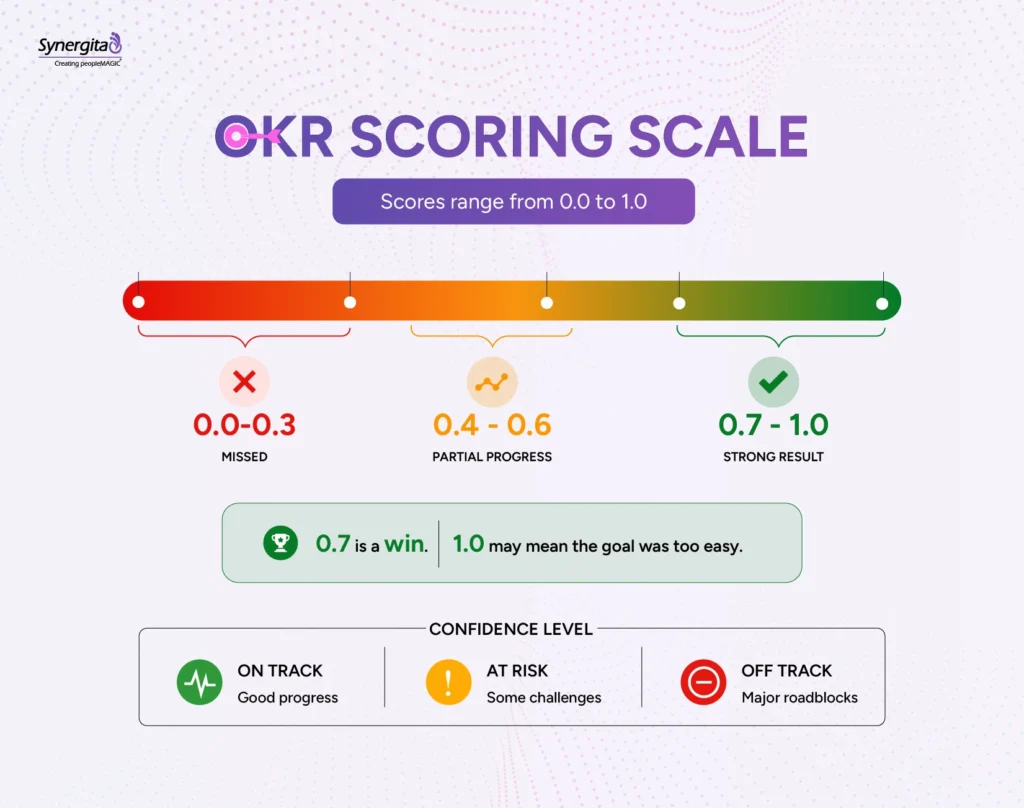
An OKR score measures how successfully a Key Result is achieved, usually on a scale from 0.0 to 1.0. This helps teams track progress, alignment, accountability, and goal performance.
Here’s the quick breakdown:
- 0.0–0.3: Missed. The goal wasn’t reached.
- 0.4–0.6: Progress was made, but fell short.
- 0.7–1.0: Strong result.
The OKR scoring system is designed to encourage teams to set ambitious goals. A score of 0.7 indicates success because it means the team made strong progress toward a challenging goal. Consistently scoring 1.0 indicates that targets need to be more challenging.
What Is the Balanced Scorecard Framework?
The Balanced Scorecard (BSC) is a strategic management framework that helps businesses measure performance across four perspectives:
- Financial: Revenue, profitability, ROI
- Customer: Satisfaction, retention, market share
- Internal Processes: Operational efficiency, quality
- Learning & Growth: Employee development, innovation
Unlike OKRs, the BSC doesn’t focus on a few big goals. It gives leaders a broad, balanced view of how the organization is performing.
The Balanced Scorecard framework depends on KPIs to measure whether each strategic area is performing well. Without KPIs, the framework would just be a list of business priorities without any measurable way to track progress.
OKR vs Balanced Scorecard: Key Differences
OKRs and the Balanced Scorecard are both strategy execution frameworks, but they work differently. Here is a quick comparison between BSC vs OKR.
| Factor | OKRs | Balanced Scorecard |
| Review Cycle | Monthly or quarterly | Annually |
| Number of Goals | 2–3 objectives, 3–5 key results each | 10–15 objectives |
| Goal Direction | Top-down and bottom-up | Primarily top-down |
| Best For | Fast-moving teams, growth-stage companies | Established organizations with complex strategy |
| Focus | Outcomes and ambitious targets | Balance across multiple business dimensions |
| Scoring | 0.0–1.0 OKR scoring system | KPI-based measurement |
A few things stand out when comparing BSC vs. OKR:
Speed
BSC usually tracks progress over a year or longer, while OKRs run in 90-day cycles, allowing faster adjustments when needed.
Scope
BSC covers financial, customer, process, and learning goals simultaneously. OKRs help you focus on what is most important right now.
Ownership shifts
BSC is mainly a top-down approach, while OKRs let teams suggest their own goals aligned with the company direction, creating stronger accountability.
OKR vs. Balanced Scorecard: Which Framework Fits Your Organization?
OKRs are ideal for growing teams that need focus, flexibility, and quick execution, while BSC is suitable for organizations that need long-term strategic tracking across multiple business areas.
Strategy execution sometimes fails when priorities, accountability, and execution are not aligned. PwC research found that 54% of organizations struggle because of the alignment gap.
Here’s a simple decision guide for the BSC vs. OKR question:
OKRs
- You’re a startup or high-growth company
- Your priorities shift frequently (quarterly or faster)
- You want cross-functional alignment without heavy overhead
- Team ownership and accountability are top priorities
- You need a lightweight OKR scorecard that scales quickly
Balanced Scorecard
- You have a large, established enterprise
- You need to track strategy across multiple business units simultaneously
- You have complex regulatory or financial reporting requirements
- Annual strategic planning is your operating model
- You need the balanced scorecard and KPI structure to satisfy board or investor reporting
Consider using both if:
- You have a mid-size business and are scaling fast
- You need short-term focus (OKRs) and long-term strategic visibility (BSC)
- Your leadership team spans both operational and financial priorities
Having said that, there’s no universal choice in the OKR vs. balanced scorecard debate. The right choice depends on your organization’s size, speed, and the kind of framework your team is comfortable with.
How to Use OKRs and Balanced Scorecard Together Effectively
Here’s how OKRs and the Balanced Scorecard can work together to balance long-term strategy with short-term execution.
- Long-term BSC objectives provide direction to the company.
- Short-term OKRs focus on weekly and monthly execution.
- KPIs from the BSC serve as benchmarks for OKR Key Results.
This hybrid approach avoids the biggest weaknesses of each framework when used on its own:
- BSC can become a slow, once-a-year process that loses urgency.
- OKRs alone can push teams to focus too much on short-term goals and miss the bigger picture.
How OKR Management Software Simplifies OKR Scoring and Performance Tracking
OKR Management Software like Synergita helps teams replace spreadsheets with a structured system for goal setting and tracking. Here’s how modern OKR software helps teams execute and track goals more effectively.
- Automated OKR scoring: Real-time OKR progress tracking with 0.0–1.0 scoring on all key results.
- AI-powered OKR tool: Unlike a spreadsheet or basic goal tracker, AI-powered OKR generation tool create ready-to-use OKRs, including recommended targets and confidence thresholds.
- Cascading alignment: OKR tools help cascade company goals to teams and individuals, ensuring everyone’s work connects to the larger goal.
- Confidence tracking: Beyond just progress, teams can flag whether a Key Result is on track, at risk, or blocked.
- Integrations: Top OKR software such as Synergita connects with Jira, Slack, and Microsoft Teams, so OKR updates live inside your team’s existing workflow.
Whether you run a pure OKR model or an OKR and BSC hybrid, Synergita helps teams manage goals, monitor progress, and stay aligned with strategic priorities.
Suggested Reading: OKR Best Practices 2026: Tips to Set and Achieve Better Goals

Final Takeaway
The Balanced Scorecard provides the strategic map, and the OKR score focuses on quarterly execution. Both frameworks together create a system that turns strategy into measurable action.
If your teams need focus, speed, and quarterly accountability, OKRs are the clearer path. If your leadership needs a broader view of strategy, BSC provides that structure. And if your business is scaling fast, the hybrid approach can be a better choice.
The next step is selecting an OKR management software to set goals, measure progress, and keep every team aligned to the business priorities.
Start free trial of Synergita OKR tool and simplify goal setting today.

Frequently Asked Questions
OKRs focus on short-term execution through measurable quarterly goals, while the Balanced Scorecard tracks long-term organizational performance across financial, customer, internal processes, and growth perspectives.
The five elements of OKRs are Objective, Key Results, OKR score (0.0–1.0 rating), confidence level (on track/at risk/off track), and a regular check-in cadence.
The four BSC perspectives are Financial, Customer, Internal Processes, and Learning and Growth. Each perspective contains specific KPIs that measure whether the overall strategy is being executed.
An OKR score rates Key Result achievement on a 0.0–1.0 scale. The objective score is typically the average of its Key Results. A score of 0.7 is generally considered a strong result.
Yes, many organizations use Balanced Scorecard and KPIs for long-term strategic tracking, while OKRs drive short-term execution, alignment, and measurable quarterly progress.
Yes. Synergita tracks Key Results on a 0.0–1.0 scale, calculates OKR scores automatically, and adds confidence-level indicators.