



Many engineering teams complete tasks consistently but still struggle with clarity on outcomes. Projects are delivered, but priorities shift, deadlines slip, and visibility into progress remains limited.
Research from McKinsey finds that companies focused on modern performance management practices are 4.2 times more likely to outperform peers and achieve higher revenue growth. This underscores why aligning engineering goals with business results matters as much as writing code.
Engineering OKRs can help your team move beyond tracking activity to focusing on measurable results such as system stability, delivery speed, and quality improvements.
This article explains why engineering OKRs matter, how to write them effectively, and provides real examples you can adapt for software, mechanical, and other engineering disciplines.
Key Takeaways
- Focus on measurable outcomes. Engineering OKRs focus your team’s efforts on measurable outcomes, not just tasks, turning activity into impact.
- Keep OKRs simple and aligned. Good OKRs are simple, quantifiable, and aligned with strategic priorities like reliability, delivery speed, or quality.
- Learn from real examples. Examples span performance, productivity, security, and team growth, giving you ready-to-use templates.
- Make progress visible. Tools like Synergita help your team track, align, and improve OKRs seamlessly across every project.
What Engineering OKRs Are, and Why They Matter
Engineering OKRs are a structured way to connect your team’s technical work with measurable business outcomes. They define what your engineering team wants to achieve and how progress will be measured, turning broad goals into clear, trackable results.
An Engineering OKR consists of:
- An Objective: A clear, outcome-focused goal that drives improvement or change.
- Key Results: Quantifiable metrics that indicate whether the objective is being achieved.
For example, an engineering objective might be “Improve release reliability,” with key results such as “Reduce deployment failures by 30%” and “Increase uptime to 99.9%.”
Unlike general OKRs, Engineering OKRs focus on operational performance, areas like release speed, code quality, infrastructure stability, or defect reduction. They help engineering teams move from task-based tracking to outcome-based accountability.
How Engineering OKRs Differ From KPIs
While both use metrics to track performance, they serve different roles in an engineering lifecycle: KPIs measure the health of your current systems, while OKRs drive strategic improvement.
- KPIs: These track ongoing stability and “business as usual” metrics (e.g., maintaining a 99.9% uptime SLA).
- OKRs: These define a specific, time-bound shift in performance (e.g., increasing uptime from 95% to 99.9% to support a new enterprise client).
Engineering OKRs focus on measurable outcomes that align with strategic priorities like reliability, performance, and velocity, not just task lists.
Why Engineering OKRs Matter
Engineering OKRs bring focus and clarity to teams that deal with complex systems and shifting priorities. They translate technical execution into measurable progress, helping leaders and engineers stay aligned on what truly drives value.
1. Aligns Team Work With Business Outcomes: OKRs connect engineering priorities to strategic goals such as faster releases or fewer incidents.
2. Improves Focus: By limiting objectives per cycle, your team avoids overcommitment and maintains clear priorities.
3. Encourages Accountability: Measurable key results make progress observable, reducing ambiguity in performance evaluation.
4. Drives Data-Informed Decisions: Clear metrics help you assess progress objectively and adjust course without guesswork.
Engineering OKRs give your team visibility, accountability, and direction. When everyone understands how their work impacts outcomes that matter, progress becomes measurable and intentionally guided.
If you’re new to OKRs, read our detailed OKR Guide: Types, Benefits, Implementation & Best Practices for a deeper understanding of how OKRs fit into organizational success.
Engineering OKR Best Practices
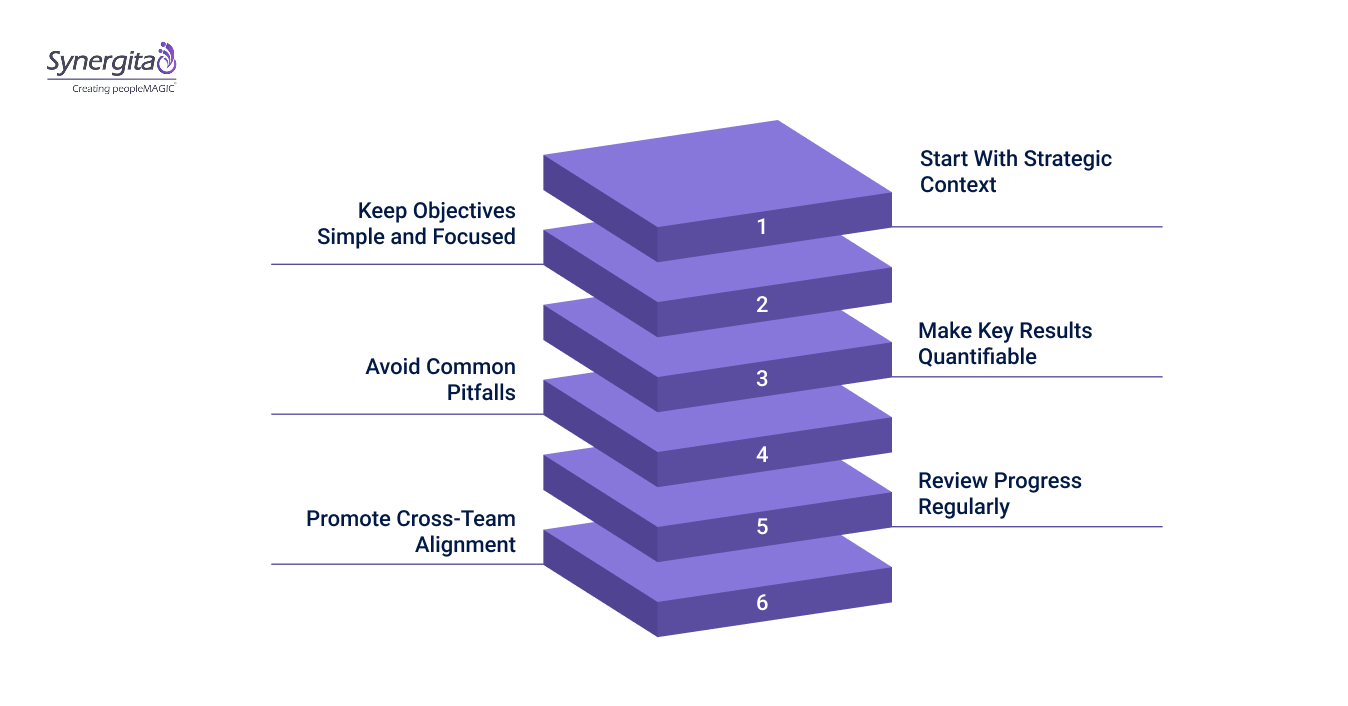
Good OKRs help your engineering team focus on what matters most. Poorly written ones create confusion and waste time. These best practices will help you define OKRs that are clear, measurable, and aligned with your company’s goals.
1. Start With Strategic Context
Before writing any OKR, define the why. Ask:
- What larger company outcome should this support?
- How does it improve customer experience or product reliability?
For example, if the company’s goal is to reduce churn, your engineering OKR might focus on improving system uptime or reducing production defects. Context ensures every technical goal connects to measurable business results.
2. Keep Objectives Simple and Focused
Engineering teams handle complex systems, but your OKRs should not be complex. Follow these rules:
- Limit to 2–3 objectives per quarter.
- Each objective should describe a single desired outcome, not a list of activities.
- Make objectives action-oriented (e.g., “Improve release stability,” not “Manage release process”).
Simplicity drives focus and prevents teams from spreading efforts too thin.
3. Make Key Results Quantifiable
Key Results define how success is measured. Each should:
- Use numerical metrics or percentages.
- Show a clear before and after state.
- Avoid words like “improve,” “enhance,” or “optimize” without measurable targets.
Example:
- ❌ Vague: “Improve code quality.”
- ✅ Specific: “Reduce code defects by 20%” or “Increase automated test coverage to 85%.”
Measurable Key Results remove ambiguity and make performance transparent.
4. Avoid Common Pitfalls
Engineering OKRs often fail when they:
- Describe tasks instead of outcomes (e.g., “Deploy new service” vs. “Reduce deployment time by 30%”).
- Lack ownership, assign each Key Result to a responsible person or team.
- When mixing personal performance goals with team OKRs, they should focus on collective outcomes.
5. Review Progress Regularly
OKRs are not set-and-forget goals. Track them consistently:
- Weekly or bi-weekly check-ins keep momentum.
- Use confidence scoring (Red / Yellow / Green or 0–1 scale).
- Discuss blockers early so adjustments happen mid-cycle, not after deadlines.
Regular reviews create visibility and accountability across teams.
6. Promote Cross-Team Alignment
Engineering rarely works in isolation. Align OKRs with Product, QA, and DevOps teams to ensure shared ownership of results like uptime, release speed, and user experience.
When OKRs connect across departments, your team contributes to outcomes that truly matter, faster delivery, and higher quality.
For a detailed walkthrough of OKR setup, watch ourOKR Masterclass Video and see how structured goal management transforms engineering performance.
Real Engineering OKR Examples
Effective OKRs give engineering teams measurable clarity and focus. Below are practical OKR sets you can adapt for your team, divided by key performance areas.
A. Software Engineering OKRs
1. Performance & Reliability
Objective: Improve platform uptime to 99.9%.
Key Results:
- Reduce average downtime from 2 hours → 30 minutes per incident.
- Increase mean time between failures (MTBF) by 25%.
- Reduce deployment rollback frequency by 50%.
2. Productivity & Delivery
Objective: Accelerate release velocity.
Key Results:
- Increase deployment frequency from weekly → daily.
- Cut average cycle time per feature by 20%.
- Automate 90% of regression test execution in the CI/CD pipeline.
3. Quality & Testing
Objective: Enhance code reliability.
Key Results:
- Raise automated test coverage from 60% → 85%.
- Reduce escaped defects in production by 40%.
- Maintain fewer than 5 critical bugs open at the end of each sprint.
4. Security & Compliance
Objective: Reduce vulnerabilities in core systems.
Key Results:
- Patch critical security issues within 24 hours of detection.
- Achieve 100% compliance with the internal security checklist.
- Conduct quarterly penetration testing with zero critical findings.
5. Team Growth & Process
Objective: Build a stronger engineering culture.
Key Results:
- Conduct 3 peer-review sessions per sprint.
- Implement a new onboarding plan, reducing ramp-up time by 25%.
- Organize monthly knowledge-sharing sessions across development teams.
B. Mechanical Engineering OKRs
1. Product Reliability & Performance
Objective: Improve equipment reliability for manufacturing lines.
Key Results:
- Reduce unplanned machine downtime by 15%.
- Extend the mean time between maintenance cycles by 10%.
- Achieve 99% accuracy in calibration audits.
2. Production Efficiency
Objective: Optimize production speed and throughput.
Key Results:
- Increase output per shift by 12% without overtime.
- Reduce energy consumption per unit produced by 10%.
- Shorten tool-change time from 12 minutes → 8 minutes.
3. Quality & Testing
Objective: Strengthen product quality during prototype and production phases.
Key Results:
- Reduce prototype defect rate by 25% through design validation.
- Implement automated quality inspections on 100% of parts produced.
- Lower customer-reported product issues by 30% within the next quarter.
4. Safety & Compliance
Objective: Improve workplace safety and regulatory compliance.
Key Results:
- Achieve zero safety incidents for two consecutive quarters.
- Complete compliance audits on all active production lines with no major non-conformities.
- Train 100% of operators on the new safety standard (ISO 45001).
C. DevOps Engineering OKRs
1. Deployment & Reliability
Objective: Improve deployment reliability across environments.
Key Results:
- Increase successful deployments from 90% → 98%.
- Reduce the average rollback rate by 50%.
- Automate environment provisioning for all new releases.
2. Incident Response & Recovery
Objective: Strengthen system resilience and recovery speed.
Key Results:
- Reduce Mean Time To Recovery (MTTR) from 60 → 20 minutes.
- Implement real-time monitoring for 100% of critical services.
- Conduct monthly chaos testing to validate incident readiness.
D. Quality Assurance (QA) OKRs
1. Testing Coverage & Efficiency
Objective: Increase testing accuracy and reduce release defects.
Key Results:
- Raise automated test coverage from 70% → 90%.
- Reduce escaped bugs per release by 35%.
- Decrease manual regression testing effort by 40% through automation.
2. Process Improvement
Objective: Enhance collaboration between QA and development teams.
Key Results:
- Introduce shared test documentation across all projects.
- Conduct weekly QA-Dev review sessions for new features.
- Reduce test cycle time per sprint by 20%.
E. Cross-Functional Engineering OKRs
1. Product Collaboration
Objective: Strengthen alignment between Engineering and Product teams.
Key Results:
- Maintain 100% alignment of engineering OKRs with product roadmaps.
- Conduct quarterly joint retrospectives for OKR evaluation.
- Reduce scope creep by 25% through early cross-team reviews.
2. Continuous Improvement & Innovation
Objective: Foster a culture of engineering excellence.
Key Results:
- Host bi-monthly innovation sprints for process improvement ideas.
- Implement at least 3 engineer-driven efficiency initiatives per quarter.
- Document and share learnings from every completed OKR cycle.
Looking to explore how different functions align their OKRs? Visit our OKR Library for goal examples across Sales, Marketing, Finance, and Product teams.

How to Track, Score, and Improve Engineering OKRs
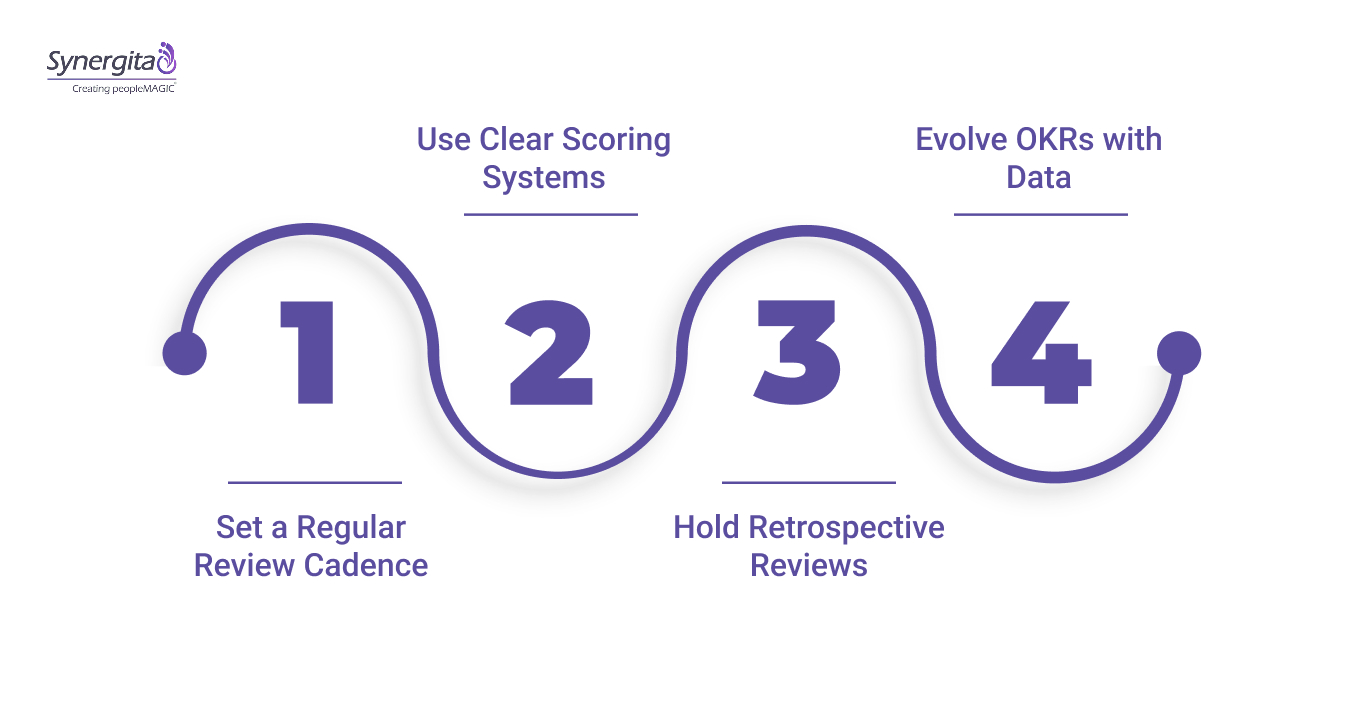
Setting OKRs is only half the process; tracking and improving them determines success. Consistent monitoring helps teams identify progress, bottlenecks, and opportunities for learning.
1. Set a Regular Review Cadence
Engineering teams benefit from predictable reviews.
- Hold weekly or bi-weekly check-ins to update progress and discuss blockers.
- Keep meetings short and data-based — progress, confidence level, next step.
- Encourage transparent reporting rather than perfect results.
Tip: Schedule OKR check-ins alongside sprint reviews to minimize meeting fatigue.
2. Use Clear Scoring Systems
Quantify progress to create visibility and accountability. Common methods include:
- Numeric Scoring (0.0–1.0): Assign each Key Result a value.
- 0.0–0.3: Off track
- 0.4–0.6: Making progress
- 0.7–1.0: Achieved
- Confidence Colors:
- 🟥 Red – At risk
- 🟨 Yellow – Needs attention
- 🟩 Green – On track
This makes performance visible without subjectivity.
3. Hold Retrospective Reviews
At the end of each OKR cycle:
- Evaluate achievements and gaps for every Key Result.
- Identify what helped progress and what slowed it down.
- Carry key insights into the next planning cycle.
Retrospectives ensure OKRs evolve with your team, not repeat past mistakes.
4. Evolve OKRs with Data
Use historical OKR data to refine targets. If deployment frequency improved 30%, the next objective might focus on reducing post-release issues.
Data keeps your OKRs ambitious but realistic, a foundation for continuous improvement.
For insights on applying OKRs across functions, check out our article on How to Design Effective OKRs for Departments.
Tools & Techniques That Make OKRs Work for Engineers
Engineering teams thrive on automation and visibility. Manual OKR tracking through spreadsheets quickly becomes unmanageable as teams scale. Using the right tools helps your team focus on progress, not paperwork.
1. Integrate OKRs with Existing Workflows
Link OKRs directly to the systems your team already uses:
- Jira or GitHub: Sync goals with issues, pull requests, and sprint progress.
- Microsoft Teams or Slack: Share automated updates and goal reminders.
- CI/CD Tools: Map deployment and test metrics to key results automatically.
These integrations remove the gap between tracking and doing.
2. Visualize Progress in Real Time
Use dashboards that display OKR status at a glance.
- Include indicators like confidence levels, completion percentages, and upcoming risks.
- Group metrics by team, function, or objective.
A clear visual summary helps leadership and engineers align decisions quickly.
3. Automate Reporting and Reminders
Automation ensures consistency.
- Send weekly progress nudges to owners.
- Auto-update results from data sources such as build pipelines or monitoring tools.
- With automation, OKR tracking becomes part of dathe ily engineering rhythm rather than an added chore.
Also Read: 10 Best OKR Software for Startups in 2026
How Synergita Supports Engineering OKRs
Once your OKRs are defined, the real challenge begins: tracking progress, keeping goals visible, and turning data into decisions.
Engineering teams often struggle with fragmented updates and manual follow-ups. Synergita helps solve this by bringing everything together in one place.
OKR Management Made Simple
Synergita’s OKR module lets engineering teams set, align, and track objectives across individuals, teams, and the organization.
- Cascading OKRs ensure your sprint goals align directly with company outcomes.
- OKR Buddy (AI Assistant) suggests measurable goals and keeps progress on track.
- Integrations with Jira, Slack, and Microsoft Teams connect goals with the tools your engineers already use.
- Custom dashboards visualize progress in real time, uptime, defect reduction, release velocity, and more.
Performance & Development
Through its Perform module, Synergita enables engineering managers to run continuous feedback loops, automate performance reviews, and identify high-potential contributors.
- Configure review workflows to fit your existing process.
- Use 9-box grids and SWOT analytics to assess technical growth and readiness.
- Automate appraisal cycles with zero disruption to active projects.
Engagement & Culture
Synergita’s Engage module helps you maintain motivation and recognition within your technical teams.
- Collect real-time feedback through pulse surveys.
- Track engagement scores and spot perception gaps.
- Enable recognition programs to celebrate milestones and collaborative wins.
Together, these modules form a complete performance ecosystem, helping engineering leaders align strategy, execution, and culture under one digital framework.
See how real teams drive alignment with Synergita in our case study: Growth Stage Company Creates Alignment With Synergita OKR.
Conclusion
When engineering teams measure what matters, they stop chasing endless tasks and start delivering predictable results. OKRs create alignment between your technical goals and business outcomes, reducing downtime, improving delivery speed, and strengthening accountability.
Yet, maintaining focus and visibility across projects, people, and priorities can be difficult without the right system.
Synergita simplifies that process. It connects your OKRs, performance reviews, and engagement insights into one clear dashboard, helping every engineer see how their work drives progress.
If your goal is to make engineering performance measurable, transparent, and aligned with strategy.
Start your free trial of Synergita and turn every objective into a tangible, trackable business outcome.

FAQs
1. What’s the difference between KPIs and OKRs?
KPIs track ongoing performance, while OKRs drive strategic change with time-bound goals and measurable outcomes.
2. How often should engineering OKRs be set?
Most organizations set engineering OKRs quarterly to balance focus with adaptability.
3. Should OKRs be tied to performance evaluations?
OKRs should not be directly tied to compensation or evaluations because that can discourage ambitious goals.
4. How can OKRs support remote or hybrid engineering teams?
Shared OKRs with a central dashboard increase transparency and keep distributed teams aligned asynchronously.
5. What happens if an engineering OKR isn’t met?
Missing an OKR isn’t a failure; it’s a data point that helps refine future goals and improve processes.