



Quick Takeaway
- Research shows that writing down goals increases your likelihood of achieving them by 42%, and this applies to businesses as well.
- Small businesses often struggle with misalignment and wasted effort. Tracking OKRs gives real-time visibility, helping teams stay focused on high-impact work.
- A successful OKR tracking framework includes: defining objectives, aligning teams, creating measurable Key Results, using OKR tracking software, conducting regular check-ins, and reviewing quarterly scores.
- Using spreadsheets is only effective for small teams; as businesses scale, OKR software provides dashboards, automation, progress reminders, and visibility into alignment.
Did you know that writing down goals makes you 42% more likely to achieve them? This applies not only to individuals but also to businesses. While setting objectives is easy, most small and medium-sized companies struggle to achieve them. This can lead to missed targets, misaligned efforts, and, more importantly, a waste of time and resources.
By tracking Objectives and Key Results (OKRs), your team can gain real-time visibility, maintain focus on high-impact activities, and keep alignment across the organization. So, how do you track OKRs correctly? In this comprehensive guide to OKRs, we discuss why tracking OKRs is essential and how to do it efficiently using an OKR tracking software.
| Table of Contents 1. What is OKR Tracking? 2. How to Track OKRs Successfully: A Step-by-Step Framework 3. Why is Tracking OKRs Essential for Businesses? 4. How to Avoid Common OKR Tracking Mistakes? 5. Conclusion 6. Frequently Asked Questions |
What is OKR Tracking?
OKR tracking is the process of monitoring the progress of your Objectives and Key Results to ensure that teams are working towards achieving them. Tracking OKRs involves maintaining visibility into key results, periodically reviewing progress, and making adjustments to the approach as necessary.
An effective OKR tracking system, such as Synergita OKR software, includes tools like dashboards, progress updates, and regular check-ins that help organizations see how every objective contributes to their overall strategy, improve collaboration, and provide key insights to modify strategies as needed.
How to Track OKRs Successfully: A Step-by-Step Framework
Tracking OKRs is not just about writing goals and reviewing them at quarter end. It requires a structured system that aligns teams, consistently measures progress, and keeps everyone accountable. Below is a straightforward framework small businesses can follow to track OKRs effectively.
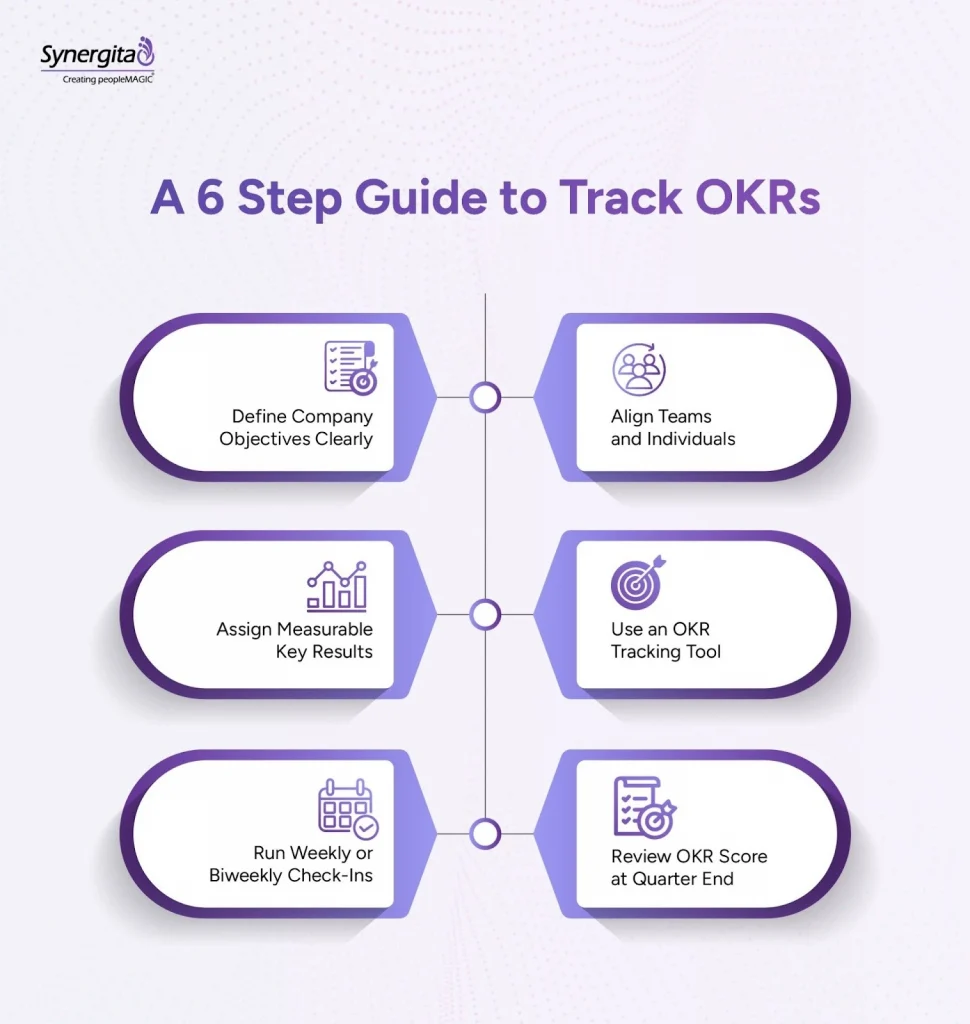
1. Define Company Objectives Clearly
Before tracking OKRs, the organization must define a set of clear, strategic objectives. These are the high-level goals that reflect what the business wants to achieve. The objectives may include increasing revenue, improving customer satisfaction, reducing churn, or expanding into new markets. These act as the foundation for every team and individual goal.
An objective should be:
- Simple to understand
- Linked to business priorities
- Time-bound and measurable
For example:
Objective: Improve customer satisfaction across all touchpoints.
A clear objective eliminates ambiguity, ensuring that everyone understands the goal.
Also Read: How to Ensure Your OKRs are Strategic?
2. Align Teams and Individuals
Once company-level objectives are set, they should cascade to departments and individuals. This ensures every employee understands how their role contributes to the larger goal. This alignment prevents teams from working in silos and increases accountability across the company.
Here is how the alignment flows from company goals to individual contributors:
- Department heads translate business objectives into team OKRs
- Individual contributors then define personal KRs aligned to their team
3. Assign Measurable Key Results
Tracking OKRs becomes ineffective if Key Results are vague or subjective. Each Objective should include two to four clearly measurable Key Results defined using numbers, percentages, or specific milestones.
Examples of measurable Key Results:
- Increase monthly recurring revenue from $20K to $30K
- Reduce customer support response time from 24 hours to 8 hours
- Acquire 500 new website sign-ups per month
Suggested Reading: OKR Examples and Templates for Better Business Performance
4. Use an OKR Tracking Tool
Many small businesses track OKRs using spreadsheets, and it works for a while when the team is small. But once the team grows, can a spreadsheet really keep up? You may face issues like missing updates, scattered data, and zero real-time visibility, which quickly become everyday problems. So, what is the solution?
The best OKR tracking software, like Synergita, automates processes like:
- Progress updates
- Weekly check-ins
- Goal alignment visibility
- Dashboard reporting
In fact, the U.S. market for OKR software was estimated at US$277.4 million in 2026 and is expected to grow at a CAGR of 13.8% over the period 2024-2030. This growth reflects the rapid adoption of OKR tracking software to streamline goal-setting and progress monitoring.
5. Run Weekly or Biweekly Check-Ins
Checking OKRs regularly keeps goals visible, strengthens accountability, and helps teams address issues before they escalate. A 30-60 minute weekly meeting can improve alignment and allow managers to correct course immediately, preventing a backlog.
OKR tracking software streamlines the process by providing visual dashboards and highlighting any bottlenecks. This ensures that meetings are actionable and results-driven, rather than just status updates.
6. Review OKR Score at Quarter End
At the end of each quarter, OKRs should be reviewed and scored objectively based on key results. A scoring scale, such as 0–100%, indicates how close each KR came to its target.
Here is how the OKR scores are interpreted:
- 60-70% achievement indicates strong progress and well-defined goals that were realistic and aligned.
- A score below 60% suggests that goals may have been misaligned or impacted by unaddressed blockers.
This scoring process is essential for continuous improvement. It helps teams identify what worked, what did not, find areas that need adjustment, and apply lessons learned to the next cycle.
Why is Tracking OKRs Essential for Businesses?
OKR tracking delivers measurable benefits for businesses, helping teams to stay aligned, accountable, and focused on high-impact priorities. Here is why OKR tracking is essential for businesses.
1. Improves Team Alignment
OKR tracking ensures all departments, from operations to customer service, are working toward the same strategic objectives. The teams collaborate effectively toward shared goals and move in the same direction.
2. Ensures Accountability
Assigning owners for each objective and tracking their progress ensures everyone knows who is responsible for specific outcomes. This transparency enables leaders to identify execution gaps early, take corrective action, and enhance team accountability.
3. Gives Real-time Visibility
Tracking OKRs in real-time ensures that leaders and teams are aware of progress. Dashboards and activity updates offer a real-time view of progress, enabling stakeholders to make informed decisions.
4. Focus on High-Impact Activities
When you track OKRs regularly, teams prioritize the critical tasks that help achieve key objectives, rather than spending time on low-impact work. The resources are also used properly, which optimizes productivity.
5. Faster Goal Achievement
Regular tracking also fosters discipline and eliminates bottlenecks, ensuring the team has a better chance of completing tasks on time. Some of the key benefits of tracking OKRs regularly include:
- Early issue detection
- Better team collaboration
- Improved planning and prioritization
- Continuous learning and improvement
How to Avoid Common OKR Tracking Mistakes?
Organizations often make the mistake of not setting measurable goals, which renders them untrackable and unachievable. This is why SMART goals are advocated: Specific, Measurable, Attainable, Relevant, and Time-bound. Here are the tips to help you track your OKRs effectively:
- Set specific goals and communicate them.
- Make your goals measurable by defining specific metrics.
- Ensure your goals are both realistic and aspirational, aligning with the company’s overall objectives.
- The goals must be relevant and revisited regularly to ensure they remain so.
- Your goals must be time-bound, adding another element of clarity.
Conclusion
Effective goal-setting is crucial to driving business growth, and consistently tracking those goals makes all the difference. If you are looking to create and track goals in your business, consider using a comprehensive OKR tool.
It enables individuals, teams, and management to stay aligned as they work toward a common goal. It also helps employees understand what they need to achieve to make a positive contribution to the company’s success.
Synergita OKR software has been one of the most effective and budget-friendly OKR tools for small and medium businesses. Powered by AI, Synergita OKR helps you track goals and provide insights to improve planning and execution. Try Synergita free for seven days and see how it streamlines OKR tracking.

Frequently Asked Questions
OKRs should be reviewed monthly or at mid-quarter checkpoints. This helps leaders identify trends, adjust priorities, and support teams before quarter-end evaluations.
Yes, Objectives and Key Results can be refined if priorities shift or unforeseen challenges arise. OKR tracking encourages agility while keeping focus on outcomes.
OKRs work for businesses of all sizes and industries. They are highly effective and valuable for small to medium-sized companies looking to align teams and achieve their goals effectively.
Yes, regularly tracking goals gives employees clarity on expectations and a sense of ownership, which boosts engagement and accountability. Synergita OKR allows you to set team and individual responsibilities and track them easily.
Yes, Synergita integrates with popular business tools, such as MS Teams, Slack, and Jira, as well as HRIS platforms including ADP, BambooHR, Hibob, HR Cloud, SAP, and Workday.