



Most managers don’t start micromanaging because they want control. They do it because they don’t have reliable insights about progress, priorities, or performance. When progress isn’t visible, managers start hovering.
TL;DR
- Organizations can improve employee performance without micromanagement when goals are clearly aligned to business priorities, and ownership is defined around outcomes, not tasks.
- Micromanagement often emerges when managers lack reliable performance signals, which is why tracking meaningful leading and lagging indicators is more effective than monitoring daily activity.
- Regular check-ins and continuous feedback create clarity about progress and obstacles, allowing performance issues to be addressed early rather than escalating into major roadblocks.
- A consistent performance cadence and the use of performance management tools bring transparency and help businesses replace constant supervision with accountability.
Managing employee performance sounds simple on paper.
“Set goals, track progress, coach people.”
But when those goals are not clearly defined, progress is not reviewed regularly, deadlines slip, customers complain, and projects get derailed. You respond by asking for status reports and introducing daily stand-ups, but by then the damage is already done.
So, how do you manage employee performance without micromanaging?
This article provides a practical guide to managing employee performance with clear expectations, measurable outcomes, and structured feedback to ensure teams stay accountable and performance improves without constant supervision.
| Table of Contents 1. A Step-by-Step Approach to Managing Employee Performance 2. Common Mistakes to Avoid When Managing Employee Performance 3. Conclusion 4. Frequently Asked Questions |
A Step-by-Step Approach to Managing Employee Performance
Here are the key steps on how to manage employee performance that work across teams.
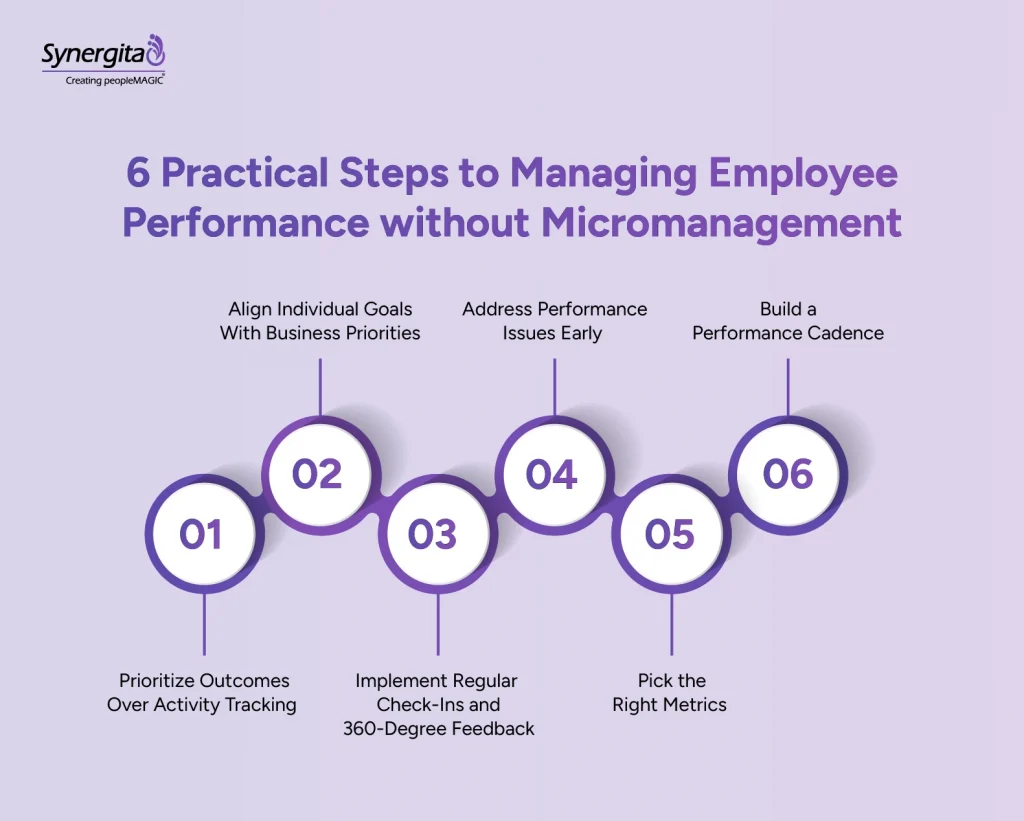
1. Align Individual Goals With Business Priorities
Effective employee performance management requires goal alignment. When employees understand how their work contributes to broader organizational objectives, they remain engaged and take ownership of outcomes rather than simply completing assigned tasks.
Research shows that employees whose individual goals are linked to organizational priorities are up to 3.5 times more likely to be engaged at work, showing the importance of goal alignment.
2. Prioritize Outcomes Over Activity Tracking
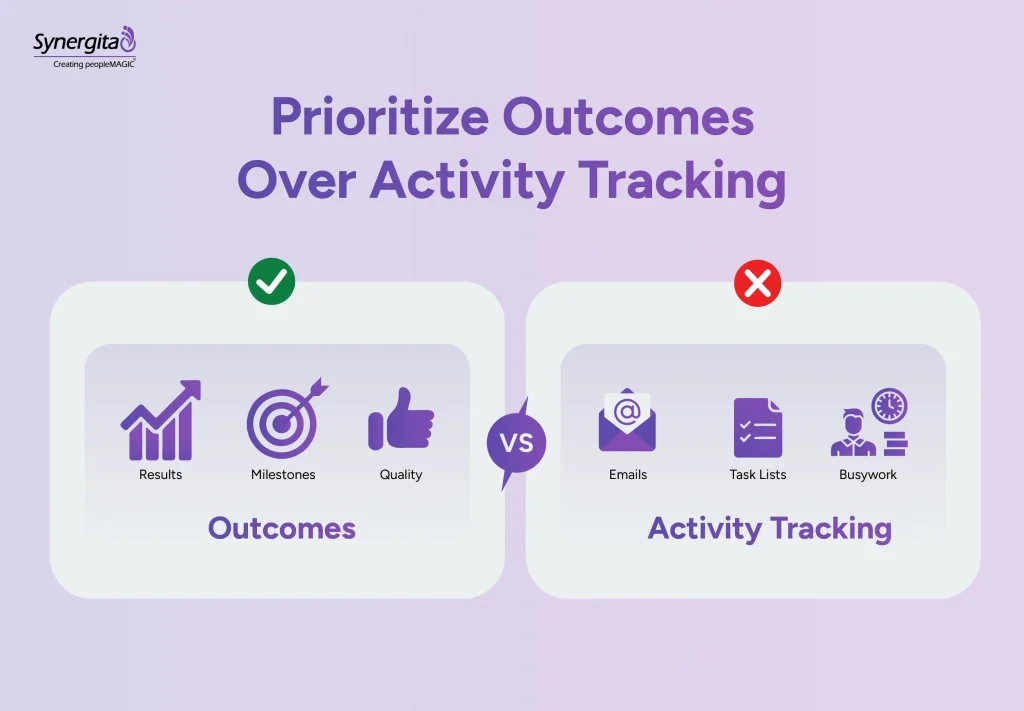
Tracking employee performance does not mean tracking every employee action. The focus should be on indicators that reflect progress and decision quality, not activity volume. This approach requires teams to:
- Prioritize leading indicators that signal progress early
- Use lagging metrics only to validate outcomes
- Review metrics regularly to ensure relevance
When employees know what truly matters, performance conversations become sharper and more actionable.
3. Implement Regular Check-Ins and 360-Degree Feedback
Most performance management programs fail due to a lack of proper feedback that influences the outcomes. Regular check-ins help build a continuous feedback culture where improvement happens in real time. Instead of just giving updates, effective check-ins focus on:
- What is working and what needs support
- Obstacles that are slowing the progress
- Coaching conversations rather than reporting updates
- 360-degree feedback from peers, managers, and cross-functional stakeholders
This keeps performance management continuous rather than reactive.
4. Address Performance Issues Early
When performance issues are not addressed on time, they can worsen gradually and impact productivity. Addressing them early helps you prevent small misalignments from turning into major problems. The focus should be on helping people course-correct, not criticizing. Early intervention offers benefits for both managers and employees:
- Prevents minor gaps from turning into missed deadlines or repeated rework
- Reduces tension by addressing concerns before frustration builds
- Keeps expectations clear and aligned while work is ongoing
- Builds trust by showing support rather than surveillance
By treating performance conversations as timely course corrections, teams stay focused on progress instead of damage control.
5. Pick the Right Metrics
Metrics are important, but you need to ensure the job isn’t turned into a scoreboard. They also distort behavior if you pick the wrong ones, or if you pick too many. The most effective approach combines two types of indicators:
- Lagging indicators: The final results (revenue, retention, CSAT, uptime)
- Leading indicators: Behaviors or inputs that predict results (quality of discovery calls, code review cycle time, time to first response, number of customer interviews)
A few rules that keep metrics from becoming toxic:
- Avoid vanity metrics. “Number of emails sent” is not performance. It is typing.
- Choose metrics that employees can influence. If they cannot move it, it becomes learned helplessness.
- Use ranges when work is variable. For example, “Maintain CSAT 4.6 to 4.8” instead of “4.8 exactly”.
- Evaluate trends, not single points. One bad week happens. A pattern is the signal.
Suggested Reading: Crucial Employee Performance Metrics You Should Track
6. Build a Performance Cadence
Micromanagement often arises when consistency in performance management is lacking. If the only formal performance conversation happens once a year, then every missed deadline becomes a major issue. So you start hovering around your employees.
A simple cadence replaces constant monitoring, making it easier to manage employee performance without hovering over them. You can include:
- Weekly 1:1 meeting
- Monthly goal and performance review
- Quarterly planning
This reduces anxiety for both sides. Employees know when they will be heard. Managers know when they will get a real signal. Employees also know what gets documented and why.
Common Mistakes to Avoid When Managing Employee Performance
Even with the right structure, many organizations face challenges in managing performance due to common pitfalls. Here are the mistakes to avoid.
- Tracking employee activities instead of outcomes
- Using too many metrics, or metrics that employees cannot influence
- Waiting for annual reviews to address performance issues
- Turning check-ins into status reporting instead of coaching
- Intervening too late and then overcorrecting
- Holding people accountable without giving clarity on expectations
- Changing priorities without updating goals or success criteria
Suggested Reading: Effective Strategies to Improve Employee Performance
How Technology Helps in Managing Employee Performance?
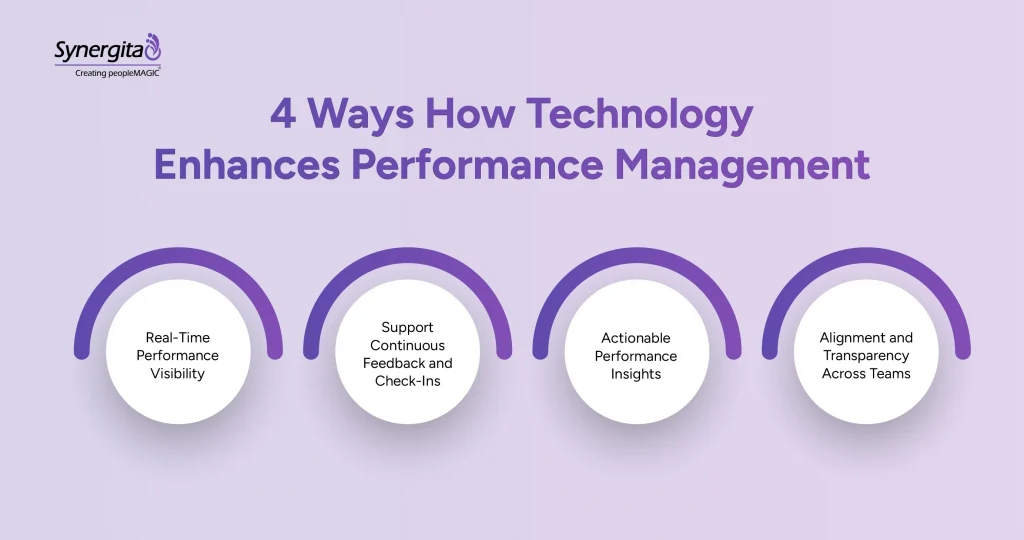
Managing employee performance at scale becomes difficult when you need to depend on manual processes for visibility, feedback, and alignment. Modern tools like performance management software help to solve this by providing a centralized platform for real-time performance visibility, automated check-ins, and streamlined feedback across teams.
1. Real-Time Performance Visibility
Performance tools make progress visible through shared goals and dashboards, reducing the need for frequent status checks. Managers can identify risks early while employees retain ownership of their work.
2. Support Continuous Feedback and Check-Ins
Built-in check-ins and feedback tools support regular performance conversations as work happens. This keeps feedback timely, relevant, and focused on improvement rather than correction.
3. Actionable Performance Insights
Technology helps surface patterns across goals, feedback, and outcomes. These insights enable managers to make informed decisions instead of relying on assumptions or isolated observations.
4. Alignment and Transparency Across Teams
Clear visibility into goals and ownership helps employees understand how their work connects to team and business priorities. This alignment improves accountability, employee experience, and ensures performance discussions are focused on outcomes.
Conclusion
If you are micromanaging, it is not because you are controlling, but because you are missing a system that provides trustworthy information. When managers lack reliable signals, they check more, ask more, and step in too often.
Start with clear outcomes. Set expectations that people can realistically act on. Track a small set of meaningful metrics and establish a cadence that catches issues early to help with timely coaching.
Synergita provides AI-powered software to manage employee performance, including goals, feedback, and check-ins, in a single shared system without surveillance. Start your 14-day free trial and see how its structured performance management system can help you replace micromanagement with clarity and trust.
Frequently Asked Questions
Many managers aim for accountability but unintentionally create control-heavy systems. This micromanagement results in lower ownership, slower decision-making, less trust, and increased manager burnout.
Define clear outcomes, set a weekly 1:1 cadence, and require simple proof of progress (deliverables, demos, written updates). Accountability comes from agreed results and regular review, not daily hovering.
You need to diagnose the cause: unclear scope, too many priorities, skill gaps, or overload. Ask what tradeoffs they are making and what they need to hit the date. If it repeats, document it and coach on planning and escalation.
Not automatically. They become micromanagement when they are used to interrogate task lists, or when they exist because goals are unclear. If you use standups, keep them short and focused on blockers and coordination.
Avoid vanity metrics and anything employees cannot influence. Also, avoid metrics that push competing behavior without guidance, like “ship faster” and “zero defects” with no tradeoff framework.
When there is a sustained pattern of underperformance, expectations have been clearly communicated, coaching has occurred, and the role fit remains correct. If it is a role mismatch, a PIP usually just delays the inevitable.
Switch your 1:1 to outcome-based questions, write down 3 to 5 outcomes for each person for the month, and ask employees to update their progress themselves. That one change removes a lot of the urge to “check”.