



Most OKRs fail not because teams lack ambition, but because goals are set without execution discipline and clear ownership. When strategy sounds clear but progress stalls, the issue is usually the absence of a complete OKR system.
TL;DR
- Only 14% of executives are satisfied with strategy execution, and 67% of strategic initiatives fail due to execution gaps.
- A complete OKR system uses three checklists: preparation (alignment and intent), brainstorming (strong objectives and outcomes), and action (execution and reviews).
- An 8-step process to build a complete OKR checklist includes clarifying the purpose, running a brainstorming session, setting objectives and key results, scheduling regular check-ins, and planning for the next cycle.
- It also covers common pitfalls such as treating OKRs like task lists, overloading metrics, skipping reviews, and using OKRs for performance evaluation, along with practical ways to avoid them.
The biggest reason objectives and key results (OKRs) fail is due to poor goal setting and weak execution.
According to ClearPoint Strategy, only 14% of executives are satisfied with their organization’s ability to execute strategy effectively, and 67% of strategic initiatives fail because of inefficient execution.
So how do you address this challenge?
An OKR checklist provides the right strategies for writing effective objectives and key results and assigning ownership from the start. It also brings discipline to execution by defining review cadence, progress signals, and decision-making throughout the cycle.
In this blog, we will provide a practical OKR checklist to help you design stronger OKRs and run them consistently, turning goals into measurable outcomes.
| Table of Contents 1. What Is an OKR Checklist? 2. What Are the Different Types of OKR Checklists? 3. A Step-by-Step Guide to Creating a Complete OKR Checklist 4. Common Mistakes Businesses Make When Using an OKR Checklist and Tips to Avoid Them 5. Conclusion 6. Frequently Asked Questions |
What Is an OKR Checklist?
An OKR checklist is a structured validation framework that helps organizations design, implement, and review OKRs across the entire goal cycle.
While many companies set annual or quarterly goals, studies show that 67% of the well-designed strategies fail because of poor execution. OKRs reduce this risk by breaking goals into clearly defined objectives and measurable key results.
Implementing OKRs requires a strategic change in how teams think about ownership, progress, and performance conversations. An OKR checklist helps the team achieve goals by:
- Ensuring objectives are clearly tied to business priorities
- Verifying that key results are measurable and influenceable
- Establishing consistent review and feedback rhythms
- Identifying execution gaps early in the cycle
Before implementing OKRs in your company, you must train your employees on the basics. This helps employees understand the intent behind OKRs and why a change in goal-setting is needed.
What Are the Different Types of OKR Checklists?
A complete OKR system typically uses three interconnected checklists, each supporting a different stage of execution.
1. Preparation Checklist
This checklist helps leadership teams lay the foundation before introducing OKRs.
It focuses on:
- Clarifying why OKRs are being adopted
- Communicating how OKRs differ from traditional goal-setting
- Aligning leadership on expectations, cadence, and ownership
2. Brainstorming Checklist
The brainstorming checklist guides teams as they define objectives and key results.
It ensures that:
- Objectives are ambitious but realistic
- Key results reflect outcomes, not activities
- Teams understand dependencies and trade-offs
This stage prevents teams from creating vague or overloaded OKRs that dilute focus.
3. Action Checklist
The action checklist governs execution and review.
It ensures that OKRs are:
- Reviewed at regular intervals
- Adjusted when priorities change
- Used as inputs for coaching and performance conversations
A Step-by-Step Guide to Creating a Complete OKR Checklist
Once all team members realize the importance of OKRs, the next step is to develop an OKR checklist to help implement them.
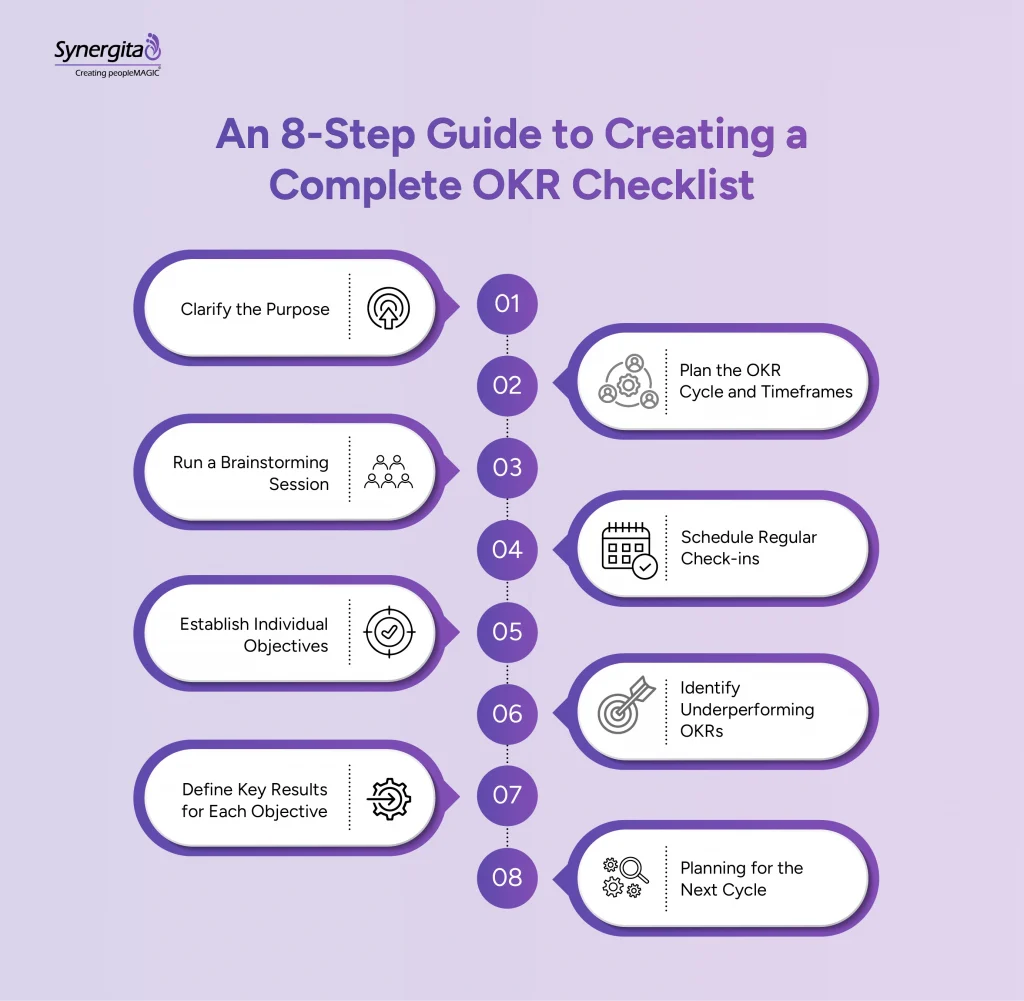
1. Clarify the Purpose
Knowing the vision you are working towards makes it easier to understand your role and purpose in a company.
- Begin with the company’s values, vision, and mission.
- Explain the company’s long-term objectives.
- Define the business objectives.
- Develop a business strategy and a plan to achieve your objectives.
- Help team members develop goals aligned with the company’s objectives.
2. Run a Brainstorming Session
Involving your team in the planning and discussion is an excellent way to keep them motivated.
- Hold a brainstorming session with your employees to get their opinions.
- Discuss which areas should be prioritized.
- Explain how goals should be simple, practical, and inspirational.
- Ask about their objectives for the future quarter or year.
- Ask your employees what outcomes they hope to achieve through these goals.
- Encourage them to divide these Key Results into small, measurable units that can be used to measure progress in real time.
3. Establish Individual Objectives
A leader must help team members determine individual goals. Here are some questions you can ask yourself to set well-defined and winning objectives for your team members:
- What makes a specific objective important to your team?
- Is the objective in line with the general objectives of the company?
- What are the limitations of meeting the objectives?
- What is the time restriction for finishing the objective?
- Can you break the objective down into smaller, quantifiable goals?
4. Define Key Results for Each Objective
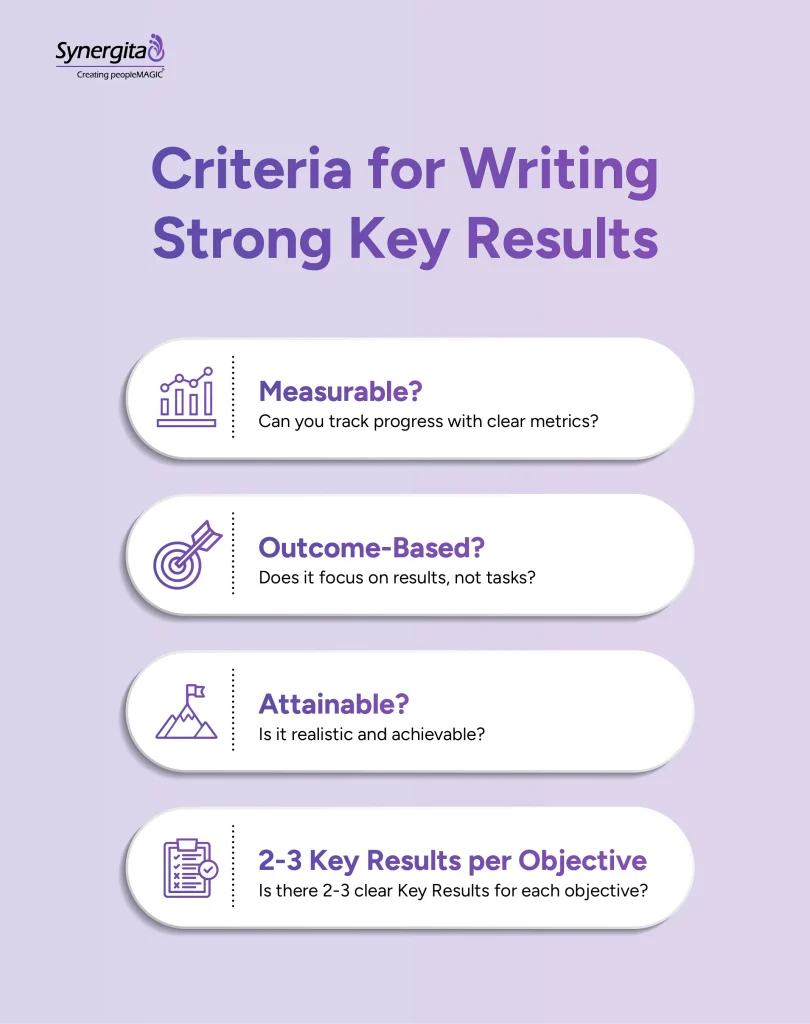
To keep team members motivated, encourage them to set individual quantifiable Key Results. Consider the following questions while setting Key Results:
- Is there a specific Key Result for each objective?
- Is the particular objective attainable?
- Is the Key Result measurable?
5. Plan the OKR Cycle and Timeframes
Planning the OKR cycle for the entire organization is essential. Here are things that you should consider:
- Individual, team, and organizational goals should all be aligned through cascading OKRs.
- The entire team should be aware of the time period for each OKR
- Tell them when and how they will be evaluated
- Discuss the challenges that may arise during the process and how to overcome them
- To ensure the task is completed on time, you should provide the necessary resources in advance
6. Schedule Regular Check-Ins
During OKR execution, routine check-ins prevent misunderstandings and bridge communication gaps.
- Hold frequent meetings to track OKR progress
- Examine if work processes are prioritized correctly
- Check whether the plan is working as intended
- Investigate pain spots and how to resolve them successfully
Suggested Reading: An Ultimate Guide to Track OKR
7. Identify Underperforming OKRs
It is impossible to anticipate all challenges from the outset. These questions can help you identify unaddressed issues:
- Is everyone on the same page about the team’s and individuals’ goals?
- Do the teams understand each other’s goals?
- How does work overlap?
8. Planning for the Next Cycle
Based on the previous cycle’s achievements and shortcomings, you and your team should work together to make the following cycle a more significant success.
- Check to see if you need to increase or decrease the number of OKRs for your team’s performance.
- Identify the problems from the previous cycle and propose solutions
- If they did not meet some critical objectives in the previous cycle, they could be carried over into the next cycle
Common Mistakes Businesses Make When Using an OKR Checklist and Tips to Avoid Them
Common mistakes to avoid when using an OKR Checklist include treating OKRs like task lists, overloading teams with metrics, failing to review OKRs regularly, and using OKRs for performance reviews. Let’s look at them in detail.
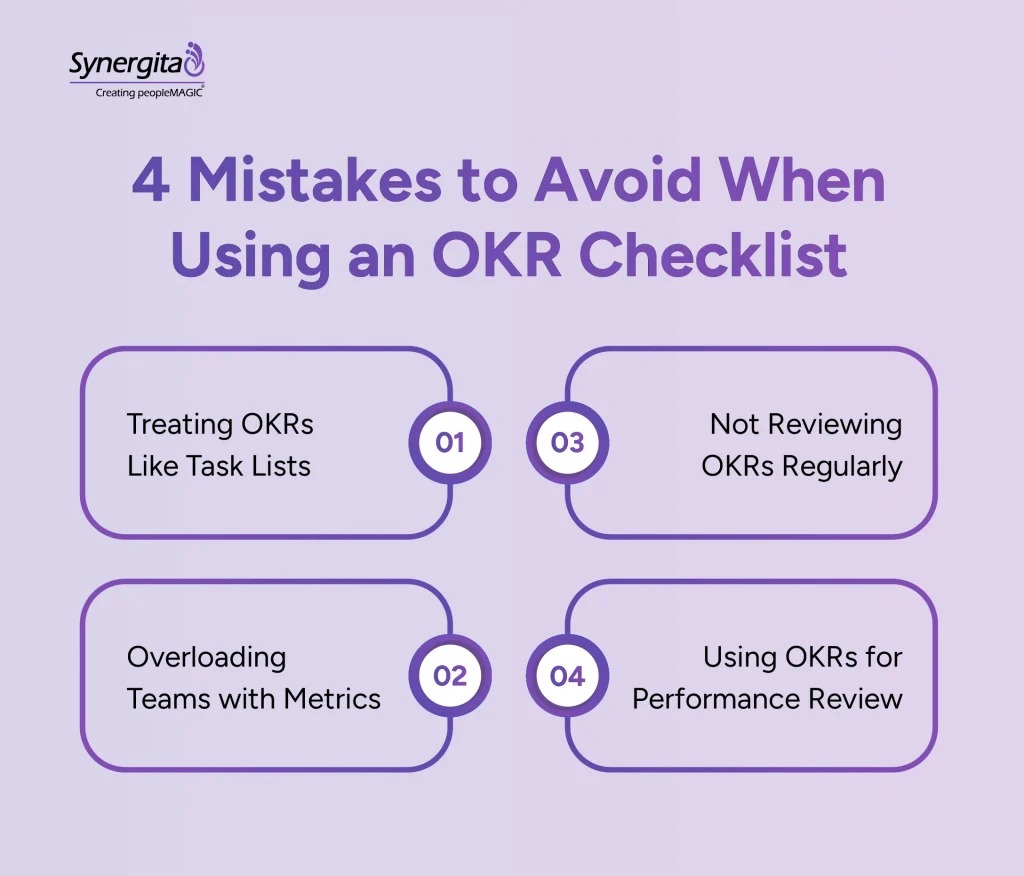
1. Treating OKRs Like Task Lists
OKRs are ineffective when they focus on activities rather than outcomes. When objectives sound like tasks and key results track effort, teams stay busy, but business results do not change. Over time, check-ins become status updates that discuss progress.
How to address this:
- Write objectives around change, not action
- Ensure key results measure impact, not completion
- Ask: “What will be different if this OKR succeeds?”
Suggested Reading: How to Shift from Activities to Outcomes
2. Overloading Teams with Metrics
Adding more key results is a common habit, but it reduces focus and slows execution. When objectives include too many metrics, especially those the team cannot influence, clarity suffers, which impacts accountability. Teams end up tracking numbers instead of making trade-offs.
How to address this:
- Limit each objective to a small set of key results
- Remove metrics that do not guide decisions
- Force prioritization by asking what matters most this cycle
3. Not Reviewing OKRs Regularly
OKRs do not yield any results when they are reviewed only at the end of the cycle. By the time issues are noticed, teams have little room to adjust, and managers respond with pressure rather than guidance. This turns OKRs into reports rather than tools for course correction.
How to address this:
- Build review cadence into the OKR checklist
- Use weekly check-ins to spot risks early
- Reserve end-of-cycle reviews for learning, not surprises
4. Using OKRs for Performance Review
OKRs lose effectiveness when they are tied directly to penalties or compensation. Employees respond by setting safe goals, hiding problems, and avoiding stretch outcomes. The system then rewards predictability instead of progress.
How to address this:
- Separate OKRs from performance ratings
- Treat missed targets as inputs for learning
- Encourage honest progress updates without fear
Conclusion
The OKR checklist helps teams align priorities, focus effort, and understand how their work contributes to business outcomes. However, even with a solid OKR checklist, managing goals, reviews, and updates manually becomes challenging over time due to scattered information and inconsistent check-ins.
OKR software simplifies this by consolidating goals, ownership, progress tracking, and reviews into a single system. Teams can create structured OKRs using templates, run regular check-ins, and track progress through a shared dashboard.
If you want to run OKRs with consistency and clarity, sign up for the Synergita OKR Management Tool. Sign up for a 14-day free trial and see how structured execution replaces manual follow-ups.
Frequently Asked Questions
An OKR checklist should be detailed enough to guide goal quality, ownership, review cadence, and decision-making, without becoming procedural overhead. If it slows teams down, it is too detailed.
Yes. Startups benefit from an OKR checklist because it prevents priority drift, clarifies ownership early, and creates execution discipline as teams scale and roles evolve quickly.
OKRs should be reviewed weekly for progress and risks, with deeper monthly check-ins for course correction. Waiting until quarter-end removes the ability to influence outcomes.
An OKR checklist guides goal design and execution, while KPIs track ongoing performance. OKRs drive change; KPIs monitor stability. They serve different but complementary purposes.
Teams should pause OKRs only when goals are stable, predictable, and no longer require alignment or prioritization. Even then, OKRs are often replaced, not removed.
OKRs are best tracked through shared dashboards, regular check-ins, and written progress updates. Visibility and cadence matter more than complex tooling.