



A silent crisis drains business productivity. Employees now rank growth opportunities above many traditional benefits. If your company provides only holiday bonuses and Paid Time Off (PTOs), you might be missing out on the best employees available in the market.
This is why more than 75% of organizations reported difficulty hiring full-time employees. What could you offer your team to motivate them to join and stay for longer?
The answer lies in providing them the opportunity to grow and develop. This step can be critical to your organization’s success. An individual development plan template plays an important role in this scenario.
In this blog, you’ll explore the best eight development plan templates that will turn personal potential into organizational progress.
Quick TL;DR
- Structured development plans directly combat turnover by investing in career pathways.
- Use specific templates for specific needs, like onboarding, leadership, or skill mastery.
- Follow a disciplined creation process: self-assessment, SMART goals, actionable steps, consistent tracking, and regular revision.
- The highest Return on Investment (ROI) comes from visibly linking individual development goals to team and company objectives, ensuring growth supports business strategy.
- The right tools automate tracking and reminders. This frees managers to focus on meaningful coaching and support conversations.
What is an Individual Development Plan (IDP)?
An Individual Development Plan (IDP) is a personalized, forward-looking roadmap for professional growth. It outlines an employee’s career goals alongside the specific knowledge, skills, and competencies needed to achieve them.
Unlike performance reviews that assess past work, IDPs are proactive growth tools focused on future development. IDPs are adaptable across career stages, from new hires to senior leaders, so you can implement them without a hurdle.
Core Structural Components of an IDP Template
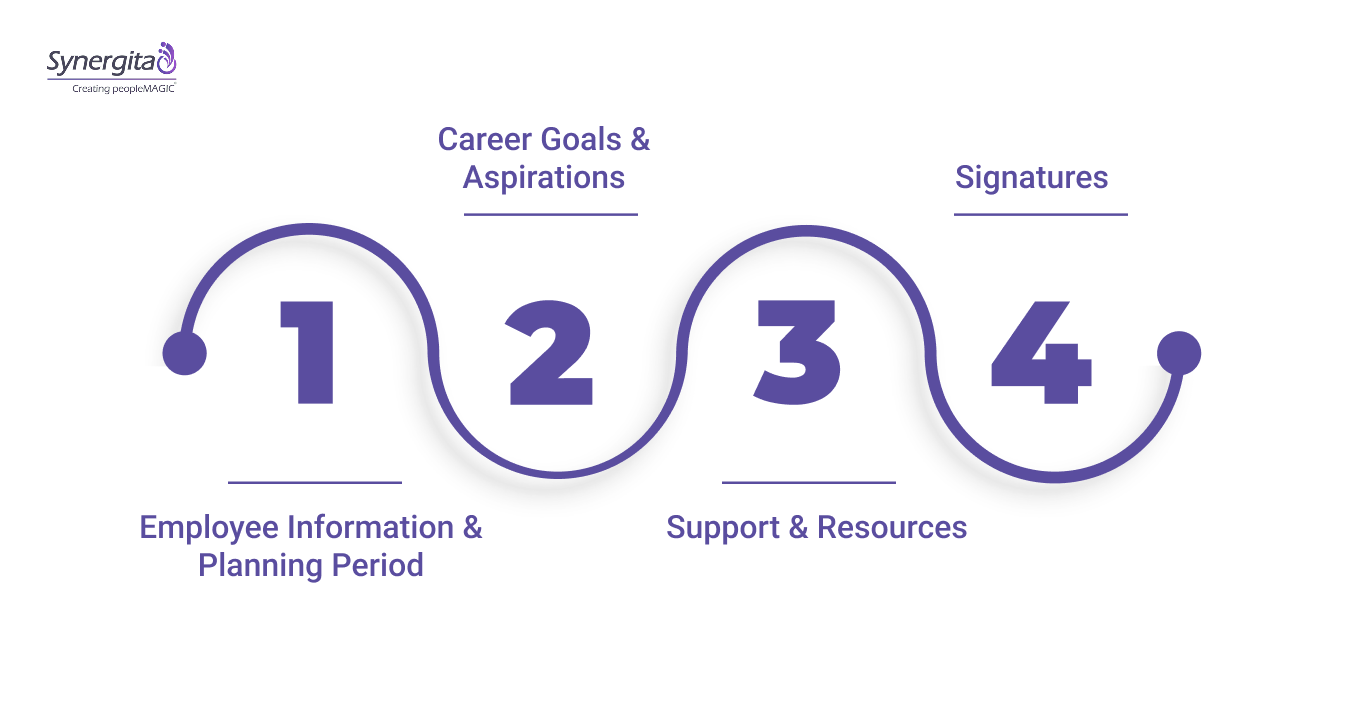
A well-structured template guides both the employee and manager through a complete development conversation. Here are the fundamental sections:
- Employee Information & Planning Period: Basic details like name, position, department, and the date or review period for the plan.
- Career Goals & Aspirations: A section for employees to articulate their short-term and long-term career objectives.
- Support & Resources: Identifies needed training, mentors, tools, or budgetary support.
- Signatures: Spaces for the employee and manager to sign, signifying mutual agreement and commitment.
To truly champion these templates, you need a compelling answer to the fundamental question: What is the Return on Investment (ROI)?
Also Read: 4 Steps on How to Build an Effective Performance Management Program
The Measurable Impact of Development Plans in Your Organization
52% of U.S. employeesare watching opportunities or actively seeking new jobs. In this situation, a strategic individual development plan template is a core retention and performance driver.
The benefits you get:
For Your team
- It provides structured, attainable pathways for advancement, moving aspirations from abstract to achievable.
- Employees with a defined growth path are more invested in their role and its purpose. Feeling stagnant is a primary driver of turnover.
- It identifies and facilitates targeted growth in key areas, from technical skills to leadership competencies.
- Progress and mastery correlate strongly with greater professional fulfillment and confidence.
For Your Organization
- Investing in growth significantly reduces preventable turnover.
- It prepares high-potential employees for future leadership roles, ensuring business continuity and reducing risk.
- Developed skills directly translate to more efficient, higher-quality output and improved employee performance.
- It promotes continuous learning as a core organizational value, making your company a destination for top talent.
Different career stages and goals demand different structures. You need various IDP templates that include a clear goal, specific actions, and a real-world example.
These templates serve as a framework that managers can adapt immediately.
Also Read: What is the Process of Employee Performance Management?
8 Individual Development Plan Templates for Your Organization
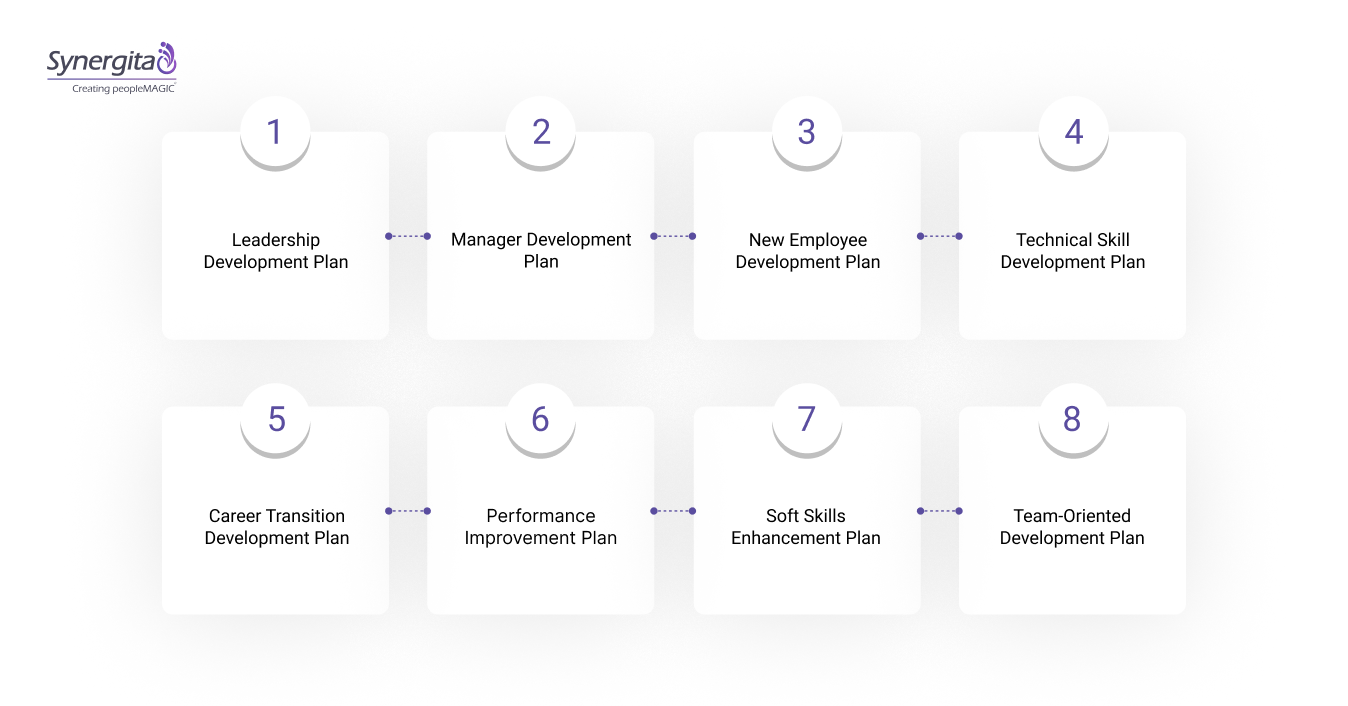
The difference between a plan that is followed and one that is forgotten often lies in its initial design. A template built for a new manager will frustrate a specialist mastering a technical skill.
Using a performance improvement format for a high-potential employee can stifle motivation. This mismatch is a common reason development efforts fail to deliver expected returns. To avoid this, you can use the templates below:
Template 1: Leadership Development Plan
For employees preparing for or currently in leadership roles, this plan helps.
Goal: Strengthen strategic decision-making and team leadership capabilities.
- Action Steps:
- Enroll in an executive leadership program within six months.
- Lead a cross-functional project team.
- Participate in industry networking events quarterly.
Example: A senior analyst aiming for a director role focuses on strategic planning. This plan uses mentorship and formal training.
Template 2: Manager Development Plan
For current managers, this enhances people management skills.
Goal: Improve team management, delegation, and conflict resolution abilities.
- Action Steps:
- Complete a leadership workshop next quarter.
- Implement regular one-on-one meetings with all direct reports.
- Read two leadership books and apply one technique from each.
Example: A new manager struggles with delegation. This plan sets goals for effective workload distribution.
Template 3: New Employee Development Plan
For onboarding and accelerating new hire proficiency, this plan template is helpful.
Goal: Achieve role proficiency and cultural integration within the first 90 days.
- Action Steps:
- Complete all onboarding training modules in the first month.
- Shadow a senior colleague for two weeks.
- Schedule weekly check-ins with a manager.
Example: A marketing associate uses a 30-60-90 day structure. They master tools and processes progressively.
New hires often experience “information overload.” Critical onboarding materials are scattered across emails, drives, and presentations. This disorganization slows proficiency.
A centralized Digital Cockpit from Synergitacan help by providing one hub for all goals and resources. New hires see their 30-60-90 day plan clearly.
Managers can partner with their team members using Synergita’s Employee Training and Development plan to create and monitor personalized development plans. This collaboration focuses on building specific competencies and advancing individual career goals.
Template 4: Technical Skill Development Plan
For specialists needing to advance or update their technical expertise, you can use this.
Goal: Master a new programming language within six months.
- Action Steps:
- Enroll in a certified course by the end of the month.
- Dedicate two hours weekly to hands-on practice projects.
- Seek mentorship from a department expert.
Example: A data analyst expands into machine learning. They use structured courses and peer learning.
Template 5: Career Transition Development Plan
For employees shifting to different roles or departments, this template works.
Goal: Transition from customer service to marketing within one year.
- Action Steps:
- Complete a digital marketing certification within four months.
- Assist the marketing team on one campaign project.
- Shadow a marketing manager bi-weekly.
Example: An internal move uses targeted skill-building and cross-departmental exposure.
Template 6: Performance Improvement Plan
For addressing specific performance gaps constructively, your team can use this.
Goal: Improve meeting deadlines and workplace communication.
- Action Steps:
- Complete a time management workshop next quarter.
- Implement daily task prioritization using a tool like Trello.
- Schedule bi-weekly progress reviews with a manager.
Example: This plan supports an employee struggling with specific competencies. It sets clear benchmarks.
Performance issues frequently stem from unclear expectations or poor habit visibility. An employee may not realize how their workflow creates bottlenecks.
Managers might only see missed deadlines, not the root cause. Traditional feedback happens too late to correct the course.
To support continuous growth, Synergita’s AI-driven insights with comprehensive 360-degree feedback provide a unified view of performance by linking.
Template 7: Soft Skills Enhancement Plan
For developing interpersonal and collaborative abilities, use this template.
Goal: Strengthen collaboration and creative problem-solving skills.
- Action Steps:
- Attend a creative problem-solving workshop.
- Volunteer for a cross-functional team project.
- Request peer feedback quarterly on collaboration.
Example: An engineer develops presentation skills. They apply training through practical application.
Template 8: Team-Oriented Development Plan
For aligning individual growth with team objectives, you can use this plan template.
Goal: Become a stronger team contributor and collaborator.
- Action Steps:
- Volunteer for additional team projects.
- Attend a communication and negotiation workshop.
- Seek monthly feedback from the team lead.
Example: This development focuses on skills that enhance team effectiveness and cohesion.
Technology provides the framework and tools, but the true power of a development plan comes from its thoughtful creation and execution.
The right platform removes administrative barriers, yet the plan’s success hinges on a deliberate, human-centered process.
Also Read: Role of AI in Performance Management
How to Create an Effective IDP?
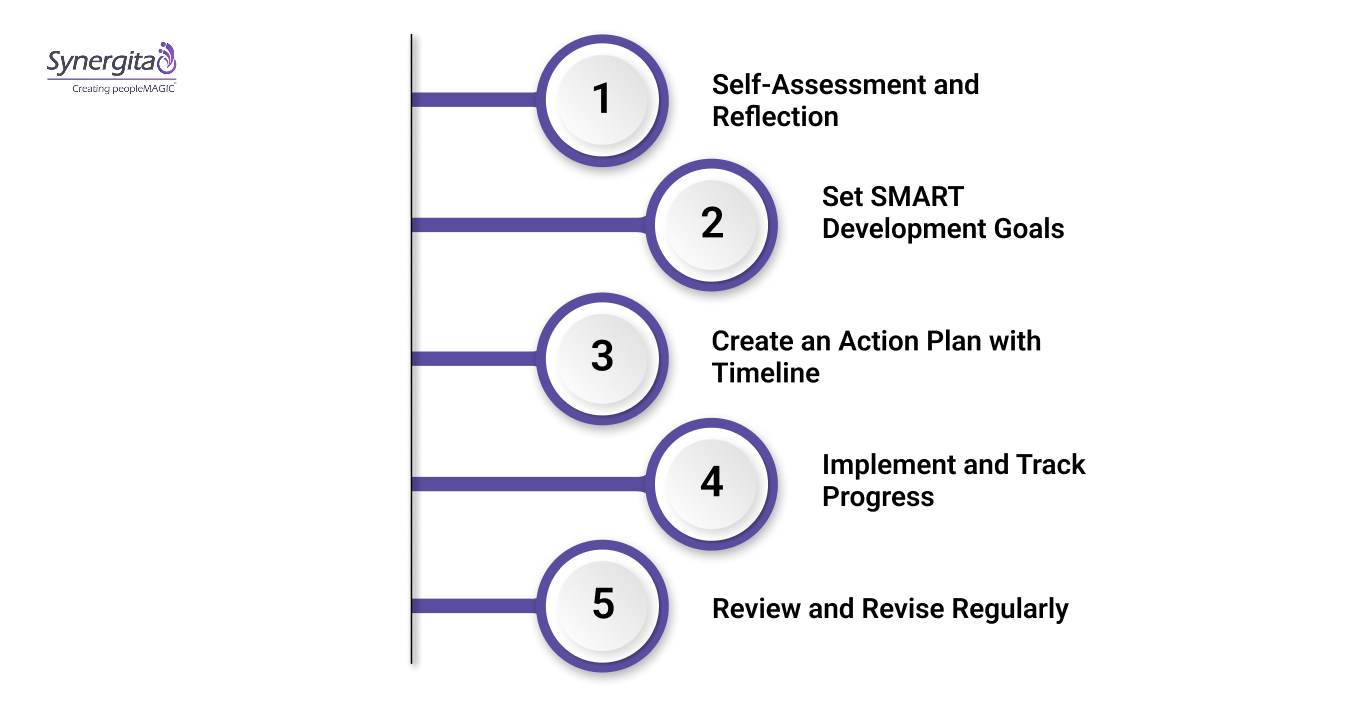
Creating a meaningful development plan is a collaborative and introspective exercise. It converts a template into a personalized roadmap.
This five-step process ensures the plan is grounded in self-awareness, strategically focused, and built for real-world execution.
Step 1: Self-Assessment and Reflection
- List 3-5 core strengths with specific examples of their application. Building on existing capabilities is more effective than focusing only on weaknesses.
- Define long-term aspirations. What does meaningful professional success look like in three to five years?
- Incorporate external insights. Seek perspectives from peers, managers, and past reviews to gain a rounded self-view.
Step 2: Set SMART Development Goals
- Specific: Target clearly defined development areas (e.g., “project management,” not “get better”).
- Measurable: Define how progress will be tracked (e.g., “complete certification,” “lead 3 project meetings”).
- Achievable: Ensure goals are realistic given available resources and timeframes.
- Relevant: Align each goal with both career aspirations and organizational needs.
- Time-bound: Attach clear deadlines to create urgency and define review points.
Step 3: Create an Action Plan with Timeline
- For 30-90 days, schedule immediate steps like training enrollment, initial skill practice, or resource gathering.
- For 6-12 months, plan for significant milestones like project leadership, certification completion, or establishing a mentorship.
Step 4: Implement and Track Progress
- Set monthly or quarterly assessments to discuss progress formally.
- Record achievements, challenges, and necessary plan adjustments.
- Gather ongoing input from managers and peers beyond scheduled reviews.
Step 5: Review and Revise Regularly
- Update the plan based on new opportunities, shifting priorities, or acquired skills.
- Conduct a comprehensive review and reset at least yearly.
- Modify the plan’s approach as career responsibilities and objectives evolve.
The five-step process provides a clear path for creating individual development plan templates. However, moving from a well-crafted document to sustained growth presents familiar organizational challenges.
Read Also: Top 8 Performance Management Systems for Small Businesses in 2026
How Synergita Provides Solutions for Common Development Plan Challenges?
You designed the perfect template. You trained managers on the process. Yet, your development initiative still feels stuck. This frustrating gap between design and delivery is predictable.
Consistent, identifiable execution challenges cause it. These challenges silently undermine even the most well-intentioned programs. Here’s how to solve those:
| Challenge & Impact | Solution Enabled by Modern Performance Platforms |
|---|---|
1. IDPs are created during reviews but never revisited. They fail to guide daily activity or quarterly progress. | The Dynamic Digital Cockpit by Synergita acts as a single source of truth. It displays live goals, upcoming actions, and feedback. |
| 2. Individual development feels disconnected from team and company objectives. This reduces organizational impact. | Synergita’s Visual OKR Platforms integrate development goals within a cascading objective framework.Employees see how their skill growth ladders up to the team. |
| Reliance on annual reviews or single-manager input provides a limited, often outdated performance view. | Continuous 360-Degree Feedback Tools by Synergitafacilitate ongoing input from peers, subordinates, and managers.This creates a real-time view of strengths and development areas. |
| 4. Managers lack insight into the words between check-ins. Employees struggle silently with unclear next steps. | AI-based sentiment analysis from Synergita decodes the true sentiment behind employee words.This can interpret feedback to measure emotional tones and perceptions. |
| 5. Managers spend excessive time coordinating forms and scheduling reviews instead of coaching. | Configurable templates and reminders automate administrative tasks.Deep integrations with tools like MS Teams, Slack, and Jira bring development conversations into existing workflows. |
| 6. Learning occurs in separate systems (LMS) while goals live elsewhere. This disconnect hinders practical application. | Synergita combines goal setting, skill tracking, and feedback within the same environment. |
So, move beyond basic pitfalls. Replan your IDPs to stay ahead of common hurdles with cultural insights within your workforce in real time.
Transforming Every Potential into Performance
Individual development plans represent a fundamental shift in talent strategy. They move organizations from passive performance management to active growth cultivation.
The manager believes feedback is clear and regular. The employee feels direction is vague and sporadic. This disconnect stalls development.
Synergita’s platform addresses this core problem directly. It replaces guesswork with data-driven alignment, ensuring development plans are based on shared reality.
Explore how Synergita can be customized to your organization’s unique challenges by booking a demo today.
FAQs
1. Who owns the IDP creation process?
The employee drives the creation with the manager as a coach. The employee owns their growth, while the manager provides resources, alignment, and feedback.
2. How often should IDPs be reviewed?
Plans need monthly or quarterly progress check-ins. A full plan review and refresh should happen at least annually, or after major role changes.
3. Are IDPs only for underperforming employees?
No. They are strategic tools for all employees. High-potential staff use them to accelerate growth, and solid performers use them to build new skills for future roles.
4. What is the difference between an IDP and a Performance Improvement Plan (PIP)?
An IDP is proactive and future-focused for all employees. A PIP is reactive, addressing specific performance deficiencies with strict timelines and outcomes.