



Your success as a manager starts with clarity, and clear goals are more than just New Year’s resolutions. Research shows that setting challenging but realistic targets can improve performance by up to 90 percent, proving the power of intentional objectives. Yet fewer than one in five employees understand their company’s priorities, and half of all senior managers cannot name the organization’s top three goals. That gap between intent and understanding is where most performance plans fall apart.
This blog will help you bridge that gap. It delivers practical frameworks to set goals that align with strategy and are clear enough to be owned. You will find real-world examples tailored to various roles, a step-by-step method to integrate performance and development goals, and insight into how alignment, participation, and execution drive engagement.
You will come away with the clarity to lead your team toward measurable progress, not just well-meaning targets.
Key Takeaways
- Manager vs. employee goals: Managers drive team impact, not just personal tasks.
- Four types of objectives: Strategic, operational, people-focused, and personal growth.
- Smart goal-setting methods: Use SMART goals and OKRs to make progress measurable.
- Real-world examples: From boosting productivity to developing future leaders.
- Common pitfalls: Vague goals, misalignment, weak tracking, and burnout risks.
- What works best: Frequent feedback, clear KPIs, shared accountability, and recognition.
- Technology advantage: Tools like Synergita keep objectives visible, fair, and actionable.
What Are Manager Objectives?
Manager objectives are clear, measurable outcomes that define how a leader drives team performance and contributes to company priorities. They go beyond task completion and focus on creating impact through strategy, execution, and people management. A manager’s objectives are not just about what they achieve personally but about how effectively they enable their team to succeed.
How Manager Objectives Differ from Employee Objectives
Employee objectives usually center on individual performance, such as meeting a sales target or completing a project on time. Manager objectives, however, carry a broader scope. They involve shaping direction, removing barriers, and ensuring the collective performance of the team contributes to larger business results.
Consider this contrast. An employee in a customer support role may be tasked with resolving tickets within a set time frame. The manager’s objective, on the other hand, could be to reduce the overall team’s response time by introducing better workflows, training staff, and monitoring key metrics.
The difference lies in ownership. Employees are accountable for their own deliverables. Managers are accountable for creating the conditions in which their teams can consistently deliver at a higher level.
Types of Manager Objectives
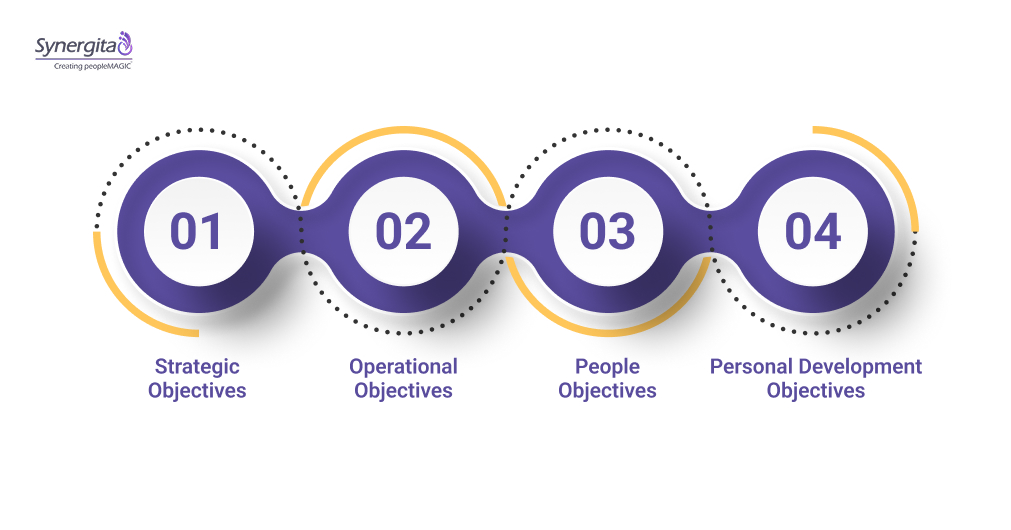
Manager objectives fall into four main categories. Together, they balance business outcomes with team development and personal leadership growth.
1. Strategic Objectives
These ensure a manager’s work directly supports the company’s vision and long-term goals. For example, a marketing manager might set an objective to capture ten percent of a new market segment within the year. Strategic objectives keep the team’s energy focused on outcomes that matter most to the organization’s direction.
2. Operational Objectives
Operational objectives focus on efficiency, consistency, and flawless execution. A project manager could aim to deliver 95 percent of projects on time and within budget by streamlining workflows and improving resource allocation. These goals ensure daily operations are predictable, reliable, and cost-effective.
3. People Objectives
A core part of management is enabling people to succeed. These objectives emphasize engagement, retention, and team capability. For instance, a sales manager might aim to reduce turnover by fifteen percent by building stronger onboarding programs and running quarterly career development discussions. The focus is on creating an environment where employees are motivated and supported.
4. Personal Development Objectives
Strong managers continue to evolve their own leadership skills. Personal development objectives center on growth in areas such as coaching, communication, or strategic thinking. A manager might set a goal to complete a leadership certification or increase cross-departmental collaboration within six months. These objectives not only enhance personal effectiveness but also elevate the team’s performance.
How to Set Effective Manager Objectives (Step by Step)
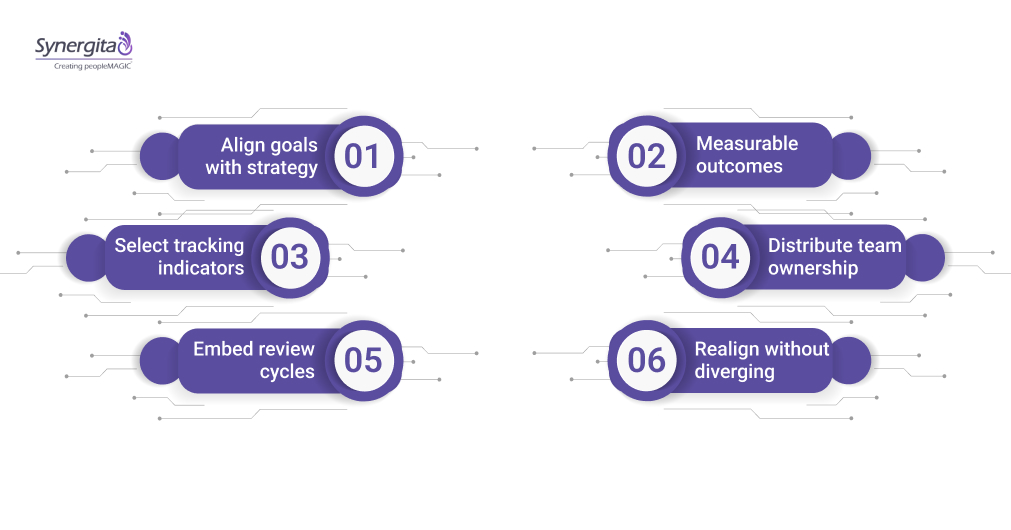
Effective objectives cannot live as broad statements in a document; they need to be translated into measurable action that managers and teams can rally around. Frameworks like SMART and OKRs are powerful, but their real value comes when applied step by step to real-world management challenges.
Step 1: Anchor goals in organizational strategy
Before creating team-level objectives, managers need to filter them through business priorities. For example, if the company is targeting international expansion, a regional sales manager’s objective should not be “increase sales by 15 percent” in isolation. Instead, it should focus on acquiring new customers in the target market and establishing early brand presence. OKRs are useful here because they ensure the objective directly supports corporate strategy.
Step 2: Define outcomes in measurable terms
Managers often set goals that sound inspiring but lack measurement. This is where SMART comes in. For instance, instead of saying “strengthen employee engagement,” a people manager could set a SMART goal such as “raise the quarterly engagement survey participation rate from 68 percent to 85 percent within six months.” The shift from abstract ambition to concrete measurement creates clarity for the team.
Step 3: Select the right indicators to track progress
Managers often choose vanity metrics that look good but say little about impact. A product manager targeting adoption of a new feature should not just track downloads; daily active usage, retention over 30 days, and customer satisfaction scores give a much truer picture of success.
Step 4: Share ownership across the team
If an engineering manager sets “reduce critical bugs by 20 percent,” it cannot sit on their shoulders alone. One team member might own test automation coverage, another code review rigor, and another production monitoring. Shared ownership makes the objective achievable and removes the perception that it is a manager-only directive.
Step 5: Build review cycles into daily work
The most common reason goals fail is that they disappear between quarterly reviews. A manager focused on raising customer satisfaction could integrate weekly ticket review meetings where frontline employees analyze patterns and fix recurring pain points. Goals survive when they are part of weekly routines, not end-of-quarter surprises.
Step 6: Course-correct without losing alignment
When obstacles appear, managers need to adjust scope or approach without abandoning the objective. For instance, a project manager aiming for 95 percent on-time delivery might realize resource shortages threaten deadlines. Instead of lowering the bar, they could re-prioritize projects, secure temporary support, and still deliver the intended outcome.
Self-check before finalizing an objective
- Does this goal link back to a company-level priority?
- Is success defined by numbers, not opinions?
- Do the right people own pieces of the objective?
- Is there a clear review rhythm to catch problems early?

Examples of Manager Objectives and Performance Goals
The most effective objectives go beyond numbers on a dashboard. They are designed to strengthen how teams work, grow, and deliver results. Here are five core areas where managers can set meaningful performance goals.
- Improving Team Productivity: A manager might set a goal to raise output by ten percent in the next quarter by refining workflows and introducing weekly prioritization sessions. Productivity here is not just about doing more but about enabling the team to focus on high-value work.
- Reducing Employee Turnover: High turnover is costly and disruptive. A manager’s objective could be to cut attrition by building stronger career development pathways, introducing stay interviews, and tracking engagement metrics every quarter.
- Enhancing Cross-Team Collaboration: Modern projects often require seamless cooperation across departments. An example objective is to increase the number of successful cross-functional projects completed each quarter by creating shared accountability frameworks and regular inter-team syncs.
- Increasing Customer Satisfaction: For customer-facing teams, satisfaction is a direct measure of impact. A manager might set a goal to lift the customer satisfaction score from 82 to 90 within six months by tightening service-level agreements and empowering frontline staff to resolve issues faster.
- Developing Future Leaders: Part of a manager’s responsibility is to build the next generation of leadership. A strong objective could be to identify three high-potential employees within the team and prepare them for leadership roles through mentorship, training, and stretch assignments over the next year.
While these examples show how managers can set meaningful objectives, putting them into practice isn’t always straightforward. Let’s look at some common challenges managers face when turning goals into results.
Common Challenges Managers Face in Goal Setting
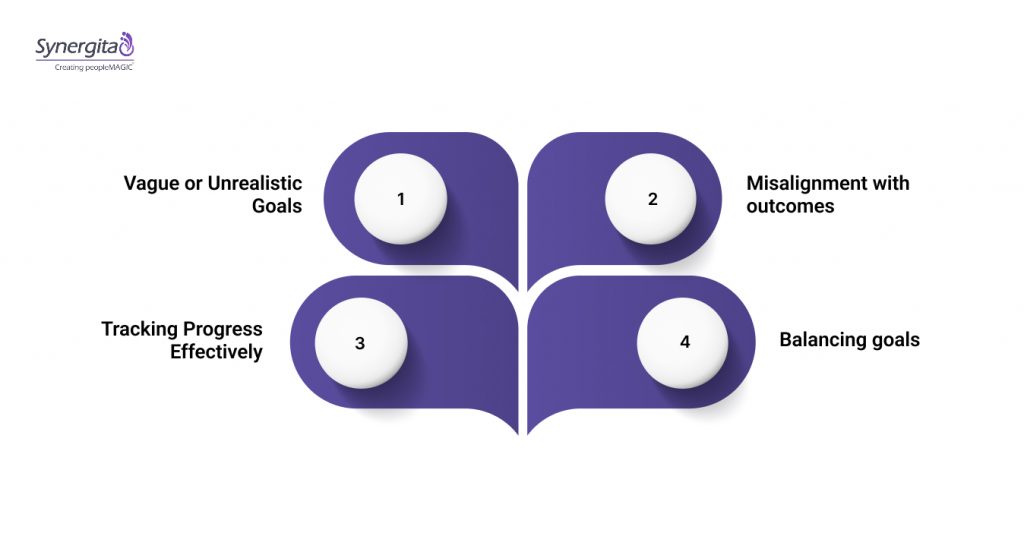
Even with the right frameworks, many managers struggle to make objectives stick. The difficulties often lie not in setting goals but in ensuring they are realistic, aligned, and trackable in practice.
Vague or Unrealistic Goals
Managers sometimes frame objectives in aspirational terms without linking them to achievable outcomes. For example, “build a high-performing team” sounds inspiring but is meaningless without metrics such as project completion rates, quality benchmarks, or engagement scores. The challenge is translating vision into evidence-based targets that can actually be evaluated.
Even if a goal is clearly written, it may still fail if it doesn’t tie directly to the company’s priorities.
Lack of Alignment with Business Outcomes
An objective might improve a team’s efficiency but fail to contribute to larger organizational priorities. For instance, reducing internal meeting times is helpful, but if the company’s focus is on customer acquisition, the manager’s goal must tie efficiency gains to faster client response times or increased deal closures. Misalignment like this often leads to wasted effort.
Even aligned goals can fall short if managers don’t track progress consistently and intervene when needed.
Tracking Progress Effectively
Many goals fail because progress is not measured consistently. Managers often rely on end-of-quarter reviews, which means issues surface too late. A goal to increase customer satisfaction, for example, loses momentum if feedback is only reviewed at the end of six months rather than tracked weekly through surveys and service metrics. Without frequent checkpoints, course correction becomes impossible.
And while monitoring metrics is crucial, focusing solely on numbers can overlook the human side of performance — the engagement, well-being, and growth of team members.
Balancing Performance Goals with People Goals
It is easy for managers to focus only on numbers while overlooking the human side of objectives. Driving a team to hit productivity targets without considering workload balance or development opportunities can improve short-term output but cause burnout or turnover in the long run. The real challenge lies in structuring goals so that business results are met while employees remain engaged and motivated.
Understanding these hurdles is the first step; the next is learning how managers can overcome them. Here are best practices to ensure objectives don’t just sit on paper but actually drive performance and growth
Best Practices for Managers to Achieve Their Objectives
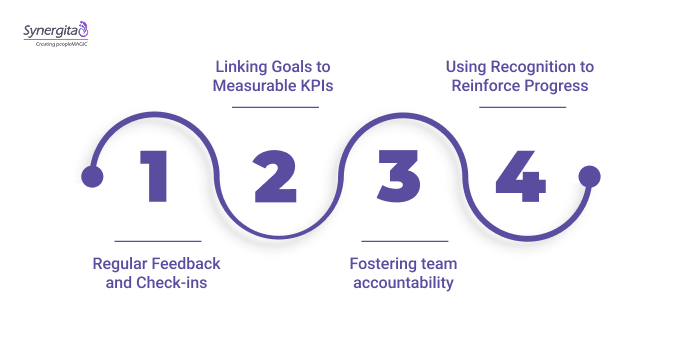
Clear objectives often fail not because they are poorly written but because they are not reinforced in day-to-day practice. Managers who turn goals into structured routines are the ones who see measurable progress. These practices ensure that objectives do not remain static statements but become an active part of team culture.
1. Regular Feedback and Check-ins
Annual or even quarterly reviews are far too slow to sustain momentum. A manager who waits until the end of a cycle risks discovering that progress stalled weeks earlier. Shorter feedback loops, such as structured weekly one-on-ones or bi-weekly team reviews, keep objectives alive. For instance, a customer success manager working toward reducing churn can review weekly account health scores with their team and intervene early when risks appear. The immediacy of these conversations allows for quick corrections and prevents small issues from snowballing into missed targets.
2. Linking Goals to Measurable KPIs
Objectives lose credibility if they are not grounded in evidence. Tying goals to a set of measurable KPIs makes them trackable and actionable. For example, if the objective is to improve project delivery efficiency, KPIs could include the percentage of milestones completed on schedule, average cycle time per task, or the variance between estimated and actual hours. These metrics not only help evaluate success but also give managers a diagnostic view of what is slowing progress, whether it is resource constraints, unclear processes, or skill gaps.
3. Encouraging Accountability Within the Team
Objectives succeed when responsibility is distributed, not concentrated. A manager setting a goal to enhance cross-team collaboration cannot carry the weight alone; they must assign explicit accountability. For instance, a product manager may assign a developer to own inter-team technical documentation while a business analyst takes ownership of cross-departmental requirement gathering. By making ownership visible, accountability shifts from being abstract to tangible, and progress becomes a collective commitment instead of a top-down directive.
4. Using Recognition to Reinforce Progress
Recognition acts as fuel for sustained effort, but it works best when tied directly to objectives rather than generic praise. A sales manager aiming to boost customer satisfaction scores could spotlight a rep who resolved a long-standing client issue, showing the team how individual actions link to the larger objective. Public recognition in meetings, small incentives for milestone achievements, or even data dashboards that celebrate weekly wins can help create a culture where objectives feel rewarding, not just mandatory.
How Synergita Helps Managers Achieve Their Objectives
Setting objectives is one thing; turning them into sustained progress is another. Many managers find that frameworks like OKRs or SMART goals sound great during planning sessions but fade away in the chaos of daily work. Synergita bridges that gap by embedding goals into everyday workflows, making progress visible, measurable, and actionable.
1. Turning Frameworks into Daily Practice
With Synergita, manager objectives never stop at documentation. Goals are connected to tasks and activities that teams handle every day, ensuring they remain active and relevant. Instead of reviewing goals at the end of the quarter, managers and teams always know where they stand, making adjustments in real time.
2. Real-Time Feedback and Recognition
Feedback loses value when it arrives too late. Synergita enables managers to deliver input as soon as progress is visible and recognize contributions instantly. This approach keeps motivation high and allows quick course corrections before small issues turn into missed objectives.
3. Aligning Team and Organizational Goals
Objectives are most powerful when they contribute to larger outcomes. Synergita helps managers cascade company priorities into clear goals for their teams. Whether it is improving project efficiency or strengthening employee engagement, every objective is tied directly to the business strategy, ensuring alignment and impact.
4. Balanced Focus on Performance and Growth
Strong management requires balancing immediate business outcomes with long-term talent development. Synergita makes this possible by allowing managers to track performance targets alongside leadership development goals. A manager can, for instance, improve project delivery while also preparing future leaders within the team.
5. Transparency and Accountability
Ambiguity often undermines objectives. Synergita eliminates that risk by documenting every goal, milestone, and outcome in one place. Employees gain confidence in fair evaluation, while managers know performance discussions are grounded in evidence rather than opinion.
By integrating these practices into everyday operations, Synergita transforms manager objectives from annual checkboxes into living goals that guide decisions, motivate teams, and drive measurable success. Start your free trial now!

Conclusion
The best managers are not judged only by the goals they set but by the progress they inspire. Objectives lose meaning if they stay on paper, and that is where many managers stumble. What transforms intent into impact is structure, visibility, and momentum; the ability to keep goals alive every single day. Synergita does exactly that by making progress transparent, feedback continuous, and accountability fair.
If you want to see your team’s objectives turn into results that truly move the needle, book a demo with Synergita and experience the difference.
FAQs
Q: What is the main objective of a manager?
A: A manager’s main objective is to ensure that the team’s efforts directly support organizational goals. This involves setting clear expectations, removing obstacles, providing guidance, monitoring progress, and enabling employees to perform at their best. Ultimately, managers turn strategy into measurable outcomes while fostering engagement and accountability.
Q: What are the 5 key performance objectives?
A: The five key performance objectives—quality, speed, dependability, flexibility, and cost efficiency—define how effectively an organization delivers value to its customers. Managers use these objectives to balance operational excellence with adaptability, ensuring products and services meet expectations while responding efficiently to market changes and internal constraints.
Q: What are SMART objectives for managers?
A: SMART objectives are goals that are Specific, Measurable, Achievable, Relevant, and Time-bound. For managers, this means defining clear targets, such as improving customer satisfaction scores by a set percentage within a defined period, aligning team efforts with strategy, and providing a benchmark for monitoring, adjusting, and celebrating progress.
Q: What are the three skills of a manager?
A: Managers require three core skills: technical skills to understand and optimize processes, human skills to lead, motivate, and communicate effectively with their teams, and conceptual skills to understand the bigger picture. Together, these skills help managers connect daily operations to organizational strategy while fostering performance and growth.