



For non-profit leaders, the core challenge isn’t a lack of passion; it’s operational whiplash. You are perpetually caught between your expansive mission and the urgent pressures of grant deadlines, donor reports, and immediate community needs. Without a clear bridge, your vision can fracture into a scattered list of tasks, leading to team burnout and a narrative of activity rather than demonstrable change.
The OKR framework directly addresses this tension. It provides the essential link between your aspirational mission and the measurable, daily work that proves your impact to funders, boards, and your community.
This guide provides a strategic blueprint to implement OKRs for non-profit strategy. You will learn to define inspirational objectives and set concrete key results that demonstrate tangible progress with these 15 actionable examples.
Key Takeaways
- Outcomes Over Activities: Effective non-profit OKRs measure end-results like “lives improved,” not just tasks like “workshops held.”
- The “So That?” Test: Apply this to every Key Result to ensure it measures a true outcome, not just an activity.
- Focus with the 3×3 Rule: Limit teams to 3 Objectives with 3 Key Results each to maintain strategic clarity.
- Separate Evaluation from Development: Frame OKRs as tools for learning and alignment, not for punitive performance reviews.
- Integrate Capacity Planning: Factor volunteer time and turnover into your goal-setting confidence scores from the start.
Importance of OKRs for Non-Profit
The adoption of a structured goal framework is critical for mission-driven organizations that operate under intense public scrutiny. Unlike for-profit entities, your success is measured by social utility rather than quarterly dividends or stock market performance.
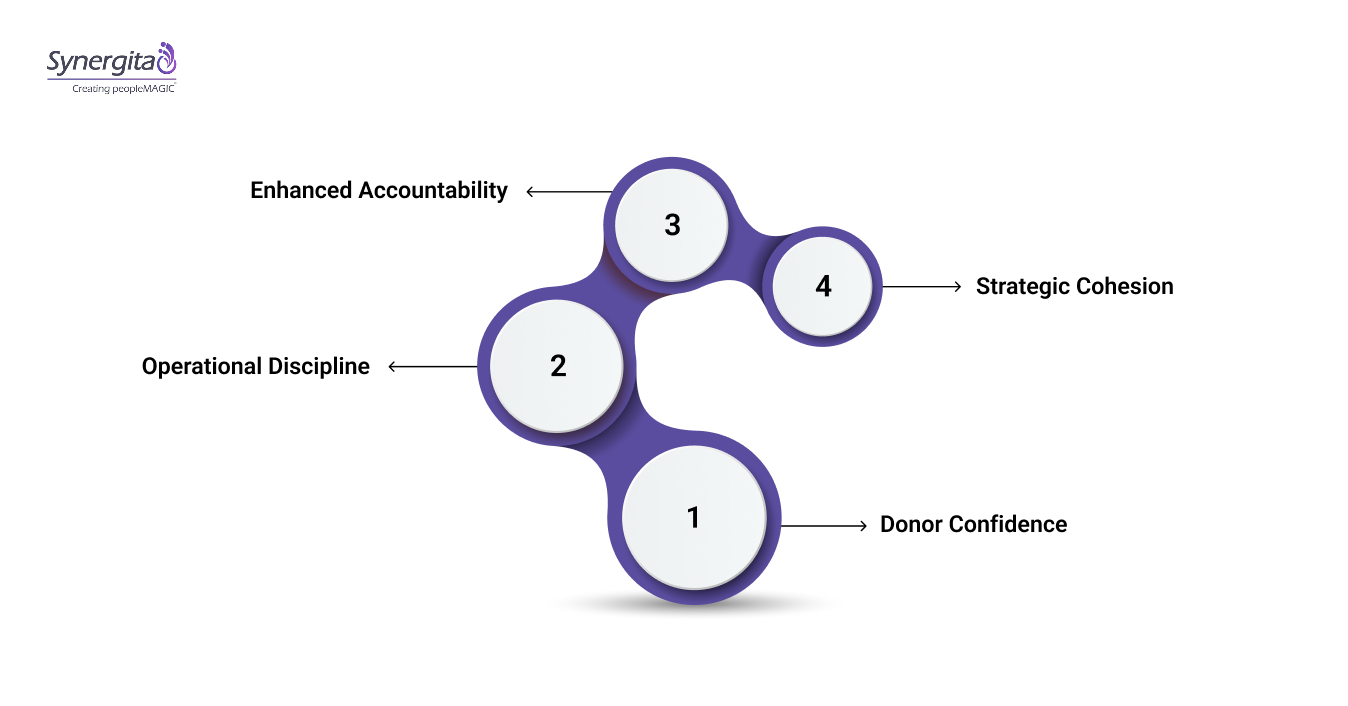
Implementing a formal system creates a disciplined culture where impact is documented through data rather than anecdotal evidence:
- Donor Confidence: Proving specific outcomes through key results makes your organization a more attractive partner for philanthropic foundations.
- Operational Discipline: Forcing teams to define “Key Results” prevents the common trap of mistaking being busy for being effective.
- Enhanced Accountability: Clear objectives eliminate ambiguity regarding who is responsible for specific community outcomes or fundraising targets.
- Strategic Cohesion: Aligning individual efforts with the master mission ensures that no department operates in a strategic vacuum.
Establishing these foundational benefits allows leadership to transition from defensive management to proactive community leadership.
Also read:Best Tools for OKR Management and Visualization
How to Craft Powerful Non-Profit OKRs: A Step-by-Step Framework
Creating effective goals requires a deep understanding of the distinction between qualitative aspirations and quantitative yardsticks. Your objectives should provide the inspirational “what,” while your key results must provide the measurable “how” for every initiative.
This dual approach ensures your team stays inspired while remaining anchored to the reality of your current operational capacity.
Follow these specific steps to build a high-impact framework for your organization:
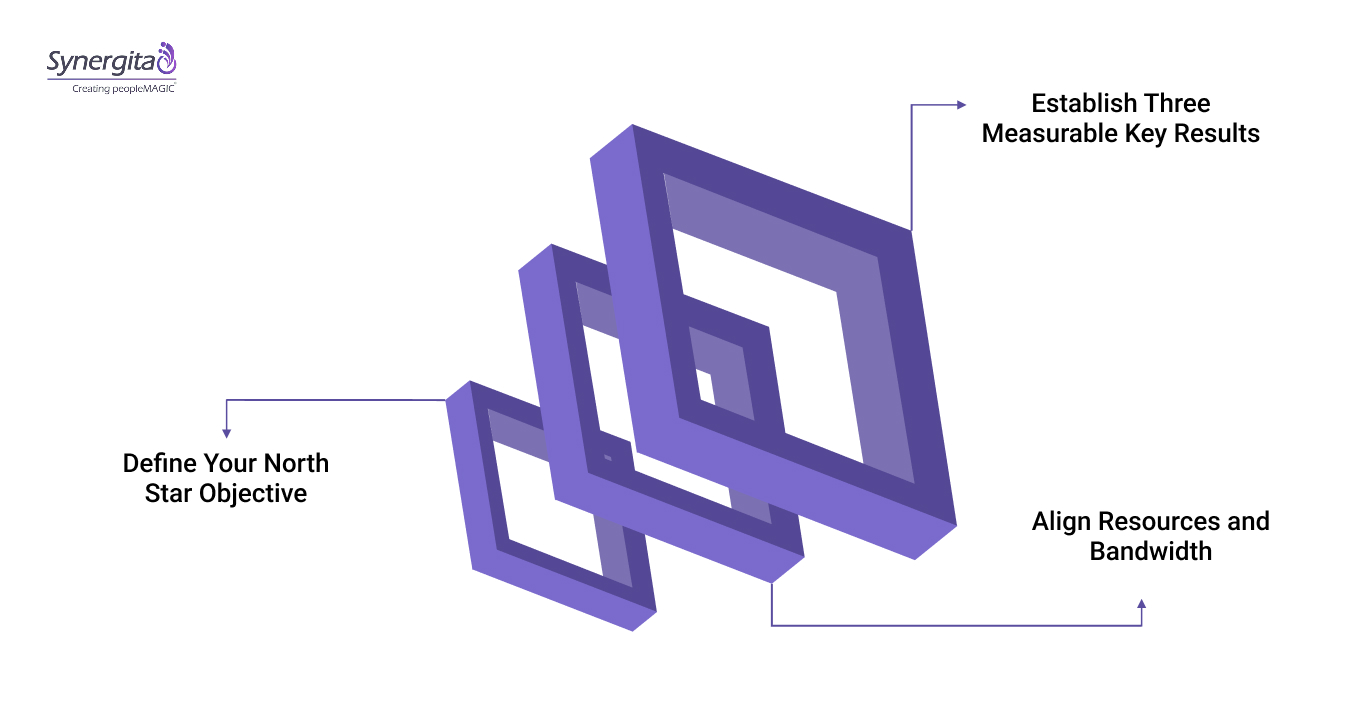
1. Define Your North Star Objective
Start by identifying one qualitative goal that encapsulates your most urgent community priority for the next ninety days. This objective must be ambitious enough to spark passion but realistic enough to be achieved within the timeframe. Avoid technical jargon and focus on the human impact you intend to create for your target demographic.
2. Establish Three Measurable Key Results
For every objective, identify three specific metrics that will prove whether you have successfully reached that strategic destination. These results must be numerical and time-bound, moving a specific needle from an X value to a Y value. If a result cannot be measured with a number, it is a task rather than a key result.
3. Align Resources and Bandwidth
Review your proposed goals against your current volunteer headcount and available financial budget to ensure feasibility for your team. You must identify which activities will be paused to make room for the new objectives you have set. Failing to account for capacity often leads to burnout and a total collapse of the goal-setting system.
Moving from theory to practice requires seeing how these principles apply to the unique departments found within a non-profit.
Also read:Essential OKR Dashboard Examples for Goal Tracking
15 Actionable OKRs for Every Non-Profit Department
Effective implementation depends on translating broad organizational goals into specific departmental targets that teams can actually execute. The following tables provide a comprehensive playbook for setting objectives across fundraising, community outreach, and internal operations.
Use these examples as a starting point to customize your own strategic roadmap for the coming quarters.
1. Fundraising and Development
| Objective 1 | Key Results |
| Diversify revenue streams to ensure long-term stability | 1. Secure 2 new institutional grants worth $50k each. |
| 2. Increase recurring monthly donors from 150 to 300. | |
| 3. Launch a corporate matching gift program with 5 local partners. |
| Objective 2 | Key Results |
| Maximize ROI for the annual community gala | 1. Reduce event overhead costs from 30% to 15%. |
| 2. Increase total individual donations during the event by 25%. | |
| 3. Secure 100% of event costs through corporate sponsorships. |
| Objective 3 | Key Results |
| Improve major donor retention and engagement | 1. Conduct 1:1 impact update meetings with the top 20 donors. |
| 2. Increase the upgrade rate of mid-level donors to major donors by 10%. | |
| 3. Achieve a 90% donor retention rate for gifts over $5,000. |
2. Programs and Community Outreach
| Objective 4 | Key Results |
| Expand the reach of our youth literacy program | 1. Enroll 500 new students across three new school districts. |
| 2. Achieve an 85% completion rate for the summer reading module. | |
| 3. Secure 50 new volunteer tutors with background certifications. |
| Objective 5 | Key Results |
| Improve the nutritional health of homeless clients | 1. Increase fresh produce percentage in meal kits from 10% to 40%. |
| 2. Establish partnerships with 5 new local organic farms. | |
| 3. Reduce per-meal cost by 15% through bulk purchasing. |
Also read:Effective OKR Examples for Teams and Businesses
| Objective 6 | Key Results |
| Enhance the effectiveness of community workshops | 1. Increase average post-workshop “knowledge gain” score by 30%. |
| 2. Maintain an average session attendance rate of 90%. | |
| 3. Implement 3 new curriculum updates based on participant feedback. |
3. Advocacy and Awareness
| Objective 7 | Key Results |
| Drive significant policy change for local housing | 1. Collect 10,000 verified signatures for the city council petition. |
| 2. Secure 3 formal meetings with key legislative decision-makers. | |
| 3. Earn 5 features in major regional news publications. |
| Objective 8 | Key Results |
| Build a massive digital community of advocates | 1. Grow the email newsletter subscriber list from 5k to 12k. |
| 2. Increase average social media engagement rate from 2% to 6%. | |
| 3. Convert 5% of digital subscribers into active event volunteers. |
| Objective 9 | Key Results |
| Standardize the organization’s brand voice across channels | 1. Complete a comprehensive brand guidelines document for all staff. |
| 2. Refresh 100% of marketing collateral with new messaging. | |
| 3. Increase brand recognition score in community surveys by 20%. |
4. Volunteer Management
| Objective 10 | Key Results |
| Create a world-class volunteer experience | 1. Increase volunteer retention rate from 40% to 70%. |
| 2. Achieve an average Net Promoter Score (NPS) of 75 from volunteers. | |
| 3. Reduce the average volunteer onboarding time from 14 days to 5 days. |
| Objective 11 | Key Results |
| Upskill the volunteer base for specialized roles | 1. Certify 20 volunteers in advanced crisis intervention techniques. |
| 2. Create 5 digital training modules for self-paced learning. | |
| 3. Increase the percentage of lead-volunteer positions filled to 100%. |
5. Internal Operations and Finance
| Objective 12 | Key Results |
| Modernize our technical infrastructure for efficiency | 1. Complete the migration of 100% of donor records to the new CRM. |
| 2. Reduce manual data entry hours for staff by 30% via automation. | |
| 3. Achieve a 95% staff proficiency rating on the new reporting tools. |
| Objective 13 | Key Results |
| Optimize financial transparency and oversight | 1. Reduce the time to finalize monthly financial reports to 5 days. |
| 2. Achieve a 0-deficiency rating in the annual external audit. | |
| 3. Maintain a 6-month operating cash reserve at all times. |
| Objective 14 | Key Results |
| Strengthen organizational internal communication | 1. Maintain a 100% attendance rate for monthly all-hands meetings. |
| 2. Achieve an 80% positive score on the internal communication survey. | |
| 3. Launch an internal knowledge base with 50+ key policy documents. |
6. Marketing and Public Relations
| Objective 15 | Key Results |
| Boost local awareness of our mission and impact | 1. Increase local website traffic from regional IP addresses by 40%. |
| 2. Distribute 5,000 impact brochures to local community centers. | |
| 3. Secure 3 speaking slots at major local business chamber events. |
Understanding the correct structure of an OKR is only half the battle for a busy non-profit executive.
Ready to implement these Non-Profit OKRs? Book a demo to see how Synergita’s templates and tracking can accelerate your goal-setting process.
Also read:Tips and Best Practices for OKR Reporting
Top 5 OKR Mistakes Non-Profits Make (And How to Avoid Them)
Implementing a new framework often reveals deep-seated cultural habits that can sabotage your progress if they are not addressed. Many organizations treat these goals as a static document rather than a dynamic management tool that informs daily decisions.
Recognizing these common pitfalls early allows you to build a more resilient and transparent organizational culture:
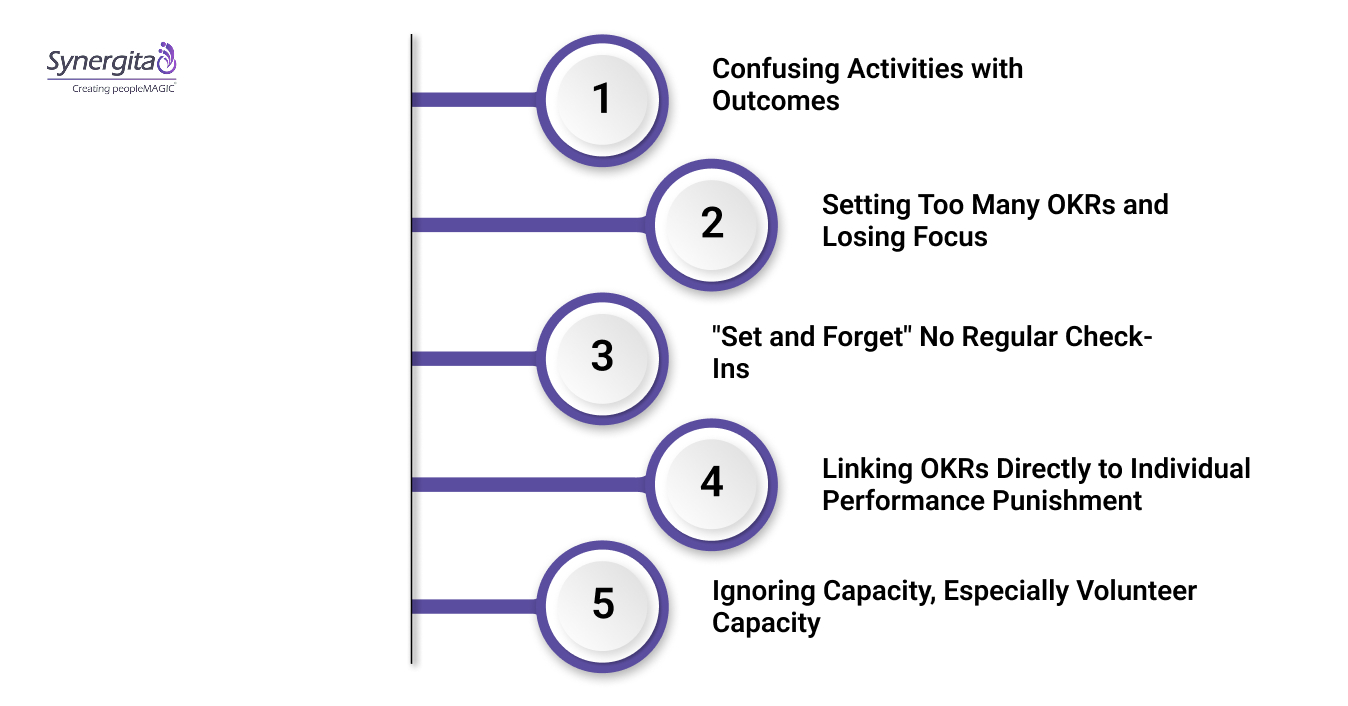
1. Confusing Activities with Outcomes
Many teams list tasks like “Write a grant” as a Key Result rather than the actual outcome of that task. A task describes what you do, while a result describes the change that happened because you did it.
Solution: Use the “So That?” test for every KR to ensure you are measuring the final impact rather than the effort.
2. Setting Too Many OKRs and Losing Focus
Non-profits often want to solve every problem at once, leading to a list of twenty goals that no one achieves. This lack of prioritization dilutes your limited resources and creates a sense of failure across the entire team.
Solution: Follow the “3×3 Rule” by setting a maximum of 3 Objectives with 3 Key Results each per quarter.
3. “Set and Forget” No Regular Check-Ins
Drafting beautiful goals in a document means nothing if they are not reviewed until the end of the quarter. Without regular visibility, teams revert to their old habits and lose track of the metrics that matter most.
Solution: Implement a bi-weekly or monthly “OKR Health Check” during existing team meetings to discuss progress and roadblocks.
Avoid the “Set-and-Forget” trap with automated check-in reminders. Synergita ensures your team stays on track with built-in feedback loops and progress prompts. Request a demo to simplify your goal tracking.
4. Linking OKRs Directly to Individual Performance Punishment
If staff feel that missing an ambitious goal will lead to termination, they will only set safe, easy targets. This “sandbagging” prevents the organization from achieving the bold breakthroughs necessary for significant social change.
Solution: Frame OKRs as learning and alignment tools for the collective mission, not as a personal report card.
5. Ignoring Capacity, Especially Volunteer Capacity
Non-profits often set aggressive goals without accounting for the unpredictable schedules of a volunteer-heavy workforce. This leads to missed deadlines and a decline in volunteer morale when targets are consistently unmet.
Solution: Build volunteer bandwidth and turnover into your confidence scoring for every Key Result during the planning phase.
Correcting these mistakes sets the stage for adopting the advanced techniques used by high-performing global NGOs.
Also read:OKR vs KPI: Key Differences and How to Use Both
Best Practices for Effective OKR Implementation
Sustaining a high-performance culture requires more than just a good template; it requires a commitment to radical transparency. Your goal-setting process must be visible to everyone, from the board of directors to the frontline field volunteers.
This openness creates a sense of shared ownership that is vital for surviving the lean periods common in the sector.
Consider these advanced strategies to refine your organizational performance:
1. Encourage a Culture of Radical Transparency
Publish your quarterly objectives in a shared space where every staff member and volunteer can see real-time progress. When everyone sees the numbers, they feel a greater sense of urgency and connection to the collective mission.
How it helps:
- Eliminates departmental silos.
- Encourages cross-functional collaboration.
- Boosts individual motivation through visibility.
2. Celebrate Learning from Failed Goals
Treat every missed key result as a data point that informs your strategy for the next planning cycle. Analyze whether the goal was too ambitious or if your execution strategy lacked the necessary resources to succeed.
How it helps:
- Reduces the fear of failure.
- Encourages innovative thinking.
- Refines your future capacity planning.
3. Standardize Your Review Rhythms
Establish a predictable schedule for planning, grading, and resetting your goals to create a consistent organizational heartbeat. This rhythm prevents goal-setting from feeling like a special event and makes it a standard part of your operations.
How it helps:
- Automates strategic focus.
- Reduces administrative friction.
- Ensures continuous improvement.
Maintaining this level of discipline is significantly easier when you have the right technical infrastructure in place.
Synergita: From Strategic Plans to Unified Execution
Non-profit leaders often manage OKRs in static documents like spreadsheets or slides. This manual approach obscures real-time progress, creates version control chaos, and makes aligning teams manually intensive. Leaders waste time aggregating data instead of analyzing it to guide their mission.
Synergita provides a unified cloud platform designed specifically for the strategic and operational needs of mission-driven organizations. It turns your OKR framework into a dynamic, visible system that connects strategy to daily execution.
- Visual Goal Alignment: Cascade your mission into Objectives and Key Results with a clear hierarchy tree. Show every team and volunteer how their work ladders up to top-level goals in real time.
- Integrated Performance Management: Connect OKR progress directly to performance conversations, feedback, and individual development plans within the Synergita Perform module.
- Automated Progress Tracking & Dashboards: Eliminate manual updates with automated check-ins and configurable dashboards. Gain instant visibility into goal health, lead/lag indicators, and team confidence scores.
- Centralized Engagement & Sentiment Analysis: Use the Synergita Engage module to capture volunteer and staff feedback. Apply AI-powered sentiment analysis to gauge morale and identify risks to your goals early.
This integrated approach ensures your okr for non-profit strategy is a living system for alignment, not a static administrative exercise.
Conclusion
OKRs provide the essential framework for non-profits to transition from measuring activities to delivering measurable impact. They create the clarity, focus, and evidence needed to secure funding, motivate teams, and adapt effectively. The 15 examples provided offer a practical blueprint for implementation across all key departments.
A dedicated platform like Synergita is critical for managing this process without adding administrative overhead. It operationalizes your strategy by creating visibility and connection across teams, volunteers, and leadership.
Book a demo with Synergita today to see how a unified platform can transform your strategic planning into aligned execution.
FAQs
Q. What is a good OKR for a non-profit?
A good non-profit OKR has an inspirational Objective and measurable Key Results focused on outcomes. Example: O: Reduce food insecurity in our county. KRs: 1) Distribute 50,000 nutritious meals. 2) Enroll 200 new households in SNAP benefits. 3) Partner with 5 local farms for fresh produce.
Q. How are OKRs different from KPIs for non-profits?
OKRs are a goal-setting framework with an ambitious Objective and measurable Key Results to drive change. KPIs are standalone health metrics monitored continuously (e.g., monthly donor count, website traffic). OKRs often use KPIs as components but focus on improving them.
Q. How often should non-profits review their OKRs?
Formal OKR cycles are typically quarterly, aligning with agile planning. However, teams should review progress in brief bi-weekly or monthly check-ins to discuss blockers and adjust tactics. This keeps goals relevant and teams aligned.
Q. Can OKRs work with a largely volunteer-based workforce?
Yes, but you must adapt. Set OKRs at the program or team level, not just for individuals. Factor volunteer capacity into confidence scoring. Use OKRs to show volunteers the direct impact of their contribution, which boosts retention and engagement.
Q. What’s the biggest mistake when starting with OKRs?
The biggest mistake is creating too many OKRs at once. Start with a pilot, one department or leadership team, for one full quarter. Learn the rhythm of setting, checking, and grading before rolling it out organization-wide. This builds internal expertise and proof of concept.