



Quick Summary
- Organizations can thrive in volatile environments by adopting flexible OKRs, shorter review cycles, stronger cross-functional collaboration, and real-time data to guide rapid course corrections.
- According to a BCG-MIT study, consultants using generative AI tools achieved up to 40% higher-quality output.
- Remote teams, innovation-focused goals, and continuous training ensure that OKRs stay relevant, actionable, and aligned with evolving priorities.
- Avoiding common mistakes like setting too many OKRs, confusing OKRs with KPIs, ignoring mid-cycle adjustments, and writing activity-based KRs helps teams achieve outcomes faster.
Objectives and Key Results (OKRs) are a powerful goal-setting framework that offers the flexibility organizations need to navigate constant change. However, to unlock their full potential in an uncertain environment, it is essential to know how to fine-tune OKRs effectively.
In this comprehensive guide, we will explore top OKR strategies that help organizations adapt their goals to changing business environments. You will learn how to build adaptability into your OKR strategy, refine review cadences, and align teams quickly as priorities shift.
Whether you are new to OKRs or already experienced, these strategies will equip you with the clarity and tools needed to make OKRs a reliable driver of agility and long-term growth.
| Table of Contents 1. Why Your OKR Strategy Needs a Fresh Approach for 2026? 2. What Are the High-Impact OKR Strategies for Changing Business Environments? 3. 5 Common OKR Strategy Mistakes You Should Avoid 4. Final Takeaway 5. Frequently Asked Questions |
What Are the High-Impact OKR Strategies for Changing Business Environments?
Modern organizations need OKRs that can keep pace with shifting customer needs, market trends, and internal priorities. The strategies below will help you strengthen adaptability, drive consistent performance, and improve your overall OKR strategy planning.
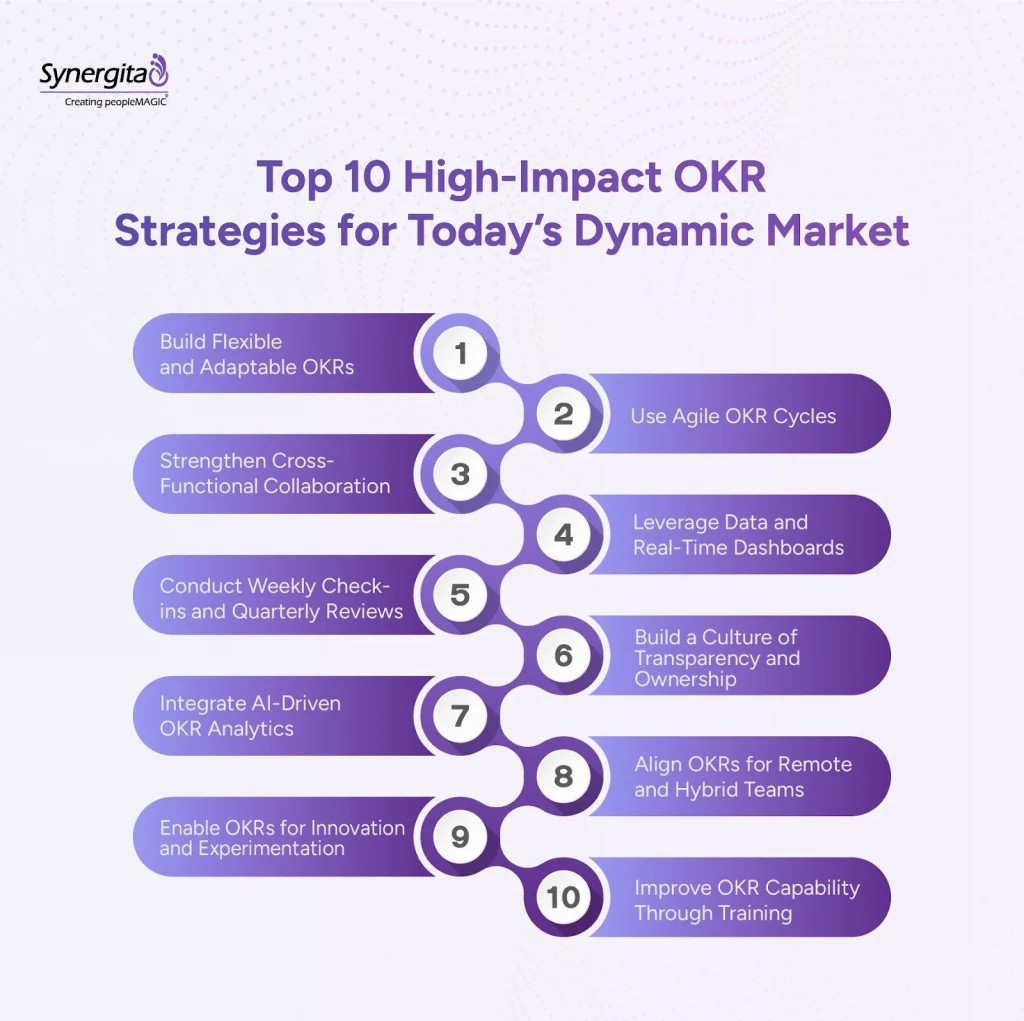
1. Build Flexible and Adaptable OKRs
In today’s competitive business environment, priorities can shift quickly. These shifts may come from changing customer demands to internal operational changes. OKRs must be designed to adapt so teams can refine priorities, adjust Key Results, or reinterpret objectives as conditions change.
For instance, a retail chain may revise its quarterly sales OKRs during sudden demand spikes.
2. Use Agile OKR Cycles
Long annual OKR cycles often result in outdated goals that no longer align with current priorities. By shifting to shorter OKR cycles, such as quarterly or monthly, organizations reassess progress, realign focus, and correct course before problems escalate.
For example, a SaaS startup launches a new feature in January. After seeing an unexpected drop in usage in February, they immediately shifted their March OKRs to prioritize UX fixes, onboarding improvements, and A/B testing, rather than waiting for a yearly review.
3. Strengthen Cross-Functional Collaboration
OKRs are more effective when different teams work together towards shared objectives. Using cross-functional OKR examples for strategy helps teams understand how their contributions align across departments.
Organizations with strong collaboration cultures often outperform others. According to WiFiTalents, teams that collaborate effectively are 21% more productive than those that don’t.
4. Leverage Data and Real-Time Dashboards
Using real-time dashboards and data-driven tracking enables teams to monitor progress continuously. Transparent, data-backed OKRs reduce ambiguity, increase accountability, and help leaders make faster decisions when priorities change or challenges arise.
5. Conduct Weekly Check-ins and Quarterly Reviews
Frequent check-ins like weekly or twice a week, combined with quarterly reviews, help businesses maintain momentum, ensure accountability, and allow early course-correction. These methods help teams stay on track with changing situations and ensure the OKRs remain effective.
6. Build a Culture of Transparency and Ownership
OKRs are most effective when everyone understands the goals, their role, and how progress will be measured. Transparent communication around objectives and progress instils ownership, which improves engagement, accountability, and long-term alignment.
7. Integrate AI-Driven OKR Analytics
AI has transformed the way organizations track and optimize their OKRs. With an AI-powered OKR management system, companies can automatically analyze OKR data, detect emerging patterns, and uncover insights that may not be visible through manual reviews.
This includes spotting early risks, identifying execution bottlenecks, predicting the likelihood of achieving Key Results, and recommending corrective actions. In a BCG-MIT study, consultants using a generative AI-enabled OKR management system produced up to 40% higher-quality output in creative tasks than those who did not use AI.
8. Align OKRs for Remote and Hybrid Teams
The shift to remote and hybrid work requires OKRs that support dispersed teams. Clear goals and open communication make it easier for teams to stay aligned and track progress. This ensures remote teams stay aligned and focused, making OKRs essential for clarity and accountability.
9. Enable OKRs for Innovation and Experimentation
OKRs shouldn’t just track routine operational goals. By defining objectives around innovation (new products, experiments, learning), organizations encourage risk-taking and continuous improvement. This keeps the culture dynamic and future-ready.
10. Improve OKR Capability Through Training
Effective OKR implementation requires understanding, discipline, and skills. Training teams, especially managers, ensure OKRs are set, reviewed, and implemented correctly. Well-trained teams are more likely to write meaningful OKRs, follow up consistently, and use feedback wisely.
Why Your OKR Strategy Needs a Fresh Approach for 2026?
Your business needs a more strategic OKR approach for multiple reasons, including changing market dynamics, new opportunities, real-world feedback, and staying competitive.
- Shifting Markets: When market signals change, you should change objectives immediately rather than waiting for the next planning session.
- New Opportunities: Your teams should be able to redirect effort the moment a promising opportunity appears rather than being locked into old commitments.
- Interconnected Teams: As one team adapts its plan, dependent teams often need to adjust their Key Results to stay in sync.
- Employee Momentum: People stay motivated when goals are relevant and connected to current priorities, not outdated targets from months ago.
- Smarter Use of Resources: Flexible OKRs make it easier to allocate time, budget, and talent in the most effective way to achieve goals on time.
- Risk Management: Early operational or customer-side risks require timely adjustments to prevent teams from being caught off guard.
- Staying Competitive: Companies that refine their OKRs regularly can respond to the challenging environment than those who stick to static plans.
5 Common OKR Strategy Mistakes Businesses Should Avoid
These common mistakes include setting too many OKRs, treating OKRs as KPIs, ignoring mid-cycle OKR adjustment, and limiting OKRs to the leadership levels.
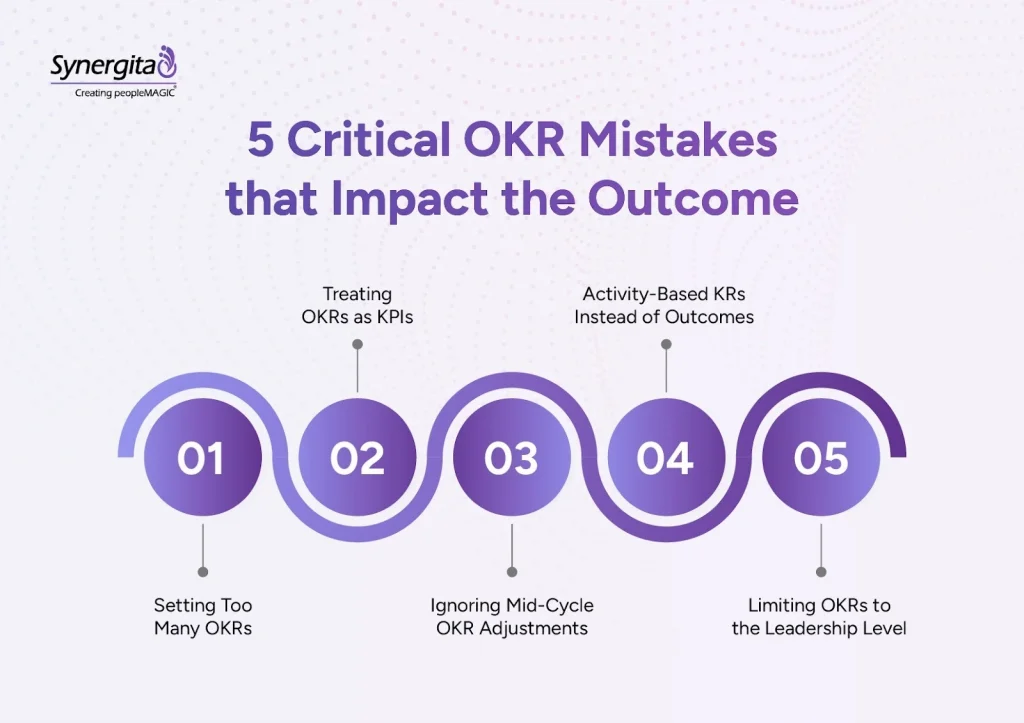
1. Setting Too Many OKRs
One of the biggest mistakes teams make is setting too many OKRs. When every team sets 6 or 7 objectives, focus is diluted and execution slows. A set of three to five objectives ensures teams put effort into what matters the most.
2. Treating OKRs as KPIs
OKRs are meant to set company-wide goals and align teams effectively, while KPIs measure ongoing performance. Mixing the two leads to confusion and low-impact goals. When teams use OKRs as a dashboard of metrics, they lose the opportunity to push meaningful improvements.
3. Ignoring Mid-Cycle OKR Adjustments
Many organizations lock OKRs at the start of the quarter and never revisit them. Such rigidity slows progress in fast-changing markets. Mid-cycle adjustments keep goals relevant and prevent teams from pursuing outdated priorities.
4. Activity-Based KRs Instead of Outcomes
Writing Key Results like “launch campaign” or “conduct 10 demos” focuses on activity rather than impact. Effective OKRs must measure the result of the effort, not the task itself.
For example, “increase qualified leads by 30 percent” is far more meaningful than “publish four landing pages.”
5. Limiting OKRs to the Leadership Level
When OKRs are limited only to the leadership level, they lose their impact across the rest of the organization. Cascading OKRs ensures that everyone works toward the same priorities with clarity and purpose.
Final Takeaway
Successful organizations refine their OKRs when priorities shift, rather than waiting for long planning cycles. The strategies in this guide explain that adaptability is now the core of staying competitive and resilient.
However, implementing key OKR strategies manually can slow teams down. This is where an AI-powered OKR management system becomes essential. Platforms like Synergita offer real-time visibility, automated insights, and early detection of execution risks, helping teams recalibrate goals with precision and confidence.
If you are looking for a modern OKR tool, try Synergita OKR free for 7 days and explore how it simplifies OKR management.
Frequently Asked Questions
OKRs help organizations stay focused on the right priorities by adapting when market conditions shift. They ensure every team knows what truly matters and how their work contributes to the bigger picture.
A focused set includes three to five Objectives with two to four Key Results for each objective. The goal is quality and execution, and not volume.
Yes, if business priorities shift or new insights emerge, OKRs should be updated. Sticking to outdated goals will impact the company’s performance.
AI-powered OKRs highlight potential risks, execution gaps, and performance trends before they become problems. This allows teams to adjust OKRs early and maintain momentum. Synergita AI OKR tool provides intelligent analytics that identify bottlenecks and recommend the next best actions.
Yes, Synergita is well-suited for startups and small enterprises. Its intuitive goal-setting, automated tracking, and easy onboarding help small and medium companies manage OKRs efficiently from day one. Moreover, its competitive pricing plans make it affordable for smaller teams without high upfront costs.