



Quick Takeaway
- First-time OKR attempts often fail because teams write goals that don’t connect to daily work. Starting small and treating the first cycle as a learning exercise makes OKR adoption easier.
- Practical, execution-focused OKR tips include starting with one team, cascading OKRs for alignment, objective clarity, outcome-based key results, baselines, influence, and regular check-ins.
- Common OKR mistakes to avoid include treating OKRs as task lists, skipping weekly reviews, using them for performance evaluations, and ignoring retrospectives.
- Synergita provides a structured and cost-effective OKR tool to help teams set, track, and improve OKRs from the first cycle onward.
The first time you try objective and key results (OKRs), it usually goes like this.
You read a few blog posts, pick a popular template, and write ambitious objectives that sound inspiring. But a few weeks in, day-to-day work looks exactly the same, weekly execution remains unchanged, and the OKR document slowly becomes an uncomfortable reminder that people don’t even want to open.
Such things happen across startups, agencies, and large organizations. The issue is not that OKRs do not work. In most cases, the first set of OKRs is designed to be difficult to use in real, day-to-day execution.
The disconnect is common. Just 23% of employees strongly agree that company goals create a sense of purpose. So, how do you use OKRs effectively if you are setting them for the first time?
In this blog, we will provide 10 actionable OKR user tips designed to help OKRs drive execution.
Table of Contents 1. What Are the Essential OKR User Tips for First-Time Users 2. A Quick Checklist of OKR Mistakes and How to Avoid Them 3. Final Takeaway 4 .Frequently Asked Questions |
What Are the Essential OKR User Tips for First-Time Users?
Here are practical OKR tips to help first-time teams write effective objectives and key results.
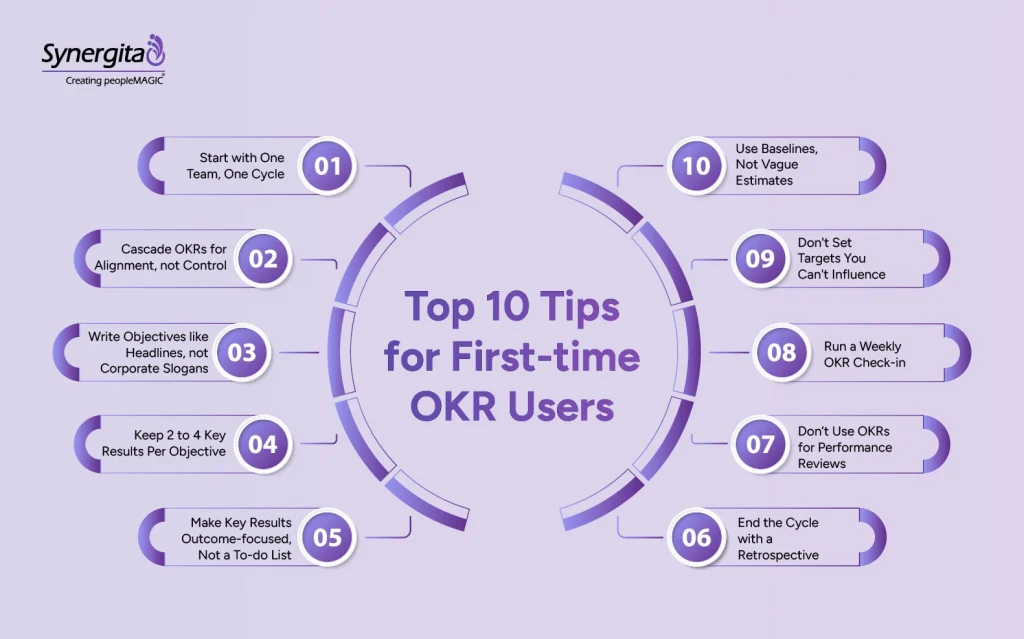
1. Start with One Team, One Cycle
The fastest way to kill OKRs is to launch them everywhere at once. For your first cycle, keep it small:
- Pick one team or one function.
- Run OKRs for one quarter (or even 6 weeks if you move fast).
- Treat it like a pilot you can improve.
This reduces resistance, lowers risk, and gives you proof that the process works.
2. Cascade OKRs for Alignment, not Control
OKRs should link company goals to team and individual priorities, without forcing the same targets at every level. Company-level OKRs should cascade into team-level OKRs. The objective sets direction, while teams define the outcomes they can directly influence.
Think of OKR cascading as alignment through contribution, not a hierarchy of copied goals.
A simple model to follow:
- Company OKRs define the strategic outcomes for the cycle
- Team OKRs explain how each team contributes to those outcomes
- Individual OKRs focus on personal impact that supports team goals
Example:
- Company objective: Improve customer retention across key segments
- Team objective (Product): Reduce friction in the onboarding experience
- Individual objective: Help new users reach their first value faster
Suggested Reading: A Complete Guide to Cascading OKRs
3. Write Objectives like Headlines, not Corporate Slogans
A strong objective is something a teammate can repeat from memory without looking it up.
Bad:
- Improve operational excellence across cross-functional deliverables.
Good:
- Ship faster without breaking things.
A simple test: if your objective sounds like it belongs on a lobby poster that does not help someone decide what to do next, you need to rewrite it.
Try this formula:
- Verb + outcome + why it matters
Example: Increase trial-to-paid conversion by removing setup confusion.
4. Keep 2 to 4 Key Results Per Objective
Most first-time OKR users write too many key results because they try to capture everything the team does. However, OKRs are meant to be a focus tool. If you need nine key results, you do not have an OKR problem; you have a prioritization problem, which is one of the most common OKR mistakes teams make.
Here is a guideline that successful organizations follow:
- 2 to 4 KRs per objective
- 1 to 3 objectives per team per cycle
If you are unsure, choose fewer. You can always track supporting work in a separate plan.
5. Make Key Results Outcome-focused, Not a To-do List
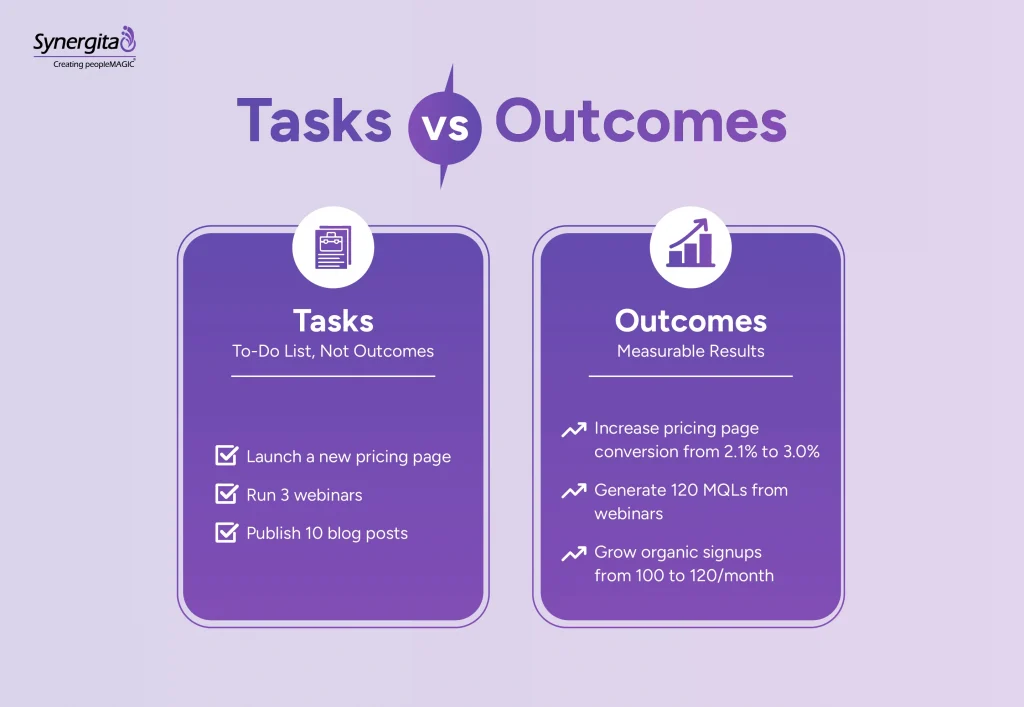
This is one of the most common issues that first-time OKR users face. Tasks describe the work you perform, while outcomes describe the change that work creates.
Tasks disguised as key results:
- Launch a new pricing page
- Run three demand-generation webinars
- Publish ten blog posts
Outcome-based KR:
- Increase pricing page conversion rate from 2.1% to 3.0%
- Generate 120 marketing-qualified leads from webinars
- Increase organic signups from 100 per month to 120 per month
6. Use Baselines, Not Vague Estimates
When writing a KR, if you don’t know the starting point, your KR is basically a wish. Efficient teams rely on key metrics to track OKR progress. Before you finalize KRs, collect:
- Current metric value (baseline)
- Time window (by when)
- Data source (where it lives)
For instance, establishing clear baselines ensures key results are based on data rather than assumptions. This allows teams to track real progress rather than relying on guesswork.
Example:
- “Increase NPS to 45” is weak if you don’t know where you start.
- Better KR is, increase NPS from 32 to 40 by the end of the quarter (Delighted survey).
7. Don’t Set Targets That Are not Achievable
A key result should reflect an outcome your team can achieve through its own work. When success depends heavily on other teams or external factors, teams struggle to achieve results consistently.
For example:
- Grow revenue by 40% (depends on multiple teams and market conditions)
- Hit 1M views on social (highly dependent on algorithms)
Better team-owned alternatives:
- Instead of “Grow revenue by 40%,” use “Increase outbound reply rate from 6% to 10%.”
- Instead of “Hit 1M views on social media”, use “Increase qualified inbound leads from social by 25%.”
It’s important to remember that setting unrealistic targets can demotivate teams and lead to poor performance.
Suggested Reading: How to Identify the Difference Between Challenging and Unattainable Objectives
8. Run a Weekly OKR Check-in
OKRs fail when they are not reviewed regularly. A weekly OKR tracking helps businesses keep goals on track and remove bottlenecks to execution.
The goal is not reporting or justification, but learning and course correction. Keep the discussion focused on outcomes. Use these questions as a guide:
- Did any key result move this week?
- What actions or decisions caused that movement?
- What is currently blocked?
- What is the single most important priority for next week?
Run this check-in in the same meeting every week. It builds accountability, helps identify problems early, and adjusts before the goals go off track.
9. Don’t Use OKRs for Performance Reviews
OKRs are meant to align day-to-day work with the company’s priorities, not to grade individual performance. The moment people feel evaluated or judged based on OKR, they start lowering targets, hiding risks, and playing it safe.
If you want OKRs to work, protect psychological safety:
- Avoid surprise scoring during reviews
- Encourage honest red and yellow status updates early
- Reward learning and course correction, not just green dashboards
Suggested Reading: Why OKRs Should Not be Used for Performance Evaluation?
10. End the Cycle with a Retrospective
You should score OKRs, but if you stop there without reflection, they become a compliance ritual. At the end of each cycle, you should run a short retrospective through team meetings, followed by structured 1:1 meetings and to reflect on execution, outcomes, and learning:
- Which actions actually moved the metrics?
- What should we stop doing next cycle?
- What is clearly working and worth doubling down on?
- Which key results were poorly designed or unclear?
The point is not to achieve good numbers at the beginning but to learn what actually drives outcomes.
A Quick Checklist of OKR Mistakes and How to Avoid Them
Even well-intentioned OKRs fail when you ignore critical mistakes. Before you lock your next cycle, use this checklist to identify issues that first-time OKR users usually face.
- Writing too many OKRs at once: Limit objectives and key results to what truly matters this cycle.
- Turning tasks into key results: If it reads like a to-do item, it probably belongs in a project plan, not an OKR.
- Skipping baselines and data sources: Always define where the number comes from and where you start.
- Reviewing OKRs only at the end of the quarter: OKRs need regular check-ins. Without weekly or bi-weekly reviews, they quickly lose relevance.
- Using OKRs for performance evaluation: Keep OKRs focused on learning and execution, and avoid treating them as performance reviews.
- Scoring without reflection: Always pair scoring with a retrospective to understand what worked and what did not.
Final Takeaway
If you are new to OKRs, your goal is not to write the perfect set on day one. Your goal is to create a simple system that helps your team focus, measure real outcomes, and learn fast. By continuously learning from each cycle, you can refine your objectives and key results over time.
As you start implementing OKRs across teams, you need a structured system to create, track, and refine OKRs without adding process overhead. Synergita OKR management software is designed to help teams set clear objectives, track progress through measurable key results, and run regular check-ins.
If you are looking for a simple and cost-effective AI-powered OKR tool, sign up for Synergita’s 14-day free trial and see how structured OKR can work for your teams.
Frequently Asked Questions
Start with 1 to 3 objectives, and 2 to 4 key results per objective. Fewer is better in the first few cycles.
Effective OKR implementation combines both approaches. Leadership defines strategic direction, priorities, and constraints, while teams propose OKRs that align with those objectives, which can be refined collaboratively.
SMART goals are a framework for writing well-defined, achievable goals, usually used for individual tasks or commitments. It should be Specific, Measurable, Achievable, Relevant, and Time-Bound.
OKRs are a goal-management framework for setting ambitious goals and measuring progress through measurable key results over a fixed cycle. OKRs encourage learning even when goals are not fully achieved.
OKRs should generally remain stable throughout the cycle to ensure focus and accountability. However, if there is a significant shift in business priorities or market conditions, OKRs can be changed.
For early OKR cycles, you can use a shared document, spreadsheet, or workspace page that your team will actually use every week. However, as you use OKRs across teams, a dedicated OKR management software can be useful. These tools provide structured tracking, progress dashboards, and integrations that reduce manual effort.
This is common in early OKR cycles and should not be treated as failure. Missing OKRs is often a signal that targets could be unrealistic, key results were poorly defined, or the initiatives were not enough. Use this insight to run a retrospective, refine assumptions, and design stronger OKRs for the next cycle.