



Performance reviews shape how your team grows, improves, and aligns with business goals. Without a structured approach, evaluations become inconsistent, time-consuming, and often ineffective.
An employee performance review template standardizes the process, ensures fairness, and saves managers hours of preparation. Whether you’re conducting annual appraisals, quarterly check-ins, or probationary reviews, the right template makes evaluations clear, actionable, and meaningful.
This guide walks you through 10 performance evaluation templates designed to fit different review cycles, organizational needs, and employee roles. Each template addresses specific evaluation scenarios and helps you turn feedback into measurable outcomes.
Key Takeaways
- Employee performance review templates eliminate inconsistency by providing structured formats for annual appraisals, probation reviews, and continuous feedback cycles.
- Goal-based templates using OKRs or SMART criteria connect individual performance to organizational objectives, making reviews measurable and strategic.
- 360-degree feedback and self-assessment templates gather input from multiple sources to create balanced, unbiased performance evaluations.
- Synergita offers customizable performance review templates with automated workflows, real-time dashboards, and goal alignment tools that adapt to any review scenario.
- Choosing the right template depends on review frequency and purpose, whether you need simple quarterly check-ins or comprehensive annual evaluations with competency assessments.
What is a Performance Review?
A performance review is a formal evaluation of an employee’s work quality, productivity, and alignment with organizational goals over a specific period.
- It typically includes feedback on achievements, areas for improvement, skill development, and goal setting for the next cycle.
- Reviews can be annual, quarterly, or continuous, depending on your organization’s approach.
- The process involves both manager and employee participation, often incorporating self-assessments and peer feedback.
Effective reviews go beyond rating past performance; they create clarity around expectations, identify growth opportunities, and align individual efforts with strategic priorities.
When structured properly, performance reviews become powerful tools for development rather than administrative checkboxes.
Also Read: Most Common Mistakes and Errors Made in Performance Appraisals
Why You Should Use an Employee Performance Review Template
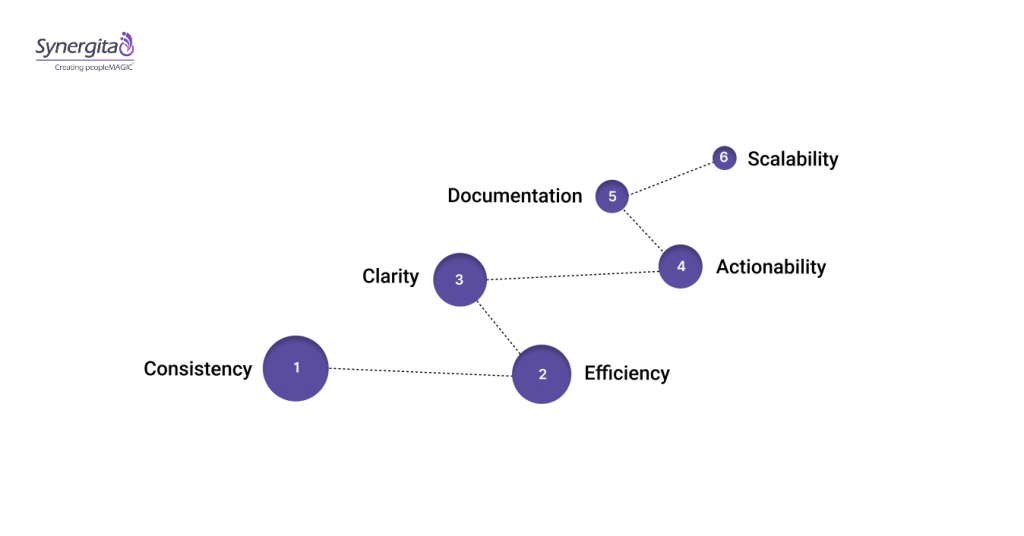
Performance evaluations without structure lead to inconsistent standards, missed development opportunities, and wasted time. A well-designed employee performance review template solves these problems by creating a repeatable framework that works across teams and review cycles.
- Consistency: Templates ensure every employee is evaluated using the same criteria, reducing bias and promoting fairness.
- Efficiency: Pre-built formats eliminate the need to start from scratch, cutting preparation time significantly.
- Clarity: Structured sections guide managers through comprehensive evaluations without missing critical areas.
- Actionability: Templates prompt specific feedback and goal-setting, turning reviews into development roadmaps.
- Documentation: Standardized records support promotion decisions, performance tracking, and legal compliance.
- Scalability: As your team grows, templates maintain evaluation quality without increasing manager workload.
Templates don’t restrict flexibility; they provide guardrails that improve quality while allowing customization based on role, seniority, or department. The key is choosing the right template for each evaluation scenario, which is exactly what the following section covers.
10 Best Employee Performance Review Templates
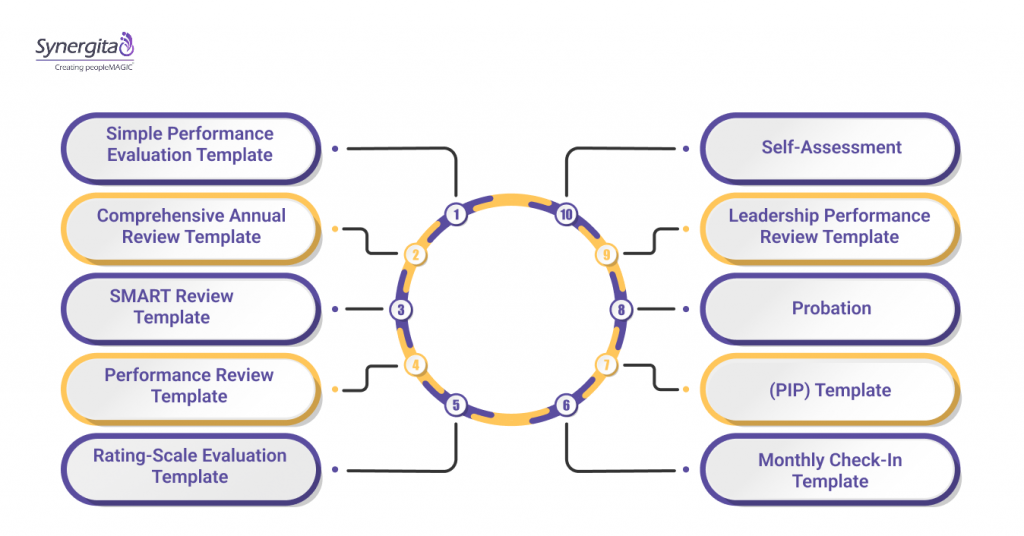
The right template depends on your review cycle, goals, and feedback needs. Some formats suit annual appraisals, while others work better for monthly check-ins or leadership reviews.
This section covers 10 proven templates for different scenarios.
1. Simple Performance Evaluation Template
This simple template is ideal for small teams, startups, or organizations new to performance reviews. It covers core performance areas without added complexity, prioritizing clarity and speed. Use it when you need quick, actionable feedback without in-depth analysis.
Core Elements to Include
- Job responsibilities and whether they were met
- Key accomplishments during the review period
- Areas needing improvement
- Manager comments and overall rating
- Employee signature and acknowledgment
Recommended Usage Scenarios
Use this template for entry-level or non-managerial roles, first-time structured reviews, or quick quarterly check-ins. It provides a clear performance snapshot without detailed competency mapping, keeping completion rates high while capturing meaningful feedback.
2. Comprehensive Annual Review Template
This template is designed for comprehensive annual reviews, covering year-long performance, achievements, and development. It supports detailed feedback, multiple evaluation areas, and alignment with strategic goals.
Core Elements to Include
- Year-long performance summary and key achievements
- Competency ratings across multiple dimensions
- Goal achievement analysis with metrics
- Strengths, weaknesses, and development opportunities
- Career aspirations and growth path discussions
- Compensation review or promotion considerations
Recommended Usage Scenarios
This format suits annual reviews for mid-level and senior employees. It supports promotion decisions, pay adjustments, and long-term planning while meeting compliance and documentation needs.
3. Goal-Based / OKR or SMART Review Template
This template measures performance against predefined objectives and key results or SMART goals. It shifts focus from subjective assessments to measurable outcomes, making evaluations data-driven and transparent. Ideal for organizations practicing objective-based management or transitioning from traditional reviews to goal-centric models.
Core Elements to Include
- List of objectives set at the beginning of the period
- Key results or success metrics for each objective
- Achievement percentage or completion status
- Qualitative assessment of how goals were approached
- New objectives for the next review cycle
- Alignment check with team or organizational OKRs
Recommended Usage Scenarios
Teams using OKR frameworks, product managers, sales roles, and project-based work benefit from this template. It works particularly well in fast-moving environments where priorities shift frequently, and measurable outcomes matter more than competency checklists. Quarterly or monthly reviews pair naturally with this format.
4. Competency-Based Performance Review Template
This template assesses role-specific competencies and behaviors, focusing on how work is done, not just results. It’s ideal for organizations with defined competency frameworks.
Core Elements to Include
- List of role-specific competencies with definitions
- Rating scale for each competency (often 1 to 5)
- Behavioral examples demonstrating competency levels
- Strengths and development areas by competency
- Training or coaching recommendations
- Link between competencies and career progression
Recommended Usage Scenarios
This template suits leadership and skill-intensive roles. It helps identify high-potential talent, supports succession planning, and maps clear development paths while assessing cultural fit and soft skills.
5. Numerical / Rating-Scale Evaluation Template
This template uses numerical ratings to quantify performance, enabling easy comparison and data-driven decisions. It’s ideal for organizations that need standardized metrics and clear performance rankings.
Core Elements to Include
- Performance categories with defined rating scales (1 to 5 or 1 to 10)
- Weighted scores for different performance dimensions
- Overall performance score or grade
- Benchmark comparison against team or department averages
- Comments section to contextualize ratings
- Action items based on numerical results
Recommended Usage Scenarios
This format suits large organizations during calibration and performance distribution. It works well for roles with clear KPIs, such as sales and customer support, and is most effective when paired with qualitative feedback to add context beyond scores.
6. Self-Assessment and 360° Feedback Template
This template collects input from multiple perspectives, including the employee, manager, peers, and direct reports. It creates a comprehensive view of performance by capturing how someone is perceived across different relationships. Self-assessment sections encourage reflection and ownership, while 360-degree feedback reduces bias and provides balanced insights.
Core Elements to Include
- Self-assessment section with guided questions
- Peer feedback on collaboration and teamwork
- Manager evaluation of results and leadership
- Direct report feedback (for managers)
- Summary of common themes across sources
- Perception gap analysis where self-view differs from others
Recommended Usage Scenarios
360-degree reviews are best suited for managers, cross-functional leaders, and senior employees. Organizations use them to strengthen leadership development, cultural alignment, and self-awareness. They’re most effective when conducted annually or semi-annually to allow time for real behavior change.
7. Manager / Leadership Performance Review Template
This template assesses managers and leaders on team performance, strategic impact, and leadership effectiveness. It focuses on how well they develop people, drive results through teams, and shape culture, making it essential for senior roles where leadership directly affects business outcomes.
Core Elements to Include
- Team performance metrics and achievement of team goals
- Leadership competencies (coaching, decision-making, communication)
- Direct report satisfaction and retention rates
- Strategic contributions and cross-functional impact
- Change management and innovation efforts
- Development of direct reports and succession planning
Recommended Usage Scenarios
Department heads, team leads, and executives require this specialized template. Organizations use it for leadership development and succession planning to identify strengths and close management gaps. Annual reviews, supported by quarterly leadership check-ins, provide the right cadence.
8. Probation / 30-60-90 Day Evaluation Template
This template tracks new hire performance during probationary periods, typically at 30, 60, and 90 days. It ensures new employees meet onboarding milestones, cultural fit, and early performance expectations. The structured checkpoints reduce turnover by identifying issues early and providing timely support.
Core Elements to Include
- Onboarding milestones and completion status
- Job knowledge and skill acquisition progress
- Cultural fit and team integration assessment
- Early wins and contributions
- Areas requiring additional training or support
- Decision to continue employment or extend probation
Recommended Usage Scenarios
All new hires benefit from this template, especially in roles with steep learning curves or critical skill requirements. Organizations with high early turnover use this format to standardize onboarding evaluations and improve retention. The 30-60-90 structure provides regular feedback when new employees need it most.
9. Performance Improvement Plan (PIP) Template
This template formalizes performance improvement by setting clear expectations, timelines, and support. It replaces general feedback with actionable milestones and defined consequences. PIPs both support struggling employees and document efforts in case termination becomes necessary.
Core Elements to Include
- Specific performance gaps with examples
- Measurable improvement goals and success criteria
- Timeline with checkpoint dates (typically 30, 60, 90 days)
- Support resources (training, mentoring, tools)
- Manager responsibilities and employee commitments
- Consequences if improvement targets are not met
Recommended Usage Scenarios
Employees consistently missing performance standards or exhibiting behavioral issues require PIPs. This template protects the organization legally while giving employees a clear path to success. HR involvement in PIP design and monitoring is critical. Use this only after informal coaching has failed.
10. Continuous / Quarterly or Monthly Check-In Template
This lightweight template supports frequent feedback conversations that replace or supplement annual reviews. It keeps performance discussions timely, relevant, and action-oriented. The format encourages ongoing dialog about priorities, obstacles, and progress rather than once-a-year judgment.
Core Elements to Include
- Recent accomplishments since last check-in
- Current priorities and focus areas
- Obstacles or support needed from the manager
- Progress on goals or OKRs
- Quick wins and development opportunities
- Priorities for the next period
Recommended Usage Scenarios
Organizations practicing continuous performance management rely on this template for monthly or quarterly touchpoints. Fast-paced environments, remote teams, and roles with shifting priorities benefit from frequent check-ins. This format works particularly well when combined with goal-based frameworks like OKRs that require regular progress updates.
Select a template based on your review cycle, goals, and feedback depth. Use goal-based formats for OKR-driven teams, competency models for leadership, and simple formats for routine evaluations. Your template should make reviews easier, not more complex.
Also Read: Constructive Feedback for Performance Review Management Systems
Picking the Right Employee Performance Evaluation Template
Synergita simplifies this entire process with configurable performance review templates built for every scenario described above. The platform adapts to your existing workflows while supporting modern approaches like continuous feedback, 360-degree reviews, and OKR alignment.
Key features:
- Customizable appraisal workflows tailored to role, department, or review cycle
- Pre-built templates for annual reviews, probation periods, PIPs, and continuous check-ins
- Goal tracking and OKR alignment that connects performance reviews to strategic objectives
- 360-degree feedback collection with automated reminders and consolidated reporting
- Real-time dashboards showing review completion, performance trends, and development needs
- Integration with HRIS to eliminate manual data entry and ensure accuracy
Stop wasting hours building review templates from scratch. Start your free trial with Synergita and transform performance evaluations from an administrative burden to a strategic advantage.
Frequently Asked Questions
1. What should be included in an employee performance review template?
A solid template includes performance assessment criteria, goal achievement tracking, competency ratings, manager comments, employee self-assessment, and development planning sections. It should also capture strengths, improvement areas, and action items for the next review period.
2. How often should performance reviews be conducted?
Annual reviews work for comprehensive appraisals, but quarterly or monthly check-ins provide more timely feedback and course correction. Many organizations now combine annual formal reviews with continuous feedback conversations for better results. Choose frequency based on role complexity and organizational pace.
3. Can performance review templates be customized for different roles?
Yes, effective templates adapt to role requirements. Sales roles need templates focused on revenue metrics, while leadership positions require assessments of team development and strategic impact. Customize core sections while maintaining consistency in rating scales and documentation standards across your organization.
4. What is the difference between a performance review and a performance improvement plan?
A performance review evaluates overall performance across multiple dimensions during regular cycles. A performance improvement plan targets specific underperformance with defined improvement goals, timelines, and consequences. PIPs are corrective tools used when standard reviews reveal persistent performance gaps requiring structured intervention.
5. How do you handle performance reviews for remote employees?
Remote reviews require the same structure as in-person evaluations but emphasize output over activity, communication effectiveness, and self-management skills. Use templates that track measurable results, project completion, and collaboration quality. Video check-ins supplement written reviews to maintain connection and clarity around expectations.