



Most performance conversations start like this: a manager opens a form, recalls a few recent events, and then tries to justify a rating. Meanwhile, the employee wonders if the process really reflects their day-to-day contributions or just what happened to stick in the manager’s memory.
That confusion isn’t unusual. In fact, only 14% of employees say performance reviews inspire them to improve, and 65% believe evaluations are irrelevant to their job, showing how traditional review cycles often fail to motivate or guide progress.
A performance management template that combines formal review moments with continuous check-ins bridges that gap. It brings rhythm to feedback, clarity to expectations, and structure to development conversations.
In this post, you’ll get ready-to-use templates plus clear guidance on running structured, effective performance reviews that work throughout the year, not just once.
Quick Take:
- Templates fail without structure: Performance reviews break down when rating criteria, feedback language, and follow-up actions aren’t clearly defined.
- Evaluation must connect to outcomes: A performance management template is effective only when it ties feedback to goals, behaviors, and measurable results.
- Hybrid reviews reduce bias and surprises: Continuous check-ins provide context that makes formal reviews fairer and more accurate.
- Manual templates create operational drag: As review cycles scale, static templates increase effort, fragment data, and reduce review quality.
- Performance management works best as a system: Teams move beyond templates when they need consistent evaluation, actionable insights, and visible follow-through across cycles.
Why Most Performance Reviews Fail (Even With Templates)
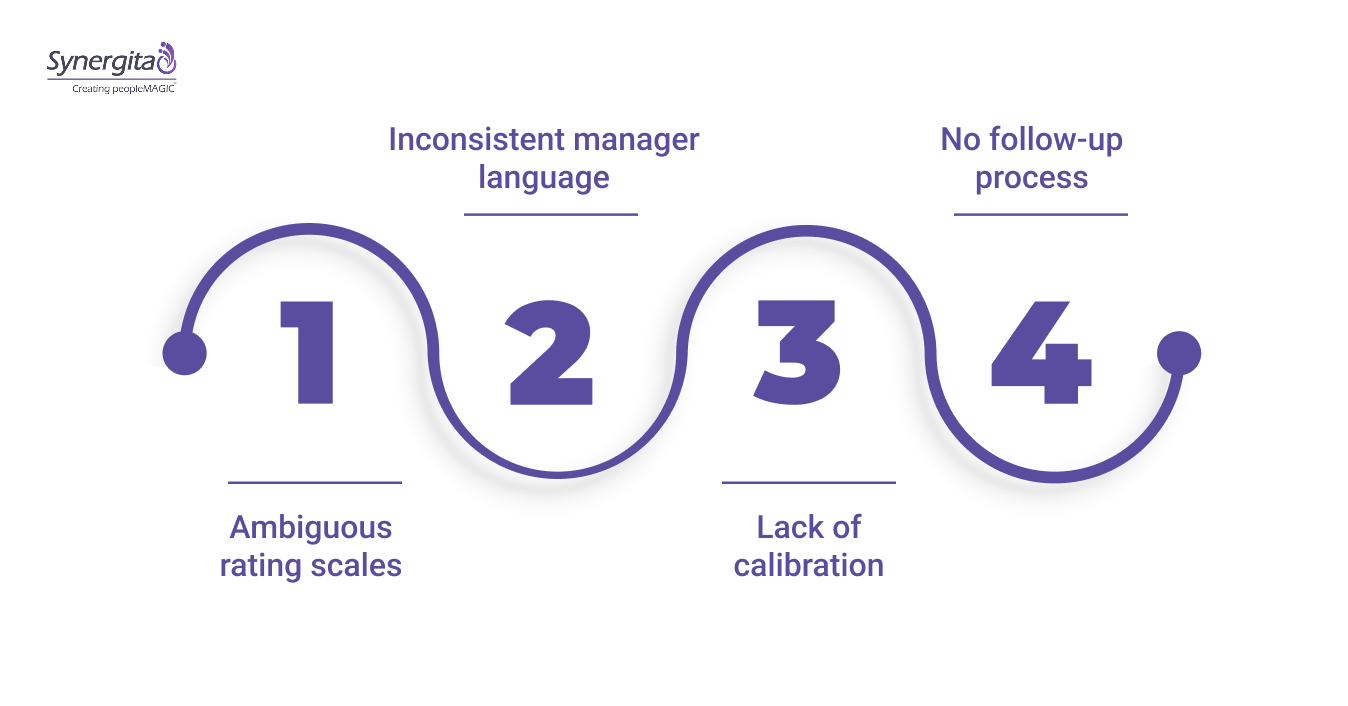
Templates don’t fail on their own. They fail when teams treat them as paperwork instead of a system for better decisions. Even well-designed review forms break down when the surrounding rules, language, and follow-through are missing.
Here’s where most performance reviews go wrong.
Ambiguous rating scales
Many templates include ratings like “Meets expectations” or “Exceeds expectations”, without defining what those actually mean.
As a result:
- One manager’s “meets” is another manager’s “exceeds”
- Ratings reflect personal standards, not performance reality
- Employees focus on defending scores instead of improving outcomes
When scales lack clear definitions, reviews feel subjective, even if the template looks structured.
Inconsistent manager language
Two managers can observe the same performance and describe it very differently.
One writes: “Strong ownership and delivery.”
Another writes: “Does what’s required.”
Without guidance on how to frame feedback, templates amplify inconsistency. Employees compare reviews across teams and quickly conclude the process isn’t fair, even when effort levels are similar.
Lack of calibration
Templates collect data, but they don’t align it.
Without calibration:
- High and low ratings drift across teams
- Bias goes unchecked
- Promotions and rewards feel arbitrary
This is why leadership often mistrusts review outcomes. The problem isn’t the form, it’s the absence of a shared benchmark.
No follow-up process
This is the most common failure point. Reviews get completed. Forms get submitted. And then nothing happens.
When templates don’t include:
- Clear development actions
- Ownership for follow-up
- Check-in checkpoints
Performance conversations become historical records instead of forward-looking plans. Employees leave reviews knowing how they were judged, but not what changes next.
To make reviews fair, actionable, and consistent, a performance management template must do more than capture scores.

What a Good Performance Management Template Must Include
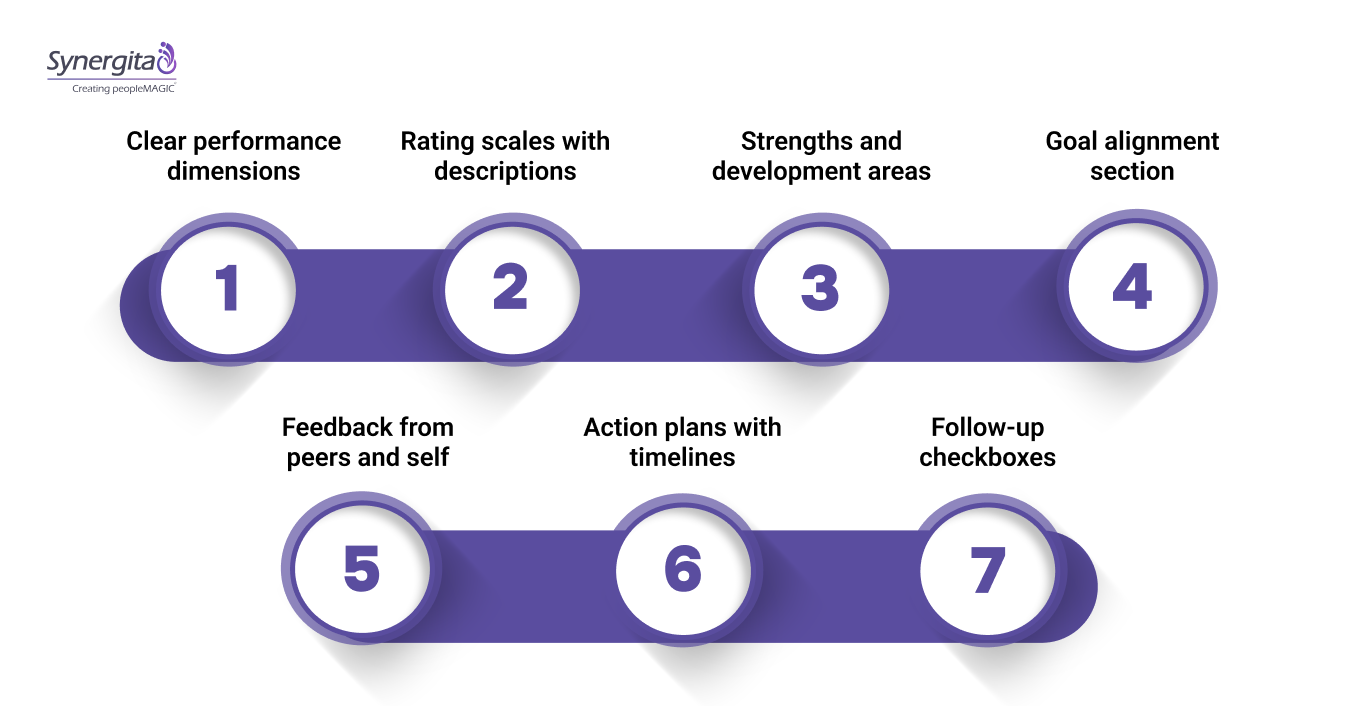
A performance management template only works if it guides better conversations, not just captures feedback. The goal isn’t to document performance. It’s to evaluate it fairly, discuss it clearly, and act on it consistently.
These are the core elements every effective performance management template must include.
1. Clear performance dimensions
Reviews fail when they evaluate everything at once. A good template breaks performance into defined dimensions, such as:
- Role outcomes
- Skill or competency areas
- Behavioral expectations
- Collaboration and ownership
This keeps feedback specific and prevents vague judgments like “overall strong performer” with no explanation.
2. Rating scales with descriptions
Numbers alone create confusion. Effective templates pair rating scales with clear descriptions that explain what each level represents. This:
- Reduces interpretation gaps between managers
- Improves consistency across teams
- Helps employees understand what “good” actually looks like
Without descriptions, ratings reflect opinion, not performance standards.
3. Strengths and development areas
Reviews shouldn’t focus only on gaps. Every template should include space for:
- Strengths to continue and build on
- Development areas to address next
This balances accountability with growth and ensures reviews don’t feel like fault-finding exercises.
4. Goal alignment section
Performance only makes sense in context. A strong template links reviews back to:
- Team or individual goals
- OKRs or key priorities
- Outcomes delivered during the period
This shifts reviews from personality-based feedback to results-based evaluation.
5. Feedback from peers and self
Manager-only feedback creates blind spots. Including:
- Self-assessment
- Peer or cross-functional input (where relevant)
adds perspective and reduces bias. Even limited multi-source feedback improves trust in the process.
6. Action plans with timelines
Feedback without action is wasted effort. Every review should end with:
- Clear next steps
- Ownership (who does what)
- Timelines for follow-up
This turns reviews into a forward-looking plan, not a historical summary.
7. Review history and follow-up checkboxes
Performance improves over time, not in isolation.
Templates should allow:
- Viewing past reviews
- Tracking commitments made earlier
- Checking whether actions were completed
This continuity is what makes performance management a system instead of a one-off event.
Once you know what a strong performance management template must include, the next step is choosing a format that brings structure and consistency to formal review conversations.

Template #1 — Structured Review Form (Download-Ready)
A structured review form is the backbone of formal performance reviews. It’s designed for moments when performance decisions matter—quarterly, biannual, or annual reviews where consistency, fairness, and documentation are critical.
Use this performance management template when you need to evaluate performance across teams, compare outcomes reliably, and anchor decisions like promotions, compensation, or role changes in evidence, not memory.
This template works best when reviews need to be repeatable, defensible, and easy to calibrate.
What this template is designed to do
At its core, a structured review form brings discipline to performance conversations. It ensures every manager evaluates performance using the same lenses, the same language, and the same expectations.
Instead of open-ended conversations that vary by reviewer, this template:
- Anchors feedback in objectives and outcomes
- Balances ratings with written context
- Produces inputs leadership can actually compare and calibrate
Example fields you’ll find in a structured review form
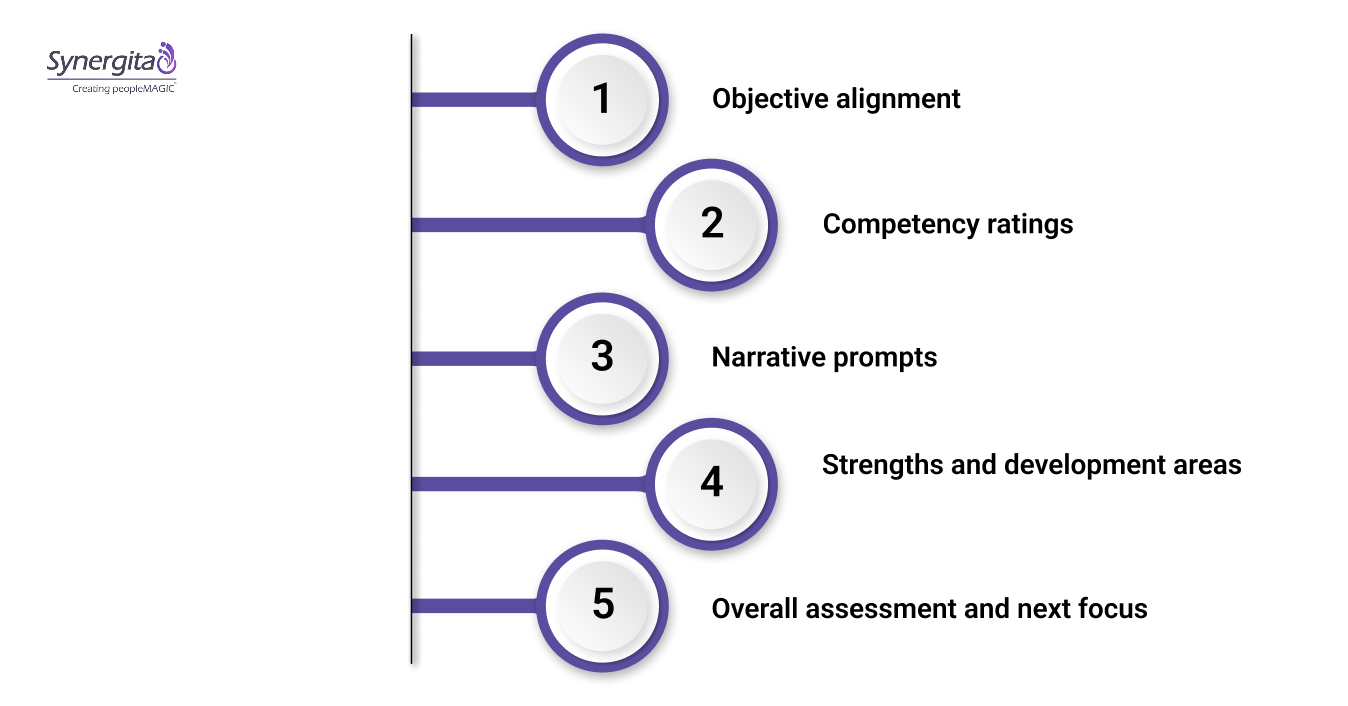
Rather than overwhelming managers with dozens of questions, an effective structured review form focuses on a few high-signal sections.
It typically captures:
- Objective alignment: A summary of the goals or OKRs set for the review period and what outcomes were achieved, supported by examples.
- Competency ratings: Ratings against role-specific skills and behaviors, each supported by clear descriptions so scores mean the same thing across teams.
- Narrative prompts: Short, focused questions such as:
- What impact did this employee have this period?
- What went well and why?
- Where did performance fall short?
- Strengths and development areas: A balanced view of what to continue leveraging and what to improve next.
- Overall assessment and next focus: A concise summary that ties performance to expectations and outlines priorities for the next cycle.
This structure keeps reviews focused on outcomes, not personalities.
Structured review form — sample table of contents
| Section | Purpose |
| Employee & Review Context | Defines role, period, and reviewer |
| Goals and Objective Alignment | Connects performance to outcomes |
| Performance Dimension Ratings | Evaluates skills and behaviors consistently |
| Narrative Feedback | Adds context behind ratings |
| Strengths & Development Areas | Balances growth and accountability |
| Overall Assessment | Summarizes performance clearly |
| Action Plan & Next Steps | Turns feedback into forward action |
| Acknowledgment & Sign-off | Confirms review completion |
This flow ensures reviews move logically from what was expected → what happened → what comes next.
Download and use
This structured review form can be created or adapted easily in Google Docs, Word, or spreadsheets. Many teams start with a document-based version before moving into a system as review cycles grow more frequent or complex.
Next, we’ll look at Template #2 designed to keep performance conversations active between formal reviews.
Template #2 — Continuous Check-In Template
Formal reviews capture performance at a point in time. Continuous check-ins shape performance as it happens. This template is designed to keep feedback flowing between review cycles, so performance management doesn’t feel episodic or reactive.
Use a continuous check-in performance management template when:
- You want regular, low-friction performance conversations
- Teams work in short cycles or fast-changing priorities
- Managers need visibility without waiting for formal reviews
- Development matters as much as evaluation
This template complements structured reviews, it doesn’t replace them.
What this template is designed to do
A continuous check-in template creates rhythm. Instead of saving feedback for the end of the quarter, it encourages short, focused conversations that keep goals, progress, and support needs visible.
It helps managers:
- Address issues early
- Reinforce strengths in real time
- Adjust goals as priorities shift
- Build trust through ongoing dialogue
For employees, it removes the anxiety of “surprise feedback” during formal reviews.
Example fields in a continuous check-in template
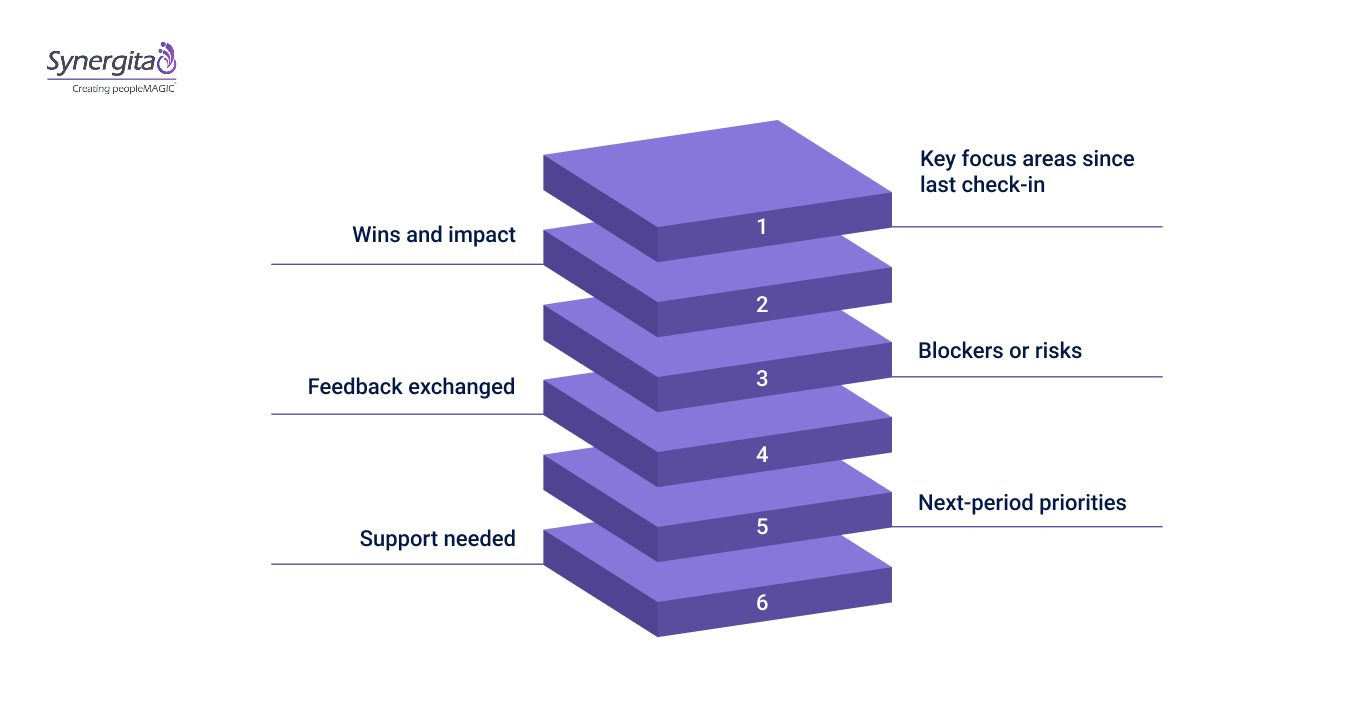
Unlike formal review forms, this template is intentionally lightweight. It focuses on signal, not scoring.
Typical fields include:
- Key focus areas since last check-in: What the employee worked on and why it mattered.
- Wins and impact: Outcomes delivered, progress made, or challenges overcome.
- Blockers or risks: Anything slowing progress or needing support.
- Feedback exchanged: Short notes from manager and employee—what’s working and what needs attention.
- Next-period priorities: Clear focus areas before the next check-in.
- Support needed: Coaching, resources, or decisions required from the manager.
These prompts keep conversations grounded in work and outcomes, not opinions.
Continuous check-in template — sample table of contents
| Section | Purpose |
| Check-in Context | Sets the time frame and participants |
| Current Focus Areas | Clarifies priorities |
| Wins & Progress | Highlights outcomes and momentum |
| Challenges & Blockers | Surfaces risks early |
| Feedback Notes | Captures two-way input |
| Next Steps | Aligns on priorities ahead |
| Support Required | Enables manager action |
This structure keeps check-ins efficient—most teams complete them in 10–15 minutes.
How this template fits into effective reviews
Continuous check-ins don’t replace formal reviews. They make them better.
By the time a structured review happens:
- Feedback is already documented
- Progress trends are visible
- Development conversations feel familiar, not forced
As performance cycles grow more frequent and expectations increase, even well-designed templates can start to feel limiting.
When to Move Beyond Static Templates
As teams grow and performance conversations become more frequent, the limits of document-based or spreadsheet-driven templates start to show. This isn’t a failure of discipline. It’s a signal that performance management has outgrown static tools.
Here are the clearest signs templates are no longer enough.
Performance data starts living in silos
Reviews, goals, feedback, and development plans often live in different places. One template for annual reviews. Another for check-ins. A separate file for goals.
Over time:
- Managers lose historical context
- Employees repeat the same conversations
- Leadership lacks a single view of performance trends
When performance data can’t be connected, it can’t inform decisions.
Review fatigue sets in
Templates rely heavily on manual effort.
Managers fill forms. Employees repeat self-assessments. HR follows up relentlessly. What starts as structure turns into overhead.
The result:
- Delayed reviews
- Shallow feedback
- Checkbox behavior instead of meaningful conversations
When the process feels heavier than the value it delivers, engagement drops fast.
Analytics and insight are missing
Templates capture information, but they don’t analyze it.
Teams struggle to answer questions like:
- Are performance ratings consistent across teams?
- Who needs development support right now?
- Are goals actually influencing performance outcomes?
Without analytics, reviews become retrospective documents instead of forward-looking tools.
Scaling requires more than documentation
At this stage, performance management needs to operate as a system—not a collection of files.
This is where Synergita fits naturally. It helps teams move beyond static performance management templates by connecting reviews, goals, feedback, and development into one structured workflow.
So performance conversations stay consistent, visible, and actionable as the organization scales.
Conclusion
A performance management template should make reviews clearer, fairer, and easier to act on, not heavier to run. For many teams, static templates are a solid starting point. They introduce structure, prompt better questions, and create a shared language for performance.
But as your organization grows, performance management stops being an HR exercise and becomes a leadership responsibility.
That’s when teams shift from managing forms to managing performance as a system.
Start your free trial and see how Synergita helps teams turn performance management templates into structured, continuous reviews, without adding process overhead.
FAQs
1. Can a performance management template really reduce bias in reviews?
A template helps, but only if it defines rating criteria clearly and encourages written context. Bias usually creeps in when managers rely on memory or vague scales. A strong performance management template creates consistency, which makes bias easier to spot and address.
2. How often should teams use a performance management template?
Most teams benefit from a hybrid approach: lightweight check-ins monthly or quarterly, supported by a more detailed template for formal reviews once or twice a year. Using a template too infrequently makes feedback stale; using it too often creates fatigue.
3. What’s the biggest mistake teams make with performance management templates?
Treating the template as the outcome instead of the conversation. When teams focus on completing forms rather than discussing performance and next steps, reviews lose impact—no matter how well designed the template is.
4. Should performance management templates be the same for every role?
Not entirely. While the structure should stay consistent, performance dimensions and expectations should vary by role. A one-size-fits-all performance management template often leads to irrelevant feedback and unclear evaluations.
5. How do you know if your performance management template is actually working?
If employees understand expectations, managers give timely feedback, and reviews lead to clear actions—not confusion—the template is doing its job. When reviews feel repetitive, disconnected, or hard to follow up on, it’s time to reassess the approach.