



In fast-paced SaaS companies, product development teams are often scattered in different directions. With so many moving parts, it’s easy for efforts to become fragmented, leading to slower product releases and missed deadlines.
The lack of alignment not only causes frustration but can also result in wasted resources and opportunities that never come to fruition. But what if there was a way to keep everyone on the same page, moving toward the same goals?
This blog will show you how SaaS companies can use OKRs for continuous product development by setting clear objectives and measurable results that guide your teams, improve focus, and ensure every effort supports company growth.
Key Takeaways:
- OKRs help SaaS companies align teams and ensure that all efforts contribute to business goals.
- Clear objectives and measurable key results drive focus and accountability within departments.
- Regular tracking and adjustments are essential for keeping OKRs on course and achieving results.
- Avoid setting unrealistic objectives or overloading teams with too many OKRs to ensure focus.
- Departments should align their OKRs with the company’s broader goals to avoid fragmentation and confusion.
What Are OKRs and Their Goal in SaaS?
OKRs (Objectives and Key Results) are a goal-setting framework that helps organizations align their efforts and track progress. In SaaS companies, OKRs ensure that teams across product development, marketing, and customer success are focused on key priorities that drive growth.
At the core of the OKR framework are two elements:
- Objectives: These are clear, qualitative goals that define what you want to achieve. Objectives should be inspiring and aligned with the company’s vision.
- Key Results: These are specific, quantitative measures used to track progress toward the objective. They should be challenging but achievable, providing a clear way to evaluate success.
The goal of OKRs in SaaS is to keep teams aligned and focused on high-impact goals. By setting clear objectives and measurable results, companies can drive better product development, enhance customer satisfaction, and boost overall performance.
With a clearer understanding of OKRs, it’s time to dive into specific examples of how SaaS teams can use them to achieve results.
Also Read: OKR Guide: Types, Benefits, Implementation & Best Practices
Top 18 OKR Examples to Drive SaaS Success
In SaaS companies, OKRs (Objectives and Key Results) are essential for setting clear goals and driving measurable outcomes. Below are several practical OKR examples across different teams within a SaaS company, showcasing how each department can focus on critical objectives to achieve business success.

Company-Level OKRs
Company-level OKRs are broad objectives that impact the entire organization. These help align different departments toward common, strategic goals.
1. Objective: Increase annual recurring revenue (ARR) by 30% within the next year.
- Key Results:
- Launch three new features that increase upsell opportunities by 20%.
- Expand the customer base by acquiring 100 new clients.
- Increase average deal size by 15% through targeted sales initiatives.
2. Objective: Enhance overall customer retention and reduce churn.
- Key Results:
- Achieve a churn rate reduction of 20% by improving customer success initiatives.
- Increase customer renewals by 25% through better customer relationship management.
- Implement a referral program that brings in 50 new clients.
3. Objective: Achieve 95% customer satisfaction and improve Net Promoter Score (NPS).
- Key Results:
- Achieve a CSAT score of 90% across all customer support interactions.
- Increase NPS by 5 points.
- Reduce response time to customer inquiries by 50%.
Sales Team OKRs
Sales teams focus on customer acquisition, increasing revenue, and improving sales processes. OKRs in sales should be outcome-driven and aligned with business growth targets.
4. Objective: Expand the sales pipeline and increase the volume of qualified leads.
- Key Results:
- Generate 500 new qualified leads per month through targeted campaigns.
- Convert 15% of new leads into paying customers.
- Increase sales meetings by 25% through effective outreach strategies.
5. Objective: Boost sales conversion rates and improve lead nurturing processes.
- Key Results:
- Increase sales conversion rate by 10%.
- Shorten the sales cycle by 20% through more efficient lead qualification.
- Develop and implement a customer relationship management (CRM) system to improve follow-up processes.
6. Objective: Increase customer lifetime value (CLTV) through upselling and cross-selling.
- Key Results:
- Upsell existing customers by 20% on new features or services.
- Implement a cross-sell strategy that results in a 15% increase in average deal size.
- Build relationships with at least five high-value clients to generate new business.
Customer Success OKRs
Customer success teams work to ensure clients are satisfied and successful with the product, focusing on retention and engagement.
7. Objective: Reduce customer churn by improving onboarding and engagement.
- Key Results:
- Reduce churn by 15% by implementing proactive outreach strategies for at-risk clients.
- Achieve a 95% customer satisfaction rate for onboarding processes.
- Increase onboarding completion rate to 90% within the first 30 days of usage.
8. Objective: Enhance the customer experience and boost engagement.
- Key Results:
- Increase customer engagement by 30% by launching quarterly educational webinars.
- Reduce support tickets by 25% by providing self-service resources (FAQs, tutorials).
- Implement a customer success program that increases monthly logins by 20%.
9. Objective: Build stronger customer relationships to drive renewals.
- Key Results:
- Increase renewal rates by 20% through regular check-ins with customers.
- Implement a quarterly business review (QBR) process with top clients to ensure satisfaction.
- Achieve a 90% satisfaction rate with post-purchase follow-up communication.
Marketing Team OKRs
Marketing teams need OKRs that focus on lead generation, brand awareness, and content strategies to attract and engage customers.
10. Objective: Increase brand awareness and lead generation.
- Key Results:
- Grow organic website traffic by 40% through SEO optimization.
- Increase social media engagement by 25% through targeted content and ads.
- Generate 1,000 new leads from inbound marketing campaigns.
11. Objective: Enhance email marketing performance and customer segmentation.
- Key Results:
- Improve email open rates by 15% through better personalization.
- Achieve a click-through rate (CTR) of 12% on email campaigns.
- Grow the email subscriber list by 20% using lead magnets and webinars.
12. Objective: Launch new marketing campaigns to support sales initiatives.
- Key Results:
- Run three targeted campaigns that generate at least 500 new qualified leads.
- Increase website conversion rate by 10% by optimizing landing pages.
- Develop and launch a content marketing strategy that drives 200,000 page views.
Product Team OKRs
Product teams focus on innovation, product improvement, and meeting user demands. OKRs for product development should focus on customer feedback and feature rollouts.
13. Objective: Improve product features based on customer feedback.
- Key Results:
- Release 5 new features that address top customer feedback.
- Achieve a 75% adoption rate for new features within the first 3 months.
- Gather feedback from 90% of users to inform future product updates.
14. Objective: Increase user engagement and product usage.
- Key Results:
- Increase daily active users (DAUs) by 25% through feature enhancements.
- Achieve a 20% increase in time spent on key features.
- Launch a user feedback loop that generates at least 200 responses monthly.
15. Objective: Enhance product performance and reliability.
- Key Results:
- Achieve 99.99% platform uptime.
- Reduce bug reports by 30% through improved testing and development processes.
- Implement automated testing tools to reduce manual testing time by 40%.
Engineering Team OKRs
Engineering teams need OKRs focused on improving system performance, platform reliability, and reducing downtime.
16. Objective: Ensure platform stability and minimize downtime.
- Key Results:
- Achieve 99.99% uptime on the platform.
- Resolve 90% of critical bug incidents within 48 hours.
- Implement automated monitoring tools that reduce incident detection time by 50%.
17. Objective: Improve the speed and efficiency of the development cycle.
- Key Results:
- Decrease average code deployment time by 30% through continuous integration (CI) practices.
- Reduce the backlog of technical debt by 20% by addressing major issues.
- Increase code coverage by 15% with additional unit tests.
18. Objective: Enhance product security and performance.
- Key Results:
- Conduct four security audits to identify and fix vulnerabilities.
- Improve response time by 15% through optimization of backend systems.
- Implement a scalable architecture that supports a 50% increase in user load.
These examples show how teams can apply OKRs, but how do you implement them effectively within your own SaaS organization?
Also Read: Effective OKR Examples for Teams and Businesses
A Step-by-Step Guide to Implementing OKRs in SaaS
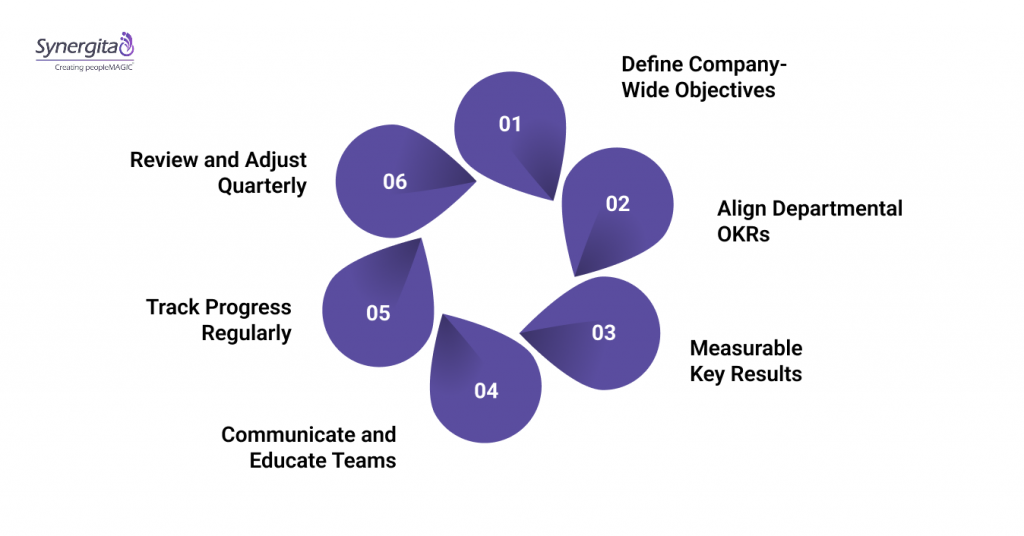
Implementing OKRs in a SaaS company involves several key steps that align teams and drive consistent progress toward business goals. While the concept of OKRs may seem straightforward, the process requires careful planning and clear communication.
By following a structured approach, SaaS companies can ensure that their objectives are meaningful, measurable, and aligned with their long-term growth. Here are the steps to implement them effectively in your SaaS company:
- Define Company-Wide Objectives: Start by identifying the high-level business goals that you want the entire company to focus on. These should be aligned with your growth targets, such as increasing revenue, improving customer retention, or launching new products.
- Align Departmental OKRs: Once company-wide objectives are established, break them down into departmental OKRs. Each department, such as sales, marketing, product, or customer success, should have objectives that contribute directly to the company’s goals.
- Set Specific and Measurable Key Results: For each objective, determine key results that are measurable. These should focus on outcomes, such as increasing sales by a specific percentage or reducing churn to a defined rate, so progress can be tracked effectively.
- Communicate and Educate Teams: Ensure that all team members understand the purpose of OKRs and how they contribute to the company’s success. Regular training sessions and clear documentation can help teams grasp how to set and track their OKRs.
- Track Progress Regularly: Set up a system to monitor progress on OKRs frequently. Use tools like Synergita’s OKR management software to make this process efficient and transparent for everyone involved, allowing teams to adjust course when necessary.
- Review and Adjust Quarterly: OKRs should be revisited at the end of each quarter to assess whether goals were achieved and to refine them for the next quarter. This review process helps keep teams agile and ensures that objectives remain relevant.
As you begin implementing OKRs in your SaaS company, it’s important to be aware of common challenges and how to prevent them.
Also Read: Goal Setting Using OKR: A Step-by-Step Guide for OKR Strategy 2025

Common Pitfalls When Implementing OKRs in SaaS
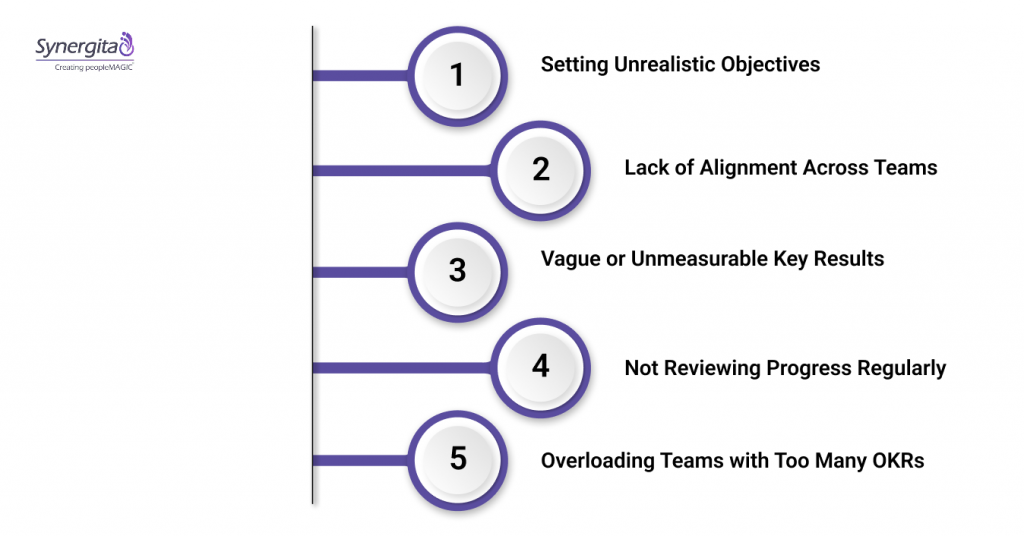
Implementing OKRs in SaaS companies can lead to significant improvements, but there are common challenges that can hinder their effectiveness. It’s crucial to avoid these pitfalls to ensure that OKRs serve their purpose and contribute to business growth. Below are some challenges that often arise when setting and managing OKRs.
To avoid these issues, keep the following points in mind:
- Setting Unrealistic Objectives: Avoid setting objectives that are too ambitious or unattainable. While OKRs should push teams to aim high, they should still be achievable within the given time frame.
- Lack of Alignment Across Teams: If OKRs are not aligned across departments, it can lead to confusion and fragmented efforts. Ensure that each department’s OKRs contribute to the company-wide goals.
- Vague or Unmeasurable Key Results: Ensure that key results are clear and measurable. Ambiguous results like “improve customer satisfaction” make it hard to track progress and assess whether goals have been met.
- Not Reviewing Progress Regularly: If OKRs aren’t tracked regularly, teams might miss important deadlines or veer off track. It’s essential to have a system in place to monitor progress and make adjustments when necessary.
- Overloading Teams with Too Many OKRs: Setting too many OKRs can overwhelm teams and dilute their focus. Limit the number of objectives each department has to ensure a concentrated effort on key priorities.
By staying mindful of these challenges and addressing them proactively, SaaS companies can ensure a smoother OKR implementation process and achieve better alignment and results across teams.
Conclusion
Implementing OKRs effectively in your SaaS company can drive alignment, accountability, and measurable success across all teams. By understanding how SaaS companies can use OKRs for continuous product development, you ensure every department stays focused on shared goals that support sustained growth and performance.
To take the next step in aligning your teams and setting clear objectives, explore how Synergita can help you manage OKRs with ease and accuracy.
Start your free trial today and see how Synergita can improve your OKR tracking and performance management processes.
FAQs
1. How do OKRs differ from traditional goal-setting methods in SaaS companies?
OKRs focus on clear, measurable outcomes linked to specific objectives, while traditional methods tend to be less focused and harder to track. OKRs provide clarity by making goals more actionable and measurable.
2. Can OKRs be adapted for different team sizes in a SaaS company?
Yes, OKRs can be tailored for both small and large teams, with smaller teams having fewer, more focused goals and larger teams breaking down objectives further into individual or departmental targets.
3. How often should OKRs be reviewed in a SaaS organization?
OKRs should be reviewed quarterly to track progress and adjust goals as needed. This ensures teams stay aligned with business priorities and address any roadblocks promptly.
4. What tools can help in tracking OKRs effectively?
OKR tools like Synergita offer dashboards, progress tracking, and integration with other platforms, helping teams stay aligned and measure their success in real-time.
5. Can OKRs be used to track both short-term and long-term goals?
Yes, OKRs can track both. Short-term OKRs focus on immediate tasks, while long-term OKRs align with broader business goals, ensuring consistency between daily efforts and strategic outcomes.