
Short-term business goals are measurable targets that help companies make progress toward larger objectives within days, weeks, or months. Examples include acquiring new customers, reducing churn, improving employee performance, and increasing revenue. Setting clear targets, deadlines, and KPIs helps teams track results and align near-term work with broader business priorities.
A business may set an ambitious annual revenue target, but achieving it depends on the work teams complete each week and month. Without clear milestones, employees can stay busy without knowing whether their work is contributing to the company’s priorities.
Short-term goals turn broad business ambitions into specific outcomes with measurable targets, deadlines, and clear ownership. They help teams prioritize work, review progress, and identify problems before they affect larger objectives.
In this guide, you’ll find SMART short-term goal examples across nine business functions, learn how to write SMART goals, compare short term and long-term goals, and understand how to connect near-term targets with OKR management.
Quick Takeaways
- Short-term business goals turn larger priorities into measurable outcomes within days, weeks, or months.
- Examples include acquiring new customers, reducing churn, improving team performance, and increasing revenue.
- Set clear targets, deadlines, and KPIs to track progress.
- Use SMART goals and OKRs to connect daily work with business objectives.
- Review goals regularly and adjust actions based on results.
| Table of Contents 1. Short-term vs. long-term business goals 2. Short-term goals vs. objectives vs. KPIs 3. How to turn a short-term goal into an OKR? 4. Short-term business goals examples at a glance 5. 15 Short-term goals examples by business function 6. 4 Key benefits of setting short-term goals 7. Final thoughts 8. Frequently asked questions |
What are short-term goals?
Short-term business goals are outcomes a company aims to achieve within a quarter. They translate annual company objectives into measurable targets that align teams around execution.
For instance, a long-term goal might be to reach $1 million in annual revenue by the end of the second year. A relevant short-term goal connected to it could be to close 8 new paid accounts this quarter by targeting one well-defined customer segment. Long-term goals provide vision, while short-term ones give the team something to execute on a weekly basis.
An example of a short-term business goal is to increase quarterly revenue by 20% through the acquisition of 10 new customers.
This goal is effective because it is clearly defined and easy to track:
- Time-bound: 90 days
- Measurable: 20% revenue growth, 10 new customers
- Actionable: Focused on a defined segment
Short-term vs. long-term business goals
Short-term goals focus on near-term results, while long-term goals define broader outcomes a business aims to achieve over several years. Short-term goals act as milestones toward long-term business goals.
| Factor | Short-term goals | Long-term goals |
| Timeframe | Days, weeks, months, or a quarter | Several years, depending on the goal |
| Purpose | Achieve near-term outcomes | Establish broader business direction |
| Scope | A specific task, project, or team result | Company-wide growth or strategic change |
| Measurement | Immediate targets and milestones | Progress toward a larger outcome |
| Review frequency | Weekly, monthly, or quarterly | Quarterly, annually, or at strategic reviews |
| Planning approach | Specific actions, owners, and deadlines | Strategy, investment, and phased milestones |
| Example | Acquire 10 new customers in 90 days | Double annual recurring revenue within three years |
These timeframes are guidelines rather than fixed rules. A long-term goal for a small project may be a short-term goal for a larger business transformation.
Examples of short and long-term goals for a business
1. Revenue growth
- Short-term goal: Acquire 10 new paying customers within 90 days.
- Long-term goal: Double annual recurring revenue within three years.
2. Hiring
- Short-term goal: Fill five priority vacancies within 60 days.
- Long-term goal: Build a 50-person specialist team over two years.
3. Customer retention
- Short-term goal: Reduce monthly customer churn from 6% to 4.5% within 90 days.
- Long-term goal: Maintain annual customer retention above 90%.
4. Product development
- Short-term goal: Release one customer-requested feature within 60 days.
- Long-term goal: Expand the product into three new market segments within two years.
The short-term target should contribute to the longer-term outcome. If the connection is unclear, reconsider whether the short-term goal deserves the team’s time and resources.
Short-term goals vs. objectives vs. KPIs
Goals, objectives, key results, KPIs, and initiatives serve different purposes in business planning. Understanding the differences helps teams define the outcome they want, measure progress, and decide what work needs to happen.
- Goal: What you want to accomplish.
- Objective: A clearly defined outcome supporting the goal.
- Key result: A measurable outcome used to assess progress toward an OKR objective.
- KPI: An ongoing metric used to monitor business performance.
- Initiative: The work or actions taken to achieve the goal.
Example: Improving customer acquisition
Suppose a company wants to build a more predictable customer acquisition process over the next quarter.
| Element | Example |
| Goal | Build a predictable customer acquisition process |
| Objective | Increase qualified lead generation over the next quarter |
| Key Result | Generate 120 qualified leads and convert 20 into paying customers |
| KPI | Lead-to-customer conversion rate |
| Initiative | Launch a targeted outbound campaign and publish content for high-intent buyers |
The goal provides direction, the objective defines the intended outcome, the key results measure progress, the KPI monitors ongoing performance, and the initiatives describe the work required.
Organizations may use these terms differently, so teams should agree on definitions before setting goals or creating OKRs.
Suggested Reading: Goals vs Objectives: Key Differences with Examples
How to turn a short-term goal into an OKR?
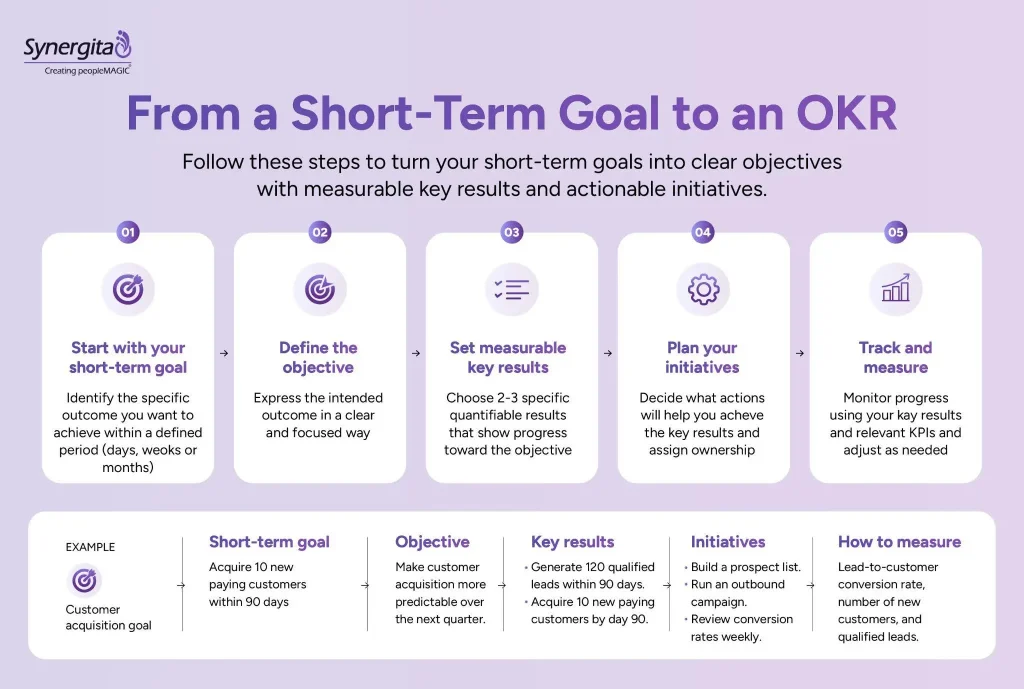
The OKR framework helps teams turn short-term goals into objectives with measurable key results. By defining the initiatives required to achieve those results, teams can connect near-term targets with broader business priorities.
Here are the four steps to follow:
- Identify the short-term goal: Start with a specific result you want to achieve within a defined period. For example, a sales team might set a short-term goal to acquire 10 new paying customers within 90 days.
- Define the objective: Express the intended outcome clearly, such as increasing new-customer acquisition over the next quarter.
- Set measurable key results: Define measurable results, such as generating 120 qualified leads and acquiring 10 new paying customers within 90 days.
- Choose initiatives and review progress: Outline the actions required, assign owners, and review progress regularly.
Short-term business goals examples at a glance
Use this table to identify a relevant short-term goal and adjust its target to reflect your organization’s current performance.
| Business priority | Short-term goal example | Target | Timeframe |
| Sales | Acquire new paying customers | 10 customers | 90 days |
| Marketing | Generate qualified leads | 100 leads | 90 days |
| HR | Reduce time to hire | From 40 to 30 days | 90 days |
| Customer success | Improve customer satisfaction | Increase CSAT by 5 percentage points | 60 days |
| Finance | Reduce discretionary spending | Cut costs by 8% | 90 days |
| Operations | Document core processes | 5 processes | 30 days |
| Product | Validate a product concept | 15 customer interviews | 30 days |
| Engineering | Reduce high-priority bug backlog | Reduce backlog by 25% | 60 days |
| Leadership | Document team goals | 100% of teams | 30 days |
| Small business | Increase repeat purchases | Improve repeat-purchase rate by 10% | 90 days |
| Startup | Validate a new market segment | 20 customer interviews | 30 days |
| Employee development | Complete role-specific training | 1 course and assessment | 60 days |
15 Short-term goals examples by business function
The following examples cover short-term goals across sales, marketing, HR, customer success, finance, operations, product, engineering, and leadership. Each example includes a target and timeframe, with practical steps to help teams put the goal into action.
1. Targeted customer acquisition strategy
Acquire 10 new paying customers within 90 days through an outbound campaign targeting a specific customer persona.
Actions to take:
- Define your target customer persona and build a relevant prospect list.
- Tailor outreach messages to the needs and pain points of your target customer persona.
- Review conversion rates weekly and adjust your messaging or targeting when results fall short.
How to measure success: Track the number of new paying customers, outreach-to-meeting conversion rate, and lead-to-customer conversion rate.
2. Revenue expansion through upselling
Increase monthly recurring revenue (MRR) by 20% within 90 days through upgrades and additional services for existing customers.
Actions to take:
- Find customers who need more features, users, or support than their current plan provides.
- Check account usage and speak with customers about their plans.
- Recommend an upgrade when it solves a clear business need.
- Give the sales team a list of accounts to follow up with.
How to measure success: Compare MRR at the start and end of the 90 days. Track upgrade revenue and the number of customers who move to a higher plan.
3. Churn reduction
Reduce monthly customer churn from 8% to 5% within one quarter by addressing the reasons customers leave.
Actions to take:
- Review cancellation requests and record the main reasons customers leave.
- Flag accounts with falling product usage or unresolved support issues.
- Contact at-risk customers to understand their concerns and agree on next steps.
How to measure success: Compare the monthly churn rate with the 8% starting point. Track the number of retained customers and the recurring revenue preserved through retention efforts.
4. Sales cycle optimization
Reduce the average sales cycle from 45 days to 30 days within 90 days without lowering deal quality.
Actions to take:
- Map each sales stage and find where deals spend the most time.
- Set clear criteria for moving a prospect to the next stage.
- Prepare standard proposals, pricing details, and answers to common objections.
- Review stalled deals with sales representatives and agree on the next action.
How to measure success: Measure the average time from lead qualification to a signed contract. Compare win rates and average deal values with the baseline figures to ensure that sales quality does not decline.
5. Customer discovery for product validation
Interview 15 customers or prospects within 30 days to test two assumptions about a product or feature.
Actions to take:
- Recruit interviewees who match your target customer profile.
- Ask about their current process, problems, and tools rather than pitching your product.
- Record recurring needs, workarounds, and objections.
- Compare the findings with your two assumptions and decide what needs to change.
How to measure success: Complete 15 interviews and document the evidence for or against both assumptions. Use the findings to decide whether to build, revise, or drop the proposed feature.
6. Improving customer loyalty through NPS
Reach a Net Promoter Score (NPS) of 40 by the end of the quarter by acting on customer feedback.
Actions to take:
- Send an NPS survey to active customers during the first month, then contact detractors to understand the reasons behind their scores.
- Group feedback by issue and assign an owner to each priority.
- Tell customers what has changed and ask for feedback on the improvements.
How to measure success: Calculate NPS by subtracting the percentage of detractors from the percentage of promoters. Track the score, survey response rate, and number of reported issues resolved.
7. Lead generation through targeted content
Generate 100 qualified leads within one quarter through content that answers the needs of your target customers.
Actions to take:
- Choose three topics based on customer questions, sales calls, and search terms.
- Create articles or guides that answer those questions and help readers assess their options. Add a relevant call to action to each page.
- Ask sales to review lead quality and share the questions prospects raise.
How to measure success: Count qualified leads that come from content and track how many sales accept them. The target is 100 qualified leads during the quarter.
8. Bottom-of-funnel SEO content strategy
Publish eight search-focused articles within 90 days for people comparing products or looking for a solution.
Actions to take:
- Find search terms related to product comparisons, alternatives, pricing, and use cases.
- Choose topics that match your product and the questions buyers ask before making a decision.
- Include clear comparisons, useful examples, internal links, and a relevant call to action.
- Review search traffic and sign-ups to find pages that need changes.
How to measure success: Track the number of published articles, organic visits, search visibility, and trial sign-ups from those pages. SEO traffic and sign-ups may take longer than 90 days to grow.
9. Operational process documentation
Document five core processes within 30 days so employees can complete routine tasks without relying on verbal instructions.
Actions to take:
- Select five processes that affect daily work or involve repeated questions.
- Ask the people who do the work to explain each step, tool, and decision.
- Write clear instructions with screenshots or checklists where needed.
How to measure success: Complete and approve all five process documents within 30 days. Check whether employees can follow them without extra guidance or repeated corrections.
10. Structured hiring and interview scorecards
Create an interview scorecard for every open role before interviews begin.
Actions to take:
- List the skills and experience each role requires.
- Write standard interview questions linked to those requirements.
- Set a rating scale and ask interviewers to record evidence for each score.
- Review completed scorecards with the hiring team before making a decision.
- Obtain approval for each role’s scorecard before the first interview.
How to measure success: Track the percentage of open roles with an approved scorecard before the first interview. Review scorecard completion and hiring-team feedback to find gaps in the process.
11. Startup runway extension strategy
Extend the startup’s cash runway by three months within one quarter without cutting spending needed to serve customers or run the business.
Actions to take:
- Review monthly costs and separate essential spending from costs that can wait.
- Choose two non-essential spending categories for cuts or reductions.
- Review vendor contracts and pause projects that do not support current priorities.
How to measure success: Compare the projected cash runway before and after the cuts, using available cash and expected monthly burn. The target is three additional months of runway.
12. Increasing average contract value
Increase average contract value (ACV) by 20% within one quarter through plans and packages that match customer needs.
Actions to take:
- Review existing contracts to find customers who need more features or services.
- Explain the differences between pricing tiers and what each includes.
- Train sales representatives to link recommendations to the buyer’s stated needs.
- Review lost deals to find where pricing or package details caused concern.
How to measure success: Compare the average contract value of new deals with the previous period. Track win rates and discounts to check that higher contract values do not come at the cost of lost deals.
13. Team alignment through performance management
Set quarterly goals for every team member within the first two weeks of the quarter and review progress during the quarter.
Actions to take:
- Link each employee’s goals to team and business priorities.
- Agree on a clear target, deadline, and owner for every goal.
- Schedule check-ins for weeks four and eight to discuss progress and blockers.
How to measure success: Track the percentage of employees with documented goals and completed check-ins. Review progress against each goal and note where employees need support.
14. Customer support response time improvement
Bring the average first response time for critical customer issues below four hours within 30 days.
Actions to take:
- Review recent critical tickets to find the main causes of delay.
- Set response-time rules for each ticket priority.
- Assign ticket owners and define when a case must be escalated.
- Check open critical tickets each day and resolve gaps in ownership or staffing.
How to measure success: Track the average first response time and the percentage of critical tickets answered within four hours. Review resolution times and customer feedback to check that responses address the issue.
15. Strategic partnership expansion
Sign two partnership agreements within 90 days that support customer referrals, distribution, or joint services.
Actions to take:
- List companies whose products, services, or customers match your business.
- Assess each prospect’s audience, business fit, and willingness to work together.
- Prepare a proposal with shared goals, responsibilities, and planned activities.
How to measure success: Count signed agreements that include clear responsibilities and success measures. Track qualified referrals, joint sales opportunities, or leads from each partnership.
4 Key benefits of setting short-term goals
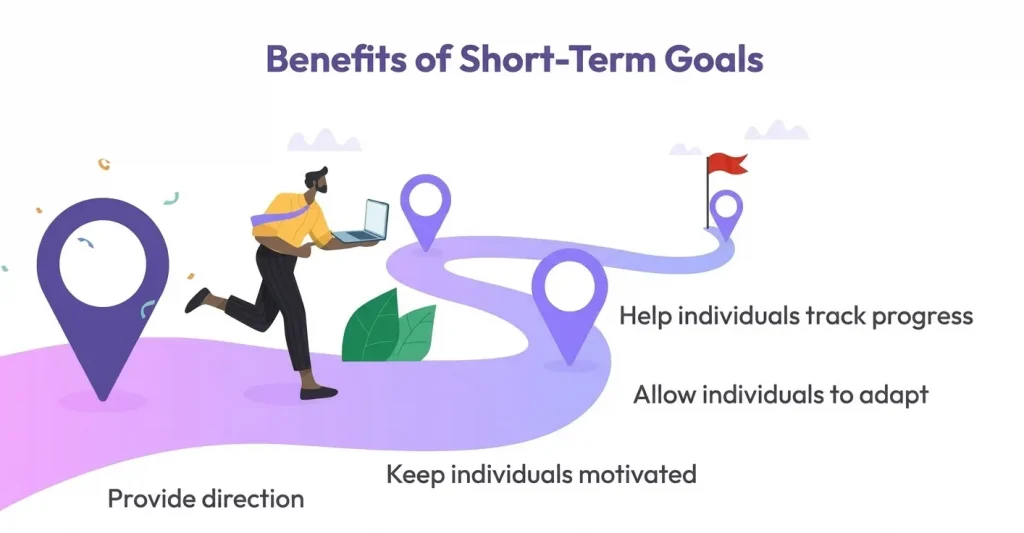
Short-term goals help businesses translate larger priorities into work teams can complete and review within a defined period. Here are four key benefits of setting short-term goals.
1. Increased Motivation
Short-term goals are easier to achieve and provide motivation that propels employees to achieve goals. This is crucial for sustaining effort for long-term goals.
2. Provide Clear Direction
Short-term goals provide a clear path toward long-term success. They provide clear direction and help teams avoid distractions.
3. Measurable Progress
Short-term goals are specific and measurable and follow the SMART goal framework, allowing you to track progress and identify areas that need improvement.
4. Adaptability
Short-term goals can be adjusted as circumstances change, making them adaptable to the current situation. This flexibility ensures short-term goals remain relevant to business needs.
Final thoughts
Short-term goals help businesses turn long-term plans into measurable progress. Whether you want to acquire new customers, improve employee performance, reduce operating costs, or strengthen customer retention, each goal should have a clear target, a realistic deadline, and an owner responsible for the outcome.
Use SMART short-term goal examples for businesses to make targets specific and measurable, and connect them to OKRs when you need to align team efforts with broader business objectives. Synergita’s AI-powered OKR management software helps teams turn short-term goals into effective OKRs, track progress, and identify key results that need attention. Start a free trial to see how it works for your team.
Frequently Asked Questions
You should set three to five per team or function. Early-stage startups with small teams often achieve better results with three sharp, well-resourced goals than with five goals competing for the same limited attention.
Yes, short-term goals must be connected to the larger business objective. Before setting any short-term goal, ask one question: does achieving this bring the business closer to its long-term objective? If the answer is no, you should reconsider the goal rather than investing time and resources into it.
You should assess whether the target was unrealistic. Did priorities shift mid-cycle? Was there a resource or support gap? The answers give you an idea of how to fix it for next quarter.
You can hold weekly check-ins to monitor operations and structured reviews with founders and managers every two weeks or once in a month. The teams that consistently hit their goals are the ones that review frequently to course-correct when needed.
Yes, you can change short-term goals based on market situations and business requirements. The idea of short-term goals is to help businesses achieve bigger and long-term company objectives, so adjust them when required, but ensure you review the changes and communicate the reasons behind them to the team.
Short-term goals focus on immediate outcomes that can often be achieved within days, weeks, or months. Long-term goals address broader business priorities over a year or longer. Short-term goals help teams make measurable progress toward long-term outcomes.
Start with the outcome you want to achieve and express it as an objective. Define measurable key results to assess progress toward that objective, then identify the initiatives required to achieve them. For example, acquiring 10 new customers could support an objective to build a predictable sales pipeline.
Track progress using measurable targets and relevant KPIs, such as new customers acquired, qualified leads generated, customer churn, or project completion rates. Assign an owner, review results regularly, and compare actual performance against the target and deadline.
The right number depends on the team’s capacity, priorities, and available resources. A practical starting point is to focus on a small number of high-priority goals, often three or fewer per employee or team, so responsibilities remain clear and progress is manageable.