



Quick Summary
- Well-designed OKRs for departments align day-to-day work with company priorities, ensuring teams focus on measurable outcomes instead of disconnected tasks or activities.
- Department heads should limit objectives, write outcome-focused goals, and define a small set of quantifiable key results to maintain clarity, accountability, and execution discipline.
- Weekly check-ins, monitoring repeated yellow statuses, and end-of-cycle reviews help teams course-correct early, resolve dependencies, and continuously improve OKR quality.
- OKR software replaces spreadsheets by aligning company, department, and team goals, giving leaders real-time visibility, clear ownership, and faster decision-making.
Even the strongest business strategies fail when departments interpret goals differently or pursue competing priorities. This is why Objective and Key Results (OKRs) for departments are essential. Well-defined departmental OKRs bridge the gap between company-wide objectives and day-to-day execution, ensuring every function works toward measurable outcomes rather than isolated tasks.
However, many department heads struggle to define OKRs for departments that are ambitious yet realistic, aligned yet flexible, and measurable without becoming restrictive. When departmental OKRs are poorly designed, they create confusion instead of clarity.
In this blog, we outline practical tips to help department leaders create effective OKRs that drive measurable outcomes and keep teams aligned with broader business priorities.
| Table of Contents 1. 10 Tips for Department Heads to Create OKRs for Departments 2. How OKR Software Supports Department-Level OKR Execution? 3. Final Takeaway 4. Frequently Asked Questions |
10 Tips for Department Heads to Create OKRs for Departments
Creating effective departmental OKRs requires clarity, alignment, and disciplined execution. The following tips offer a step-by-step approach department heads can use to design OKRs that are focused, measurable, and aligned with organizational priorities.
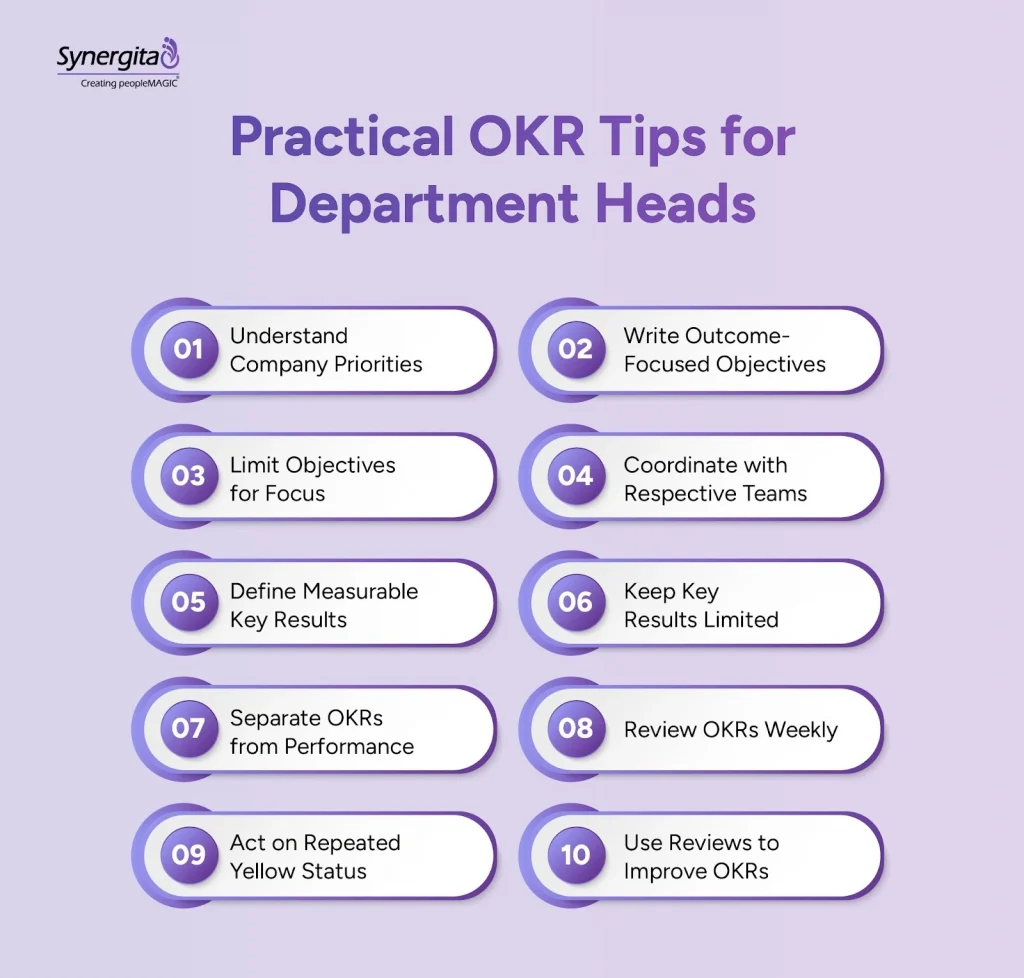
1. Understand Company Priorities
A clear understanding of company goals is the first step in effective OKR planning, which determines where the organization is heading. Without clarity on top-level strategy, OKRs for departments can drift into unrelated activities.
Managers should review quarterly company priorities before drafting their team’s objectives to support cascading OKRs from the company to department and team levels. As a result, objectives remain aligned to broader goals, reducing the risk of misalignment during execution.
2. Write Outcome-Focused Objectives
Objectives should be inspiring and focused on outcomes, not task lists. This helps teams understand why the work is important rather than just what needs to be done. Managers can use a simple test to determine if the objective is result-oriented:
- If the objective sounds like a to-do item, rewrite it
- If it describes a change in behavior, performance, or business outcome, it is likely effective
For example: Replace “implement new CRM” with “Increase CRM adoption to 85% across sales teams to improve sales pipeline accuracy.”
Suggested Reading: Guide to Craft High-Impact Team Objectives with OKRs
3. Limit the Number of Objectives for Focus
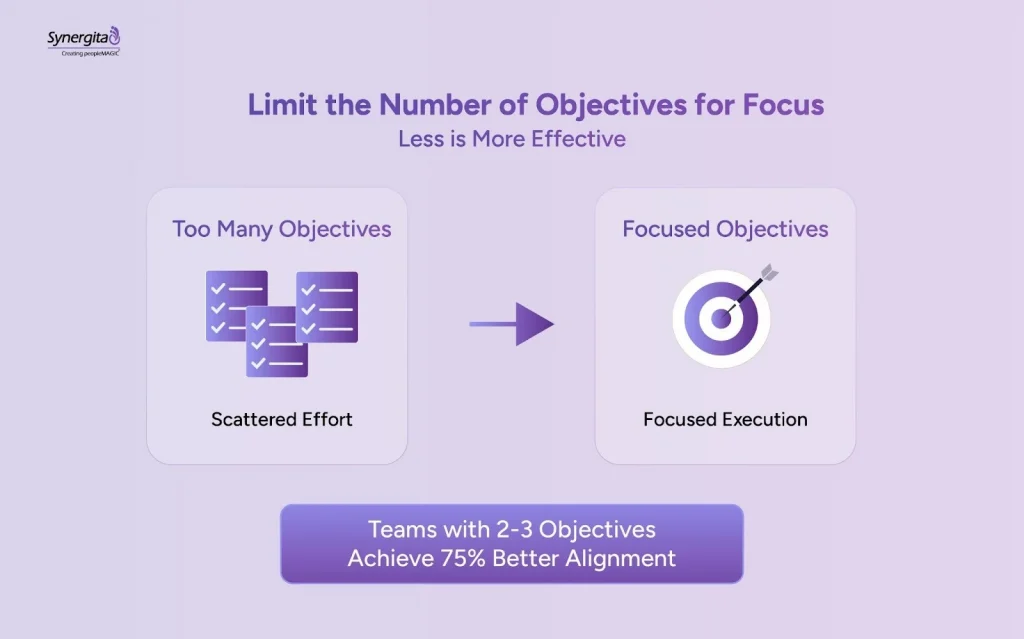
Managers often dilute impact by overloading teams with too many objectives. Limit OKRs to two or three per cycle to ensure focus and prevent resource fragmentation. A smaller set of objectives gives leaders clearer visibility into progress and prevents teams from being pulled in multiple directions at once.
Research shows that OKR frameworks help teams align focus; around 75% of organizations report improved alignment and clarity through OKRs.
4. Coordinate with Respective Teams
Cross-functional alignment is the key to creating effective OKRs. If your OKRs depend on another team’s output, engage them early. This reduces bottlenecks and surprises during execution. Regular coordination also ensures that objectives are realistic and supported by all relevant stakeholders.
For instance, an OKR for the IT department often depends on coordination with data security, infrastructure, and application teams to meet uptime, incident response, and deployment reliability targets.
5. Define Measurable Key Results
Key results should be metric-driven, measurable, and time-bound. Poorly defined KRs like “Improve team performance” do not indicate success. Instead, use measurable outcomes such as “Reduce average customer response time from 48h to 24h by the end of the quarter.” This clarity enables objective progress checks and supports real performance evaluation.
Similarly, OKR examples for IT department teams often focus on outcomes like improving system uptime, reducing incident resolution time, or increasing deployment reliability.
6. Keep Key Results Limited
Each objective should not have more than 3–5 key results. Too many KRs weaken focus and make weekly reviews harder to manage. Limiting key results increases concentration on what matters most, improves tracking accuracy, and simplifies decision-making. As a practical guideline:
- Aim for 3 to 5 key results per objective
- Eliminate key results that overlap or measure the same outcome
- Prioritize metrics that best indicate success, not everything that can be measured
7. Separate OKR Progress from Performance Ratings
Linking OKRs directly to compensation can lead to conservative goal-setting that is easy to achieve. This will impact ambition and innovation. Managers should treat OKRs for departments as a framework for alignment and learning and not as a performance evaluation tool.
For example, a manager might coach a team to aim for an aspirational KR (e.g., an 80% increase in customer retention) without tying it to pay, enabling stretch goals and innovation.
Suggested Reading: Why OKRs Should Not Be Used as a Performance Evaluation Tool
8. Review OKRs Weekly
Frequent check-ins help teams make timely course corrections and resolve issues before they derail progress, making OKR tracking more consistent and actionable.
Surveys show that only about 10% conduct weekly check-ins, with many defaulting to monthly or quarterly reviews. This indicates that teams that adopt a weekly check-in differentiate themselves in performance outcomes.
9. Act on Repeated Yellow Status
A single yellow status indicates caution and can be normal. However, repeated yellow signals require immediate attention. Instead of pushing teams to “try harder,” managers should treat this as feedback from the system.
Repeated yellow usually indicates:
- The key result is overly ambitious or poorly defined
- Required inputs from other teams are delayed
- Resources or ownership are insufficient
Addressing these issues early prevents end-of-quarter surprises and improves the quality of future OKRs.
10. Use OKR Reviews to Improve the Next Cycle
Every cycle should end with a reflection on what worked and what didn’t. Retrospectives help teams learn from data and adapt future OKRs. Focus the discussion on insights and not blame to improve effectiveness and team confidence in the OKR process.
How OKR Software Supports Department-Level OKR Execution?
As teams grow, managing OKRs through spreadsheets or static documents becomes difficult. OKR management software helps department heads implement best practices by centralizing alignment, visibility, and consistency in a single system.
Instead of spending time consolidating updates or chasing status reports, leaders gain real-time insight into progress and risks. A well-designed OKR platform supports departmental success by:
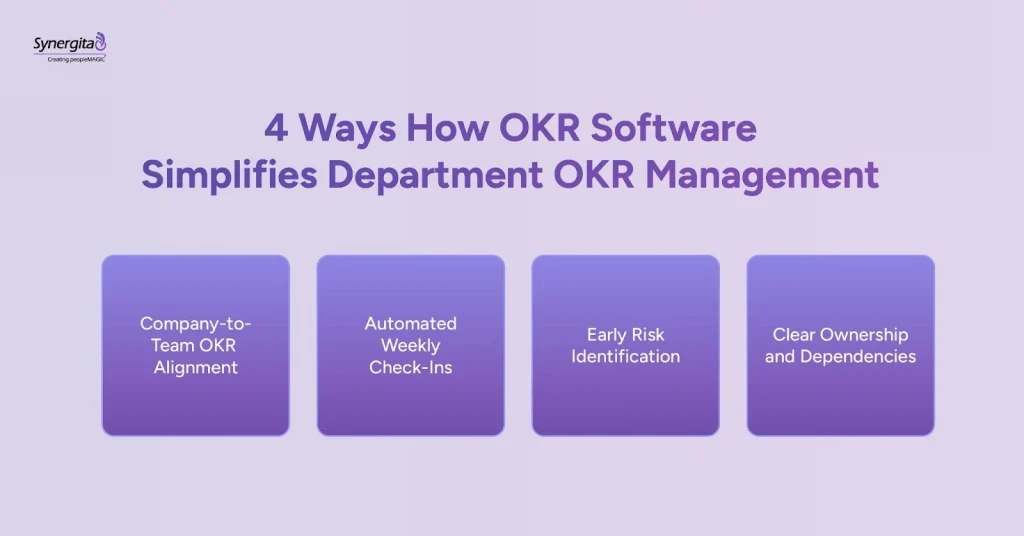
- Company-to-Team OKR Alignment: Provides clear alignment between the company, department, and team OKRs
- Automated Weekly Check-Ins: Allows weekly check-ins and progress tracking without manual follow-ups
- Early Risk Identification: Highlights at-risk key results early to enable faster course correction
- Clear Ownership and Dependencies: Makes dependencies and ownership visible across teams
Final Takeaway
Execution gaps are not due to a lack of strategy, but to how effectively goals are translated at the department level. When OKRs for departments are designed with focus, measurable outcomes, and regular reviews, teams gain direction and accountability at every stage of execution.
Department heads who treat OKRs as a living system rather than a quarterly task see better alignment and faster course correction. To make this repeatable at scale, the right tools matter. Synergita simplifies how departments create, align, and track OKRs, enabling leaders to spend less time managing updates and more time driving outcomes.
Experience how Synergita helps departments turn strategic goals into consistent execution with a 14-day free trial.

Frequently Asked Questions
OKRs for departments define clear objectives and measurable key results at the functional level, helping teams align their work with company-wide priorities while focusing on outcomes rather than activities.
Company OKRs set the overall strategic direction, while departmental OKRs translate strategies into actionable goals specific to each function, such as Sales, Engineering, or HR.
Most departments should limit themselves to two or three objectives per cycle to maintain focus and ensure leaders can actively manage progress.
A strong objective describes the outcome you want to achieve, not the tasks involved. It should be clear, aspirational, and directly connected to business impact.
An OKR for the human resource department usually focuses on outcomes such as talent retention, employee engagement, or hiring efficiency. For example, an objective could be to improve employee retention, with key results measured by reduced attrition rates, shorter hiring cycles, or higher employee engagement survey scores.
Yes, Synergita provides visibility into dependencies and ownership across teams, helping department heads identify risks early and coordinate more effectively.
Yes, Synergita offers a 14-day free trial, allowing department heads to experience how the platform simplifies the creation and management of OKRs before making a decision.