
Most companies have a common problem. People work hard, stay busy, and still miss the mark because expectations were never fully defined, feedback came too late, and performance is subjective instead of data-driven. The result: employees feel dissatisfied, and productivity declines.
TL;DR: The 30-Second Takeaway
- The Problem: Employees in most organizations face unclear expectations, delayed feedback and biased evaluation, leading to poor performance and disengagement.
- The Insight: Companies with strong performance management see 23% higher profits, driven by higher engagement, better productivity, and lower turnover.
- The Fix: Shift from annual reviews to continuous, structured evaluations backed by data, clear metrics, and two-way feedback.
- The Impact: Better decisions on pay and promotions, lower attrition, stronger accountability, and a culture of continuous improvement.
- Keep reading to: Understand the 9 outcomes of effective evaluations and how a structured system simplifies evaluation.
Gallup’s study found that top-quartile business units achieve 23% higher profits than bottom-quartile ones. This is due to higher engagement, which leads to lower turnover, fewer errors, better productivity, and improved employee wellbeing.
This shows why employee performance evaluation is critical for businesses, which is directly linked to employee performance evaluation and well-being.
In this blog, we will explore what is employee performance evaluation, why it’s important, the difference between performance evaluation, appraisal, and review and how to make performance evaluations more effective.
| Table of Contents 1. What Is Employee Performance Evaluation? 2. 9 Reasons Why Employee Performance Evaluation Is Important 3. Performance Evaluation vs. Appraisal vs. Review: What Is the Difference? 4. How to Make Employee Performance Evaluations More Effective 5. How a Performance Management System Makes Evaluation Work 6. Final Takeaway 7. FAQs |
What Is Employee Performance Evaluation?
Employee performance evaluation is a structured process for assessing how well someone is doing their job, and what needs to change. It covers progress toward goals, skill development, behavioral patterns, and contributions to team outcomes.
Employee performance evaluation helps in:
- Measuring output against agreed expectations
- Identifying where someone is growing and where they are stuck
- Informing HR decisions, compensation, promotion, development plans, and, when necessary, separation.
Why Employee Performance Evaluation Is Important: 9 Outcomes That Affect Your Bottom Line
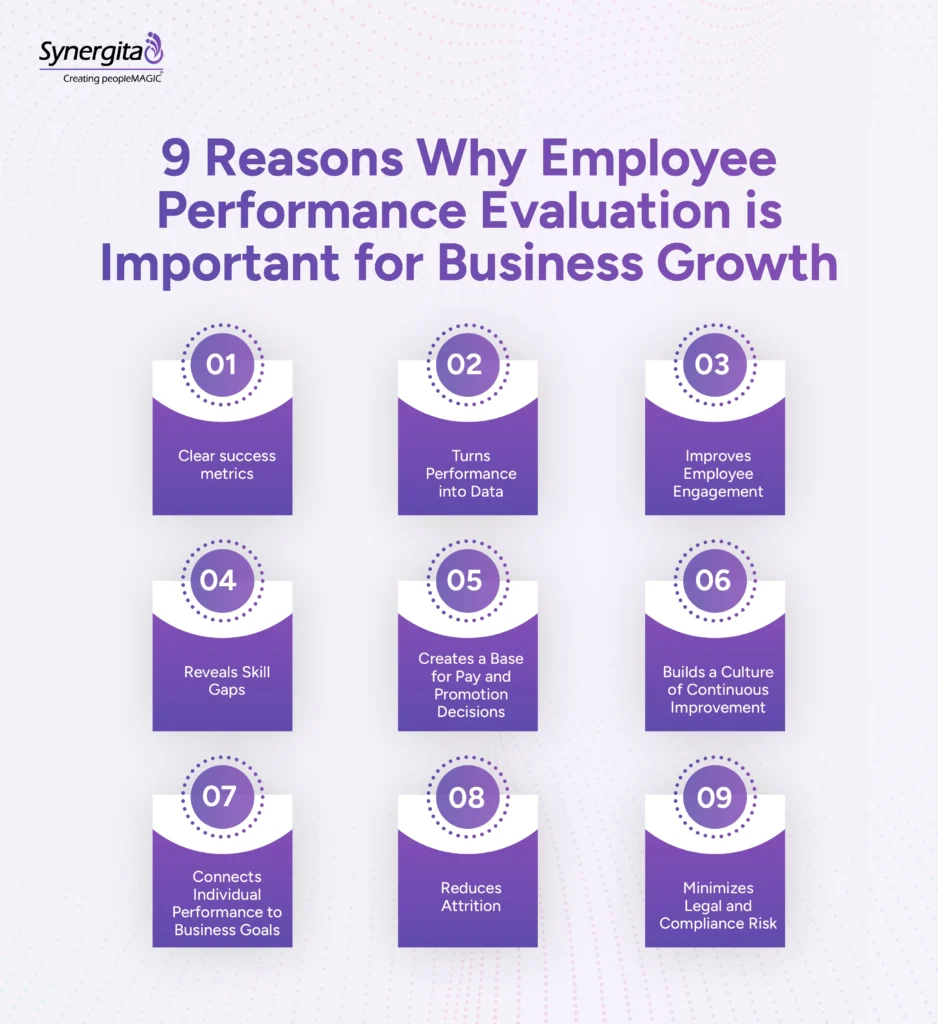
Most organizations know evaluation but only a few implement it effectively. Here are the 9 outcomes that separate organisations with effective evaluation from the ones that just treat it as a routine task.
1. Clear Metrics of Success
Most performance problems start when there are no clear metrics. Managers and employees operate on different assumptions that result in conflicts.
A structured employee performance evaluation has well-defined parameters. Employees know what they are being measured against and managers have clear criteria to assess.
Here are the signs your expectations are unclear right now:
- Employees submit work that consistently misses the mark in ways they did not anticipate
- Managers give feedback like “you need to be more proactive” without explaining what that looks like
- Two managers evaluating the same employee would arrive at different ratings because there are no shared criteria to assess
2. Turns Performance into Data
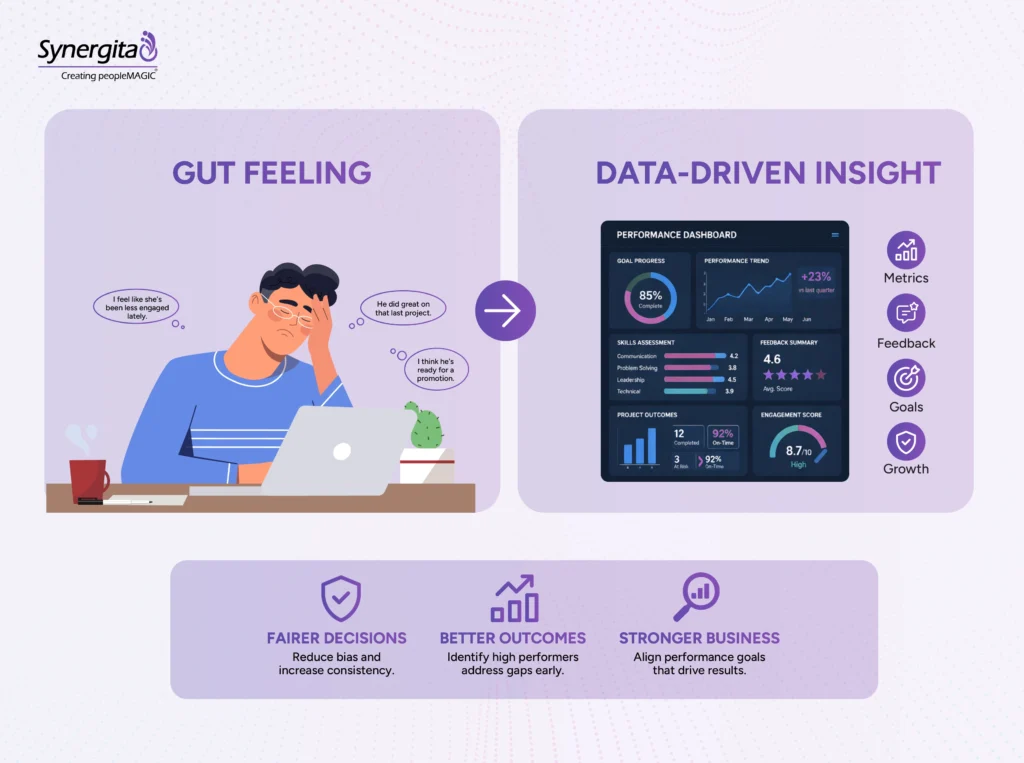
Without documentation, performance management becomes subjective. Managers depend on:
- Recent memory: Recency bias skews ratings toward the last two weeks, not the full year
- Personal rapport: Employees with stronger manager relationships get the benefit of the doubt
- Gut instinct: One strong trait inflates the overall score (the halo effect)
- Unconscious bias: With no data anchor, discrimination risk rises
Structured evaluation for job performance replaces “I feel like you’ve been less engaged lately” with something measurable like:
- Goal completion rates
- 360-degree feedback scores
- Project outcomes and delivery timelines
- Attendance and behavioral records
Organizations with documented evaluation processes make better decisions related to promotion, compensation differences, and terminations if legally challenged.
3. Improves Employee Engagement
Poor employee performance evaluations reduce engagement. Gallup found that US employee engagement hit a decade-low in 2024, driven by declines in the two things that poor evaluations damage most: expectation clarity and feeling valued at work.
Employees who leave a review feeling confused, unfairly assessed, or unheard are more likely to start job hunting than to improve. The difference between an evaluation that drives employee engagement and one that damages it:
| Done poorly | Done right |
| Feedback delivered as a surprise. | Ongoing dialogue throughout the year. |
| Vague ratings like “meets expectations”. | Specific, evidence-based observations. |
| One-sided assessment. | Acknowledged contributions + clear development path. |
| No follow-through after the review. | Agreed actions with owners and timelines. |
4. Reveals Skill Gaps
Evaluating employees’ performance on an ongoing basis means skill gaps are tracked early, and can be fixed through training or coaching. A skill gap that goes undetected for one year means an impact on output for that period. It also affects customer satisfaction, and the team’s collective performance.
The cost of late detection includes:
- A fixable coaching issue becomes a formal performance improvement plan
- Customer complaints of quality drops before anyone internally notices
On the other hand, early identification of skill gaps also help to identify:
- Employees ready for more responsibility get identified before they start looking elsewhere
- Internal promotion pipelines stay full rather than defaulting to external hiring
- High performers feel seen, which directly affects retention
A continuous feedback system empowers managers with the right data to make informed decisions unlike annual reviews that find gaps too late.
5. Creates a Base for Pay and Promotion Decisions
Without evaluation data, pay and promotion decisions rely on politics, visibility, and whoever has the strongest internal support. These decisions may seem justified to those who benefit but unfair to others.
Documented performance data changes three things:
- High performers have a clear, evidence-based case for advancement
- Managers have a consistent framework, not a gut call, to back their recommendations
- HR has audit trails for compliance and legal defensibility
According to Mercer’s report, after job security, fair pay is the second most important reason employees choose to stay with their employer.
6. Builds a Culture of Continuous Improvement
In organizations without evaluation structures, feedback is reactive and it is given when something goes wrong, not as part of ongoing development. This sends a message to the employees that we only notice your performance when it is a problem.
The problem deepens when evaluations are not applied consistently across all levels:
- Senior employees exempt from evaluation signal that it is a compliance exercise for junior staff
- When leadership is not evaluated, accountability becomes directional, downward only
The credibility of the entire process depends on its application equally across all levels, regardless of seniority.
7. Connects Individual Performance to Business Goals
Individual goals that do not connect to organizational objectives are not goals; they are tasks. Teams can hit 100% of their targets while the company misses it. Effective evaluation fixes this by linking individual work to team priorities, and team priorities to business outcomes.
This alignment produces three outcomes:
- Wasted effort drops, people stop working for metrics that do not move the business
- Accountability increases, it is harder to claim success when the business outcome did not follow
- Evaluation becomes strategically important, not treated like an administrative task
8. Reduces Attrition
Replacing an employee costs a significant amount, depending on seniority and role complexity. Attrition is expensive, disruptive, and largely preventable. But why do employees explore other opportunities? Is it only for higher pay? Not really, employees leave for three consistent reasons:
- They do not feel recognized, 69% of employees say they would work harder if their efforts were better recognized.
- They do not trust their manager. 42% of employees who voluntarily left their organization report that their manager could have done something to prevent them from leaving.
- They do not see a path forward.
Regular performance evaluation addresses all three issues directly
9. Minimizes Legal and Compliance Risk
Undocumented evaluations expose firms to indefensible disputes, and labor courts consistently favor employees without employer proof, per rulings under the Industrial Disputes Act.
Documented evaluation records help businesses avoid legal issues because:
- Terminations backed by performance history are harder to challenge
- Consistent evaluation criteria across demographics reduces discrimination liability
- Pay decisions tied to documented ratings satisfy equal pay audit requirements
- HR has a paper trail that shows the process was followed, not just that outcomes were reached
The absence of documentation does not mean nothing happened; it means you cannot prove what did. In employment law, that gap is expensive.
Performance Evaluation vs. Performance Appraisal vs. Performance Review: What Is the Difference?
This table highlights the distinctions between performance evaluation, performance appraisal, and performance review:
| Aspect | Performance evaluation | Performance appraisal | Performance review |
| Frequency | Continuous, year-round | Typically annual or semi-annual | Specific scheduled event |
| Focus | Past performance + future development | Past performance | Past performance summary |
| Purpose | Improve skills, align goals, inform decisions | Make compensation and promotion decisions | Summarize and document |
| Format | Ongoing feedback + periodic formal assessment | Structured rating-based form | Formal meeting with documentation |
| Best used for | Day-to-day performance management | Annual pay cycles | End-of-period record |
The top organizations use all three: continuous feedback throughout the year, formal evaluation at quarterly or mid-year checkpoints, and an annual appraisal that drives performance-based compensation decisions.
How to Make Employee Performance Evaluations More Effective
Most evaluation processes fail not because of bad intentions, but because they are built around the wrong mechanics.
| What to do | Why is it important |
| Use a structured competency framework, not free-form notes | Open-ended commentary produces inconsistent, biased, and legally risky records |
| Make performance evaluation continuous, not annual | Annual reviews are a snapshot; quarterly check-ins give managers a running record to act on |
| Base feedback on data; goals, outcomes, peer input, not memory | Memory skews toward recent events; documentation makes evaluation accurate and defensible |
| Make it a two-way conversation, not a top-down verdict | Employees who self-assess and give upward feedback are more likely to act on what comes out of it |
| Always close with agreed next steps, not just a rating | An evaluation without clear actions is documentation, not development |
Evaluation checklist: Does your current process do these things?
- Goals set at the start of the period, not during the review
- Feedback documented throughout the year, not recalled at review time
- Structured competency framework used consistently across the team
- Employee self-assessment is included in the process
- Output includes specific development actions with owners and timelines
- The review process is the same regardless of the employee’s seniority or relationship with their manager.
How a Performance Management System Simplifies Evaluation
Running a structured performance evaluation process manually in a growing organization is challenging because it is time-consuming, subjective and lacks standard metrics. Managers miss check-ins. Feedback gets retroactively written to fit a rating that was decided informally.
A performance management system solves these problems so managers can focus on the conversation. It supports the evaluation process by:
- Capturing continuous feedback in real time, not just at review periods
- Tracking goal progress throughout the year so evaluations are data-driven, not recalled
- Enabling 360-degree input from peers, direct reports, and cross-functional collaborators
- Standardizing review cycles so every manager follows the same process
- Giving HR and leadership visibility into performance patterns across the organization
The impact is that evaluation becomes a system rather than an event. Managers spend less time preparing documentation and more time having useful conversations. Employees get feedback more often, not just once a year and feel more valued and stay engaged.
Final Takeaway
The importance of performance evaluations is reflected in your attrition numbers, promotion decisions, legal exposure, and your ability to develop people before the business outgrows them. You can fix this with an effective and regular evaluation process.
Tools like Synergita are useful for businesses that want to implement continuous, 360-degree feedback and a well-defined review process. Synergita’s AI-powered system provides data-driven insights for fair promotions and training, helping businesses build a high-performance culture.
If your current process relies on memory and spreadsheets, consider a structured performance management tool. Start a free trial and see how Synergita helps in effective performance evaluation.
FAQs
The purpose of employee performance evaluation is to measure how well employees meet expectations, identify skill gaps, and inform decisions about compensation, promotion, and development, replacing guesswork with documented, auditable data.
The purpose of employee evaluation at work is to provide both managers and employees with a structured, honest picture of performance, so development happens by design, not by accident.
Performance evaluation is important because it directly impacts retention, productivity, and profitability. Gallup found that business units with strong performance management generate 23% higher profit than those without.
A performance review matters because it creates a formal record of expectations, contributions, and decisions, protecting both the employee and the organization while resetting the path forward.
Performance appraisal is important because it ties compensation and promotion decisions to documented evidence rather than opinion, making every HR decision defensible, consistent, and fair.