
Poor communication and collaboration are the main reasons for workplace failures. Even highly capable teams struggle when goals are not aligned and decisions are disconnected. These 20 activities can help teams communicate and collaborate more effectively.
| TL;DR – 30 Seconds Quick Takeaway The Problem: 86% of workplace failures are linked to poor collaboration, yet many teams still set OKRs without improving how they actually work together. The Fix: Choose activities from these 20 based on your team’s real challenges, and make it a habit to run one activity consistently each month. The Impact: Teams that collaborate effectively create stronger OKRs, work faster, and achieve key results more consistently with fewer delays and obstacles. Keep reading to: Get all 20 activities grouped by goal, plus OKR examples, measurement tips, and a step-by-step approach to making collaboration stick. |
In many cases, teams fail to achieve objectives and key results (OKRs) because the people behind them don’t work together.
According to a recent report, 79% of strategies fail due to poor collaboration. OKR execution depends on teams that communicate openly, trust each other’s judgment, and stay aligned even when priorities shift. That’s why team-building is essential.
The right activities improve collaboration and OKR performance. In this guide, we will explore 20 collabration team building activities that help teams build trust and work together more effectively.
| Table of Contents 1. How OKRs and Team Collaboration Work Together 2. 20 Team Building Activities for Collaboration 3. How to Measure the Impact of Team Building on Collaboration 4. Final takeaway 5. FAQ |
How OKRs and Team Collaboration Work Together
OKRs give teams a clear direction. The Objective defines the bigger goal, while the Key Results measure progress toward achieving it.
Companies like Google, Amazon, and Netflix use this framework because it keeps everyone aligned, but the framework only works when people communicate, coordinate, and trust each other.
That’s where collaboration makes the difference. It brings in different perspectives, helps teams solve problems faster, and keeps everyone aligned on shared goals.
Helen Keller rightly said, “Alone we can do so little; together we can do so much.”
20 Team Building Activities for Collaboration
Every team has different collaboration challenges. Some need better cross-functional communication, others need more trust or stronger teamwork across departments. These activities help you find the right fit for your team.
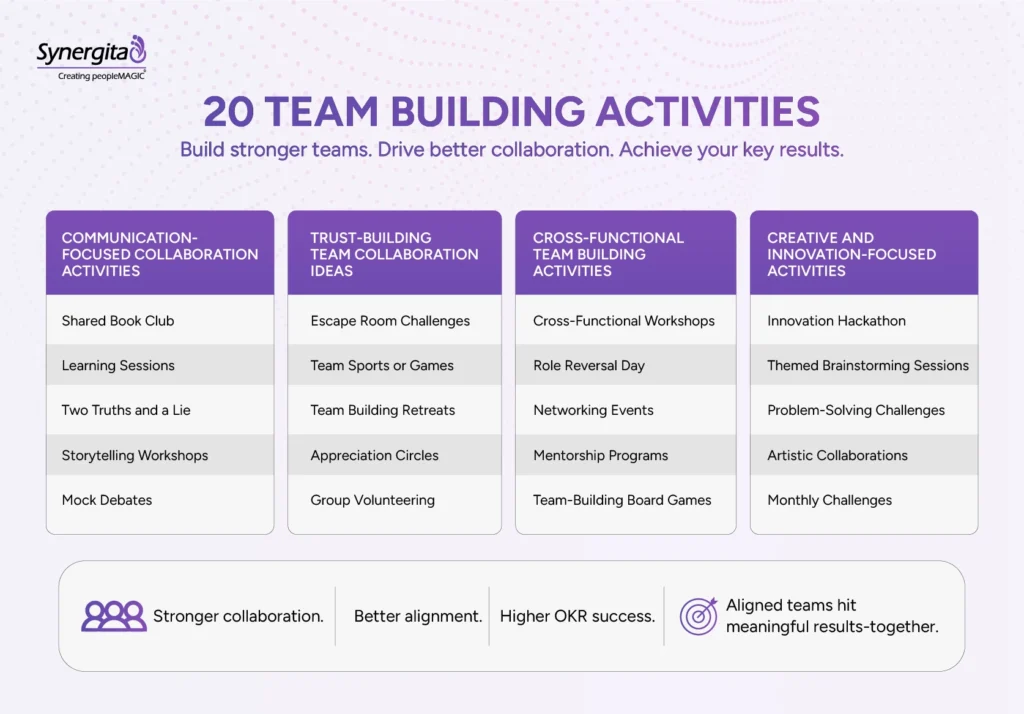
Communication-Focused Collaboration Activities
1. Shared Book Club
Pick a book on leadership, teamwork, or your industry and discuss it together as a team. These discussions help people share ideas, learn from different viewpoints, and build stronger communication habits. Over time, it creates better alignment and collaboration across the team.
2. Learning Sessions
These sessions allow team members to share a skill, project win, lesson learned, or area of expertise. It’s informal, easy to participate in, and builds the kind of open communication that OKRs depend on.
3. Two Truths and a Lie
This is a simple collaboration activity that offers an icebreaker for people to talk openly. Each person shares two true statements and one false one, and the team guesses the lie. This activity helps people open up, feel more comfortable around each other, and build trust within the team.
4. Storytelling Workshops
Clear communication is essential for OKR alignment and execution. Storytelling workshops help teams improve communication skills and communicate with clarity and purpose, reflecting Amazon’s emphasis on customer-centric communication. This enables employees to explain ideas, strategies, and goals more clearly, making it easier to turn plans into action.
5. Mock Debates
Mock debates are simple collaboration activities that help your people to improve communication and push them to see different perspectives. This skill is especially useful when aligning on priorities or working through OKRs together.
Trust-Building Team Collaboration Ideas
6. Escape Room Challenges
Escape rooms force teams to communicate under pressure, divide tasks, and trust each other’s judgment. The real learning happens in the debrief.
Ask what worked and what didn’t, and connect those insights back to how your team handles OKR sprints, turning the exercise into a meaningful collaboration activity that improves execution.
7. Team Sports or Games
Whether it’s a casual sports day or a competitive board game tournament, these activities build camaraderie and trust outside the stress of work. Teams that play together usually communicate better at work, and that directly supports collaborative OKR execution.
8. Team Building Retreats
Off-site gatherings give teams space to bond, plan strategically, and exchange ideas without the usual daily pressures. A well-run retreat can reset team dynamics and realign everyone on shared OKRs going into a new quarter.
9. Appreciation Circles
Each person calls out something they appreciate about a colleague. It sounds simple, but it shifts team culture fast. When people feel appreciated and recognized, they naturally become more involved, motivated, and engaged in achieving team goals and OKRs.
10. Group Volunteering
Volunteering together outside the workplace helps teams connect on a more personal level. Working toward a shared cause strengthens trust, improves collaboration, and brings teams closer together.
Cross-functional Team Building Activities
11. Cross-Functional Workshops
This type of collaboration activities bring people from different departments together to solve a shared challenge. These workshops expose teams to how other functions think and work, which is exactly what cross-team collaboration activities should do.
It’s also one of the fastest ways to spot where OKR dependencies exist across teams.
12. Role Reversal Day
This collaboration activity means team members swap roles for a day. This builds empathy fast and helps people understand how their work connects to others’ OKRs.
Inspired by Amazon’s two-pizza team model, stay small, move fast, and make sure everyone understands their part.
13. Networking Events
Participating in industry events helps teams build relationships with external partners and peers. These connections can create new opportunities for collaboration, knowledge sharing, and business growth that support broader organizational goals.
14. Mentorship Programs
Mentorship programs allow teams to pair senior and junior team members within and across departments and work towards common goals. These programs encourage shared learning and aligns the team with a culture of continuous improvement which is critical for OKR execution.
15. Team-Building Board Games
Games like Pandemic or Codenames encourage collaboration, communication, and problem-solving under pressure. They offer simple ways to build the coordination and teamwork skills that directly support successful OKR execution.
Creative and Innovation-Focused Activities
16. Innovation Hackathon
Give teams a real business problem and a deadline to solve it. Hackathons are high-impact collaboration team-building activities that push people to think beyond boundaries, move fast, and work together under pressure; the same conditions where OKRs either succeed or break down.
17. Themed Brainstorming Sessions
Give your next brainstorm a theme or constraint to bring innovation.
Questions like “How would a fast-growing startup solve this problem?” or “How would we solve this with zero budget?” gives the team a real business problem to address.
These exercises push teams to think creatively and develop more effective solutions.
18. Problem-Solving Challenges
Structured problem-solving exercises are powerful collaborative activities that improve critical thinking and demonstrate that complex challenges require true team effort. They’re especially useful when preparing for OKR planning cycles.
19. Artistic Collaborations
Create something together: a mural, a video, a short film. Artistic collaboration builds unity and encourages people to contribute their individual strengths toward a shared output. That’s the same dynamic needed for well-functioning OKR teams.
20. Monthly Challenges
Set a team challenge each month: a fitness goal, a learning sprint, a charity drive. These low-lift initiatives keep the collaborative spirit alive between big quarterly OKR pushes and develop a mindset of continuous improvement.
How to Measure the Impact of Team Building on Collaboration
Running collaboration team-building activities is only half the job; you also need to measure whether they’re actually improving team collaboration and delivering results. Here are some steps to measure it.
1. Surveys and Feedback Loops
Collect feedback after each collaboration activity to understand how much it actually improved team collaboration and overall team dynamics. Insights from team members provide valuable data on the effectiveness of team-building activities.
2. Observational Insights
Observe communication patterns and trust levels before and after activities. Visual cues, changes in communication dynamics, and team interactions can provide valuable insights.
3. OKR Progress as a Metric
Analyze OKR progress before and after implementing team-building activities. Check whether better collaboration is actually leading to real results, like faster progress and improved key outcomes in your OKRs.
4. Team Dynamics Shifts
Evaluate improvements in team dynamics, trust, communication, and conflict resolution. Collaborative activities should contribute positively to team cohesion.
5. Project Outcomes
Compare project achievements influenced by team-building activities with those of previous projects. Real improvements in project outcomes are a clear sign that your collaboration team building activities are actually paying off.
Final Takeaway
Building strong team collaboration requires consistent effort, habits, shared experiences, and a team that actually trusts each other. These 20 collaboration team building activities give you the framework to do exactly that.
OKRs help turn collaboration into measurable progress by providing teams clear goals, better alignment, and a clear understanding of how their work contributes to team success.
Try Synergita OKR software free for 14 days and see how it helps your team set clear objectives, improve collaboration across teams, and achieve key results regularly.
Frequently Asked Questions
Collaboration team-building activities are structured exercises designed to improve teamwork, communication, and trust within teams. For example: workshops, escape rooms, brainstorming sessions, and cross-functional challenges.
Team building activities improve communication and alignment between team members to set, execute, and consistently hit key results, reducing delays and misalignment during OKR cycles.
A structured session where teams collaboratively define objectives and key results, with built-in steps for discussion, prioritization, and ownership assignment across the team.
Role Reversal Day, Cross-Functional Workshops, and Innovation Hackathons are some of the best cross-functional team building activities. They break down departmental silos and help teams understand how their work connects across functions.
High trust leads to faster decision-making, more honest feedback, and stronger OKR execution. Low trust creates bottlenecks, miscommunication, and slower progress toward shared goals.
Yes, OKRs work well for small teams. Fewer dependencies mean faster alignment, quicker check-ins, and clearer ownership, making OKR execution more straightforward overall.
The 7 C’s of collaboration are Communication, Coordination, Cooperation, Cognition, Coaching, Conflict Management, and Conditions.