
Quick Summary
- About 90% of organizations fail to execute their strategies successfully, but adopting OKRs helps teams turn ambitious goals into measurable outcomes.
- Effective OKRs require clear objectives, outcome-driven key results, limited priorities, and strong cross-team alignment.
- Continuous visibility through real-time tracking, weekly or biweekly check-ins, transparency, and collaboration keeps teams on track and helps them achieve their OKRs.
- OKR best practices, such as limiting objectives, avoiding vague key results, and recognizing achievements, help teams maintain focus and deliver stronger results.
Are bold goals truly the issue, or is it the day-to-day execution that prevents them from becoming reality? According to a recent report, about 90% of organizations fail to execute their strategies successfully. That’s where following best practices for OKRs can make all the difference.
By establishing clear, aligned objectives and a disciplined follow-through system, you can close the strategy–action gap. In this post, we will explore OKR best practices for 2026 so your organization can turn ambitious goals into achievable business outcomes.
| Table of Contents 1. What Are the Top OKR Best Practices for 2026? 2. What Are Common Mistakes to Avoid When Implementing OKRs? 3. Final Takeaway 4. Frequently Asked Questions |
What Are the OKR Best Practices Businesses Should Follow in 2026?
OKR implementation in 2026 is not only about ambition but also about alignment, clarity, and a disciplined process. The OKRs best practices below integrate strategic insight, human behavior, and data-backed techniques to help you set and achieve meaningful objectives.
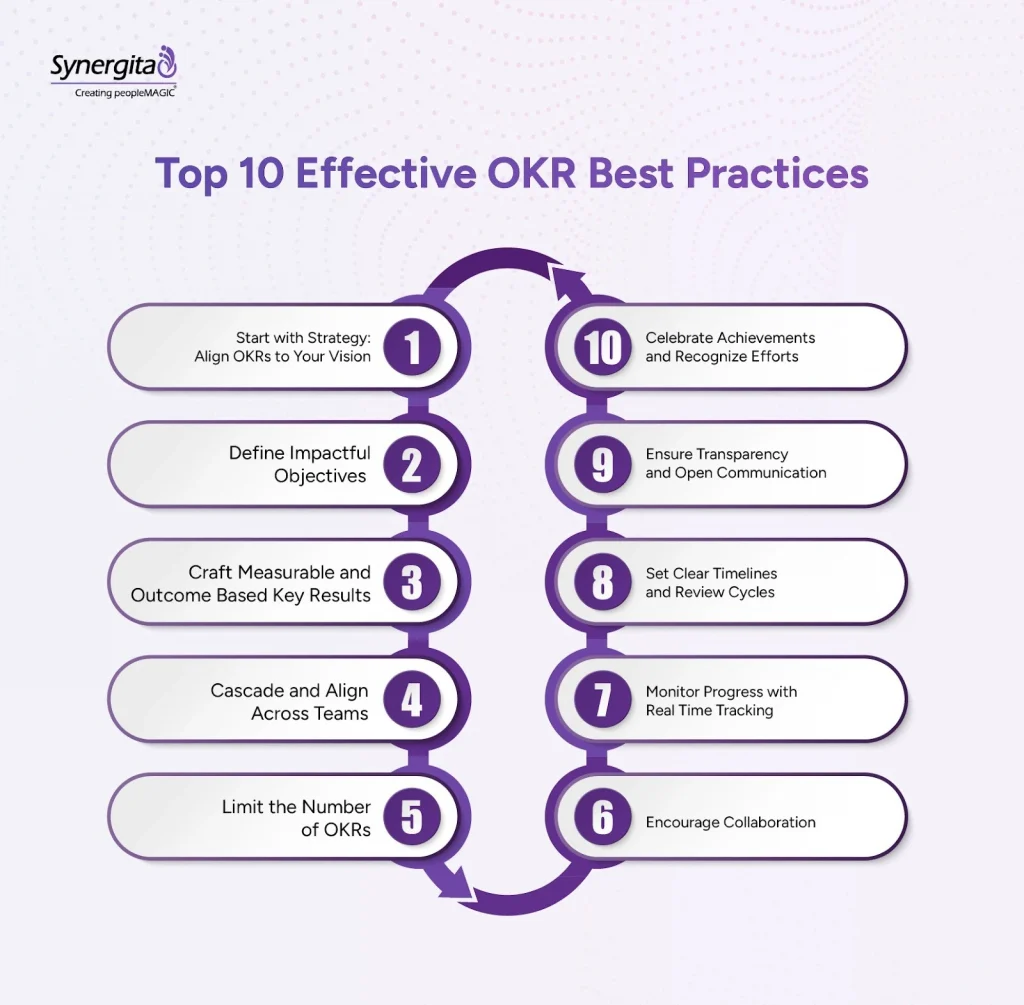
1. Start with Strategy: Align OKRs to Your Vision
Before defining your objectives, it’s essential to align them with a clear business strategy. When goals are closely tied to company vision, teams understand not just what they are working on, but why it matters.
Research from Gartner shows that when individual goals align with organizational needs, employee performance can improve by 22%. When setting OKRs, leaders should ask themselves:
- Are these objectives directly supporting the company’s mission?
- Do teams understand how their contributions impact top-level goals?
- Is there alignment across departments to avoid duplicated effort?
Suggested Reading: How Adopting OKRs Helps in Creating Company-Wide Alignment
2. Define Impactful Objectives
Once you align on the strategy, use the OKR framework to define the objectives you want to achieve. They should clearly describe a desired outcome, not just operational tasks.
For example, instead of defining your objective as “Increase customer engagement,” you should include a powerful metric like “Achieve 15% growth in monthly active users by Q4.”
A well-defined objective motivates action. Here are the key points to remember when defining objectives:
- Objectives should be aspirational yet achievable.
- Avoid generic statements; focus on clarity and purpose.
- Ensure each objective reflects a measurable impact on the business.
For more clarity on setting high-impact, strategy-driven objectives, check out our detailed blog on how to ensure your OKRs are strategic.
3. Create Measurable and Outcome‑Based Key Results
Key Results must be quantifiable and tied to business outcomes, not just activities. Using frameworks like SMART or CLEAR can ensure the key results are structured and relevant. To make Key Results actionable, you should:
- Focus on outcomes rather than tasks. For example, “increase retention by 10%” vs. “send follow-up emails.”
- Use numbers wherever possible to track progress objectively.
- Limit the number of Key Results to maintain focus.
4. Cascade and Align Across Teams
Even the best top-level OKRs can fail if teams don’t engage with them. That’s why cascading OKRs from company to department to individual is essential. But this cascade should go both ways, and strategy can be top-down; teams should contribute bottom-up to ensure their goals reflect real capacity and challenges.
To implement effective alignment:
- Hold regular alignment meetings between leadership and teams.
- Map each team’s objectives to corporate goals to strengthen OKR alignment and ensure there is no gap between leaders and teams.
- Assign clear ownership for every Key Result to drive accountability.
Suggested Reading: How to Bridge the Alignment Gap Between Leaders and Teams?
5. Limit the Number of OKRs
Pursuing too many things simultaneously is not a good practice. The same rule applies to OKRs as well. OKRs expert John Doerr recommends that each team have a maximum of 5 objectives and 4 key results per objective.
Setting too many goals reduces focus. One of the best OKR practices is to prioritize tasks with the most significant impact on strategic goals.
6. Encourage Collaboration
Some of the goals may require collaboration from various teams. For instance, a product team’s goal to improve usability may need support from design, engineering, and customer success. Here are the ways to improve collaboration:
- Create Shared OKRs: Align objectives across teams to promote joint ownership.
- Use Clear Communication Channels: Conduct regular meetings to keep everyone informed.
- Define Roles Clearly: Assign accountability and supporting responsibilities to avoid confusion.
7. Monitor Progress with Real‑Time Tracking
Another OKR best practice for successful goal setting is continuous visibility. Using modern OKR tools allows teams to track progress in real time, detect blockers early, and adjust strategies quickly to stay on track. Moreover, weekly or biweekly check-ins help maintain momentum and accountability.
8. Set Clear Timelines and Review Cycles
Defining a clear review schedule, whether weekly, monthly, or quarterly, and following it is essential. These reviews help track progress and enable teams to understand what worked, what did not, and what needs to change.
When you make these sessions a regular part of your workflow, OKRs become an integral part of daily operations, which supports continuous learning and improvement.
9. Ensure Transparency and Open Communication
Transparency and open communication are among the best practices for OKRs. Businesses must share objectives and progress with all stakeholders so everyone understands priorities, and encourage dialogue about confidence levels, challenges, and risks.
To enhance transparency, businesses should:
- Publish company and team OKRs in a shared space.
- Encourage open discussions during check-ins.
- Invite feedback on OKR relevance and feasibility.
10. Celebrate Achievements and Recognize Efforts
Recognizing efforts and progress is as important as achieving a milestone. Celebrate when your team achieves major KRs, and when they reach 70-80% of an ambitious target. This motivates team members to stay engaged and push harder to complete the remaining objectives. Consistent recognition also builds a culture where progress is valued, not just the outcomes.
Effective recognition practices:
- Give shout-outs in meetings or internal communications.
- Offer performance rewards for exceptional contributions.
- Highlight success stories to encourage others.
What Are Common Mistakes to Avoid When Implementing OKRs?
Even well-defined OKRs can fall short if teams overlook the common pitfalls. Here is a checklist of common OKR mistakes organizations should avoid to ensure OKRs deliver real impact:
- Setting Too Many Objectives: Trying to pursue every goal at once dilutes focus and overwhelms teams. Limit OKRs to the few that truly move the business forward.
- Writing Vague Key Results: Key Results should measure outcomes, not tasks. Avoid statements like “send emails” and focus on quantifiable impact.
- Failing to Align OKRs Across Teams: Disconnected goals lead to duplicated work and conflicting priorities. Ensure every team’s OKRs are aligned with the company’s objectives.
- Treating OKRs as a One-Time Exercise: OKRs should be a continuous process, not quarterly surprises. Skipping regular reviews reduces accountability and slows progress.
- Ignoring Cross-Functional Collaboration: Some objectives require collaboration across multiple teams, yet organizations often operate in silos, leading to delays and incomplete outcomes.
- Making OKRs Too Safe or Too Ambitious: Oversimplified OKRs limit growth, while unrealistic ones damage morale. You must maintain a balance between aspiration and practicality.
- Lack of Transparency: When OKRs are not openly shared across the company, teams miss the bigger picture and struggle to align their efforts toward common goals.
- Relying Only on Manual Tracking: Using spreadsheets or manual updates slows visibility and leads to outdated data. Leveraging automated OKR tools simplifies tracking and improves accuracy.
Final Takeaway
Following OKR best practices is the best way to achieve ambitious goals. It is about building a system that combines clarity, alignment, and accountability in everyday execution. When teams know what they are working toward and can regularly track progress, they can achieve big milestones.
As you refine your OKR approach for 2026, the right tools simplify the process. Synergita OKR software helps you set clear objectives, track OKRs, and maintain consistent review cycles so your teams stay focused and motivated. This makes it easier to turn ambitious goals into real business outcomes.
Try Synergita OKR software free for seven days and see how it transforms OKR goal setting.

Frequently Asked Questions
You need to select key results that clearly measure progress toward the objective, focus on outcomes rather than tasks, use quantifiable metrics, and avoid vague indicators that do not reflect real impact.
You should check OKRs weekly or every two weeks to address blockers early, review progress, and make necessary adjustments to achieve quarterly OKR targets.
To ensure OKRs are outcome-focused, define each key result with clear metrics, set specific targets or percentages, and link them to meaningful business outcomes.
Yes, smaller teams often achieve faster results because OKRs provide structure, alignment, and visibility in fast-moving environments with limited resources. Synergita’s AI-powered OKR tool is user-friendly and helps small businesses easily set and track OKRs.
Synergita OKR tool provides structured review templates, progress charts, and conversation logs so teams can run efficient, focused review cycles without preparing reports from scratch.