
Quick summary:
OKR best practices are the principles teams follow to set clear Objectives and measurable Key Results, align individual and team priorities with business goals, and review progress regularly. They help managers create better OKRs, improve accountability, maintain team focus, and measure progress toward organizational outcomes.
According to SHRM research published in January 2026, 37% of organizations do not cascade organizational goals from senior leadership to inform individual goals. As a result, employees may achieve their individual targets but contribute very little to the organization’s strategic priorities.
This shows the importance of setting goals that connect individual contributions with broader business priorities.
OKR best practices help organizations set objectives, define measurable key results, and keep teams focused on shared priorities. In this guide, we cover practical OKR tips, examples, common mistakes, and ways to improve OKRs in 2027.
| Table of contents 1.What are OKR best practices? 2. What are the OKR best practices businesses should follow in 2027? 3. OKR best practices examples by team 4. Better OKRs: From weak to strong key results 5. OKR best practices checklist: What to review before finalising goals 6. What are the most common OKR mistakes to avoid? 7. Final takeaway 8. Frequently asked questions |
What are OKR best practices?
OKR (Objectives and Key Results) best practices are the principles teams follow to set clear Objectives and measurable Key Results, align priorities with business goals, and review progress regularly. OKR best practices for managers help them maintain focus, improve accountability, and ensure that teams work toward outcomes that support organizational priorities.
OKR quick reference
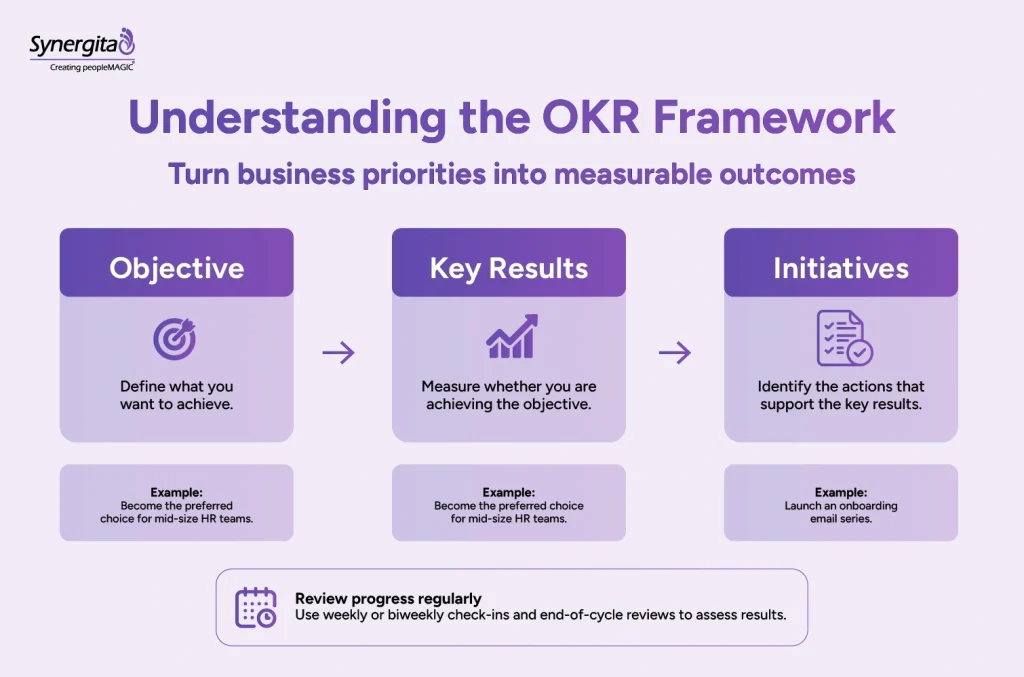
An OKR combines an objective with a small set of measurable key results. Teams review progress weekly or biweekly and assess outcomes at the end of their chosen OKR cycle. The table below breaks down each element, with an example and a rule of thumb.
| Element | What it answers | Example | Rule of thumb |
| Objective | What do we want to achieve? | Become the preferred choice for mid-size HR teams | Clear, motivating, and linked to a defined goal |
| Key Result | How will we know we have achieved it? | Grow trial-to-paid conversion from 12% to 18% | Measurable, outcome-based, and limited in number |
| Initiative | What will we do to move the key result? | Launch an onboarding email series | Actions and projects that support Key Results |
| Check-in | Where are we right now? | Update confidence level and blockers | Weekly or every two weeks |
| Review cycle | What did we learn? | Quarterly scoring and retrospective | Every quarter |
| Score | How did we do? | A score of 0.7 represents 70% completion on a linear scoring scale | A score of 0.7–0.8 can indicate good progress on an ambitious OKR |
What are the OKR best practices businesses should follow in 2027?
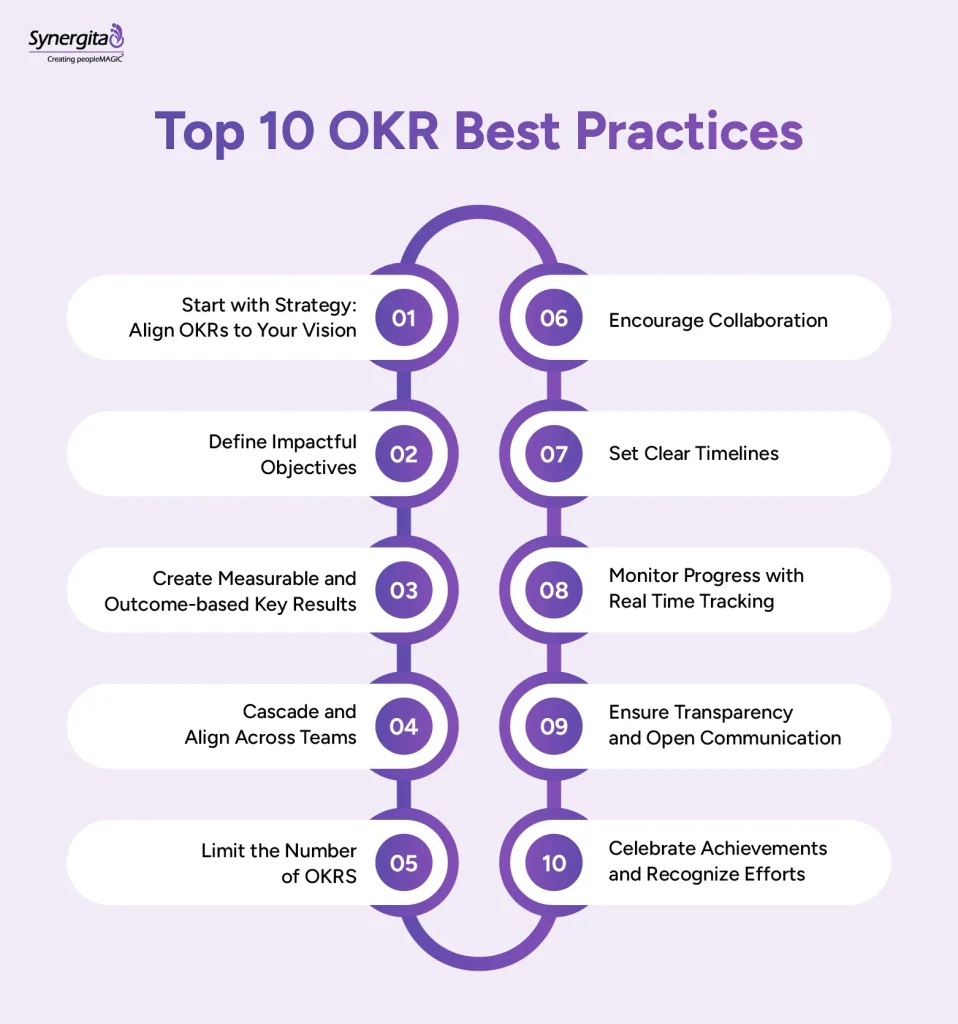
Effective OKRs connect business priorities with measurable outcomes. The best practices below explain how to write clear objectives, define best key results, maintain team alignment, and review progress throughout the OKR cycle.
Effective OKR practices start with aligning team objectives with business priorities.
1. Start with strategy: Align OKRs to your vision
Before setting OKRs, identify the business priorities that matter most to your organisation. These priorities should guide the objectives you define for the coming cycle. When objectives reflect the company’s vision and long-term direction, teams have a clearer understanding of the outcomes they need to achieve.
Use these questions to check whether your objectives reflect the organisation’s strategic priorities:
- Do the objectives address the company’s most important business priorities?
- Do they support the company’s long-term vision?
- Are the expected business outcomes clear?
Suggested Reading: How Adopting OKRs Helps in Creating Company-Wide Alignment
2. Define impactful objectives
Once the business priorities are clear, write objectives that describe the outcomes your team wants to achieve. Keep routine tasks separate from the objectives themselves. They should clearly describe a desired outcome.
For example, an objective could be “Increase customer engagement,” supported by a key result such as “Grow monthly active users by 15% by Q4.”
A well-defined objective motivates action. Here are the key points to remember when defining objectives:
- Objectives should be aspirational yet achievable.
- Avoid generic statements; focus on clarity and purpose.
- Ensure each objective reflects a meaningful business priority.
For more clarity on setting high-impact, strategy-driven objectives, check out our detailed blog on How to Ensure Your OKRs are Strategic.
3. Create measurable and outcome-based key results
Key Results must be quantifiable and linked to business outcomes. Using frameworks like SMART or CLEAR can help ensure that Key Results are structured and relevant.
You can use these guidelines when writing key results:
- Focus on outcomes rather than tasks. For example, “increase retention by 10% within three months” vs. “increase retention”
- Use numbers wherever possible to track progress objectively.
- Limit the number of Key Results to maintain focus.
Also, do not confuse key results with KPIs. KPIs track the ongoing health of the business, while OKRs create a specific change within a set period. A KPI such as monthly churn becomes the baseline for a key result, such as reducing it from 4% to 3%.
Suggested Reading: OKR vs KPI: The Key Differences
4. Align OKRs across teams and departments
You can set ambitious and effective OKRs, but they may fail if teams don’t engage with them. That’s why cascading OKRs from the company to departments and individuals is essential. But cascading should go both ways. While strategy flows top-down, teams should provide bottom-up input to ensure their goals reflect actual capacity and operational challenges.
To improve alignment across teams:
- Hold regular alignment meetings between leadership and teams.
- Map each team’s objectives to corporate goals to identify gaps and avoid conflicting priorities.
- Assign clear ownership for every Key Result to drive accountability.
For organizations with multiple teams, OKR portfolio management involves reviewing all team OKRs together so leaders can spot overlaps, dependencies, and gaps early. Keeping OKRs visible across levels helps teams understand how their objectives connect to broader business priorities.
Suggested Reading: How to Bridge the Alignment Gap Between Leaders and Teams?
5. Limit the number of OKRs
Pursuing too many things simultaneously is not a good practice. The same rule applies to OKRs as well. OKR expert John Doerr recommends that each team have a maximum of five objectives and four Key Results per objective.
To get better results, you should focus on the objectives that have the greatest impact on your organization’s strategic goals.
6. Encourage collaboration
Some goals may require collaboration across teams. For instance, a product team’s goal to improve usability may need support from design, engineering, and customer success. Here are some ways to improve collaboration:
- Create Shared OKRs: Align objectives across teams to promote joint ownership.
- Use Clear Communication Channels: Conduct regular meetings to keep everyone informed.
- Define Roles Clearly: Assign accountability and supporting responsibilities to avoid confusion.
7. Set clear timelines
Every OKR needs a defined start date, end date, and review schedule. Most organizations use quarterly OKR cycles, although the duration may vary depending on business priorities. Set deadlines for drafting, finalizing, and evaluating OKRs so teams know when to commit to goals and assess results.
At the end of each cycle, review the outcomes, document lessons learned, and use those insights to shape the next set of OKRs.
8. Track OKR progress regularly
Another OKR best practice is to maintain visibility into progress throughout the OKR cycle. Modern OKR tools allow teams to monitor key results, identify blockers early, and make timely adjustments.
Consistent OKR tracking also provides data for OKR reports, which give leaders a clear view of progress, risks, and confidence levels without manual compilation.
9. Ensure transparency and open communication
Transparency and open communication are essential to effective OKR management. Businesses should make objectives and progress visible across teams and encourage employees to discuss challenges, risks, and changes in priorities.
To enhance transparency, businesses should:
- Publish company and team OKRs in a shared space.
- Encourage open discussions during check-ins.
- Invite feedback on OKR relevance and feasibility.
10. Celebrate achievements and recognize efforts
Recognizing effort and progress is as important as celebrating achievements. Celebrate major milestones and meaningful progress toward ambitious key results. Recognizing effort and progress helps teams stay motivated, even when they do not achieve every target. Consistent recognition also builds a culture where progress is valued, not just the outcomes.
Here are some effective recognition practices your teams can adopt:
- Give shout-outs in meetings or internal communications.
- Offer performance rewards for exceptional contributions.
- Highlight success stories to encourage others.

OKR best practices examples by team
A good OKR example pairs one outcome-focused objective with three measurable key results, such as the objective “Build a predictable inbound pipeline,” supported by the key result “Increase organic sign-ups by 30%.” The examples below cover company, marketing, HR, product, and customer success teams.
Company
- Objective: Become the leading performance platform for mid-sized businesses.
- KR1: Grow annual recurring revenue by 25%.
- KR2: Increase net revenue retention to 105%.
- KR3: Raise NPS from 35 to 45.
Marketing
- Objective: Build a predictable inbound pipeline.
- KR1: Increase organic sign-ups by 30%.
- KR2: Raise marketing-qualified leads from 400 to 550 per month.
- KR3: Improve demo-to-opportunity conversion from 20% to 28%.
HR
- Objective: Create an engaged, high-retention workforce.
- KR1: Reduce voluntary attrition from 16% to 12%.
- KR2: Raise the engagement survey score from 70 to 78.
- KR3: Cut average time to hire from 45 to 35 days.
Product
- Objective: Deliver a product customers rely on every day.
- KR1: Increase weekly active users by 15%.
- KR2: Raise adoption of new features from 25% to 40% within 60 days of release.
- KR3: Reduce critical bugs reported per month from 20 to 8.
Customer Success
- Objective: Help customers reach value faster.
- KR1: Reduce time to first value from 30 to 14 days.
- KR2: Increase gross retention from 88% to 92%.
- KR3: Raise CSAT from 4.1 to 4.5.
Better OKRs: From weak to strong key results
| Weak key result | Better key result | Why it works |
| Launch the new website | Increase website conversion rate from 2% to 3.5% | Measures the outcome, not the task |
| Improve customer satisfaction | Raise CSAT from 4.1 to 4.5 by the end of Q3 | Has a baseline, target, and deadline |
| Send weekly training emails | Reduce new-hire ramp time from 90 to 60 days | Tracks the result the training should produce |
OKR best practices checklist: What to review before finalising goals
Before approving OKRs, confirm that each objective is clear and tied to strategy, each key result is a measurable outcome with a baseline, target, deadline, and one owner, and check-ins and reviews are scheduled.
Use this reusable OKR checklist before signing off on any team’s OKRs.
- The objective is clear, inspiring, and linked to a company priority.
- Each key result measures an outcome, not a task.
- Each key result has a baseline, a target, and a deadline.
- The team has no more than 5 objectives, with up to 4 key results each.
- Every key result has one named owner.
- Dependencies on other teams are identified and agreed.
- The stretch level is right, so reaching 70-80% would still count as strong progress.
- Check-ins and the end-of-cycle review are scheduled.
- OKRs are visible to the whole company.
- There is a plan for reporting progress.
What are the most common OKR mistakes to avoid?
The most common OKR mistakes are setting too many objectives, writing vague key results, skipping cross-team alignment, treating OKRs as a one-time exercise, setting goals that are too safe or too ambitious, lacking transparency, and relying on manual tracking.
Here is a checklist of common OKR mistakes organizations should avoid to ensure OKRs deliver real impact:
- Setting too many objectives
Trying to pursue every goal at once dilutes focus and overwhelms teams. Limit OKRs to the few that truly move the business forward.
- Writing vague key results
Key Results should measure outcomes, not tasks. Avoid statements like “send emails” and focus on quantifiable impact.
- Failing to align OKRs across teams
Disconnected goals lead to duplicated work and conflicting priorities. Ensure every team’s OKRs are aligned with the company’s objectives.
- Treating OKRs as a one-time exercise
Teams should review OKRs regularly rather than wait until the end of the quarter. Skipping regular reviews reduces accountability and slows progress.
- Making OKRs too safe
Oversimplified OKRs limit growth, while unrealistic ones damage morale. You must maintain a balance between aspiration and practicality.
- Lack of transparency
When OKRs are not openly shared across the company, teams miss the bigger picture and struggle to align their efforts toward common goals.
- Relying only on manual tracking
Using spreadsheets or manual updates slows visibility and leads to outdated data. Using automated OKR tools simplifies tracking and improves accuracy.
Final takeaway
Following OKR best practices helps teams pursue ambitious goals with greater focus and accountability. This involves building a system that combines clarity, alignment, and ownership in everyday execution. When teams know what they are working toward and can regularly track progress, they can achieve big milestones.
As you refine your OKR approach for 2027, the right OKR solution simplifies the process. Synergita OKR software helps you set clear objectives, track OKRs, and maintain consistent review cycles, making it easier to turn ambitious goals into real business outcomes.
See Synergita OKR pricing to find the plan that fits your team or start a free trial today.
Frequently asked questions
Start by aligning Objectives with business priorities. Write clear, outcome-focused Objectives and define measurable Key Results that show progress. Limit the number of OKRs, assign ownership, and review progress regularly to keep teams focused.
A team should generally have 2–5 Objectives, with 2–4 Key Results under each Objective. This keeps priorities manageable and gives employees enough time to work towards measurable outcomes. The exact number depends on the team’s responsibilities and business priorities.
Teams should check OKR progress weekly or biweekly and conduct more detailed reviews monthly. A quarterly review helps assess results, identify gaps and decide which priorities need attention in the next cycle.
Managers can improve participation by involving employees in setting team and individual OKRs. Explain how each Objective connects to business priorities, assign clear ownership, encourage feedback, and discuss progress during regular check-ins.
First, identify why the Key Result is falling behind. Check whether the target is unrealistic, resources are limited, priorities have changed, or the current approach is not working. Discuss corrective actions with the team and revise the target only when there is a valid business reason.
Measure OKR success through the progress made against each Key Result. Compare actual results with the defined targets, review the business impact, and assess whether the Objective was achieved. Teams can also use progress reports to identify gaps and guide future decisions.
OKRs (Objectives and Key Results) define what an organisation wants to achieve and how it will measure progress towards those goals. KPIs (Key Performance Indicators) measure ongoing performance against specific business metrics.
For example, increasing customer retention by 15% can be an OKR, while the monthly customer retention rate is a KPI.
Yes. OKRs can support employee performance management by connecting individual contributions with team and organizational goals. Managers can use OKR reviews to discuss progress, identify development needs, and recognize contributions. However, OKR achievement should not be the only measure of employee performance.