
Your teams work hard but pull in different directions. Ambitious company goals lack clear connections to daily work. This disconnect wastes resources and delays strategic priorities.
The consequence is slowed growth and poor return on human capital investment. Global employee engagement declined to 21% in 2024, with managers experiencing the largest drop. Without a clear framework, proving employee value to executives becomes impossible.
This guide provides a structured playbook for aligning employees with company goals. We explain the OKR methodology and its strategic benefits. Our actionable plan converts individual effort into collective success.
Key Takeaways
- Alignment ensures every employee’s daily work directly contributes to the organization’s top-level objectives.
- Use the OKR framework (Objectives and Key Results) for both top-down clarity and bottom-up engagement.
- Transparency is essential; all goals must be visible across departments to foster collaboration.
- Implement structured check-ins and continuous feedback to maintain alignment in an agile environment.
- Misalignment is a major hidden cost, leading to wasted effort and resource fragmentation.
What Is Goal Setting For Employees?
Goal setting for employees is the process of defining specific, measurable targets for individuals and teams that directly contribute to organizational strategy. Effective goal setting provides employees with clear expectations regarding their priorities and desired outcomes.
It converts abstract company vision into concrete, quantifiable work tasks and projects. This practice establishes an accountability framework, measuring employee success against defined performance standards.
When done correctly, goal setting provides the structural foundation for all performance management and development activities.
Also Read:Continuous Feedback in Performance Management System – Is it relevant?
With the goal setting defined, you must understand why aligning these goals is the critical difference between activity and impact.
Why It Is Important To Align Employees With Company Goals
When goals are disconnected, teams often operate in isolation, mistaking activity for progress and failing to prioritize high-impact work. Strategic alignment ensures every payroll dollar is invested in moving the corporate needle, eliminating redundant or low-value activities. Disengagement cost the world economy $438 billion in 2024.
Proving the collective ROI of your workforce to the board relies entirely on this demonstrable link between individual and corporate goals. True alignment shifts the organizational focus from tasks completed to measurable results achieved.
Here is why mandatory goal alignment is critical for business execution:
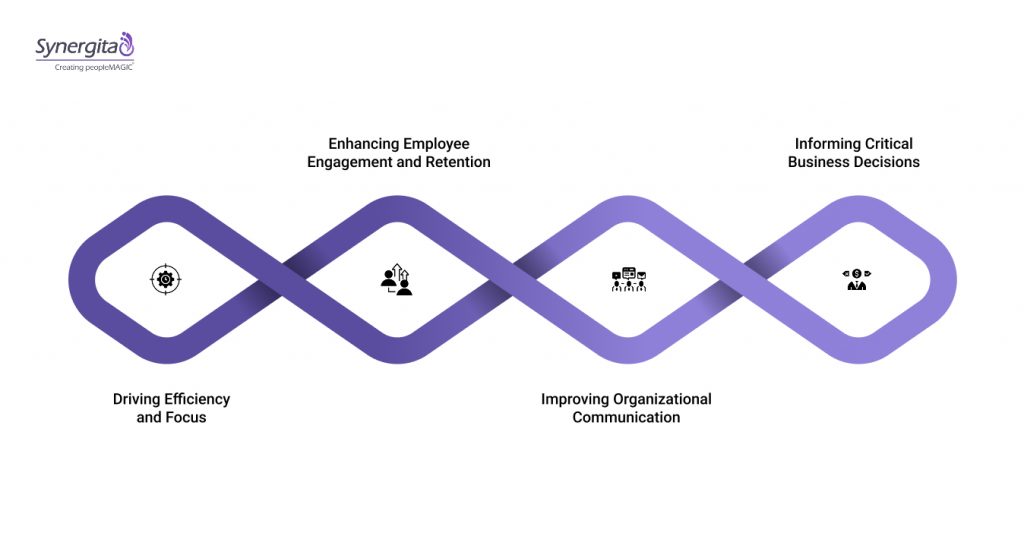
1. Driving Efficiency and Focus
Clear alignment prevents resources from being spent on projects that do not contribute to the company’s current strategic priorities. It limits individual work to the most important, high-impact outcomes. This razor-sharp focus ensures teams execute with urgency and minimal internal distraction.
Isyour team productive but not progressing on key priorities? Synergita creates the visible link between daily work and strategic goals. Book a demo to see how we make every contribution count.
2. Enhancing Employee Engagement and Retention
Employees who clearly understand how their daily work affects the company’s mission report higher satisfaction and purpose. Seeing their contribution in a larger context validates their effort and reinforces their value to the organization. This connection significantly reduces disengagement and voluntary turnover risk.
3. Improving Organizational Communication
A cascaded goal framework necessitates open, structured communication across departments and management layers regarding strategic priorities. It forces leaders to clarify the “why” behind their decisions, improving transparency throughout the organization. This clarity minimizes silos and strengthens cross-functional collaboration.
4. Informing Critical Business Decisions
Goal alignment data provides objective proof of which teams are executing the company strategy successfully and which are lagging behind. This objective data should then inform critical decisions regarding resource allocation, talent deployment, and budget prioritization. Data-driven goal tracking eliminates subjective assumptions in strategic planning.
Also Read:A Successful Performance Culture depends on Continuous Feedback
Understanding the strategic imperative is crucial, but executing alignment requires a systematic, step-by-step methodology.

How To Align Employees With Company Goals: 5 Simple Ways
Achieving true organizational alignment requires a systematic, multi-step process that utilizes modern performance frameworks like OKR. It moves beyond the outdated annual cascade, emphasizing continuous communication and bi-directional accountability.
Alignment must be a core, non-negotiable cultural practice, not a once-a-year HR activity. The process must clearly define expectations at every level, ensuring clarity from the CEO to the frontline employee.
Follow these systematic methods to achieve disciplined goal alignment:
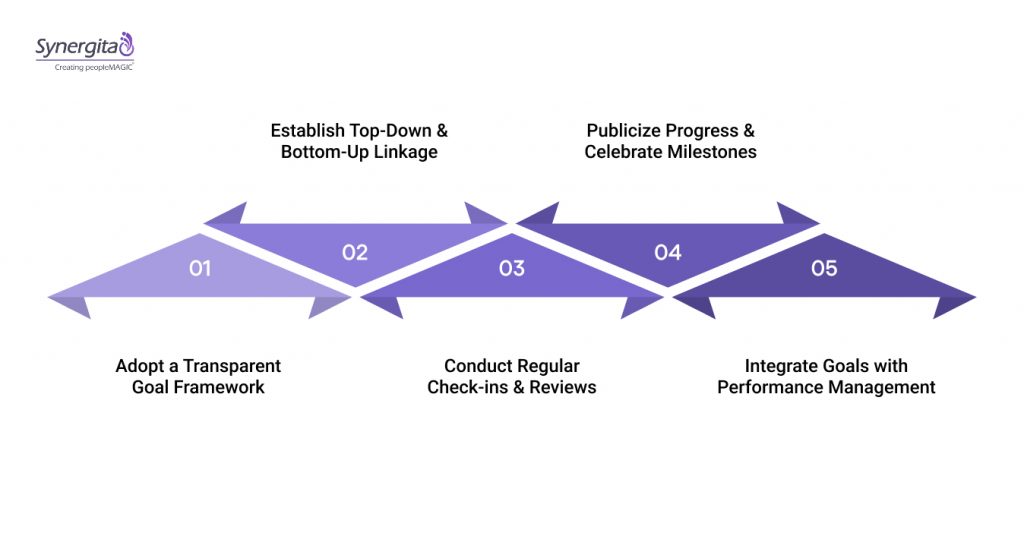
1. Adopt a Transparent Goal Framework (OKR)
Establish a structured system like Objectives and Key Results (OKR) that clearly separates ambitious qualitative goals from measurable quantitative results.
The framework must be uniform across all departments to ensure consistent measurement and understanding. This clarity provides the foundation for transparent communication.
How it helps:
- Standardizes measurement: Ensures all departments use the same definitions for success and progress tracking.
- Increases visibility: Makes all team and individual goals searchable and visible across the entire organization.
- Clarifies accountability: Defines precisely who is responsible for specific Key Results.
2. Establish Top-Down and Bottom-Up Linkage
Initiate the process with high-level company OKRs, which then guide team and individual goal setting (top-down). Encourage teams to propose their own supporting Key Results for high-level Objectives (bottom-up).
This bi-directional approach ensures employee ownership while maintaining strategic coherence.
How it helps:
- Ensures ownership: Employees feel more engaged when they contribute to setting their own goals.
- Validates strategy: The bottom-up input tests the feasibility and practicality of the top-level goals.
- Creates a goal chain: Demonstrates how individual tasks connect directly to major company Objectives.
3. Conduct Regular Check-ins and Progress Reviews
Replace the single annual review with frequent, structured check-ins between managers and employees to discuss goal progress and necessary adjustments.
These conversations should focus on identifying obstacles and providing developmental support. Agility requires that goals be living documents, ready for modification.
How it helps:
- Maintains agility: Allows managers to quickly pivot goals when market conditions or priorities change.
- Provides coaching: Offers timely opportunities for managers to coach employees on performance.
- Mitigates failure: Identifies off-track goals early, allowing for course correction before the deadline.
Also Read:Here is How You Fix Challenges in Hybrid Team Management!
4. Publicize Progress and Celebrate Milestones
Make goal progress data transparent and easily accessible through organizational dashboards, showcasing progress against Key Results across all departments.
Publicly recognize individuals and teams when they achieve significant milestones or demonstrate aligned effort. Visibility reinforces commitment and drives motivational momentum.
How it helps:
- Drives accountability: Peer visibility encourages managers and employees to keep their goals updated.
- Fosters learning: Teams can observe successful strategies and metrics used by other departments.
- Reinforces culture: Celebrations highlight desired behaviors and solidify the importance of aligned goal achievement.
5. Integrate Goals with Performance Management
Ensure that employee performance ratings and compensation decisions are fundamentally tied to their measurable achievement of aligned Key Results.
This integration is essential to demonstrate that goal alignment is a high-stakes, rewarded activity. This connection proves the sincerity of your commitment to the framework.
How it helps:
- Increases seriousness: Employees dedicate more effort when goal results directly impact their careers.
- Simplifies reviews: Performance discussions become objective, focusing on measurable goal outcomes.
- Validates ratings: Objective goal data provides a clear basis for defensible and fair performance appraisals.
Need to implement OKRs across your organization? Synergita offers complete goal management with real-time tracking. Book a demo to explore our cascading goal framework.
Implementing this methodology is only effective if your organization adopts specific behavioral and cultural standards as non-negotiable best practices.
Best Practices To Align Employees With Company Goals
Achieving truly successful and sustained alignment requires more than just launching a new OKR platform; it demands behavioral and cultural discipline. These best practices serve as non-negotiable cultural standards for your leadership team.
Failing to enforce these principles will lead to the rapid deterioration of your new alignment framework. Discipline ensures the system remains a strategic asset, not just a set of forgotten forms.
Employ these authoritative best practices for maximum alignment impact:
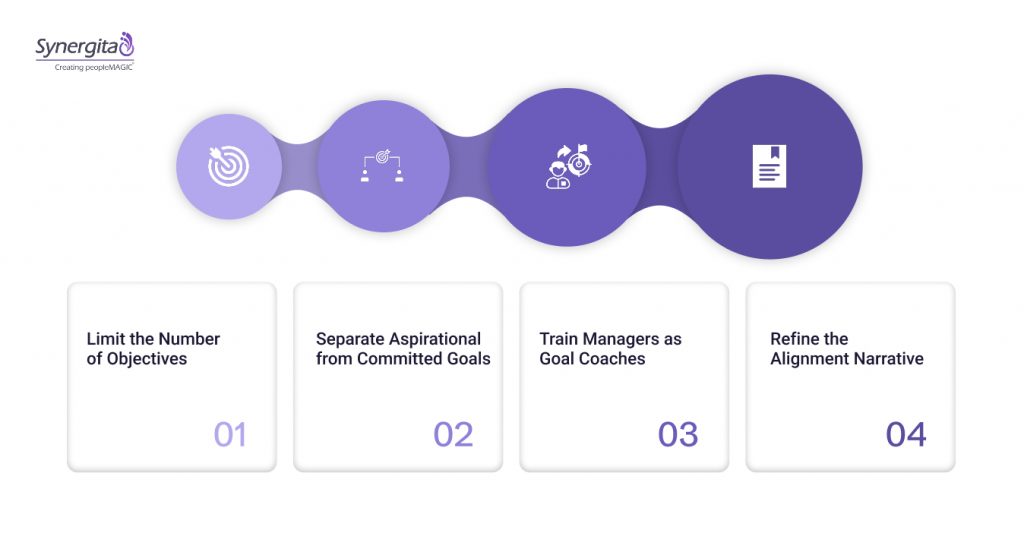
1. Limit the Number of Objectives
Restrict the organization, teams, and individuals to three to five core Objectives per quarter or cycle. Spreading focus across too many goals dilutes effort and guarantees mediocre outcomes across the board. Rigorous focus is the single most important driver of goal success.
2. Separate Aspirational from Committed Goals
Clearly distinguish between aspirational (stretch) goals, which might achieve 70% success, and committed goals, which must be achieved 100%. This distinction prevents confusion and encourages productive risk-taking in certain strategic areas. It helps manage expectations and performance discussions fairly.
3. Train Managers as Goal Coaches
Invest heavily in training managers to facilitate meaningful goal-setting conversations, not simply dictate targets or passively check boxes. Managers must be skilled in asking probing questions, providing continuous coaching, and helping employees overcome obstacles. Manager competency is the single biggest determinant of system success.
4. Refine the Alignment Narrative
Ensure senior leaders consistently and frequently communicate the strategic narrative that connects individual effort to company vision. Regularly articulate how every department and function fits into the larger corporate strategy. This continuous reinforcement maintains momentum and belief in the alignment process.
Also Read:Employee Engagement and Development in the Hybrid/ Remote Work Mode
Even the best practices fail if the underlying technology is fragmented and unable to support continuous, real-time alignment tracking.
How Synergita Supports Your Success Every Step Of The Way
Manual goal tracking across disconnected systems creates outdated information and wasted effort. This fragmentation prevents real-time visibility into goal alignment and performance. Strategic adjustments become delayed, undermining the entire goal framework’s credibility.
Synergita provides a unified platform integrating OKR tracking with performance management. Our solution connects goal setting directly with feedback and analytics. This transforms alignment from bureaucratic process to strategic advantage.
The Synergita platform delivers specific capabilities crucial for full organizational alignment:
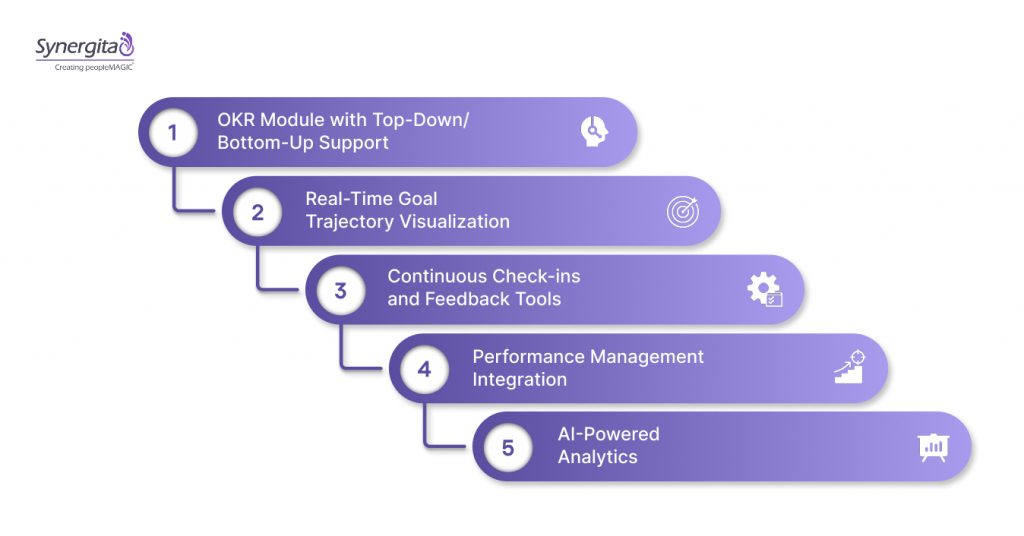
- OKR Module with Top-Down/Bottom-Up Support: Visualize the complete goal hierarchy and alignment chain from the CEO Objective to the individual Key Result.
- Real-Time Goal Trajectory Visualization: Show employees and managers the immediate status, progress, and lead/lag indicators for all their assigned Key Results.
- Continuous Check-ins and Feedback Tools: Facilitate frequent, structured manager-employee conversations to discuss progress and maintain goal agility.
- Performance Management Integration: Tie appraisal scores directly to goal achievement, ensuring high-stakes accountability for successful alignment.
- AI-Powered Analytics: Provide managers with focused insights on which teams are aligned and which goals are at risk of failure.
Ensure that every single employee contribution is channeled directly toward your most critical corporate objectives.
Also Read:Types of Performance Appraisal Systems for your Remote and Hybrid Workplace

Conclusion
Mastering employee alignment is essential for business execution and strategic coherence. A disciplined OKR framework eliminates wasted effort and proves human capital value. This alignment converts ambition into measurable results.
Synergita provides unified technology for fast, transparent goal alignment across your organization. Our integrated OKR and Performance modules ensure continuous, visible alignment. This system frees leaders to focus on coaching rather than administrative tracking.
Book a demonstration to see how Synergita can establish measurable, transparent goal alignment across your entire organization.
FAQs
Q. What is the difference between cascading goals and aligned goals?
Cascading goals are typically rigid, top-down commands, while alignment involves mutual communication and bottom-up input. True alignment ensures two-way buy-in and ownership at every level.
Q. Is OKR the only goal-setting framework that supports alignment?
No, but OKR is highly favored because its structure explicitly links the qualitative Objective to the measurable Key Results. This measurable nature makes alignment tracking significantly clearer than traditional methods.
Q. How often should we review and adjust OKRs?
OKRs should be set quarterly for agility, with mandatory, light check-ins conducted weekly or bi-weekly. Avoid the annual review cycle, as it lacks the necessary speed for today’s dynamic business environment.
Q. What is the biggest risk of poor alignment?
The biggest risk is organizational drag, where teams are productive but working on conflicting or low-priority projects. This misalignment creates a massive, hidden cost in wasted time and missed opportunities.
Q. How do you handle disagreement during the alignment process?
Disagreements should be managed by the immediate supervisor or manager, forcing a trade-off decision based on the highest-level company OKRs. If a goal does not directly support a top-level objective, it should be eliminated.