
Quick summary: The five proven ways to align employees with company goals are adopting a transparent goal framework like OKRs, linking top-down and bottom-up goals, holding regular check-ins, publicizing progress and celebrating milestones, and connecting goals to performance management. Together, they show employees how their daily work supports business priorities.
Your employees are busy. Projects are moving, deadlines are being met, and teams are putting in the hours. But are they working on the things that will help your business reach its goals?
When employees don’t know how their work connects to company priorities, teams can work hard and still miss the bigger goals. Managers spend time resolving competing priorities, important goals lose focus, and business plans fall behind.
Low employee engagement makes it difficult to keep teams focused on company goals. Gallup reported that only 21% of employees worldwide were engaged in 2024.
Employees need to understand what the business is trying to achieve, how their work contributes, and whether their efforts are making progress.
This guide covers five practical ways to align employees with company goals, connect individual work to business priorities, and use Objectives and Key Results (OKRs) to help teams stay focused on shared outcomes.
| Table of Contents 1. What is goal setting for employees? 2. Why is employee alignment important for achieving company goals? 3. How to align employees with company goals: 5 practical ways 4. Best practices to align employees with company goals 5. How does team alignment improve employee engagement? 6. How does Synergita support employee alignment? 7. Final takeaway 8. Frequently asked questions |
What is goal setting for employees?
Goal setting for employees involves defining specific, measurable targets that connect individual responsibilities and team activities to broader company objectives. Effective goal setting provides employees with clear expectations regarding their priorities and desired outcomes.
It turns the company’s broader goals into specific targets for teams and individuals. Managers can then assess progress against clear performance expectations.
Clear goals also give managers a starting point for performance reviews and employee development plans.
Effective goal setting connects employees’ work to company goals and shows them how their individual objectives support business priorities.
Why is employee alignment important for achieving company goals?
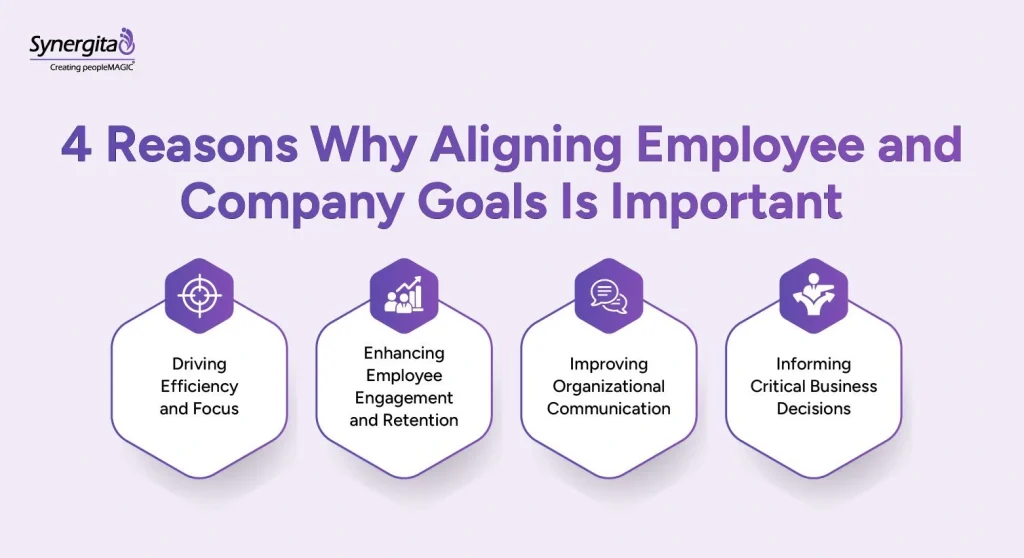
Aligning employees with company goals helps everyone focus on shared priorities, reduce duplicated work, and use resources effectively. It improves accountability, supports employee engagement, and helps teams measure how their work contributes to business results.
Goal alignment helps organizations direct time and resources towards work that supports business priorities and reduces duplicated effort. Employee disengagement cost the global economy $438 billion in 2024.
Connecting individual goals to business results helps leaders explain how employees’ work contributes to organizational performance. Alignment helps teams measure progress by results, not only by the number of tasks completed.
Here’s why aligning employee goals with company priorities is important:
1. Efficiency and focus
Employee alignment improves efficiency by helping teams focus on work that supports company objectives and spend less time on tasks that do not contribute to business priorities.
2. Enhancing employee engagement and retention
Employee alignment can support engagement and retention by helping employees understand how their contributions support organizational success. Understanding this connection can help employees see how their work contributes to organizational success and may support engagement and retention.
3. Improving organizational communication
Employee alignment improves communication by making company priorities, team responsibilities, and individual contributions clear across departments. It encourages leaders to explain why priorities have been set, helping employees understand the decisions behind their goals. This clarity minimizes silos and strengthens cross-functional collaboration.
4. Informing critical business decisions
Goal-tracking data helps managers see which teams are progressing and where they may need support. Managers can use this information to allocate resources, identify skills gaps, and review budget priorities.
Data-driven goal tracking helps reduce reliance on assumptions in strategic planning. Understanding why alignment is important is the first step. The next is putting it into practice.
Suggested read: A Successful Performance Culture depends on Continuous Feedback
How to align employees with company goals: 5 practical ways
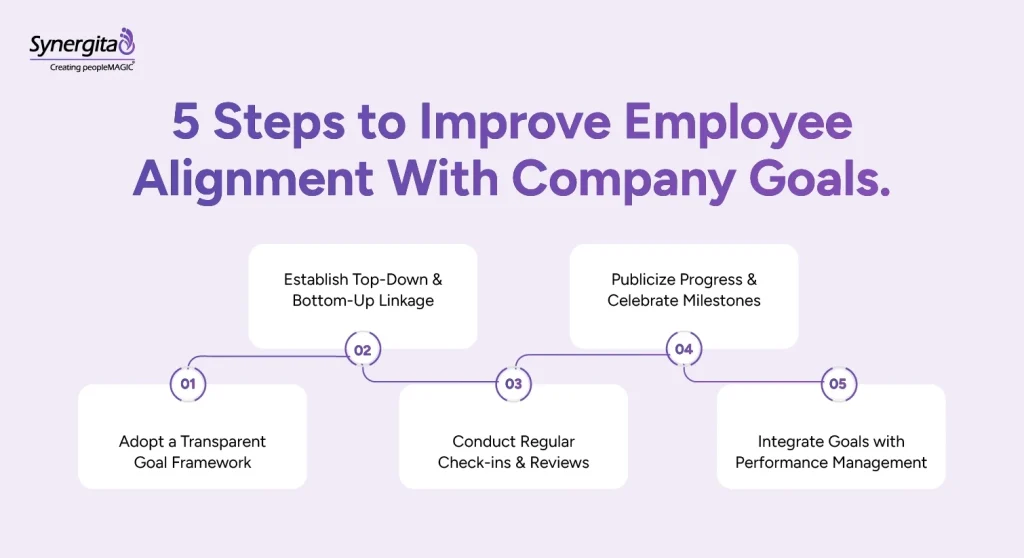
Organizations can align employees with company goals by establishing measurable objectives, connecting individual and team targets, reviewing progress regularly, recognizing achievements, and linking goals to performance management.
A framework such as OKRs can help teams set measurable results and review progress throughout the goal cycle. These five steps can help organizations connect individual work to shared business priorities. The following steps can help organizations align goals across teams:
Step 1. Adopt a Transparent Goal Framework (OKRs)
Objectives and Key Results (OKRs) help organizations align employees with company goals by defining desired outcomes and measurable results. Objectives describe the intended outcome, while Key Results show whether the organization is making progress towards it.
You can align individual work with quarterly goals through your organization’s goal management system, OKR platform, or shared goal-tracking dashboard. Connect each employee’s quarterly objectives to team Key Results and company priorities, then review progress during regular check-ins.
For a step-by-step explanation of setting objectives and measurable results, read the OKR implementation guide
Step 2. Establish top-down and bottom-up linkage
Start with company-level OKRs, which guide team and individual goal setting (top-down). Encourage teams to propose their own supporting Key Results for high-level Objectives (bottom-up).
The most effective approach is to match personal effort to corporate goals by giving employees clear objectives, measurable outcomes, and an understanding of how their contributions support business priorities.
This two-way approach connects company priorities with employee input. Leaders set the overall direction, while teams help define goals that are realistic for their work.
How it helps:
- Ensures ownership: Employees feel more engaged when they contribute to setting their own goals.
- Validates strategy: Input from teams helps leaders check whether the goals are realistic and identify resource or capacity constraints.
- Creates a goal chain: Shows how individual tasks connect to major company objectives.
You can explore Amazon’s journey with OKRs for another example of applying objectives and key results.
Step 3. Regular check-ins and progress reviews
Schedule regular conversations between managers and employees to review goal progress, discuss obstacles, and agree on any changes. The frequency will depend on the work, the goal cycle, and how quickly priorities change.
Managers can use OKR tracking, shared goal dashboards, milestone reviews, regular check-ins, and performance management reports to keep teams aligned. These methods help managers monitor progress, identify obstacles, clarify ownership, and adjust goals when business priorities change.
These conversations should focus on identifying obstacles and providing developmental support. Review and update goals when business priorities or team responsibilities change.
How it helps:
- Maintains agility: Allows managers to quickly pivot goals when market conditions or priorities change.
- Provides coaching: Offers timely opportunities for managers to coach employees on performance.
- Mitigates failure: Identifies off-track goals early, allowing for course correction before the deadline.
Managers can use goal management software to keep objectives, ownership, and progress visible throughout the goal cycle.
Step 4. Publicize progress and celebrate milestones
Use shared dashboards to give teams visibility into goal progress across departments. Recognize employees and teams when they reach milestones or contribute to shared goals.
How it helps:
- Accountability: Peer visibility encourages managers and employees to keep their goals updated.
- Improves learning: Teams can observe successful strategies and metrics used by other departments.
- Culture: Celebrating milestones reinforces the value of working toward shared goals.
Step 5. Integrate goals with performance management
Include progress against agreed goals in performance discussions, alongside role expectations, skills, collaboration, and other contributions
Linking goals to performance discussions shows employees that goal achievement matters and gives managers a basis for discussing results, development, and future priorities
How it helps:
- Strengthens accountability: Employees dedicate more effort when goal results directly impact their careers.
- Simplifies reviews: Performance discussions become objective, focusing on measurable goal outcomes.
- Validates ratings: Objective goal data provides a clear basis for defensible and fair performance appraisals.
A structured OKR management system helps organizations connect goal achievement with employee feedback and performance reviews.
Best practices to align employees with company goals
Clear goals need regular attention to stay relevant. These practices can help leaders keep teams focused while giving employees room to raise concerns and adapt to changing priorities.
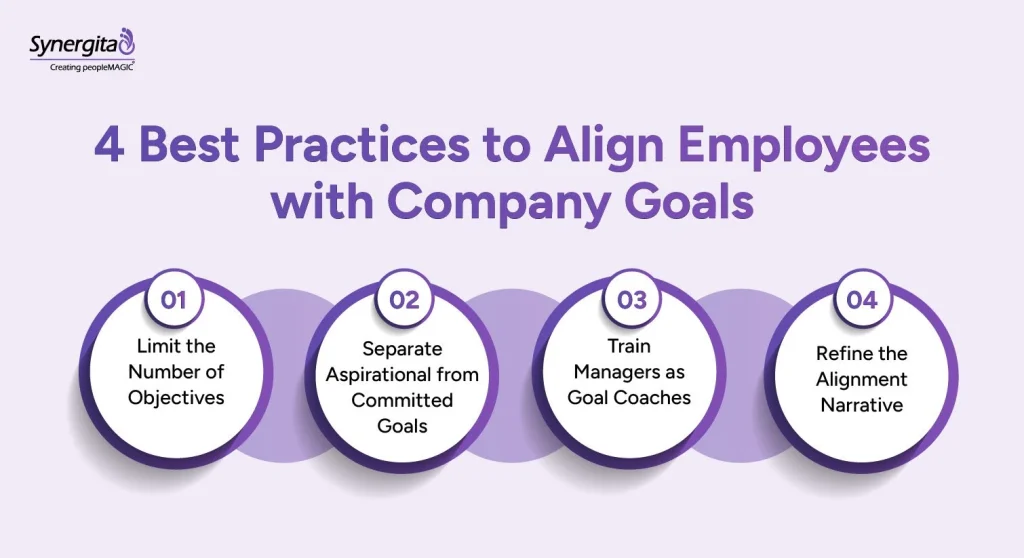
Use these best practices to maintain employee alignment:
1. Limit the number of objectives
Set a manageable number of objectives for each team and employee. Three to five objectives per quarter can be a useful starting point, depending on the role and the goal cycle. Too many goals can divide attention and make it difficult to decide what deserves priority.
2. Separate aspirational from committed goals
Clearly distinguish between aspirational goals, which encourage employees to pursue ambitious outcomes, and committed goals, which represent results the team is expected to deliver. This distinction prevents confusion and encourages productive risk-taking in certain strategic areas. It helps manage expectations and performance discussions fairly.
3. Train managers as goal coaches
Help managers guide goal-setting conversations instead of simply assigning targets. They should ask employees about obstacles, discuss progress, provide feedback, and help resolve problems that affect results.
4. Individual goals connect to company priorities
Leaders should explain the reason behind key business priorities and show how each department contributes. When priorities change, explain what has changed and how teams should adjust their goals.
Suggested read: Employee Engagement and Development in the Hybrid/ Remote Work Mode
How does team alignment improve employee engagement?
When employees understand how their work contributes to company goals, they can see why their responsibilities matter and how their progress supports the wider team. Shared goals also help departments coordinate their work and avoid conflicting priorities.
Regular feedback gives employees a chance to discuss progress, raise concerns, and ask for support. Managers can use these conversations to recognize contributions, address obstacles, and adjust goals when business needs change.
How does Synergita support employee alignment?
Synergita offers goal and OKR management solutions that help organizations set objectives, track key results, and monitor progress against business priorities.
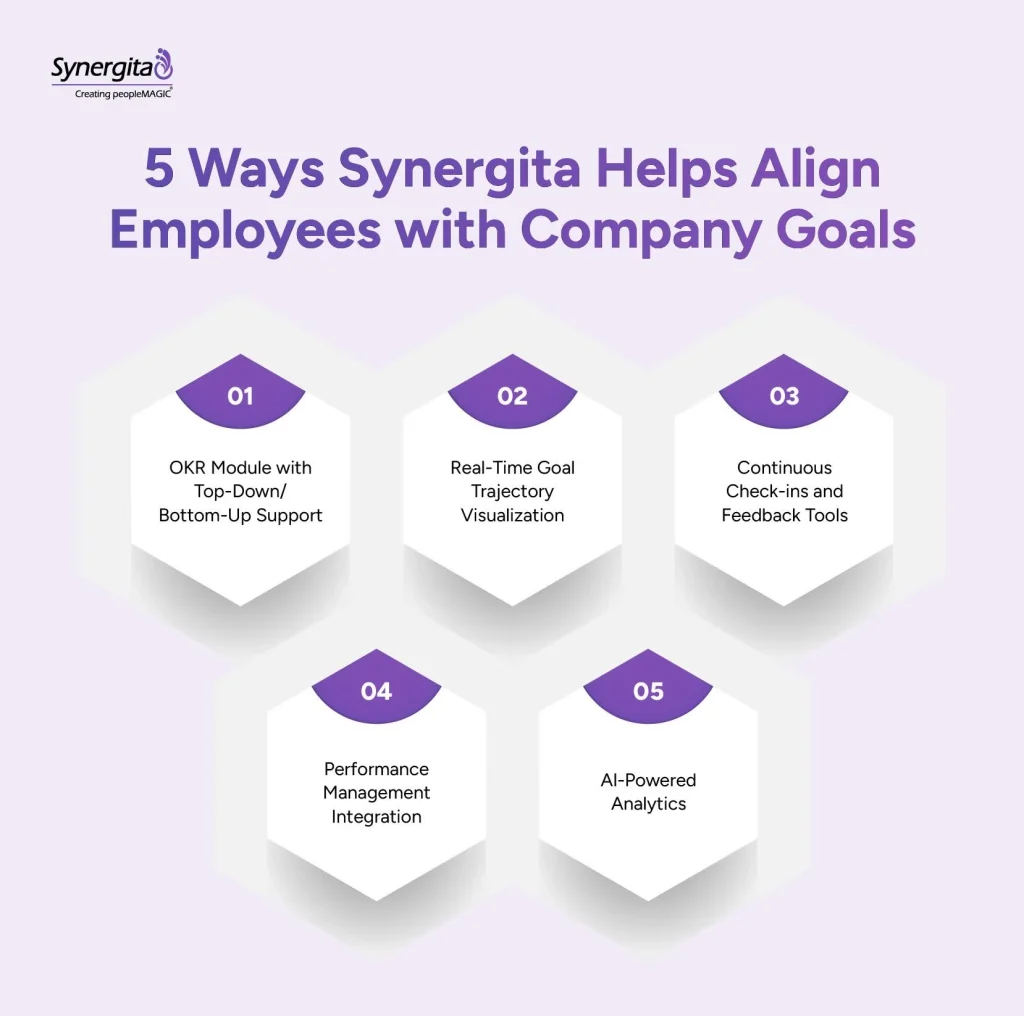
With Synergita, organizations can:
- Set aligned goals: Connect team and individual goals with company objectives.
- Track OKR progress: Monitor key results and identify goals that need attention.
- Conduct regular check-ins: Review progress and address blockers.
- Use progress insights: Analyze goal progress to support informed decisions.
Synergita also offers integrations with tools teams already use, helping organizations incorporate goal tracking into their existing workflows.

Final takeaway
Employee alignment requires a clear understanding of business priorities, realistic expectations, and timely decisions when plans change. If teams are missing targets despite working hard, examine whether competing priorities, unclear ownership, or resource constraints are affecting their progress. Use these findings to refine your goal-setting process and give managers the support they need to guide their teams.
Synergita helps organizations connect company objectives, individual goals, progress tracking, and performance discussions in one platform. This gives leaders better visibility into how work contributes to business outcomes.
Book a demo with Synergita to explore how your organization can build a goal alignment process that supports its strategic priorities.

Frequently asked questions
Cascading goals translate company objectives into team and individual targets, often from the top down. Aligned goals ensure that individual and team priorities support shared business objectives while allowing employees to contribute input.
No. OKRs, SMART goals, and Management by Objectives (MBO) can all support employee alignment, although each framework approaches goal setting and measurement differently.
Organizations should review OKRs at regular intervals throughout the goal cycle. Weekly, biweekly, or monthly check-ins can help teams identify obstacles and adjust their approach as business needs change.
Poor alignment can lead to duplicated work, conflicting priorities, wasted resources, and missed business targets.
Managers should identify the source of disagreement, assess competing priorities and resource constraints, and agree on trade-offs that support the organization’s most important objectives.
Employee goals include increasing sales conversion rates, reducing customer issue resolution time, improving employee onboarding completion, and reducing recruitment time.
Aligning goals means ensuring that individual and team objectives contribute to the organization’s broader business priorities.
Organizations can align compensation with business goals by linking appropriate incentives, bonuses, and pay review criteria to clearly defined business outcomes.