
Many organizations struggle with OKRs not because the framework fails, but because execution weakens after planning. Goals are set and approved, but they are often ignored as the team becomes engaged in daily work. Reviews become irregular, alignment slips, and OKRs become static documents instead of a system that drives outcomes.
Quick Summary
- OKR implementation remains unsuccessful mainly due to skill gaps, weak alignment, vague objectives, and irregular reviews, not because teams resist the framework.
- Successful OKR implementation involves focus on outcomes, clear priorities, and continuous execution rather than one-time planning or task tracking.
- Common challenges in implementing OKRs include too many OKRs, low leadership ownership, and poor cross-team visibility, which dilute focus and slow progress.
- Regular check-ins, stronger OKR capability building, and clear alignment across the company, team, and individual levels are key to making OKRs successful.
Implementing OKRs successfully is one of the biggest challenges organizations face these days.
According to an LSA Global report, teams are 50% less clear than their leaders on the company’s strategy. This indicates a disconnect that affects OKR implementation.
As businesses scale, these OKR challenges, like misaligned goals and activity-based objectives, lead to unsuccessful OKR implementation, wasting time and effort.
So, how to overcome OKR implementation challenges?
In this blog, we will explore the top hurdles to successful OKR implementation, the ways to overcome them, and a quick checklist to avoid common OKR mistakes.
| Table of Contents 1. 8 Common OKR Implementation Challenges and How to Fix Them 2. A Quick Checklist to Avoid Common OKR Mistakes 3. Final Takeaway 4. Frequently Asked Questions |
What Does Successful OKR Implementation Mean?
OKR implementation is not just about writing objectives and key results; it is about executing them consistently, focusing on outcomes, and reviewing progress throughout the cycle.
Effective OKR implementation includes:
- Translating company strategy into clear, outcome-focused objectives
- Aligning team and individual OKRs to shared priorities
- Defining measurable key results that guide decision-making
- Reviewing progress regularly and adjusting when priorities change
When OKRs are implemented well, they act as an effective tool for teams to plan, execute, and course-correct throughout the cycle, rather than a document created once and forgotten.
8 Common OKR Implementation Challenges and How to Fix Them
Here are the most common OKR implementation issues and key tips to solve them effectively.
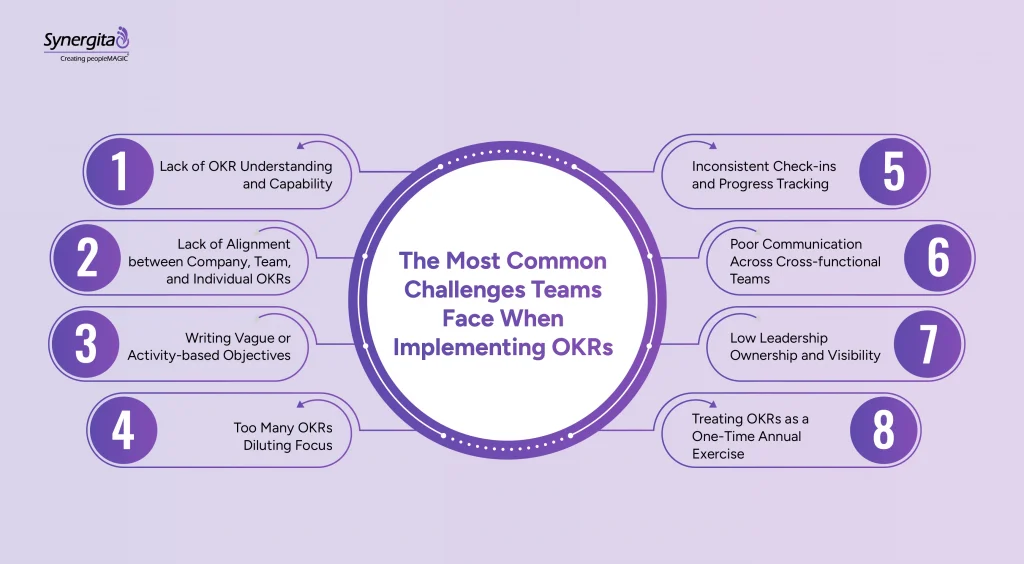
1. Lack of OKR Understanding and Capability
OKR implementations fail in many organizations because teams don’t know how to use OKRs well. When teams are new to the OKR framework, they fall behind on task lists, KPIs, and goals, creating problems from the very first cycle.
How to fix it:
- Train teams to write and implement outcome-based objectives and measurable key results.
- Run guided OKR planning sessions in the first few cycles when rolling out OKRs across the organization.
- Clarify the difference between OKRs, KPIs, and tasks.
Suggested Reading: 5 Step Plan to Roll Out OKRs in Your Organization
2. Lack of Alignment between Company, Team, and Individual OKRs
One of the most common OKR implementation challenges is misalignment across levels. Leadership may define strategic OKRs, but teams translate them independently, resulting in goals that compete rather than reinforce one another. For example, teams may optimize local outcomes that do not contribute to the company’s top priorities.
How to fix it:
- Start OKR planning with company-level objectives and cascade OKRs to the team and individual levels.
- Ask teams to show how their OKRs contribute to business goals explicitly
- Review alignment during planning workshops, not post-approval
3. Writing Vague or Activity-based Objectives
You may set strong objectives, but they may not deliver the desired outcomes unless they are specific and measurable. For instance, objectives like “Improve customer experience” or “Launch new features” sound good, but they don’t drive measurable outcomes.
When objectives focus on activities instead of outcomes, teams struggle to prioritize the right work, make informed decisions, or understand whether they are actually making progress.
How to fix it:
- Frame winning OKR objectives around impact or change, not tasks
- Test objectives by asking what will be different if they succeed
- Ensure key results clearly define measurable outcomes
Suggested Reading: How to Shift from Activities to Outcome
4. Too Many OKRs Diluting Focus
When implementing OKRs, teams often feel the urge to include every priority, especially in early cycles. But when teams have too many objectives, they may not give each one sufficient attention, which can dilute focus.
How to fix it:
- Limit the number of objectives (1–2) per team per cycle
- Remove low-impact OKRs before finalizing the list
- Ensure that OKRs represent priorities, not all work
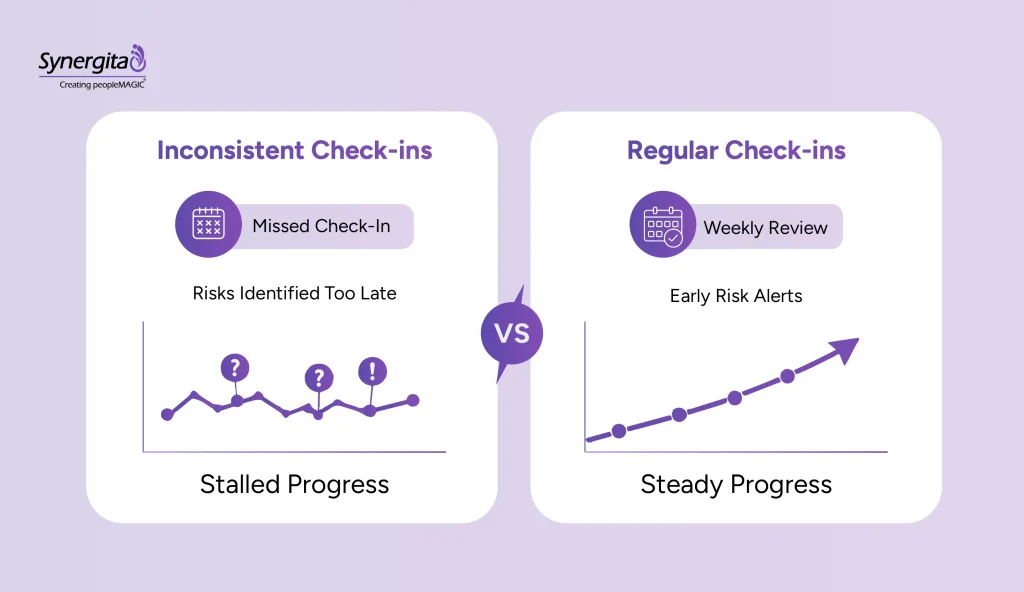
5. Inconsistent Check-ins and Progress Tracking
OKRs break down when progress is reviewed irregularly or only at the end of the cycle. For instance, teams may discover blocked key results too late, leaving no time for course correction and turning OKRs into retrospective reports.
How to fix it:
- Define a fixed weekly or biweekly check-in cadence
- Track progress using simple, consistent status updates
- Use check-ins to identify risks early, not just report completion
6. Low Leadership Ownership and Visibility
OKR implementation stalls when leaders approve OKRs but disengage during execution. If leadership discussions focus only on operational metrics and ignore OKR progress, teams quickly deprioritize goal tracking.
How to fix it:
- Make OKRs part of leadership review meetings
- Encourage leaders to actively sponsor key objectives
7. Poor Communication Across Cross-functional Teams
OKRs can’t be implemented successfully when communication between teams is unclear or unmanaged. Teams may commit to objectives that rely on inputs from others, leading to delays, misaligned expectations, and execution bottlenecks.
How to fix it:
- Identify cross-team dependencies during OKR planning
- Align review cadences for interdependent OKRs
- Ensure shared visibility of objectives across teams
8. Treating OKRs as a One-Time Annual Exercise
Some organizations treat OKRs as a “set it and forget it” activity, defined at the start of the year and rarely revisited. But priorities change quickly, teams evolve, and market conditions shift. When OKRs aren’t reviewed and adjusted along the way, they don’t reflect actual work and weaken focus, accountability, and execution.
How to fix it:
- Run OKRs in shorter, quarterly cycles and conduct retrospectives at the end of each cycle
- Use learnings to refine OKRs for the next iteration
A Quick Checklist to Avoid Common OKR Mistakes
Before implementing OKRs across the organization, use this checklist to identify the early warning signs that often lead to failed or stalled OKR implementations.
- OKRs were introduced without preparing teams for a shift in goal-setting mindset
- OKRs are already tied to performance ratings or compensation
- Teams rarely review what worked and what didn’t at the end of a cycle
- OKR examples were copied from other companies without adapting them to internal realities
- Leaders delegate OKRs but don’t actively review or reference them themselves
Final Takeaway
OKR implementation challenges often arise from unclear goal setting, weak alignment across teams, and irregular progress reviews. When OKRs are reviewed frequently and updated as priorities change, they remain relevant and useful rather than becoming a forgotten exercise.
This is where the right tool makes a difference. Synergita OKR software helps teams structure meaningful OKRs, run regular check-ins, track progress in real time, and stay aligned without spreadsheets or manual follow-ups. It gives leaders the clarity they need while keeping teams focused on outcomes, not activities.
If you want to implement OKRs successfully, explore Synergita OKR. Start your 14-day free trial and see how it simplifies OKR implementation for your organization.

Frequently Asked Questions
OKRs fail when teams don’t regularly review progress, lack ownership, or treat them as documentation rather than a working system that guides weekly priorities and decisions.
Most teams perform best with 1-2 objectives per cycle and 2–3 key results for each objective. Fewer OKRs help teams focus and make progress easier to track.
You should review OKRs at least weekly or biweekly through structured check-ins. Regular reviews help teams stay aligned, spot risks early, and adjust priorities when needed.
OKR software simplifies goal alignment, check-ins, and progress tracking. It reduces manual effort, improves visibility, and helps teams stay consistent throughout the OKR cycle.
Synergita OKR software allows businesses to generate AI-powered OKRs, cascade company OKRs into team and individual goals to ensure everyone works toward shared priorities with clear visibility and alignment.
Yes, Synergita’s OKR management tool is designed for both first-time OKR users and experienced teams, offering guided OKR creation, built-in best practices, and templates to reduce early implementation issues.