
In 2026, the role of executive assistants (EAs) is growing. Rather than just managing calendars and sorting through emails, EAs are now expected to play a key role in driving business efficiency. Yet many of them struggle because traditional task lists and performance reviews don’t tie their effort to measurable business outcomes.
Objectives and Key Results (OKRs) work exceptionally well by filling this gap. In fact, the forecast that the OKR software market will reach $2.98 billion by 2029 reflects the growing adoption of structured goal frameworks across organizations of all sizes.
For leaders evaluating performance frameworks, the question is how to embed them to deliver real impact. Most importantly, does it help in real life? Yes! Decision‑makers who adopt OKRs with clear ownership and measurable outcomes see faster decision cycles.
This article helps you craft OKRs customized for executive assistants, equipping your support function with a measurable approach.
Key Notes
- The OKR software market is forecasted to reach $2.98 billion by 2029, reflecting growing adoption across organizations of all sizes.
- OKRs help executive assistants organize their responsibilities by clarifying what truly matters
- 61% of organizations implement OKRs to enhance cross-team alignment, with an equal 61% seeking direct performance improvement.
- By regularly reviewing and updating OKRs, EAs can adapt to changing priorities and improve their performance over time.
- OKRs build a culture of accountability, ensuring that every action taken is aligned with the organization’s larger objectives.
What OKRs Mean for Executive Assistants?
In 2026, the value of an Executive Assistant is measured by their ability to amplify leadership impact. The OKR framework provides the structure to turn that “invisible” support into visible, measurable business results. It breaks down into two simple parts:
- Objectives: These are qualitative, aspirational goals that describe how you are making the executive or team more effective (e.g., “Transform the Executive’s Schedule into a Strategic Asset”).
- Key Results: These are the specific, quantitative metrics that prove you are succeeding (e.g., “Reduce internal meeting time by 20%” or “Achieve 100% on-time delivery of Board materials”).
By using this framework, EAs move away from simply “clearing the inbox” to intentionally driving organizational success. Instead of being judged on effort, you are evaluated on outcome, connecting your daily hustle to the high-level goals of the leadership team.
As recent research indicates, 61%of organizations leverage this alignment to drive direct performance improvements, ensuring that every role, including the EA, is moving in the same strategic direction.
3 Direct Benefits of OKRs for the Admin Department
OKRs’ benefits are not limited to supporting functions that contribute to organizational priorities. OKRs help EAs demonstrate many measurable impact that resonates with leadership expectations, such as:
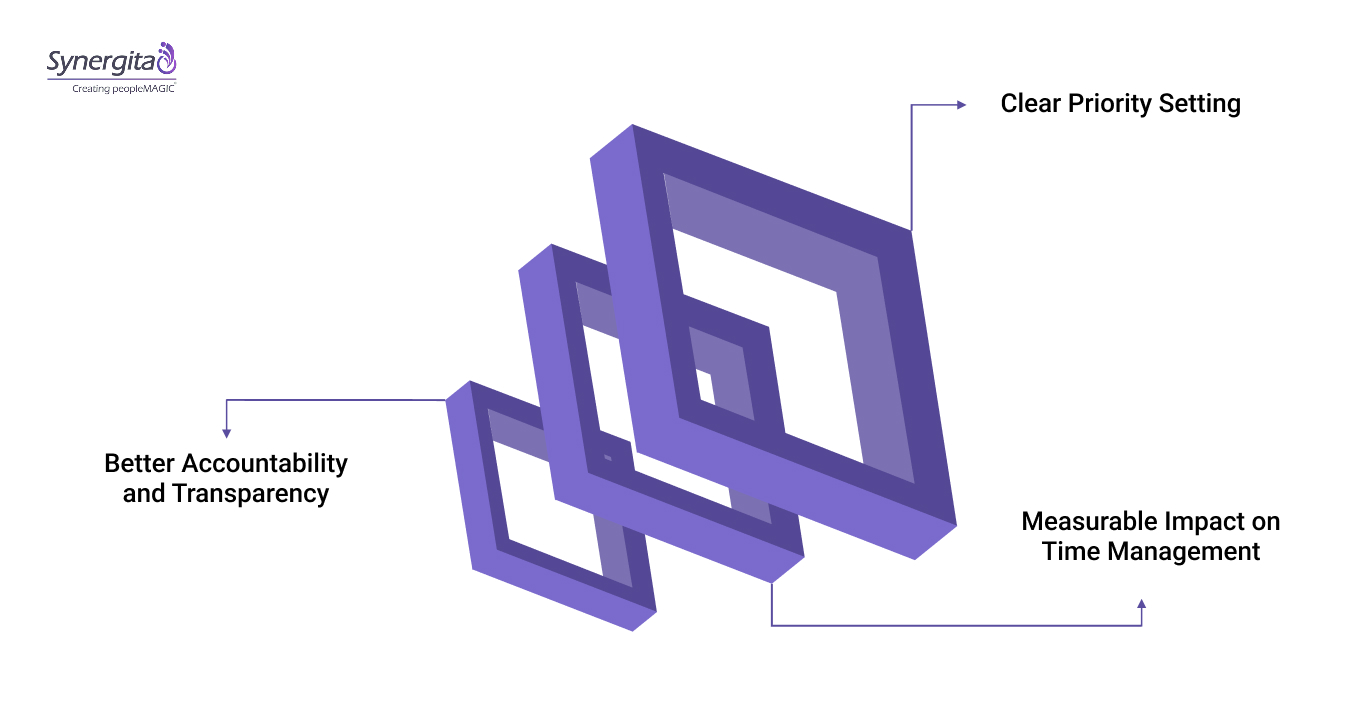
- Better Accountability and Transparency: OKRs clarify ownership. When goals and results are explicit, both the EA and leadership understand expectations upfront, reducing miscommunication.
- Clear Priority Setting: Instead of juggling an endless task list, OKRs force prioritization of what matters most. EAs can focus on outcomes like accelerating decision cycles rather than administrative busywork.
- Measurable Impact on Time Management: Instead of vague objectives like “manage time better,” your team will have SMART goals. It means Specific, Measurable, Achievable, Relevant, and Time-bound goals that OKRs turn time management into a strategic advantage.
If the benefits are significant, how will you decide which OKRs to prioritize? For that, you’ll receive a descriptive overview of OKR examples used by successful EAs.
Also Read: Building a Successful OKR Culture for Teams
10 OKRs for Executive Assistants to Bring Change
You can stop viewing your executive assistant as a cost center. This isn’t about better task management. Ultimately, you need someone who can work as a force multiplier at the core of your operations.
Here are examples of 10 OKRs your admin department’s EAs need:
Objective 1: Enhance the CEO’s Productivity Levels
Key Results:
- Optimize the CEO’s calendar to ensure 95% of time is spent on high-priority tasks.
- Reduce meeting overlap and ensure 90% on-time start for all meetings.
- Minimize time spent on non-strategic tasks, achieving a 20% reduction in time allocated to administrative tasks.
Objective 2: Drive Leadership Team Accountability
Key Results:
- Facilitate and organize 100% of leadership team meetings, ensuring proper agenda management.
- Ensure 95% completion of action items from leadership meetings within agreed timelines.
- Improve leadership team alignment by tracking 90% of strategic decisions made and ensuring follow-up actions are completed on time.
Objective 3: Elevate Board and Stakeholder Communication
Key Results:
- Organize quarterly board meetings with a 100% on-time execution rate.
- Enhance board communication efficiency by ensuring 95% follow-up on key meeting outcomes.
- Improve stakeholder engagement through timely and comprehensive reporting, achieving a 90% satisfaction rate in post-meeting feedback.
Objective 4: Improve Cross-Functional Collaboration for Leadership Success
Key Results:
- Facilitate cross-departmental collaborations between leadership and key teams, achieving 100% of scheduled meetings.
- Track and ensure 90% follow-through on action items resulting from cross-functional meetings.
- Achieve a 95% collaboration success rate, as measured by feedback from internal stakeholders.
Many executive assistants spend a disproportionate amount of time on administrative tasks between teams. These administrative delays can lead to lost time and opportunities for leadership teams.
By adopting Synergita’s OKR tools, EAs can easily create organized workflows and track key administrative tasks in real-time. The system’s integration with collaboration tools like Microsoft Teams and Slack ensures that all team members stay aligned.
Objective 5: Drive Operational Efficiency in Leadership Support Functions
Key Results:
- Organize document management systems to ensure 90% efficiency in accessing critical information.
- Implement systems that reduce internal meeting time by 15%, ensuring more strategic focus.
- Achieve 95% on-time completion of all executive-level administrative tasks, ensuring no delays in leadership processes.
Objective 6: Enhance Leadership’s Decision-Making Efficiency
Key Results:
- Optimize the process for gathering executive team inputs, reducing decision-making time by 25%.
- Ensure 100% preparation for all executive meetings, providing executives with all required materials 48 hours prior.
- Improve the decision cycle by tracking 95% of the required action items and outcomes for future decisions.
Objective 7: Strengthen the CEO and Leadership Team’s Stakeholder Relations
Key Results:
- Coordinate 100% of the CEO’s external communications, ensuring 90% of them are aligned with organizational priorities.
- Ensure timely follow-up with key stakeholders, achieving 95% positive feedback on communication and relationship-building efforts.
- Achieve a 10% increase in stakeholder engagement as measured by meeting attendance and feedback.
Even when meetings are productive, EAs may find it challenging to track and follow through on action items. This leads to missed deadlines, reduced accountability, and poor alignment across teams.
Synergita helps solve these challenges by allowing EAs to schedule and track meetings with a clear focus on actionable outcomes. With real-time task tracking, EAs can ensure 95% completion of action items post-meeting, while automated reminders and follow-up prompts guarantee timely execution.
Objective 8: Manage Confidential Information and Critical Documentation
Key Results:
- Ensure 100% accuracy in handling confidential information, with no security breaches.
- Implement a document management system that reduces retrieval time by 25%.
- Maintain a 100% on-time record for preparing executive-level confidential reports and presentations.
Objective 9: Elevate Executive Performance Through Strategic Time Management
Key Results:
- Optimize the CEO’s calendar by prioritizing 80% of meetings related to high-impact decisions.
- Reduce time spent on non-strategic tasks by 25% through improved delegation and task management.
- Ensure 95% of executive time is focused on high-priority business activities.
Objective 10: Facilitate Knowledge Sharing
Key Results:
- Coordinate 100% of leadership development activities, such as training sessions or mentoring programs.
- Ensure 85% of executives participate in bi-monthly knowledge-sharing sessions.
- Organize 90% of team-wide initiatives that promote cross-functional learning, enhancing team synergy.
By following these examples, EAs can contribute to the organization’s overall success. However, you always need to follow a few best practices to apply these in the real world.
Also Read: OKR Best Practices 2026: Tips to Set and Achieve Better Goals
3 Best Practices for Setting OKRs for Executive Assistants
Setting effective OKRs (Objectives and Key Results) for executive assistants (EAs) is essential to ensure they contribute meaningfully to organizational success.
By aligning their objectives with company priorities and setting measurable goals, EAs can improve accountability and stay focused on high-priority tasks. Here are some best practices for setting successful OKRs for EAs:
1. Align OKRs with Organizational Goals
Ensure that the EA’s objectives align with broader organizational goals to maintain a clear connection between individual tasks and company priorities. This alignment ensures the EA’s work contributes to the business’s larger success.
2. Set Achievable and Measurable Key Results
Define key results that are clear, quantifiable, and easy to track. Measurable key results provide a tangible way to assess progress, such as reducing scheduling conflicts by 30% or increasing meeting attendance by 10%.
3. Track Progress and Adapt
Continuously monitor progress toward achieving the set OKRs. Provide regular updates and be flexible enough to adjust objectives as needed based on shifting business priorities or challenges.
By implementing these best practices, your EA could deliver the expected result. To make their work smoother, an OKR management platform, Synergita, works best.
How Does Synergita Help in Achieving EA OKRs?
Synergita offers an intuitive platform that simplifies OKR tracking for executive assistants and the admin department. By automating routine tasks, Synergita enables best practices among its EAs to focus on strategic objectives such as:
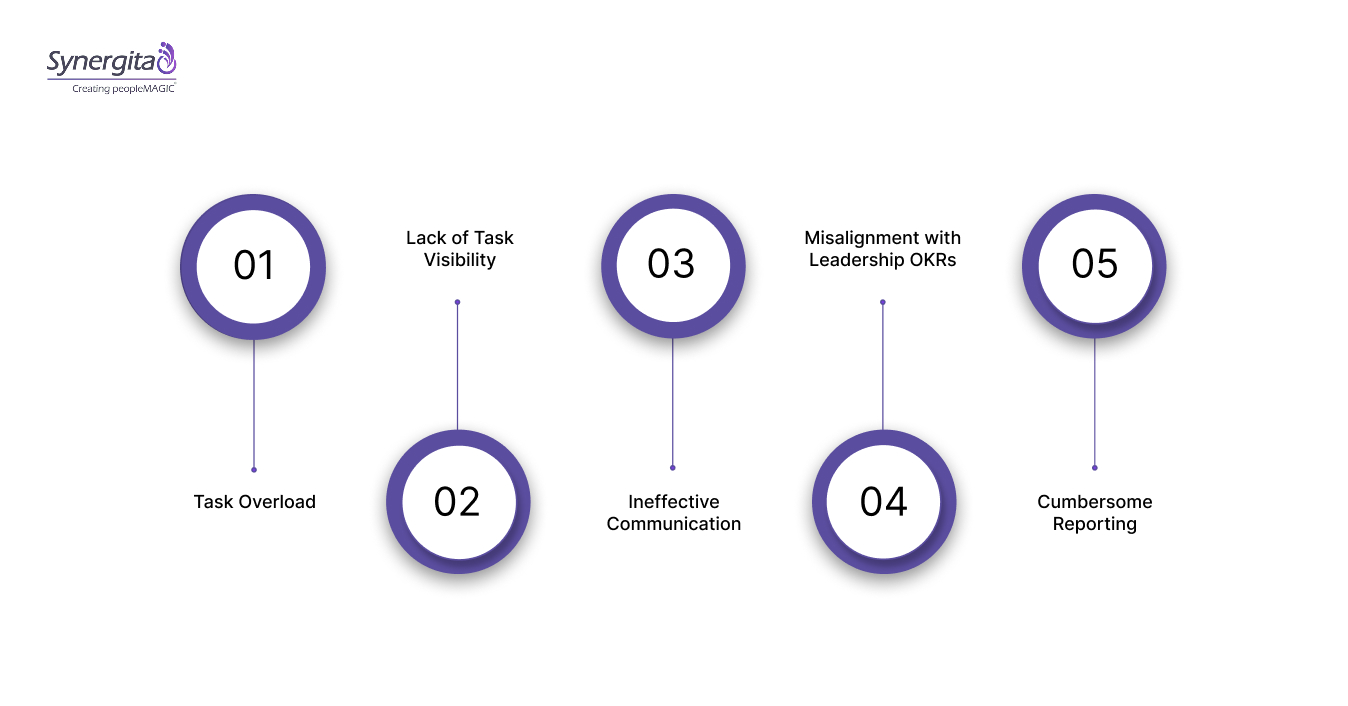
- Task Overload: EAs often juggle multiple responsibilities without a clear system for prioritization. Synergita’s visual goal cascading ensures every objective is linked directly to company-wide goals, making it easy for EAs.
- Lack of Task Visibility: EAs often struggle to keep track of progress and ensure deadlines are met. Synergita’s real-time dashboards provide up-to-date visibility, enabling EAs to monitor task progress and make adjustments quickly.
- Ineffective Communication: Misalignment between leadership teams and EAs often leads to confusion or missed opportunities. Automated notifications and reminders in Synergita keep everyone aligned, ensuring EAs and leadership are always on the same page without extra effort.
- Misalignment with Leadership OKRs: Ensuring EA objectives align with broader organizational goals can be a challenge without an effective system. Synergita’s AI-Chatbot: OKR Buddy ensures EAs’ OKRs are aligned with leadership goals, enabling better strategic alignment.
- Cumbersome Reporting: Gathering and reporting OKR progress from various teams is time-consuming and prone to errors. Synergita’s automated reporting tools generate real-time progress updates, providing accurate insights into OKR performance.
Explore how Synergita’s OKR tracking can support your executive assistant’s role in driving alignment across your organization. Book a demo with Synergita’s team to find out how it’s the best fit for your team.
Read Also: The Purpose of OKRs in the Workplace
Drive the Best Impact From Your Executive Assistant Today
Traditional methods fail to provide clear connections between daily responsibilities and the company’s strategic goals. This lack of clarity leads to inefficient time management and difficulty demonstrating measurable impact on the business.
Synergita’s OKR platform transforms how Executive Assistants work by providing a clear structure for goal setting with leadership priorities. With real-time tracking and integrated workflows, Synergita ensures every action is tied to an impactful result.
Learn how Synergita can help track and align their OKRs with leadership goals, boosting productivity and efficiency.
FAQs
1. How do OKRs help in prioritizing tasks for executive assistants?
OKRs allow executive assistants to focus on the most impactful tasks by breaking down high-level goals into actionable, measurable results. This helps eliminate distractions and ensures EAs prioritize activities that align with leadership priorities.
2. What challenges do Executive Assistants face when implementing OKRs?
EAs may initially struggle with setting clear, measurable goals that align with leadership expectations. Overcoming these challenges requires defining realistic objectives and ensuring regular feedback loops to keep track of progress accordingly.
3. How can admins ensure alignment with broader company objectives?
EAs can ensure alignment by regularly reviewing the company’s goals and adjusting their OKRs accordingly. Close collaboration with leadership is key to understanding key priorities and aligning daily responsibilities with overarching company strategies.
4. What role do OKRs play in enhancing leadership support for executive assistants?
OKRs provide a structured way for EAs to track and demonstrate their contributions to leadership success. By aligning tasks with leadership objectives, EAs enhance their productivity and build stronger relationships with executives by showing a clear impact.
5. How do OKRs drive long-term professional growth for your team?
OKRs promote continuous learning and development by challenging EAs to set ambitious yet achievable goals. This growth mindset helps them develop new skills, improve their problem-solving abilities, and increase their value within the organization.