
Do your people initiatives look strong on paper, but teams still feel misaligned? Many HR teams face this challenge. Employees stay busy, managers push priorities, yet confusion around goals and expectations continues to slow execution.
Research shows that only about 48% of employees clearly understand an organization’s goals. At the same time, organizations with aligned teams are more than twice as likely to outperform their peers. The gap is not effort. It’s alignment.
As an HR leader, you sit at the center of this problem. You design engagement programs, performance frameworks, and learning initiatives, but impact often feels uneven across teams. Without a shared way to align people’s goals with business priorities, even well-intentioned HR efforts lose momentum.
This is where OKRs can help. When used correctly, OKRs give HR teams a practical way to connect strategy to people, clarify expectations, and create alignment without adding bureaucracy.
In this guide, you’ll learn how HR teams can leverage OKRs for better workforce alignment to bring clarity, focus, and stronger workforce alignment across the organization.
At a Glance
- Workforce misalignment often comes from unclear priorities, inconsistent management, and hard-to-measure HR impact.
- HR initiatives lose momentum when they run in parallel instead of toward shared goals.
- OKRs help HR translate strategy into clear people priorities and measurable outcomes.
- When used correctly, OKRs improve manager consistency, engagement, and accountability.
- HR teams should keep OKRs separate from performance ratings to avoid fear.
- Starting small and reviewing progress regularly makes alignment sustainable.
Why Workforce Alignment is a Challenge for HR Teams?
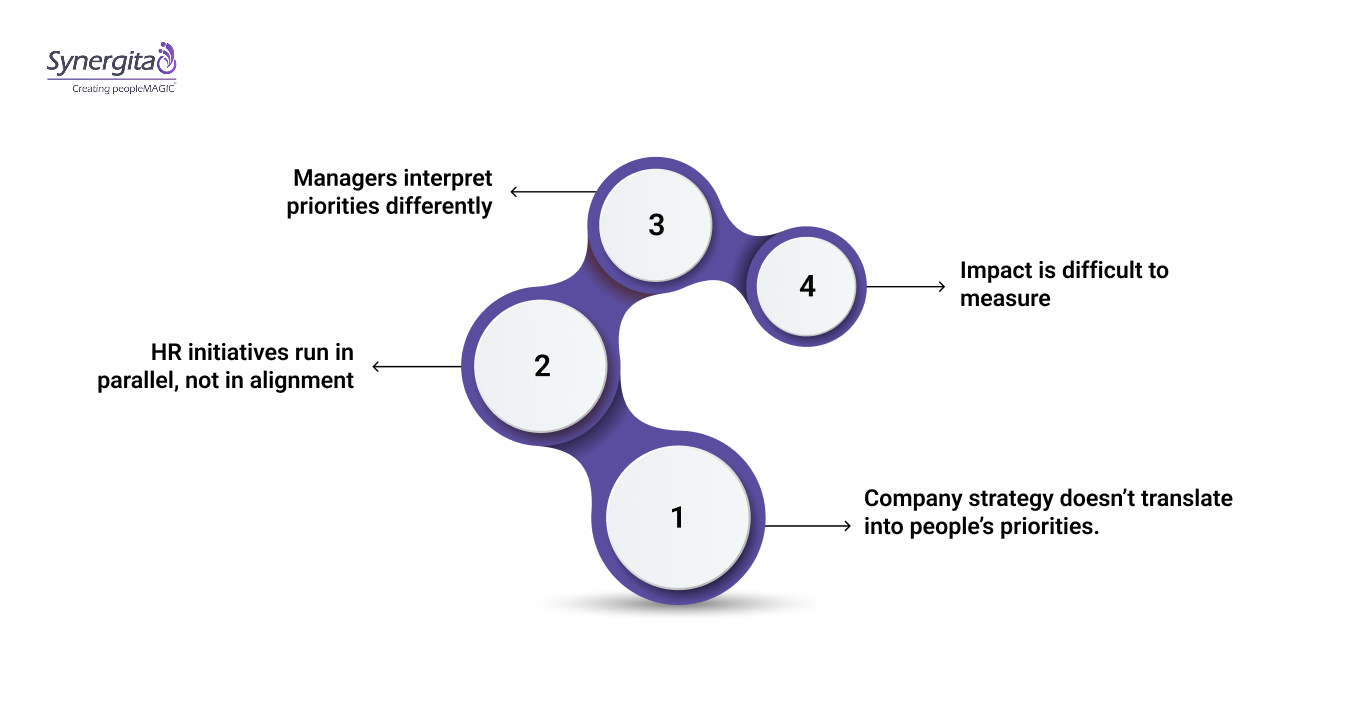
Workforce alignment rarely breaks because of lack of effort. It breaks because priorities get lost as strategy moves from leadership to teams. HR teams often feel this gap most clearly.
1. Company strategy doesn’t translate into people’s priorities.
Leadership sets strategic goals, but those goals often remain abstract for employees. You may communicate strategy through town halls or decks, yet people still struggle to see how their daily work supports it. When priorities feel distant or unclear, employees make their own interpretations. Alignment weakens, even though everyone is working hard.
2. HR initiatives run in parallel, not in alignment
HR teams manage multiple programs at once, such as engagement, performance, learning, and well-being. These initiatives often run side by side without a shared direction. Without a unifying framework, teams see HR efforts as separate activities instead of parts of a larger goal. This limits their overall impact.
3. Managers interpret priorities differently
Managers play a key role in reinforcing alignment, but they don’t always interpret priorities the same way. One manager may emphasize speed, another quality, and another engagement. This inconsistency creates confusion across teams. Employees receive mixed signals about what matters most, and alignment breaks at the team level.
4. Impact is difficult to measure
HR teams track activity, such as program participation or completion rates. What’s harder to measure is whether these efforts improve alignment, engagement, or performance. When impact isn’t clear, it’s difficult to adjust or improve. Alignment becomes an intention rather than a measurable outcome.
Must Read: Essential OKR Dashboard Examples for Goal Tracking
How Do OKRs Help HR Teams Improve Workforce Alignment?
OKRs give HR a practical way to turn alignment into something visible and measurable. Instead of relying on broad messaging and disconnected initiatives, you create shared priorities that teams can track and act on.
1. Translate strategy into people’s priorities
Company strategy often feels abstract at the employee level. OKRs help you break strategic goals into clear objectives that teams can understand and support.
When people can see the “why” behind their work, decisions become easier, and alignment improves across roles and departments.
2. Connect HR initiatives to business outcomes
HR programs work best when they link to real outcomes, not just participation. OKRs help you tie initiatives like manager development, engagement efforts, and learning programs to measurable results.
This keeps HR efforts focused on impact and makes it easier to show progress to leadership.
3. Create consistency in how managers set priorities
Managers often interpret priorities differently, which leads to mixed signals for employees. OKRs create a common structure for setting goals and tracking results.
When managers use the same framework, teams get clearer direction, and alignment becomes more consistent across the organization.
4. Make alignment measurable and easier to improve
Alignment problems often stay invisible until performance drops or engagement declines. OKRs bring early signals by tracking progress through regular check-ins and measurable key results.
This helps you identify what’s working, where alignment breaks down, and what needs to change before issues spread.
How HR Teams Can Use OKRs Across Key Focus Areas
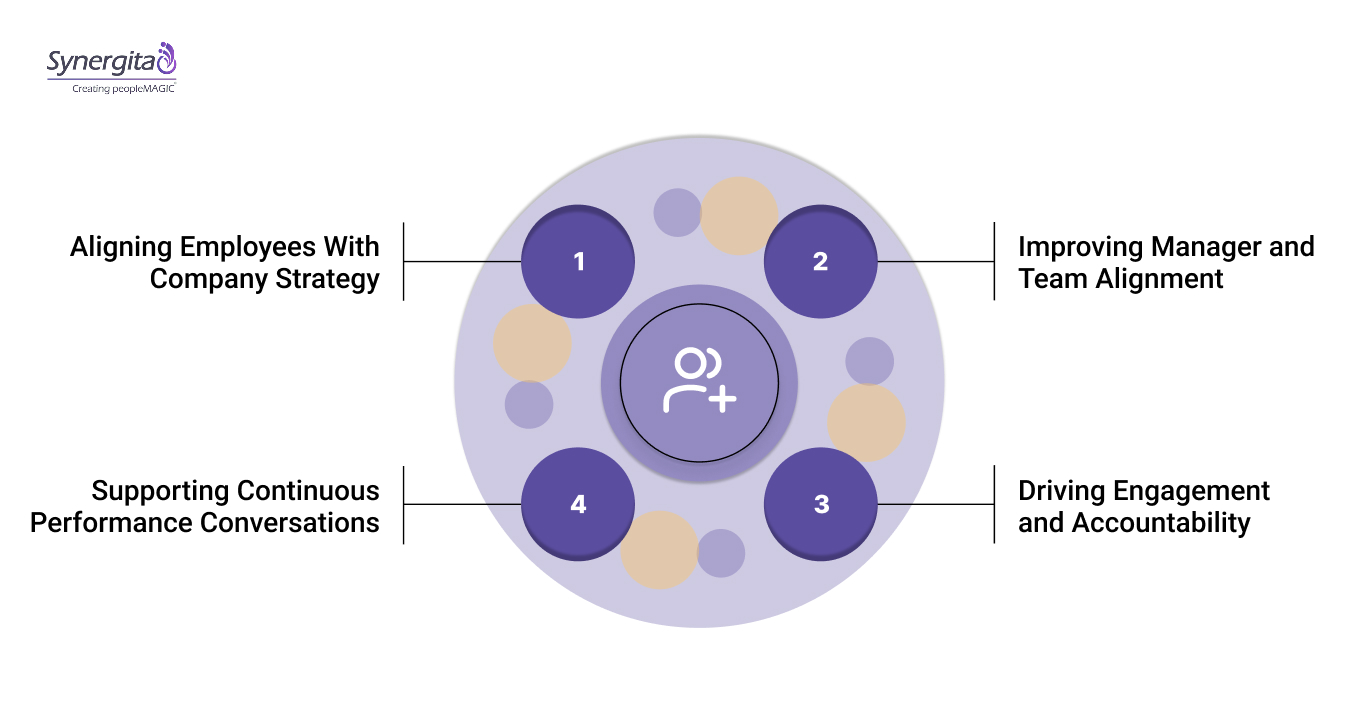
HR teams get the most value from OKRs when they apply them across the areas that directly influence alignment. Instead of treating OKRs as a standalone framework, you use them to bring consistency to how people’s priorities are set, communicated, and reinforced.
1. Aligning Employees With Company Strategy
Employees often hear about strategy, but they don’t always see how it applies to their role. OKRs help you translate high-level goals into clear, people-focused objectives.
When employees can connect their work to company priorities, decision-making improves, and effort becomes more focused. Alignment stops being a message and becomes something teams can act on every day.
2. Improving Manager and Team Alignment
Managers play a critical role in reinforcing priorities, yet alignment often breaks at this level. OKRs give managers a shared structure for setting goals and reviewing progress.
When managers use the same framework, teams receive consistent signals about what matters. This reduces confusion and helps HR create alignment across departments without micromanaging.
3. Driving Engagement and Accountability
Engagement improves when expectations are clear, and progress is visible. OKRs help you define what success looks like and who owns it.
By focusing on outcomes rather than activity, teams feel accountable for results without feeling controlled. This balance strengthens ownership and keeps engagement tied to meaningful work.
4. Supporting Continuous Performance Conversations
Performance discussions often happen too late or focus only on outcomes. OKRs encourage regular check-ins that keep conversations timely and constructive.
These ongoing discussions help managers and employees adjust priorities, address challenges early, and stay aligned throughout the cycle. Over time, performance conversations become more about progress and learning than evaluation.
Must Read: How to Improve Employee Performance: Effective Strategies
Practical OKR Examples for HR Teams
These examples show how HR teams can use OKRs to improve alignment without turning them into performance scores.
Each example focuses on clarity, ownership, and measurable outcomes that support both people and business priorities.
1. Improve Employee Understanding of Company Priorities
Employees often hear strategy, but don’t internalize it. Misunderstanding leads to misaligned effort.
This OKR helps HR ensure employees clearly understand what the organization is trying to achieve and how their roles contribute. By measuring understanding through surveys or feedback loops, you can move beyond communication efforts and focus on actual clarity and alignment.
- Objective: Ensure employees clearly understand company priorities and how their work contributes.
- Key Result 1: Achieve 85% positive responses to “I understand company priorities” in employee surveys.
- Key Result 2: Ensure 90% of teams can articulate how their goals align with company objectives.
- Key Result 3: Reduce misaligned or duplicate team goals by 30%.
2. Strengthen Manager Effectiveness in Goal Alignment
Managers translate strategy into daily direction. When that translation breaks, alignment breaks.
This OKR focuses on helping managers set and reinforce clear, aligned goals for their teams. By improving manager capability and consistency, HR can reduce mixed signals and ensure priorities are reinforced the same way across teams.
- Objective: Improve managers’ ability to translate strategy into clear team goals.
- Key Result 1: Train 100% of people managers on goal-setting and alignment practices.
- Key Result 2: Increase manager effectiveness scores related to goal clarity by 20%.
- Key Result 3: Reduce goal misalignment escalations by 30%.
3. Improve Cross-Team Collaboration and Clarity
Work often slows down between teams, not within them. Lack of clarity creates friction and delays.
This OKR helps HR address alignment gaps across departments. By improving shared goals and collaboration clarity, teams understand how their work connects with others. This reduces rework, confusion, and unnecessary escalation.
- Objective: Reduce friction and delays caused by unclear cross-team priorities.
- Key Result 1: Define shared goals for 100% of cross-functional initiatives.
- Key Result 2: Reduce cross-team rework caused by misalignment by 30%.
- Key Result 3: Improve cross-team collaboration scores by 20%.
4. Increase Engagement Through Clear Expectations
Engagement drops when expectations feel vague or unfair. Clarity builds trust and ownership.
This OKR focuses on improving engagement by making expectations explicit and measurable. When employees know what success looks like and how progress is tracked, motivation improves, and accountability feels fair instead of enforced.
- Objective: Improve employee engagement by clarifying expectations and success criteria.
- Key Result 1: Increase engagement survey scores related to role clarity by 15%.
- Key Result 2: Ensure 95% of employees have clearly defined goals.
- Key Result 3: Reduce role-related confusion issues raised to HR by 30%.
5. Improve Adoption of Continuous Feedback Practices
Annual reviews arrive too late to correct course. Regular feedback keeps alignment on track.
This OKR encourages a shift from episodic reviews to ongoing conversations. By increasing adoption of regular feedback and check-ins, HR helps teams address issues early and maintain alignment throughout the cycle.
- Objective: Shift from annual reviews to ongoing feedback and alignment.
- Key Result 1: Ensure 80% of employees receive monthly feedback check-ins.
- Key Result 2: Increase usage of continuous feedback tools by 40%.
- Key Result 3: Reduce end-of-cycle performance surprises by 30%.
6. Align Learning and Development With Business Needs
Training often happens without clear purpose. Alignment turns learning into impact.
This OKR ensures learning initiatives support actual business priorities. By tying development programs to skill gaps and strategic needs, HR helps employees grow in ways that directly support organizational goals.
- Objective: Ensure learning programs directly support strategic skill gaps.
- Key Result 1: Identify and prioritize top 5 critical skill gaps.
- Key Result 2: Align 80% of learning programs to business-critical skills.
- Key Result 3: Improve post-training skill application scores by 20%.
7. Improve Goal Clarity Across the Organization
Unclear or inconsistently written goals create confusion and dilute focus.
This OKR helps HR improve the quality and consistency of goals across teams. By standardizing how goals are written and reviewed, employees can better understand expectations and how success is measured.
- Objective: Increase clarity and consistency in how goals are defined and communicated.
- Key Result 1: Ensure 100% of teams document goals using a standard format
- Key Result 2: Reduce goal clarification questions by 25%
- Key Result 3: Achieve a 90% goal clarity score in quarterly pulse surveys
8. Strengthen Accountability Without Increasing Pressure
Accountability should enable ownership, not create fear or micromanagement.
This OKR focuses on making accountability visible while maintaining psychological safety. Clear ownership helps teams move faster without turning goals into performance scores.
- Objective: Improve ownership and accountability while preserving psychological safety.
- Key Result 1: Define owners for 100% of shared or cross-team goals
- Key Result 2: Reduce ownership-related escalations by 25%
- Key Result 3: Increase employee agreement with “Accountability feels fair” by 20%
9. Improve Career Path and Growth Clarity
Unclear growth paths weaken motivation and retention.
This OKR helps HR provide employees with a clearer view of career progression and development expectations. Clear paths support engagement and long-term retention.
- Objective: Help employees understand career paths and growth expectations.
- Key Result 1: Document career paths for 100% of key roles
- Key Result 2: Increase employee clarity on career progression by 25%
- Key Result 3: Reduce career-related attrition by 15%
10. Improve Visibility Into People and Alignment Metrics
Without visibility, alignment issues go unnoticed until they affect performance.
This OKR ensures HR and leaders have access to meaningful people and alignment data. Better visibility supports faster, more informed decisions.
- Objective: Make people and alignment data visible and actionable.
- Key Result 1: Define and track 5 core people and alignment metrics
- Key Result 2: Publish quarterly people and alignment dashboards
- Key Result 3: Reduce manual HR reporting effort by 40%
Now that we have seen all the OKR examples for HR teams, let us take a look at how OKRs are implemented.
How HR Teams Should Implement OKRs Without Creating Fear?
OKRs can strengthen alignment, but only if employees feel safe using them. When OKRs are misunderstood or positioned as evaluation tools, fear replaces trust. HR teams play a key role in setting the right tone from the start.
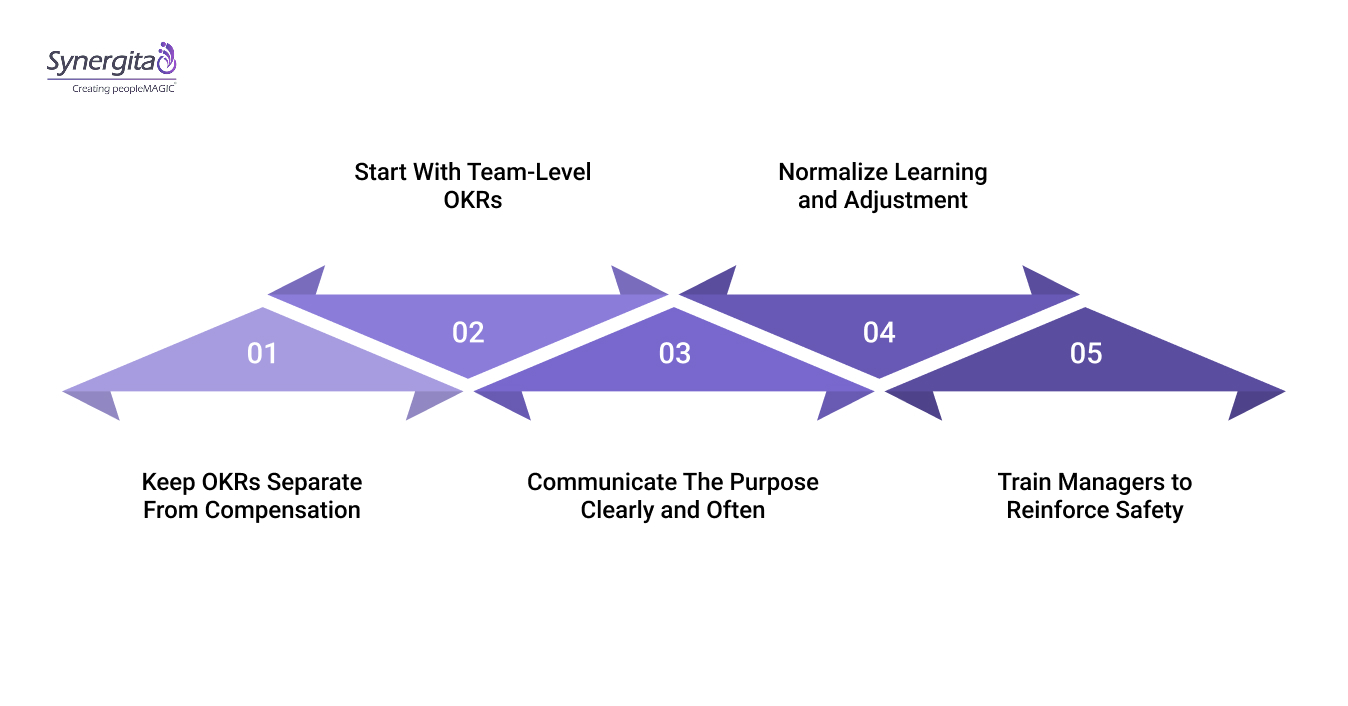
1. Keep OKRs Separate From Compensation and Ratings
OKRs should not determine pay, promotions, or performance scores. When people believe their rewards depend on OKR scores, they set safe goals and avoid honest reporting.
You create psychological safety by clearly separating OKRs from appraisal and compensation processes. This encourages ambition and learning instead of risk avoidance.
2. Start With Team-Level OKRs Before Individual Ones
Rolling out individual OKRs too early can feel personal and threatening. Begin with team-level objectives so employees focus on shared outcomes.
Once teams are comfortable using OKRs, you can gradually introduce individual goals where they add value. This phased approach builds confidence and trust.
3. Communicate The Purpose Clearly and Often
Fear grows when expectations are unclear. HR should explain why OKRs exist and how they help teams align, not monitor.
Reinforce the message that OKRs are tools for clarity and improvement. Repeating this consistently helps reduce skepticism and resistance.
4. Normalize Learning and Adjustment
Not every objective will be fully achieved. That’s expected. OKRs work best when teams treat misses as learning opportunities, not failures.
Encourage open conversations about what worked, what didn’t, and what needs to change. This keeps OKRs focused on progress instead of judgment.
5. Train Managers to Reinforce Safety
Managers shape how OKRs feel day to day. If managers use OKRs to pressure teams, fear spreads quickly.
Equip managers to use OKRs as coaching tools. When managers focus on support and clarity, employees engage more openly, and alignment improves.
Must Read: Most Common Mistakes and Errors Made in Performance Appraisals
Common Mistakes HR Teams Make With OKRs
OKRs can improve workforce alignment, but only when HR teams apply them with the right intent. Most problems arise not from the framework itself, but from how it is introduced and used.
1. Treating OKRs as a Performance Evaluation Tool
One of the biggest mistakes is using OKRs to judge individual performance. When employees feel OKRs affect ratings or compensation, they become cautious and set low-impact goals.
OKRs work best as alignment and learning tools. Performance management should remain separate, so teams feel safe setting ambitious objectives.
2. Rolling Out Too Many Objectives at Once
HR teams often try to cover every initiative with OKRs. This overwhelms managers and employees and weakens focus.
Limiting OKRs to a small number of high-impact objectives keeps alignment clear and execution realistic.
3. Writing Vague or Activity-Based Key Results
Key results like “launch engagement program” or “conduct training sessions” track effort, not outcomes.
When key results don’t measure change, HR teams struggle to show impact. Focus on measurable improvements such as clarity, adoption, or behavior change.
4. Using Okrs Solely As a Top-Down Communication Tool is Ineffective
OKRs fail when they are pushed down without discussion. Alignment requires participation, not just visibility.
HR teams should encourage dialog and refinement so teams understand and commit to shared goals.
5. Reviewing OKRs Only During Appraisal or Annual Cycles
Alignment issues surface long before review season. Waiting too long removes the opportunity to adjust.
Regular check-ins help HR spot misalignment early and support managers before problems grow.
Conclusion
Workforce alignment doesn’t improve through more communication or more programs. It improves when priorities are clear, ownership is visible, and progress is reviewed consistently. For HR teams, this is where OKRs make a real difference.
When used correctly, OKRs help you translate strategy into people priorities, bring consistency across managers, and connect HR initiatives to measurable outcomes. They replace assumptions with clarity and help teams focus on what truly matters, without adding fear or bureaucracy.
The key is intent and execution. Start small, keep OKRs separate from evaluations, and focus on learning over perfection. When HR leads OKRs with the right mindset, alignment becomes a shared responsibility across the organization.
See how HR teams use Synergita to align people, priorities, and outcomes without turning goals into performance scores. Book a demo today.
FAQs
1. Are OKRs suitable for HR teams?
Yes. OKRs work well for HR teams when they focus on alignment and outcomes, not evaluation. You can use OKRs to clarify people’s priorities, align managers, and measure the impact of HR initiatives without turning them into performance scores.
2. Should HR teams set OKRs for individual employees?
Start with team-level OKRs first. Teams should establish trust and feel comfortable with the framework before implementing individual OKRs. Many HR teams use OKRs to guide collaboration and functional alignment rather than individual performance tracking.
3. How do OKRs differ from HR goals or KPIs?
HR goals and KPIs often track ongoing activities like participation or completion. OKRs focus on what needs to change within a defined period. You use KPIs to monitor stability and OKRs to drive improvement and alignment.
4. How often should HR teams review OKRs?
Monthly or quarterly reviews work well for HR teams. These check-ins help you assess alignment, identify gaps early, and adjust initiatives before issues spread. Avoid limiting reviews to appraisal or annual planning cycles.