
Disjointed feedback and subjective scoring cause high turnover and leadership stagnation within your senior management ranks. You cannot build a high-performing culture when managers receive vague praise or outdated annual critiques from their superiors.
Leaders require a structured roadmap that connects their daily actions to the long-term strategic success of the business. Relying on gut feelings leads to inconsistent performance and a lack of accountability across your entire management layer.
Only 2 in 10 employees say their performance is managed in a way that motivates them to do outstanding work.
This guide provides a comprehensive performance evaluation template for managers to ensure objective, data-backed leadership growth.
Quick Look
- Focus on leading indicators: Track team retention and employee growth rather than just hitting basic revenue targets.
- Adopt continuous feedback: Replace annual surprises with a monthly or quarterly cadence to drive real-time leadership improvement.
- Utilize BARS scales: Use Behaviorally Anchored Rating Scales to remove subjective bias from your managerial review process.
- Integrate 360-degree data: Gain a complete view of a manager’s cultural impact through anonymous peer and subordinate insights.
What is Performance Evaluation?
A performance evaluation is a formal, structured process for assessing an employee’s work contributions and developmental progress. For leaders, it focuses on strategic output, team management efficacy, and adherence to core company values.
It serves as a diagnostic tool to identify skill gaps and provide a roadmap for future leadership responsibilities. This process ensures that individual efforts directly support the broader business objectives and cultural standards of the organization.
Defining these metrics is the first step toward building a more transparent and results-oriented management culture.
Also read: How to Give Constructive Feedback to Employees
Why Standardizing Performance Evaluation Template for Managers Is Important
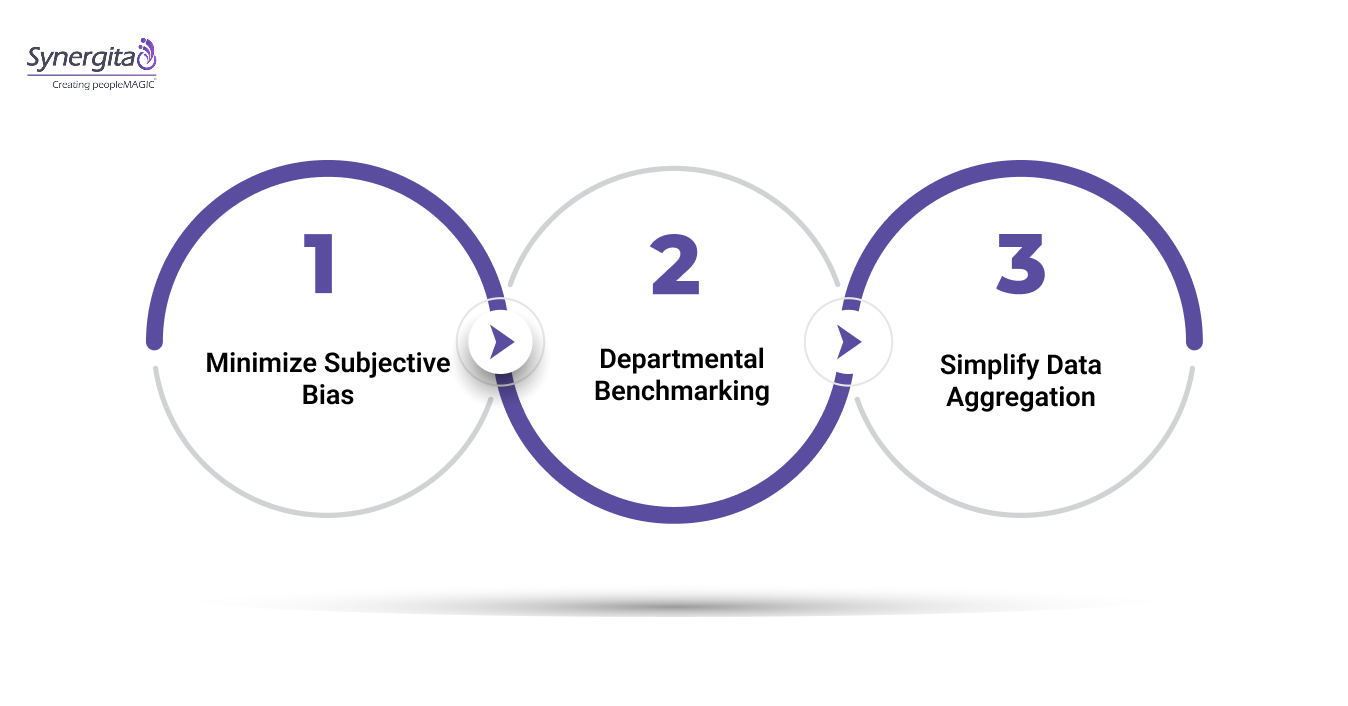
Standardized templates eliminate the risk of departmental bias and ensure every leader meets the same excellence bar. You create a fair environment where meritocracy thrives, and career paths become transparent across the entire organization.
Use these strategies to create a consistent evaluation framework for your leadership team:
1. Minimize Subjective Bias
Standardized templates force reviewers to use specific benchmarks rather than relying on personal feelings or recency. This creates a legally defensible and ethically sound review process for all management levels. It ensures that every leader is judged on the same objective criteria across different teams.
2. Enable Cross-Departmental Benchmarking
Unified forms allow HR to compare leadership efficacy across disparate functions like marketing and engineering. You can identify which managers excel at development and which need more support in strategic alignment. This data drives more informed decisions regarding promotions and internal leadership rotations.
3. Simplify Data Aggregation
Consistent data points make it easier for HR teams to track organizational health trends over several cycles. You can visualize improvements in management quality and correlate them with overall business performance metrics. This systematic approach saves time during the end-of-year reporting and succession planning phases.
Institutionalizing these standards ensures that your leadership reviews remain objective and focused on high-level growth.
Stop struggling with inconsistent review formats and subjective feedback that stalls leadership growth. Book a demo to see how Synergita provides the standardized, data-backed performance evaluation template for managers you need to build a fair and high-performing culture.
The Core Components of a High-Impact Managerial Evaluation
An effective managerial review must balance hard business outcomes with the soft skills required to inspire a workforce. High-impact evaluations look beyond simple profit and loss statements to assess the manager’s long-term institutional value.
Include these fundamental categories in your managerial review process to ensure a holistic assessment:
1. Strategic Goal Achievement
Assess how well the manager translates high-level company objectives into actionable team results and measurable outcomes. This component evaluates their ability to prioritize tasks that contribute directly to the organizational bottom line. It focuses on the successful completion of quarterly OKRs and annual department targets.
2. People Development Efficacy
Measure the manager’s ability to coach subordinates, reduce turnover, and build a sustainable talent pipeline for the future. A leader’s success is largely defined by the professional growth and satisfaction of their direct reports. Track metrics like internal promotion rates and team engagement scores to quantify this specific impact.
3. Operational and Resource Management
Evaluate how effectively the leader manages budgets, timelines, and departmental assets to achieve maximum output. This category ensures that leaders remain fiscally responsible while pursuing aggressive growth targets for their teams. It highlights their ability to maintain high productivity levels without burning out their available resources.
Understanding these components allows you to choose the right frequency and format for your review cycles.
Also read: Logistics OKR Examples: 15 Best Objectives And Key Results
Annual Reviews vs. Continuous Check-ins: Which Template Works Best?
The shift toward agile business models requires a more frequent approach to feedback than the traditional year-end meeting. Continuous management allows for immediate course corrections and keeps leaders focused on evolving priorities throughout the fiscal year.
Compare the two approaches to determine which feedback model best suits your leadership culture:
| Feature | Annual Reviews (Traditional) | Continuous Check-ins (Agile) |
| Frequency | Once per year | Monthly or Quarterly |
| Focus | Past performance and compliance | Future growth and adaptation |
| Feedback Loop | Delayed and often surprising | Immediate and transparent |
| Data Source | Manager’s memory and notes | Real-time OKR and KPI data |
Adopting a more frequent cadence ensures that your managers remain aligned with the rapidly changing needs of the business.
Also read: IT OKR Examples: Top 15 Objectives And Key Results
The Master Performance Evaluation Template for Managers
This master template provides the specific criteria and rating scales needed to evaluate leadership excellence across five domains. Instead of generic questions, use these 10 creative evaluation modules to uncover the true strategic impact of your leadership team.
Metric 1: The “North Star” Alignment Score
Evaluates how effectively the manager anchors their team’s daily output to the organization’s primary mission.
| Performance Indicator | Behavioral Descriptor (Level 5) | Rating (1-5) |
| Objective Cascading | Flawlessly translates CEO-level goals into tactical team OKRs with 100% clarity. | |
| Priority Shielding | Protects team bandwidth by saying “no” to projects that do not align with the North Star. |
Metric 2: The Velocity and Impact Ratio
Measures not just “busy-ness,” but the actual completion of high-stakes business outcomes.
| Performance Indicator | Behavioral Descriptor (Level 5) | Rating (1-5) |
| OKR Attainment | Consistently hits the 70-80% “stretch goal” sweet spot across all quarterly cycles. | |
| Data-Driven Pivoting | Adjusts strategy mid-quarter based on lead indicators without losing team momentum. |
Metric 3: The Talent Magnet Index
Assesses the manager’s ability to attract, retain, and inspire high-performers within their unit.
| Performance Indicator | Behavioral Descriptor (Level 5) | Rating (1-5) |
| Retention Resilience | Zero regrettable churn; team members actively turn down external offers to stay. | |
| Psychological Safety | Creates a “fail-forward” environment where team members share risks without fear. |
Metric 4: The Succession Pipeline Builder
Quantifies how many “future leaders” this manager is currently developing.
| Performance Indicator | Behavioral Descriptor (Level 5) | Rating (1-5) |
| Coaching Cadence | Weekly 1-on-1s focus 80% on long-term career growth rather than just task updates. | |
| Promotion Velocity | At least one direct report has been promoted or moved to a cross-functional lead role. |
Metric 5: The Efficiency Architect
Evaluates the ability to optimize internal workflows and remove administrative friction.
| Performance Indicator | Behavioral Descriptor (Level 5) | Rating (1-5) |
| Process Innovation | Successfully automated or eliminated at least two redundant manual workflows this year. | |
| Resource Load Balancing | Evenly distributes work to prevent “hero culture” and burnout among top performers. |
Implementing these metrics manually across a growing organization often leads to data fragmentation and administrative fatigue. Book a demo to see how Synergita transforms into a dynamic, automated dashboard for your leadership team.
Metric 6: The Fiscal Navigator
Measures the manager’s ability to deliver high-quality results while respecting financial constraints.
| Performance Indicator | Behavioral Descriptor (Level 5) | Rating (1-5) |
| ROI-Driven Spending | Justifies all departmental spend with clear links to revenue growth or cost savings. | |
| Budget Integrity | Operates within a 1% variance of the approved annual financial plan. |
Metric 7: The Clarity Architect
Assesses the manager’s skill in communicating complex changes and maintaining transparency.
| Performance Indicator | Behavioral Descriptor (Level 5) | Rating (1-5) |
| Crisis Communication | Maintains team calm and focus during organizational shifts or market volatility. | |
| Feedback Fluidity | Delivers “radical candor” feedback that is both direct and deeply supportive. |
Metric 8: The EQ Pulse
Measures emotional intelligence and the ability to navigate complex interpersonal dynamics.
| Performance Indicator | Behavioral Descriptor (Level 5) | Rating (1-5) |
| Self-Awareness | Actively seeks feedback on their own leadership gaps and shows visible improvement. | |
| Empathy in Action | Recognizes signs of burnout early and adjusts team pressures before performance dips. |
Also read: HR Analytics And Reporting: A Complete Guide
Metric 9: The Culture Guardian
Evaluates how the manager protects and promotes the core values of the organization.
| Performance Indicator | Behavioral Descriptor (Level 5) | Rating (1-5) |
| Value Modeling | Their daily actions are cited by others as the “gold standard” for company culture. | |
| Accountability | Holds high-performers accountable for “toxic” behaviors, regardless of their output. |
Metric 10: The Inclusion Catalyst
Measures active efforts to build diverse teams and foster an equitable workplace.
| Performance Indicator | Behavioral Descriptor (Level 5) | Rating (1-5) |
| Equitable Opportunity | Ensures high-visibility projects are distributed fairly across a diverse group of staff. | |
| Advocacy | Actively champions voices from underrepresented groups during leadership meetings. |
Applying these metrics correctly requires a clear understanding of how to quantify qualitative leadership traits.

How to Measure Managerial Performance Step-by-Step
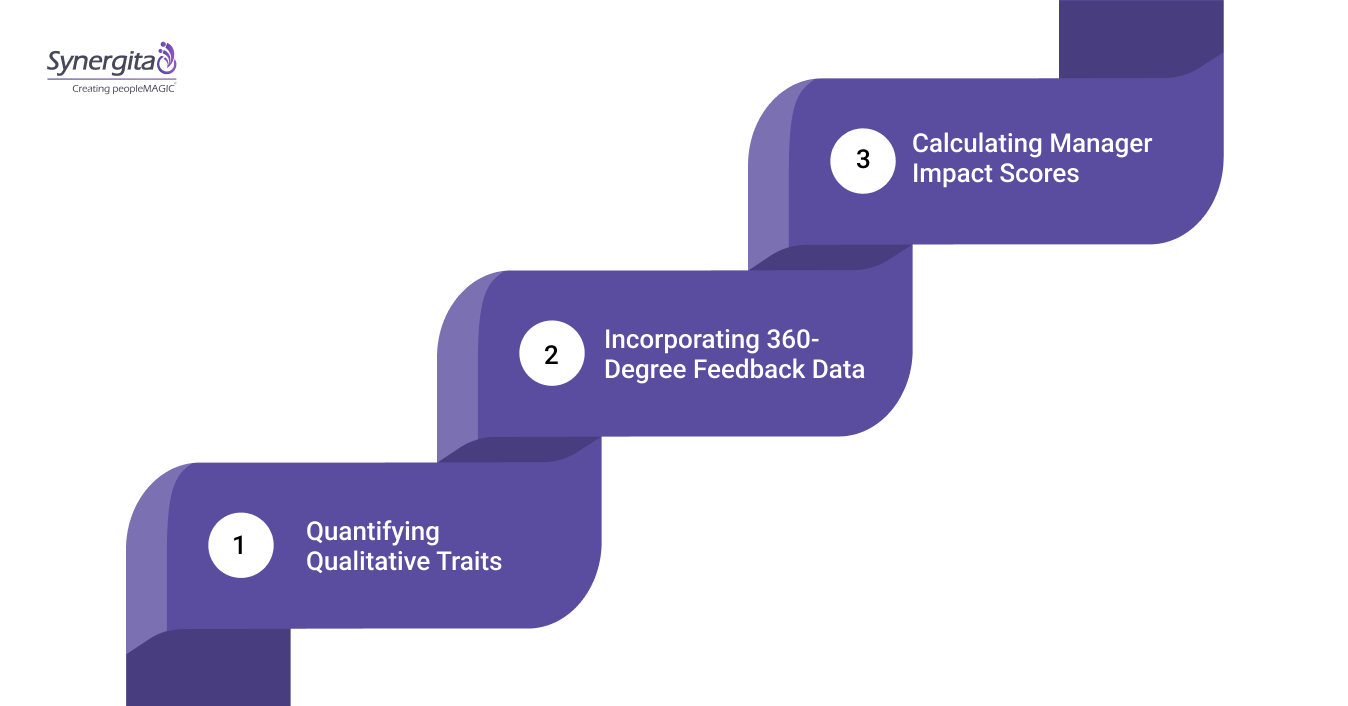
Quantitative data is the only way to prove leadership value and justify significant promotion or compensation decisions. You must move away from gut feelings toward a system that rewards specific behaviors and tangible team results.
Follow these steps to accurately quantify the performance of your management team:
1. Quantifying Qualitative Traits
- Deploy BARS Frameworks: Use Behaviorally Anchored Rating Scales to assign numerical values to specific leadership behaviors and cultural traits.
- Define Success Levels: Provide clear behavioral examples that distinguish “exceeding expectations” from “needs improvement” for every soft skill.
- Eliminate Scoring Ambiguity: Remove the subjective guesswork that often leads to friction and defensiveness during the final review discussion.
2. Incorporating 360-Degree Feedback Data
- Gather Multi-Level Insights: Collect anonymous feedback from peers, direct reports, and upper management to gain a complete view of leadership impact.
- Expose Leadership Blind Spots: Identify hidden issues that traditional top-down reviews miss, such as micro-management tendencies or internal communication gaps.
- Validate Cultural Respect: Ensure that leaders are genuinely respected by the teams they manage rather than just the executives they report to.
3. Calculating Manager Impact Scores
- Correlate Retention and Performance: Link team turnover rates and engagement scores directly to the manager’s individual performance rating to see their true footprint.
- Assess Long-Term Value: Identify “toxic high-performers” who hit revenue targets but cause high-potential talent to leave the organization.
- Spot High-Potential Mentors: Use these calculations to find leaders who build resilient, loyal teams capable of delivering consistent, long-term results.
Accurate measurement sets the stage for meaningful feedback conversations that drive actual behavior change in your leaders.
Also read: The Ultimate 360 Debrief Guide: Definition, Steps And Best Practices
Frameworks for Effective Feedback: Moving from Scores to Conversations
Review scores only provide value when they lead to productive, growth-oriented conversations between leaders and their superiors. The goal is to provide a clear path forward that focuses on behavior change and skill acquisition.
Utilize these structured communication models to turn your evaluation data into a constructive dialogue:
1. The SBI Feedback Model
Detail the specific Situation, the observed Behavior, and the resulting Impact to make feedback objective and actionable. This prevents the manager from becoming defensive by focusing on facts rather than making broad character judgments. It provides a clear link between their actions and the overall team or business performance.
2. Future-Focused Action Planning
Collaborate on a set of specific developmental goals that the manager must achieve before the next review cycle. This ensures that the evaluation serves as a springboard for growth rather than a backward-looking audit. Assign clear deadlines and resource support to help them master the new skills identified during the review.
Turn these structured conversations into measurable growth milestones without the administrative struggle of manual tracking. Book a demo to see how Synergita captures these developmental action plans and automates follow-ups.
Structured conversations help managers feel supported rather than scrutinized during the most critical phases of the review process.
Key Rules of Engagement to Avoid Bias
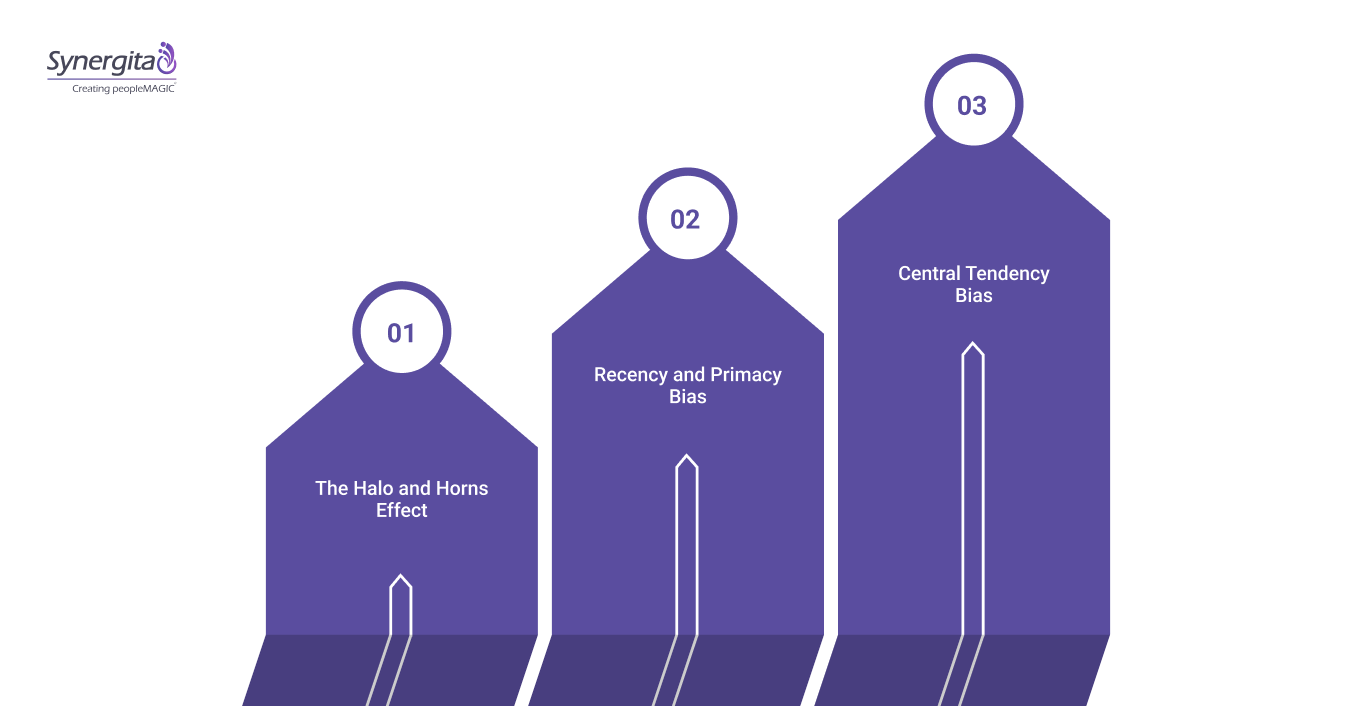
Even the best templates fail if the reviewers are influenced by unconscious biases that skew the final results. You must train your senior leaders to recognize these cognitive shortcuts to maintain the integrity of the process.
Watch for these specific biases that frequently undermine the accuracy of managerial performance reviews:
1. The Halo and Horns Effect
Reviewers often let one positive or negative trait influence their entire assessment of a manager’s multi-faceted performance. This leads to unbalanced reviews that ignore significant areas for improvement or fail to acknowledge major successes.
Encourage reviewers to evaluate each competency category independently to ensure a more accurate and fair outcome.
2. Recency and Primacy Bias
Managers are often judged solely on their most recent work rather than their contributions across the entire review period. This creates a peak-end effect that ignores consistent performance or early-quarter wins that were critical to success.
Use continuous documentation and regular check-ins to ensure the final review covers the full duration of the cycle.
3. Central Tendency Bias
Some reviewers avoid high or low scores, giving everyone an average rating to avoid difficult conversations or extra work. This obscures the performance of your top leaders and fails to address the critical gaps in struggling managers.
Force a spread of ratings or require specific evidence for middle-of-the-road scores to drive more meaningful distinctions.
Training your leaders to avoid these pitfalls is the final step in modernizing your review culture.
Also read: Effective Coaching Conversations: Techniques, Tips And Best Practices
Modernizing the Review Process with Synergita
Manual review processes involve mountains of paperwork and fragmented data that obscure the true state of your leadership. HR leaders waste hundreds of hours chasing managers for incomplete forms and trying to normalize subjective scoring across teams.
This administrative burden prevents you from focusing on strategic talent development and long-term succession planning for your company.
Synergita provides a dynamic platform that turns your review cycle into a streamlined, data-driven growth engine for your managers.
- Automated workflows that send reminders and track completion rates in real-time.
- Advanced 360-degree feedback modules for a comprehensive view of leadership impact.
- AI-powered analytics that identify bias patterns and performance trends across departments.
- Integrated OKR tracking to link managerial performance directly to business outcomes.
- Customizable dashboards that visualize leadership strength and succession readiness.
Our platform ensures your leadership reviews are objective, timely, and focused on the future success of your organization.
Conclusion
A standard performance evaluation template for managers is the foundation of a fair and ambitious leadership culture. By focusing on both strategic outcomes and team development, you ensure that your managers grow alongside the business.
This framework provides the transparency and accountability needed to build a world-class management team that survives market shifts. Moving toward a continuous performance model requires the right technology to support your evolving organizational needs and goals.
Synergita simplifies this transition by providing automated tools that drive engagement and track progress without the administrative headache. We help you turn static evaluations into a powerful strategy for developing your next generation of leaders.
Schedule a personalized demo to see how Synergita can modernize your managerial review process today.
FAQs
Q. How often should managers be evaluated?
Formal reviews typically occur annually, but high-growth organizations use a monthly or quarterly cadence. Frequent check-ins allow for immediate course corrections and prevent “end-of-year surprises” regarding performance gaps. This agile approach ensures leadership goals evolve alongside the business.
Q. What are the best KPIs for people managers?
Effective managerial KPIs include team retention rates, internal promotion velocity, and employee engagement scores. You should also track the percentage of team OKRs achieved and the frequency of documented coaching sessions. These metrics balance technical output with long-term talent health.
Q. How do you handle a manager who disagrees with their review?
Use the SBI model to provide objective evidence for every score rather than debating subjective opinions. Shift the focus from the past “grade” to a future-focused development plan with clear milestones. This collaborative approach turns a potential conflict into a productive growth conversation.
Q. What is a Behaviorally Anchored Rating Scale (BARS)?
BARS is a numerical rating system that uses specific behavioral descriptors to define each level of performance. Instead of a vague “4 out of 5,” it describes exactly what behavior constitutes “exceeding expectations.” This method significantly reduces reviewer bias and increases scoring accuracy.
Q. How can I reduce bias in managerial reviews?
Implement standardized templates and gather 360-degree feedback from peers and direct reports to gain a holistic view. Ensure all senior leaders undergo bias training to recognize the “Halo” or “Recency” effects before they score. Consistency across departments is key to maintaining institutional fairness.