
A late shipment can start with a supplier delay, a warehouse issue, or an inefficient delivery route. When each team works toward separate targets, these issues can arise that affect delivery performance, costs, and customer satisfaction.
According to Deloitte’s 2025 Manufacturing Industry Outlook, more than 35% of surveyed U.S. manufacturers cited transportation and logistics costs as a primary business challenge.
Logistics OKRs help connect these operational priorities to measurable business outcomes. A well-defined OKR ensures that logistics teams stay aligned on targets related to cost, speed, and customer satisfaction. Instead of broad goals such as “improve delivery performance,” teams can set specific objectives and track measurable results.
Below are 15 logistics OKR examples covering inventory, transportation, warehousing, supplier management, delivery, and fleet maintenance, followed by practical tips for setting and reviewing them.
| TL;DR Get 15 ready-to-use logistics OKR examples across key operational areas. Find measurable Key Results for cost, delivery, inventory, safety, and efficiency. Learn how to set focused OKRs without turning routine tasks into objectives. Use practical guidelines to keep logistics teams aligned and accountable. |
| Table of contents 1. What are logistics OKRs? 2. How OKRs help logistics Teams improve performance 3. Top 15 logistics OKR examples 4. Do’s and don’ts when using OKRs for logistics teams 5. Final takeaway 6. Frequently asked questions |
What are logistics OKRs?
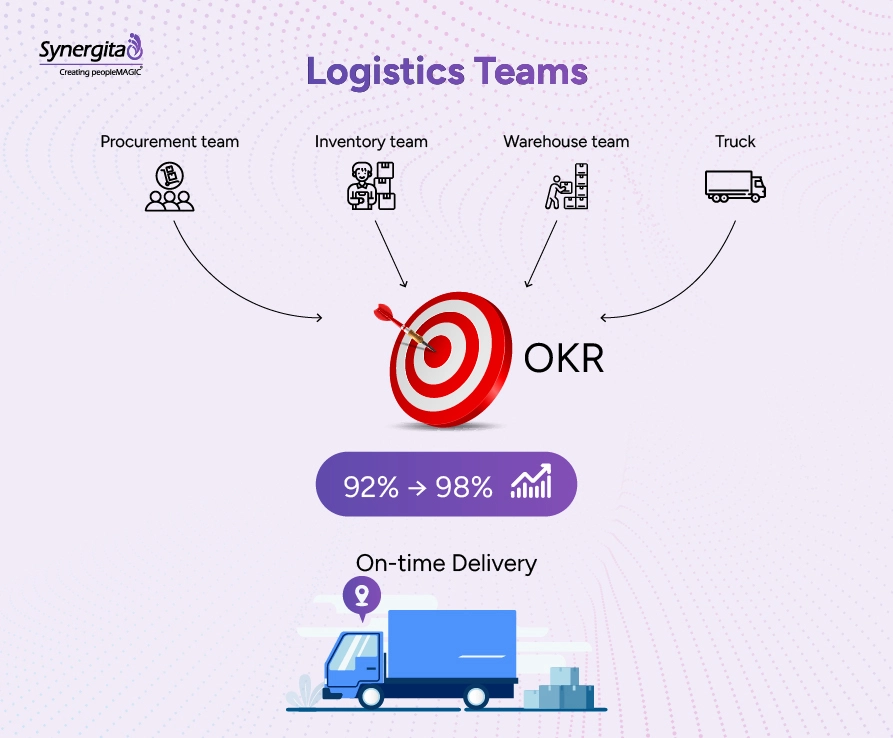
Logistics OKRs (Objectives and Key Results) are a goal-setting framework that helps supply chain and transportation teams set clear objectives and measure progress through specific, measurable results. These OKRs align day-to-day activities across warehousing, shipping, and inventory management with broader business goals and operational priorities.
For example, on-time delivery can be a logistics KPI but it can be a Key Result when a team sets a target to increase it from 92% to 98%.The OKR system can also help connect teams that influence the same outcome.
Suggested read: OKR vs KPI: Key Differences and How to Use Both
How OKRs help logistics Teams improve performance
Logistics teams can use OKRs for priorities that require measurable improvement. OKRs are most useful when a team needs to improve, change, or achieve something specific.
1. Align distributed workforces
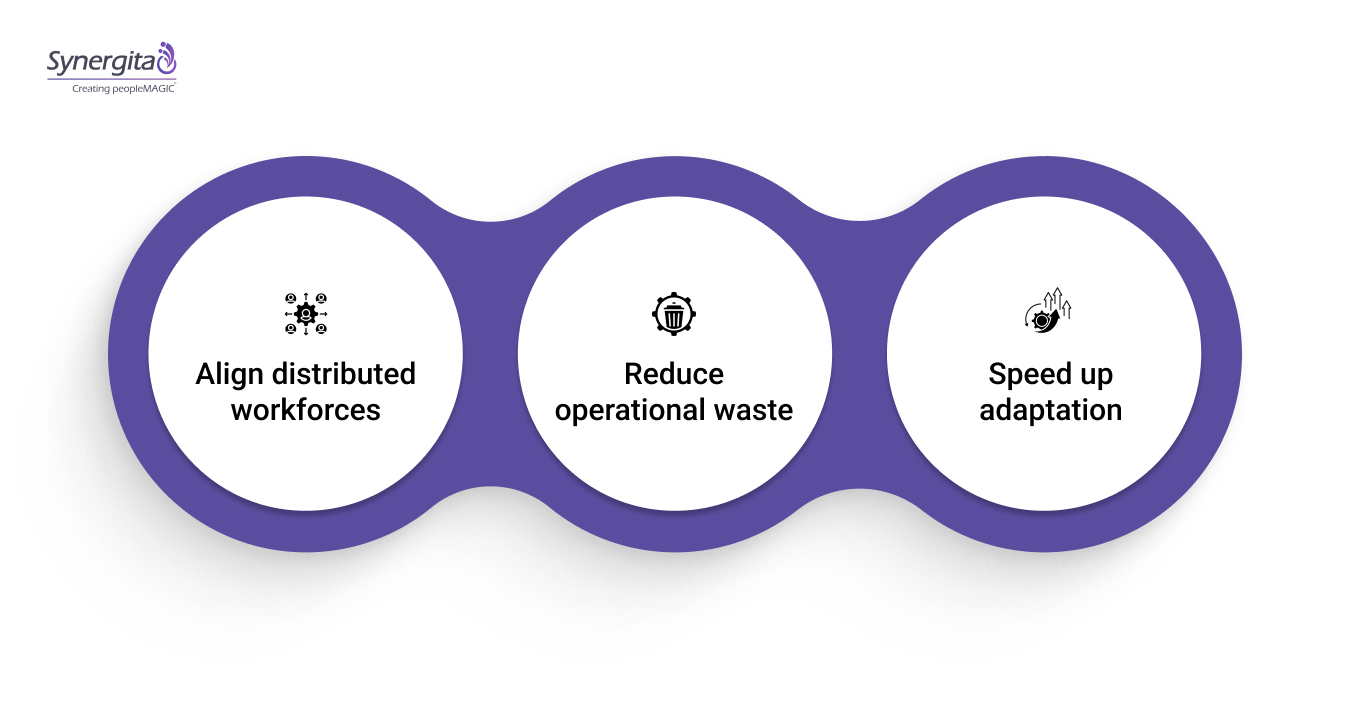
Drivers and warehouse staff may rarely work together directly, but their work affects the same delivery outcome. An OKR can connect warehouse accuracy with successful order fulfillment and delivery performance, helping each team understand how its work contributes to the wider objective.
2. Reduce operational waste
Logistics operations contain many potential sources of waste, including idle time, excess inventory, inefficient routes, packaging materials, and unnecessary handling. A focused OKR gives teams a measurable result to improve instead of asking them to fix everything at once.
3. Speed up adaptation
Supply chains can be affected by weather, shortages, strikes, demand changes, and supplier disruptions. Quarterly OKRs give teams a defined review point to reassess priorities and adjust targets when business conditions change.
Supply chain disruptions are not the only pressure on logistics teams. More than 80% of manufacturing professionals surveyed by Deloitte in 2024 said labor turnover had disrupted production, adding pressure to already complex logistics operations.
Top 15 logistics OKR examples
These logistics objectives examples cover inventory, transportation, supplier reliability, delivery, warehousing, fleet maintenance, sustainability, and other key logistics priorities. Each objective defines the desired outcome, while key results set measurable targets to track progress
The following logistics goals and objectives examples show how teams can turn common operational priorities into measurable OKRs.
[Note: The targets below are illustrative OKR examples. Adjust them to your team’s baseline, operating model, customer commitments, and OKR cycle. ]
1. Improve Inventory Management
Objective: Increase inventory turnover to free up working capital.
| Key Result | Target |
| Inventory Turnover Ratio | Increase from 4x to 6x annually. |
| Stock-out Rate | Reduce stock-outs to less than 2% of orders. |
| Obsolete Inventory | Liquidate 100% of stock older than 12 months. |
2. Reduce transportation costs
Objective: Lower shipping expenses without compromising delivery speed.
| Key Result | Target |
| Cost Per Mile | Decrease the average fleet cost per mile by 10%. |
| LTL to TL Conversion | Consolidate 30% of LTL shipments into Full Truckload. |
| Carrier Renegotiation | Secure 5% rate reduction with the top 3 carriers. |
3. Improve supplier reliability
Objective: Ensure upstream partners meet strict quality standards.
| Key Result | Target |
| On-Time Inbound Delivery | Increase the supplier’s on-time rate to 95%. |
| Order Accuracy | Achieve 99% accuracy on inbound manifests. |
| Vendor Lead Time | Reduce average lead time from 14 days to 10 days. |
4. Enhance last-mile delivery
Objective: Improve last-mile delivery performance.
| Key Result | Target |
| On-Time Delivery Rate | Achieve 98% on-time delivery for end customers. |
| Customer Complaints | Reduce delivery-related tickets by 25%. |
| Cost Per Delivery | Lower the last-mile cost per unit by $0.50. |
5. Strengthen warehouse safety
Objective: Strengthen safety performance across distribution centers.
| Key Result | Target |
| Safety Incidents | Maintain zero “Lost Time Injuries” this quarter. |
| Safety Training | Ensure 100% of staff complete updated OSHA training. |
| Hazard Reporting | Increase near-miss reporting by 20% to identify risks. |
Safety OKRs should measure both outcomes and leading indicators. Incident rates show the result, while training completion and near-miss reporting can help teams identify risks earlier.
6. Accelerate order fulfillment
Objective: Speed up processing time inside the warehouse.
| Key Result | Target |
| Order Pick Time | Reduce average pick time per order by 15%. |
| Dock-to-Stock Time | Process inbound goods within 4 hours of arrival. |
| Shipping Accuracy | Maintain a 99.9% packing accuracy rate. |
7. Improve logistics sustainability
Objective: Reduce the environmental footprint of supply chain operations.
| Key Result | Target |
| Carbon Emissions | Reduce CO2 emissions per shipment by 10%. |
| Packaging Waste | Switch 50% of packaging to recyclable materials. |
| Route Optimization | Reduce total fleet idle time by 20%. |
8. Digitize supply chain
Objective: Remove paper processes to improve data visibility.
| Key Result | Target |
| Manual Data Entry | Reduce manual entry errors by 90% via automation. |
| IoT Adoption | Install trackers on 100% of high-value assets. |
| Real-Time Visibility | Achieve 100% shipment tracking coverage. |
9. Improve Fleet Maintenance
Objective: Maximize vehicle uptime and reliability.
| Key Result | Target |
| Unplanned Downtime | Reduce vehicle breakdown incidents by 30%. |
| Preventive Maintenance | Complete 100% of scheduled services on time. |
| Asset Utilization | Increase fleet utilization rate to 85%. |
10. Improve Reverse Logistics
Objective: Streamline the returns process to recover value faster.
| Key Result | Target |
| Return Processing Time | Process all returns within 24 hours of receipt. |
| Cost of Returns | Reduce logistical cost per return by 15%. |
| Value Recovery | Increase the resale of returned items by 20%. |
11. Enhance customer communication
Objective: Provide proactive updates to reduce support volume.
| Key Result | Target |
| WISMO Tickets | Reduce “Where is my order” tickets by 40%. |
| Tracking Page Visits | Increase customer engagement with tracking links to 80%. |
| Notification Accuracy | Ensure 100% of delays trigger an automated alert. |
12. Reduce packaging waste
Objective: Improve box utilization to reduce shipping weight.
| Key Result | Target |
| Air Shipment Ratio | Reduce “shipping air” (empty space) by 15%. |
| Dimensional Weight | Lower average DIM weight charges by 10%. |
| Material Costs | Reduce packaging spend per unit by 5%. |
13. Streamline freight auditing
Objective: Eliminate overpayment on carrier invoices.
| Key Result | Target |
| Billing Errors | Identify and recover 100% of billing discrepancies. |
| Audit Cycle Time | Reduce invoice audit time from 5 days to 1 day. |
| Duplicate Payments | Eliminate all duplicate carrier payments. |
14. Improve cross-docking efficiency
Objective: Move goods faster through the transfer points.
| Key Result | Target |
| Dwell Time | Reduce average pallet dwell time to under 2 hours. |
| Handling Touches | Decrease touches per unit by 20% via cross-docking. |
| Throughput Volume | Increase cross-dock throughput by 15%. |
15. Vendor contract negotiation
Objective: Secure better terms for the upcoming fiscal year.
| Key Result | Target |
| Payment Terms | Extend payment terms from Net 30 to Net 45. |
| Service Level Agreements | Sign updated SLAs with the top 5 vendors. |
| Rate Locking | Lock in fixed fuel surcharges for 12 months. |
Do’s and don’ts when using OKRs for logistics specialists
Having the right goals is only the first step. Teams also need a consistent review process to keep objectives relevant and identify problems before they affect operational results.
Follow these guidelines to keep your logistics team on track:
| Do’s | Don’ts |
| Focus on outcomes: Measure results, not activities. | Don’t track BAU: Avoid routine tasks as OKRs. |
| Review weekly: Check progress and address delays early. | Don’t set too many: Keep objectives focused, ideally 3–5. |
| Involve drivers: Set realistic targets with frontline input. | Don’t ignore safety: Never let targets encourage unsafe practices. |
| Link to strategy: Connect OKRs to business priorities. | Don’t set and forget: Review and adjust goals regularly. |
When OKRs span multiple logistics functions, a shared tracking system can make ownership and progress easier to manage.
Final takeaway
Disconnected logistics goals can lead to missed deliveries, excess inventory, warehouse delays, and rising transport costs. Use these logistics objectives examples to identify 3–5 priorities linked to your biggest operational constraint, then set measurable Key Results around them.
Keep your existing KPIs and workflows in place, and use OKRs to focus improvement efforts. For teams managing multiple functions, Synergita can bring goals, ownership, and progress into one shared view.
Start your free trial and turn your logistics challenges into measurable OKRs.
Frequently asked questions
A good logistics OKR connects a specific operational improvement to measurable results. For example, increase on-time delivery from 92% to 98% while reducing delivery-related complaints by 20%.
Five common logistics KPIs are on-time delivery rate, order accuracy, cost per shipment, inventory turnover, and warehouse productivity. These metrics cover service, cost, inventory, and operational performance.
A logistics objective should describe a specific outcome the team needs to improve. Start with the operational problem, define the desired result, and use measurable Key Results to track progress.
A supply chain planner can focus on improving inventory efficiency while maintaining service levels. Key Results could include reducing excess inventory by 15%, keeping stock-outs below 2%, and maintaining the required service level.
OKRs for logistics teams turn operational priorities into measurable improvement goals. An effective OKR delivery process helps teams track progress, maintain accountability, and achieve logistics targets more consistently.
Warehouse objectives examples include improving fulfillment speed, accuracy, safety, and inventory handling. Teams can target faster picking, higher packing accuracy, shorter dock-to-stock time, or improved inventory accuracy.
Logistics OKRs focus on achieving a defined improvement, while KPIs monitor ongoing performance. For example, on-time delivery can remain a KPI and become a Key Result when the team targets a specific improvement.
Logistics teams should review OKRs weekly or biweekly during the OKR cycle. Regular reviews help identify delays, ownership gaps, and changing conditions early, allowing teams to address issues before they affect results.