
Hotel operations face a constant test. Aligning front desk, housekeeping, and sales is tough. Disconnected teams often miss shared goals. This hurts guest scores and revenue.
A recent analysis shows a critical gap. Independent hotels captured only 10‑15 % repeat guests vs. nearly 60 % at major chains, illustrating retention differentials.
This blog addresses that core challenge. You’ll get a framework for unity. Objectives and Key Results (OKRs) create focus. They turn strategy into measurable action for every department.
So, you will learn how to apply OKRs specifically for hotels. The goal is to move your hotel from scattered efforts to synchronized success.
Key Takeaways
- OKRs combine a qualitative Objective with quantitative Key Results to align hotel teams and drive measurable outcomes.
- Independent hotels see only 10-15% repeat guests.
- Departmental OKRs translate the overall strategy into specific goals for Management, Front Office, Sales, F&B, and Housekeeping.
- Execution relies on three habits: limiting scope for focus, committing to regular check-ins, and ensuring total transparency.
- The common failure point is the execution gap between planning and doing, often due to manual, disconnected tracking.
What are Hotel OKRs?
Every detail of a successful hotel management works together. The front desk, the room, and the dining area are memorable for their clients.
That smooth experience is no accident. It is the result of focused, aligned effort. This is the core promise of an OKR hotel strategy.
The concept was pioneered at Intel and adopted by giants like Google. Its adoption is accelerating. In fact, the OKR software market exceeded $1.38 billion in 2025.
For hotels, it moves teams from routine tasks to shared outcomes.
- The Objective (The “What”): This is a clear, inspirational, and qualitative goal. It answers, “Where do you want to go?” It should motivate and challenge your team.
- The Key Results (The “How”): These are 3-5 quantitative metrics that track your progress. They answer, “How will you know you’re getting there?” Each one must be specific, measurable, and time-bound.
A generic goal is “improve guest satisfaction.” An OKR hotel framework makes it strategic, for example:
- Objective: Become the top-rated hotel for business travelers in our city.
- Key Result (KR) 1: Increase guest satisfaction scores among business travelers from 80% to 90% in six months.
- Key Result 2: Reduce average check-in time by 25% by the end of Q3.
- Key Result 3: Increase revenue from ancillary services (like dining) by 20%.
Let’s move from theory to practice. The next section provides a ready-to-use OKR framework for your key hotel departments.
Also Read: 14 Best DevOps OKR Examples with Initiatives
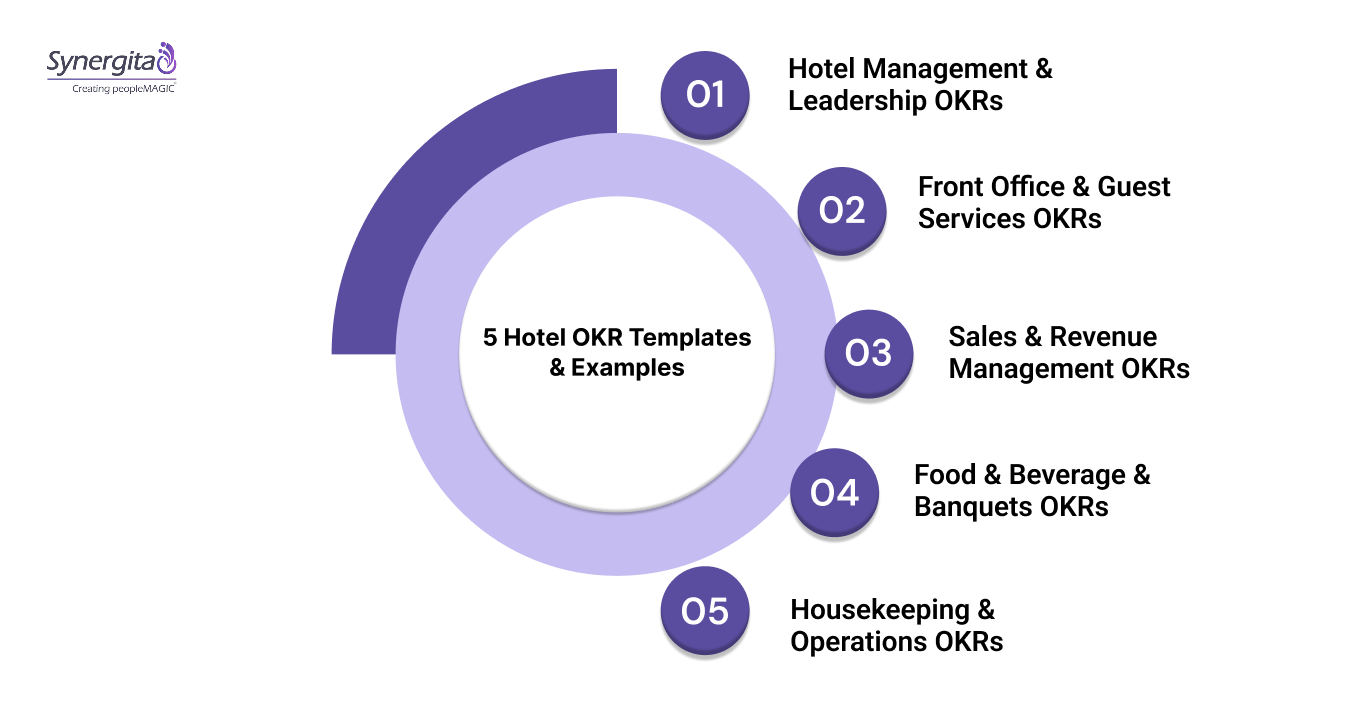
5 Departmental OKR Hotel Examples & Templates
Your hotel has many moving parts. Aligning them all seems daunting. What does a great goal look like for housekeeping? How should sales measure true success?
Without clear templates, teams create disjointed goals. This causes effort without impact. Use the examples below to start your OKR hotel rollout today:
1. Hotel Management & Leadership OKRs
Objective: Achieve exceptional hotel performance and market leadership.
- KR 1: Increase the overall guest satisfaction score by 20%.
- KR 2: Grow total quarterly revenue by 15%.
- KR 3: Improve the employee engagement score by 25%.
2. Front Office & Guest Services OKRs
Objective: Deliver a flawless and memorable guest arrival and stay experience.
- KR 1: Reduce average check-in and check-out time by 25%.
- KR 2: Decrease formal guest complaints by 20%.
- KR 3: Increase positive online review scores by 15%.
3. Sales & Revenue Management OKRs
Objective: Drive exceptional sales performance and profitability.
- KR 1: Increase the sales team’s closing rate by 15%.
- KR 2: Boost revenue from upselling services by 20%.
- KR 3: Achieve a 10% increase in direct website bookings.
4. Food & Beverage & Banquets OKRs
Objective: Elevate the F&B experience to become a major revenue and reputation driver.
- KR 1: Increase the average spend per cover by 10%.
- KR 2: Achieve a 90% customer satisfaction score for banquet events.
- KR 3: Reduce operational waste in kitchens by 15%.
5. Housekeeping & Operations OKRs
Objective: Ensure impeccable property standards and operational efficiency.
- KR 1: Achieve a 95% score on room quality audits.
- KR 2: Reduce maintenance request resolution time by 30%.
- KR 3: Lower linen and amenity costs by 10% through waste reduction.
Now, introducing a new platform adds friction, as staff must switch between systems to update goals. Synergita integrates with tools like Microsoft Teams, Slack, and Jira that hotel staff can easily use.
Teams update progress within their existing workflow. These connect daily work to your hotel’s main goals. But writing them is only step one. How do you make sure that you implement these OKRs easily?
Also Read: Modern Performance Appraisal Methods for Today’s Workforce
How to Implement OKRs in a Hotel Successfully?
You have your departmental blueprints. Now comes the real test: Execution. A perfect OKR hotel plan fails without disciplined implementation.
Teams get busy with day-to-day fires. Strategic goals give you the practical steps to avoid that trap. 3 essential best practices for hotel teams:
1. Focus & Limit Scope
- Limit teams to 3-5 Objectives per quarter.
- Each Objective should have 3-4 Key Results.
- This forces a strategic priority. It prevents teams from spreading effort too thin. An OKR hotel strategy thrives on focus.
2. Commit to Regular Check-ins
- A quarterly goal needs weekly attention.
- Adopt a bi-weekly check-in rhythm. Use 30 minutes to review progress. Discuss what is working.
- Identify blockers early. This habit turns goals into conversations. It kills the “set-and-forget” culture.
3. Ensure Transparency & Alignment
- Cascade goals from the top down. Post all OKRs where every employee can see them.
- The front desk team should understand how their speed impacts the hotel’s revenue goal.
- Housekeeping should see how room quality drives guest scores.
- This visibility creates unity. It turns separate departments into one aligned hotel.
These practices build a rhythm of execution. They transform plans into results.
Read Also: Team Alignment Workshop Guide: Strategies and Activities
The Tool for Execution: Introducing Synergita
Spreadsheets and documents create silos. They lack the rhythm for real execution. Synergita closes this gap. It is the operational engine for your hotel’s goals.
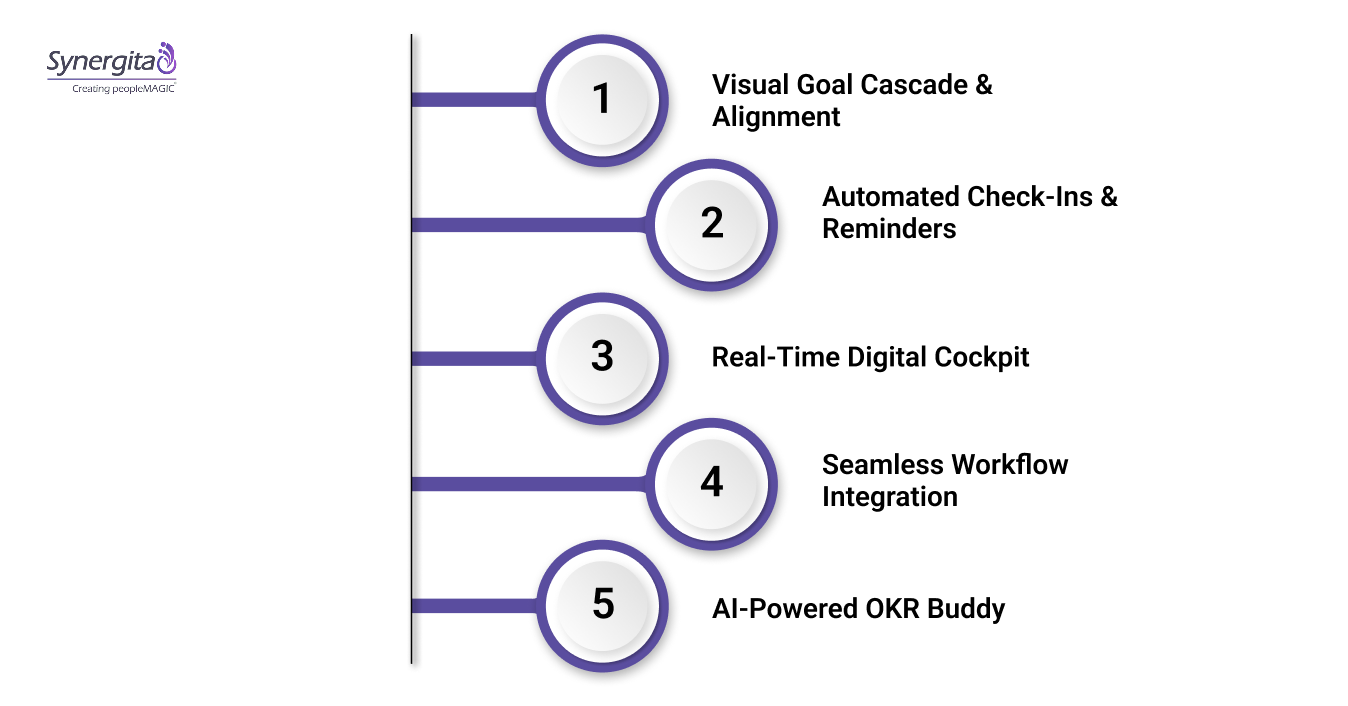
Key features include:
- Visual Goal Cascade & Alignment: Creates a clear, transparent link from company objectives to team and individual Key Results. Everyone sees the connection between their work and the hotel’s success.
- Automated Check-Ins & Reminders: Enforces the bi-weekly review rhythm with automated prompts and nudges. This builds accountability and prevents goals from being forgotten.
- Real-Time Digital Cockpit: Provides leaders with a live dashboard. Instantly view progress across all departments. See what is on track, at risk, or stalled for faster decision-making.
- Seamless Workflow Integration: Integrates with tools like Microsoft Teams and Slack. Teams update progress without switching context. This reduces friction and boosts adoption.
- AI-Powered OKR Buddy: Offers intelligent suggestions for crafting better Objectives and Key Results. It helps keep goals ambitious yet measurable.
Synergita is built for fast implementation. Its Insta Go methodology supports rapid OKR hotel rollout. You can align your teams and launch goals without a long, disruptive process.
Also Read: Why Competency-Based Performance Management Outperforms Traditional Reviews
Take the Right Step
Implementing an OKR hotel strategy transforms operations. Every team works towards unified, measurable outcomes. This alignment directly boosts guest satisfaction and revenue.
The journey starts with clear definitions. Yet, maintaining this discipline manually is challenging. A platform like Synergita provides the necessary framework as it automates the rhythm of execution and makes alignment visible.
You can book a consultation with Synergita, which can drive your specific goals.
FAQs
1. What is the difference between hotel KPIs and OKRs?
Key Performance Indicators (KPIs) are ongoing health metrics you track (e.g., daily occupancy rate). OKRs are set quarterly to drive ambitious, specific change (e.g., increase occupancy rate by 15% in Q3). OKRs often use KPIs as a baseline for their Key Results.
2. How often should hotel teams review OKRs?
Formal quarterly planning and grading are essential. The key to success is holding brief bi-weekly check-in meetings to update progress, discuss blockers, and keep goals top-of-mind.
3. Should you link OKR results to employee bonuses?
It is not recommended, especially early on. Tying bonuses can incentivize sandbagging (setting easy goals) or discourage ambitious risk-taking.
Keep OKRs as a tool for alignment and growth, not direct compensation.
4. What is the best way to get started with OKRs in our hotel?
Run a pilot. Choose one department (e.g., Front Office) for one quarter. Use the templates provided.
Learn from the experience, then roll out to other teams. Starting small builds confidence and clarity.