
Your teams are busy, projects are moving, meetings are happening, and deadlines are approaching. But is your team moving in the same direction? Deadlines keep slipping, priorities keep changing, and departments seem to be working toward different goals.
As organizations grow, it’s easy for teams to lose sight of what is most important. Without strong team alignment, even your best employees can spend time on the wrong priorities, duplicate work, and struggle to coordinate across teams. Growth doesn’t demand more effort from your teams; it demands better alignment across them.
Find out why team alignment fails, explore proven strategies to strengthen workforce collaboration, and use practical workshop ideas to keep everyone focused on the goals that matter most.
| TL;DR Identify the gaps preventing your teams from working toward shared business goals. Apply proven team alignment strategies to improve collaboration, accountability, and execution. Use practical workshop ideas to clarify roles, align priorities, and strengthen cross-functional teamwork. Build lasting alignment with repeatable practices and tools that keep teams focused on shared goals. |
| Table of contents 1. What is team alignment? 2. 7 common causes of team misalignment 3. What are the top team alignment strategies? 4. When to run a team alignment workshop 5. Team workshop ideas to improve alignment 6. Final takeaway 7. Frequently asked questions |
What is team alignment?
Team alignment is the state where every member of a team understands the shared goal, knows how their individual work contributes to it, and coordinates with others instead of working in isolation. It is the difference between a group of people completing tasks and a team moving toward the same outcome.
Alignment is important because effort without direction rarely delivers results. A team can work long hours and complete tasks yet still miss business outcomes if that work isn’t connected to organizational priorities. When output doesn’t translate into outcomes, it’s a clear sign that the problem is alignment, not effort.
Aligned teams and productive teams are not the same. A productive team completes tasks, while an aligned team ensures those tasks support goal alignment. Productivity measures speed; alignment provides direction. Without direction, moving faster can simply take teams further away from the desired outcome.
To understand alignment better, it helps to look at two connected concepts:
- Employee alignment: [Individual-level version] Each person’s goals, role expectations, and daily priorities match what the business needs from them.
- Organizational alignment: [Company-wide version] Strategy, structure, and teams all point toward the same objectives, from the leadership level down to the frontline.
Strong employee alignment ensures that individual goals, daily responsibilities, and team priorities are connected to broader business objectives. When employees understand how their work contributes to company goals, teams can make better decisions and stay focused on shared outcomes.
Suggested Reading: How to Align Performance Management with Employee and Business Goals?
Together, these layers create strategic alignment, where teams move faster, avoid unnecessary rework, and stay connected to the goals that matter most.
McKinsey’s research found that organizations that communicate a clear, compelling vision for the future are over four times more likely to be organizationally healthy than those that don’t.
7 common causes of team misalignment
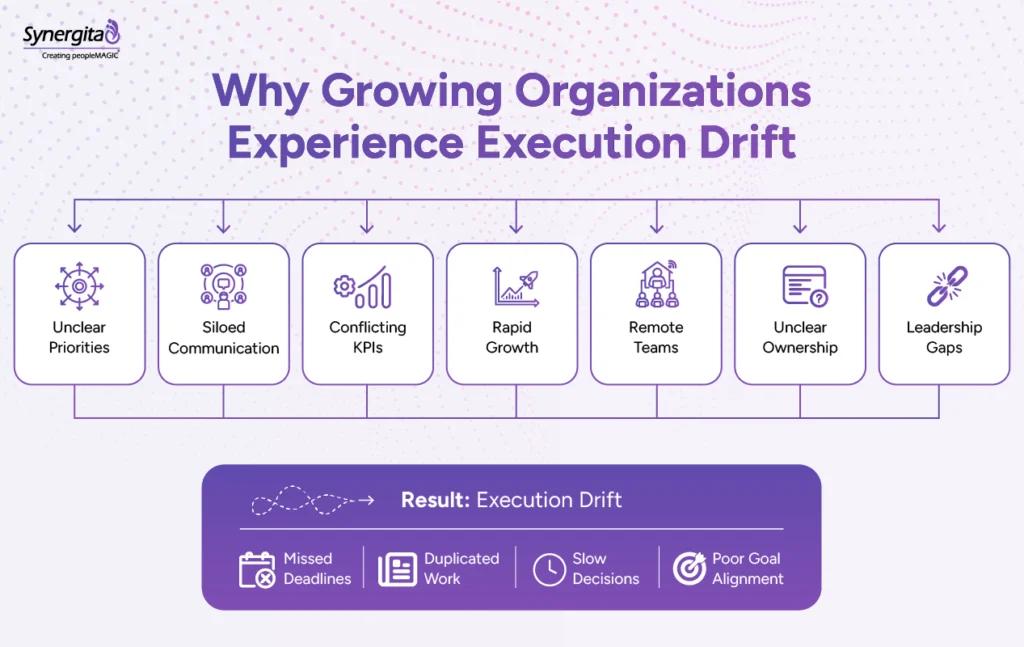
As organizations add more people, products, and locations, keeping everyone aligned becomes challenging. Processes that worked when teams shared the same context may no longer work at a larger scale. Without clear priorities, shared goals, and ownership, teams may start working toward different priorities.
1. Unclear priorities
Teams can’t focus on their work when priorities are unclear. When everything is treated as urgent, people usually shift attention to the latest request. Clear priorities help teams understand what needs immediate attention and what can wait.
2. Siloed communication
Departments can work toward different priorities when information does not move easily across teams. Marketing, product, sales, and customer success may have different views of the same project. This can lead to duplicated work, inconsistent messaging, or missed dependencies.
For example, a marketing team launches a campaign promoting a new feature before the product team completes development. At the same time, the customer success team prepares onboarding materials based on outdated specifications.
The lack of cross-functional team alignment creates inconsistent customer messaging, increases support tickets, and delays adoption after launch.
3. Conflicting KPIs
Different success metrics can create conflicting priorities across functions. Sales may focus on closing deals, customer success on retention, and product on feature delivery. When these metrics are not connected to a shared company goal, teams naturally optimize for their own targets, even when those priorities conflict with other teams.
4. Rapid growth
As organizations grow, communication and coordination become more difficult. For example, processes that worked well with 30 employees may not work as the company grows to 300.
Without clear ways to communicate priorities, cascade goals, and document decisions, new employees may not know what is expected of them or how their work connects to team goals.
5. Remote teams
Distributed teams have fewer opportunities to resolve issues through quick and informal conversations. A simple misunderstanding can turn into a meeting request, a time-zone coordination problem, and several back-and-forth messages. Teams that do not have clear ways to share information and make decisions can also find cross-functional collaboration more difficult.
6. Unclear ownership
Without clear ownership, important work can easily get delayed. When no one knows who is responsible for a task, issues can remain unresolved until deadlines slip. This can lead to rework and unnecessary coordination.
7. Leadership gaps
When business priorities are not communicated consistently, teams lose sight of strategic goals.
A 2025 survey by Atlassian of 12,000 knowledge workers and 200 Fortune 1000 executives found that just 7% of executives feel confident they know exactly how each team’s work supports the company’s biggest goals. If leaders cannot clearly connect team efforts to business goals, employees will struggle to understand how their work contributes.
Suggested Reading: How to Bridge the Gap Between Leaders and Teams?
What are the top team alignment strategies?
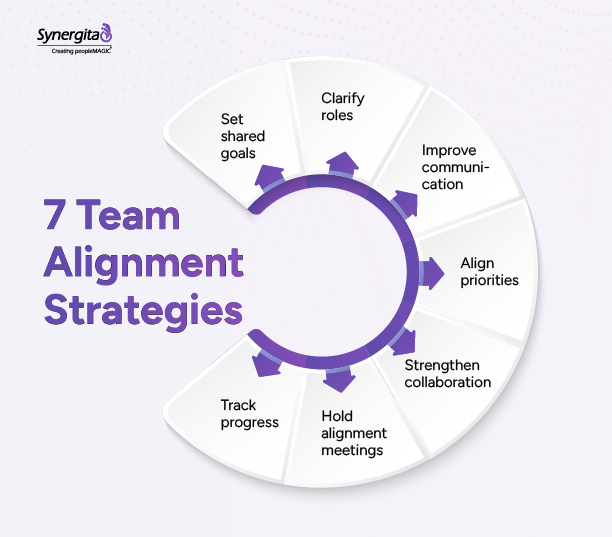
The most effective team collaboration strategies and team alignment practices include setting shared goals, defining clear roles and ownership, establishing consistent communication, tracking progress, resolving blockers quickly, encouraging cross-functional collaboration, and regularly reviewing priorities.
A clear team alignment framework gives organizations a repeatable approach to connect goals, responsibilities, communication, and progress tracking across teams.
1. Set shared goals
Align everyone around clear business objectives instead of individual tasks. When goals are connected to company priorities, teams gain the clarity to decide what is important, what can wait, and where to put the effort.
2. Clarify roles
Define responsibilities and ownership to eliminate confusion and overlap. A simple exercise of defining ownership can reveal gaps before they lead to missed deadlines or confusion.
For example, in a large client implementation, a project manager may assume the technical lead handles client communication, while the technical lead expects the account manager to do it. This unclear ownership can create confusion, cause delays, and affect client trust. Clearly defined responsibilities prevent these gaps.
3. Improve communication
Create consistent communication channels to keep everyone informed. This does not mean more meetings; it means a predictable, shared place where priorities, decisions, and blockers are visible to everyone who needs them.
4. Align priorities
Ensure teams focus on the highest-impact initiatives, even as priorities change. Priorities that were right in January can be wrong by April, so teams must continuously review and adjust priorities as business needs change.
5. Strengthen collaboration
Encourage cross-functional communication through shared planning and knowledge sharing. Make collaboration part of everyday workflows through clear communication, shared plans, and accessible documentation. For example, teams can:
- Plan projects across teams
- Share updates and knowledge
- Document key decisions
- Track cross-team dependencies
- Resolve blockers together
6. Hold alignment meetings
Use regular check-ins to review progress, resolve blockers, and reinforce priorities. A consistent, focused alignment meeting helps teams address blockers early instead of waiting until misalignment affects execution.
Weekly alignment meetings become valuable when they focus on decisions rather than status updates.
For instance, a retail business preparing for its seasonal sales campaign may bring together merchandising, operations, marketing, and logistics every week to review blockers, confirm changing priorities, and assign ownership. Addressing issues early helps prevent inventory shortages, delayed promotions, and conflicting execution plans.
7. Track progress
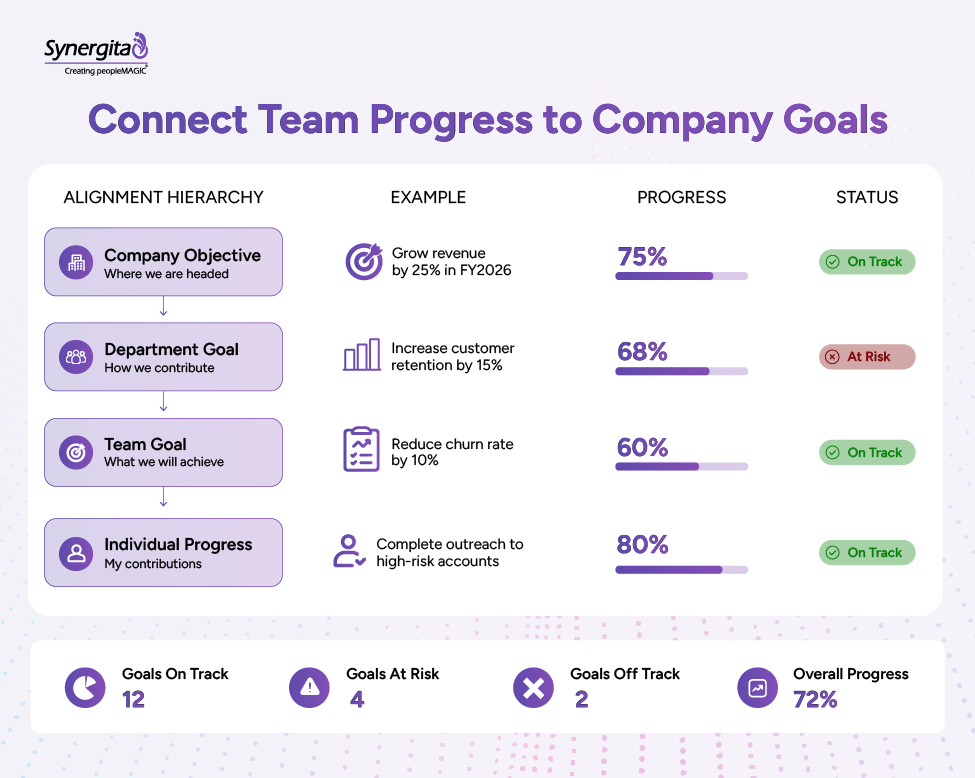
Measure goal alignment with dashboards and continuous feedback to keep the team focused. This is where team alignment tools add value. A shared dashboard that connects team goals with company objectives helps identify gaps early, before they impact business results.
When to run a team alignment workshop
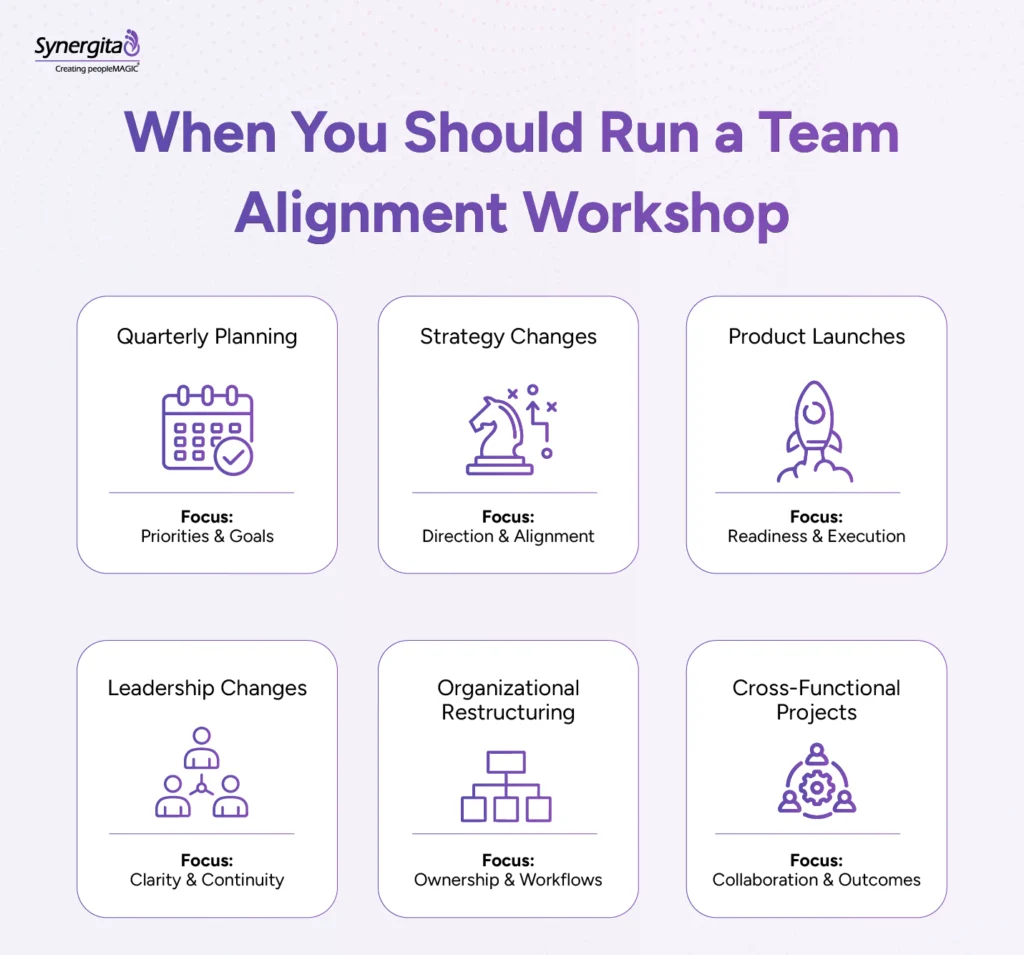
A team alignment workshop is worth scheduling at specific moments when priorities, structure, or direction are shifting, not on a fixed monthly calendar. The right timing can prevent weeks of confusion by bringing teams together before misalignment starts affecting execution.
| Situation | Why It Is Important | Alignment Focus |
| Quarterly Planning | Align teams before setting priorities, OKRs, and execution plans. | Shared goals, priorities, and measurable outcomes |
| Strategy Changes | Reconnect teams when business priorities or direction shifts. | Updated objectives and team direction |
| Product Launches | Align cross-functional teams on timelines, responsibilities, and success metrics. | Collaboration, ownership, execution readiness |
| Leadership Changes | Help teams adapt to new expectations and decision-making styles. | Communication, trust, and role clarity |
| Organizational Restructuring | Clarify ownership after changes in roles or reporting structures. | Accountability and workflows |
| Cross-Functional Projects | Bring teams together before major initiatives begin. | Dependencies, communication, shared outcomes |
Cross-functional alignment sessions can prevent small coordination gaps from turning into larger delays, especially when multiple teams depend on each other.
A Harvard Business Review study of 95 teams across 25 corporations found that 75% of cross-functional teams are dysfunctional, failing on at least three of five basic measures, including staying aligned with company goals.
The research also found that teams with strong governance succeeded 76% of the time, compared with just 19% of teams without it.
Team workshop ideas to improve alignment
The right team collaboration activities can help teams move from unclear priorities and disconnected efforts to shared goals and better collaboration. These activities help uncover alignment gaps, clarify ownership, and provide clarity on what the team needs to achieve.
The five activities below address different sources of misalignment, from unclear goals and priorities to role confusion and communication gaps.
1. Goal mapping
A visual map connects team objectives to broader business goals and makes dependencies easier to spot. It helps teams understand how their work contributes to company priorities and identify areas where goals may be disconnected.
This gives the team a clearer view of:
- Goal dependencies
- Gaps between objectives
- Shared business outcomes
2. Role alignment matrix
Defining ownership and responsibilities helps to reduce overlap and confusion. Team members document their responsibilities and their understanding of others’ roles, then review them together to clarify who owns what.
3. Priority ranking
When teams have competing priorities, ranking them by business impact and urgency can bring different perspectives to the surface. Asking everyone to rank a short list helps the team agree on what deserves attention first.
The discussion can also reveal:
- Where priorities differ
- What matters most now
- What can wait
4. Alignment spectrum
A simple rating exercise helps the team assess how well everyone agrees on priorities, communicates with one another, and works together. Team members rate each area, then discuss the areas with the lowest scores. This gives the team a clear starting point for addressing alignment gaps.
5. Team alignment check-in
Regular check-ins give team members a space to discuss progress, blockers, and anything that needs clarification. Instead of treating this as a one-time workshop, teams can use it as a recurring practice to identify misalignment while it is still small and easier to address.
Final takeaway
Strong team alignment comes from clear priorities, shared ownership, and visibility into how each team’s work contributes to business goals. Without that structure, organizations can lose valuable time to confusion, duplicated effort, and shifting priorities.
As organizations grow, maintaining that alignment becomes easier when teams have a shared system for managing goals, performance, and feedback. OKR software can make this alignment easier by connecting company objectives with team goals, tracking progress, and keeping priorities visible across the organization. Synergita helps teams turn company goals into measurable OKRs and stay aligned as priorities evolve.
Book a demo to see how it fits into your team’s existing workflow.
Frequently asked questions
Team alignment ensures every employee works toward the same business objectives instead of disconnected priorities. When teams understand how their daily work contributes to company goals, they make faster decisions and avoid duplicated effort.
Effective team alignment strategies include shared goals, clear ownership, consistent communication, and regular progress reviews. Organizations can improve alignment by setting measurable objectives, defining responsibilities, encouraging cross-functional collaboration, and revisiting priorities as business needs change.
Strategic alignment connects business strategy with team execution, while organizational alignment ensures every part of the business supports those strategic goals. Strategic alignment focuses on translating company objectives into team priorities.
Alignment meetings should focus on priorities, decisions, blockers, and ownership instead of lengthy status updates. The most productive meetings are short, recurring, and action-oriented. Teams should review progress toward shared goals, resolve cross-functional issues, clarify responsibilities, and confirm the next priorities before ending the meeting.
A team alignment workshop should help participants establish shared goals, clarify responsibilities, and improve collaboration. Effective workshops include activities such as goal mapping, role alignment exercises, priority-ranking sessions, and discussions about ownership and communication.
The most useful team workshop ideas help participants uncover gaps and reach agreement on priorities, responsibilities, and ways of working. Goal mapping, role alignment matrices, priority-ranking exercises, and recurring team check-ins can strengthen collaboration across departments.
Team alignment tools improve collaboration by giving everyone visibility into shared goals, ownership, and progress. Instead of relying on scattered spreadsheets or individual updates, teams work from a single source of information.
Leaders can improve cross functional team alignment by communicating shared goals, defining ownership, and reviewing progress consistently. Successful leaders create regular opportunities for departments to coordinate decisions, resolve dependencies, and adjust priorities as business needs change.