
Many organizations begin a quarter with ambition, but only a few end with full execution. The gap is due to how effectively goals are defined, tracked, and reviewed. Addressing this gap requires a structured and disciplined OKR planning process.
Quick Takeaway
- Many companies struggle with OKR execution because employees lack clarity on strategic priorities; effective quarterly OKR planning translates high-level goals into focused objectives and measurable key results.
- The key techniques include clear strategic planning, outcome-based objectives, measurable key results, cross-functional team involvement, simple templates, and regular review planning.
- Common mistakes in OKR planning, like unclear priorities, overlapping OKRs, or neglecting iterative reviews, can be avoided by following a structured process.
- Using OKR software helps companies streamline planning, set clear, measurable OKRs, track progress effectively, and maintain alignment across company, team, and individual goals.
Many teams struggle to turn their company’s strategy into results due to poor organization-wide alignment with OKRs. In fact, less than half of employees fully understand their organization’s strategic priorities, and only 40% feel clear about their role in achieving those goals. This disconnect directly hinders execution and engagement.
Effective OKR planning bridges this gap by translating high-level business goals into focused quarterly objectives and measurable key results. By treating planning as a structured process rather than a one-off task, teams can set clear priorities, build shared understanding, and establish rhythms for execution and review.
In this blog, we explore techniques that help teams plan OKRs with clarity, purpose, and real impact.
| Table of Contents 1. What Is OKR Planning? 2. What Are the Important OKR Planning Techniques for Quarterly Success? 3. Why is Quarterly OKR Planning Important? 4. Common OKR Planning Mistakes to Avoid 5. Conclusion 6. Frequently Asked Questions |
What Is OKR Planning?
OKR planning is the process of deciding what you want to achieve in a given period and how you will measure success. It helps teams translate business priorities into clear OKRs and define key results that demonstrate real progress, not just activity.
OKRs for quarterly and annual planning help teams set priorities for the quarter or year. A well-defined OKR framework provides the structure teams need to set objectives, define measurable key results, and track progress consistently.
What Are the Important OKR Planning Techniques for Quarterly Success?
Quarterly OKR planning works only when teams focus on what matters this quarter and align their efforts accordingly. Here are techniques for planning OKRs that teams can execute and achieve goals.
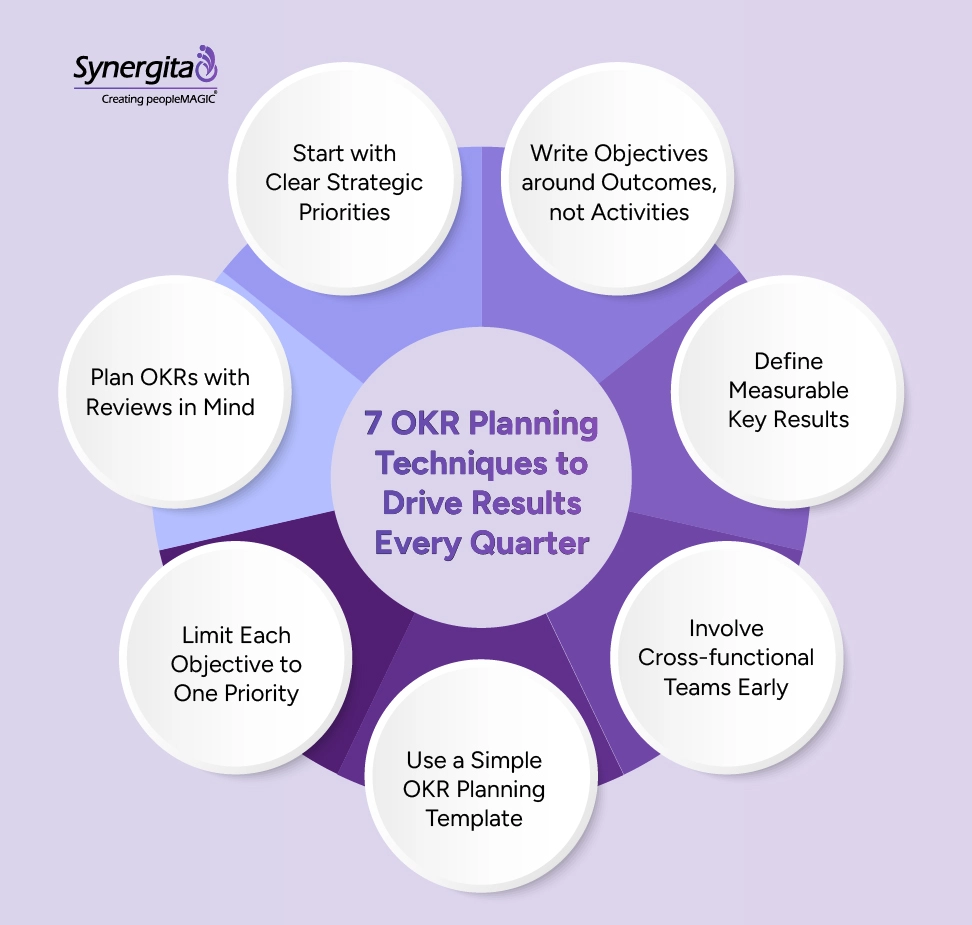
1. Start with Clear Strategic Priorities
Before writing any OKRs, set priorities for what the business must focus on over the next 90 days. Without this, OKRs may turn into task lists disguised as goals. This ensures OKRs support meaningful business outcomes rather than disconnected initiatives.
- Identify 2–4 priorities that are the most important this quarter
- Ensure every objective is connected to a clear business priority
- Drop anything that doesn’t clearly support them
This step sets the foundation for strategic OKR planning and prevents scattered focus.
2. Write Objectives around Outcomes, not Activity
The objectives you set should describe the change you want to see by the end of the quarter, not the work you plan to do. Outcome-driven objectives help the team focus on the most important tasks, making it easier to evaluate success. Ask the question: if this succeeds, what will change?
Here are some quick tips:
- Frame objectives around impact, not efforts
- Avoid activity-based language like “launch,” “implement,” or “execute”
- Keep objectives qualitative but specific
Suggested Reading: How Organizations Should Move from Activities to Outcomes
3. Define Measurable Key Results
Key Results should be specific, measurable, time-bound, and clearly define what the team wants to achieve by quarter-end. They must focus on outcomes, such as growth, adoption, or quality, rather than listing activities or tasks.
For example,
Objective: Improve customer onboarding
Key Results:
- Reduce onboarding time from 10 days to 5 days
- Increase activation rate from 60% to 75%
- Maintain CSAT of 4.5+ for new users
Key results like this make it easier to measure the team’s achievements for the quarter.
4. Involve Cross-functional Teams Early
OKR misalignment usually starts during OKR planning, and not during execution. If OKRs depend on other teams, it’s better to involve them during planning and then cascade OKRs across teams to prevent blockers during execution. Here are some best practices you should keep in mind:
- Clarify ownership where objectives involve multiple functions
- Use planning discussions to resolve conflicts, instead of escalating them later
5. Use a Simple OKR Planning Template
Teams do not need complex frameworks to plan OKRs effectively. What they need is consistency; simple OKR templates provide a clear structure for setting, tracking, and reviewing OKRs each quarter.
Your template should capture:
- The strategic theme for the quarter
- A clear objective
- 2–4 measurable key results
- A defined owner
- A regular review cadence
6. Limit Each Objective to One Priority
One of the common OKR misconceptions is adding too many objectives. When you prioritize multiple objectives, can you focus on each one? You can’t! Overloaded OKRs dilute focus and create confusion about priorities. This makes it difficult for teams to execute effectively. Here’s how to do it right:
- One objective = one meaningful outcome
- Do not add more than three objectives per quarter.
- Use Key Results to measure progress, not add scope
7. Plan OKRs with Reviews in Mind
Teams may fail to meet OKRs if reviews are not conducted regularly and on time. When planning OKRs, teams must specify how often reviews should be conducted. This is very important because if reviews are delayed or skipped, it breaks momentum and increases misalignment. Here’s how to include reviews in planning:
- Decide upfront how often progress will be reviewed
- Set weekly or bi-weekly check-ins
- Make OKRs visible to managers and teams
Reviews should be embedded in the OKR quarterly cycle to maintain momentum and enable timely course corrections.
Why is Quarterly OKR Planning Important?
Quarterly OKRs planning helps the team keep priorities aligned with the quarter, improve execution discipline, create faster feedback loops, and enhance alignment and accountability.
1. Keeps Priorities Relevant to the Quarter
Quarterly OKR planning ensures teams focus on what matters right now, not on goals set months ago that may no longer be relevant as markets, customers, or internal priorities change.
2. Improves Execution Discipline
Shorter planning cycles lead to more realistic commitments, making it easier for teams to track OKR progress and deliver outcomes within the quarter.
3. Creates Faster Feedback Loops
Regular reviews help teams learn what worked, what didn’t, and why, so they can use those insights when planning for the next cycle.
4. Improves Alignment and Accountability
A quarterly OKR planning process keeps teams aligned with business priorities and ensures clear accountability and ownership of outcomes.
Common OKR Planning Mistakes to Avoid
Here are common mistakes businesses should avoid when planning OKRs.
- Starting OKR planning without clear quarterly business priorities
- Writing objectives that are too broad to guide the quarterly focus
- Defining key results without validating data availability upfront
- Planning OKRs without checking capacity, resources, or constraints
- Creating overlapping OKRs across teams without ownership clarity
- Finalizing OKRs without alignment reviews across levels
- Setting key results that depend heavily on external teams or factors
- Treating planning as a one-time workshop instead of an iterative process
- Locking OKRs without sanity-checking ambition versus feasibility
Conclusion
Poorly planned OKRs lead to misalignment and confusion around priorities. Careful planning reduces these issues by setting clear direction, realistic scope, and measurable outcomes before the team starts execution. Using a structured OKR management system supports effective planning and maintaining alignment between company and team goals.
This is where Synergita OKR software adds significant value. It helps teams plan OKRs with clarity, align goals across levels, and keep everything visible from the start of the quarter. Try Synergita free for 14 days.

Frequently Asked Questions
Most teams should plan three to four OKRs per quarter to maintain focus, avoid overload, and ensure they can achieve the goals within available time and resources.
Quarterly OKR planning usually takes one to two weeks. It includes drafting objectives, defining key results, reviewing alignment, and finalizing goals across leadership and teams.
Leadership and team members should participate in OKR planning to ensure everyone understands their goals and creates a roadmap to achieve them.
Yes, OKRs can be revised if priorities change significantly. However, frequent changes mean there are gaps in planning, unclear priorities, or unrealistic goal-setting.
Synergita OKR management software provides structured workflows to guide teams in defining objectives, writing measurable key results, and aligning OKRs across company, team, and individual levels.