
Your leadership team just approved the 2026 strategic plan. It includes increasing revenue, improving customer satisfaction, and boosting productivity. But, these aren’t goals; they’re wishes. Without specificity, measurement, and a timeline, even well-intentioned business goals become ineffective.
Key Takeaways
- Many businesses set vague goals like “increase revenue” or “improve productivity” without a specific target, which does not help.
- Effective goals include clear metrics, timelines, and supporting objectives.
- The 10 practical business goal examples across finance, market growth, operations, talent, and sales help companies focus on balanced growth areas like revenue, profitability, retention, efficiency, and innovation.
- Successful execution requires 3–5 strategic goals, measurable objectives, and a structured framework like OKRs to track progress.
Almost every business starts the year with ambitious plans but many struggle to translate them into measurable results. Leadership sets vague goals like “grow the business” without clear targets.
Teams don’t know which goals to prioritize when everything seems important. Annual planning produces goals that sound impressive but lack actionable direction. This creates confusion between goals, objectives, OKRs, and KPIs, leading to missed targets.
This guide provides 10 proven company goals examples across finance, operations, marketing, and HR, with specific metrics, timeframes, and supporting objectives you can customize for your industry.
| Table of Contents What Are the Top Business Goals Examples to Accelerate Growth in 2026? – Revenue Growth Goal – Profitability Goal – Market Expansion Goal – Customer Retention Goal – Operational Efficiency Goal – Product Innovation Goal – Talent Acquisition Goal – Employee Engagement Goal – Sales Goal Final Takeaway Frequently Asked Questions |
What Are the Top Business Goals Examples to Accelerate Growth in 2026?
High-performing companies align their corporate goals across financial performance, customer growth, operational excellence, and talent strategy, which creates strong organization-wide alignment. Here are ten smart business goal examples that successful companies use to drive measurable growth.
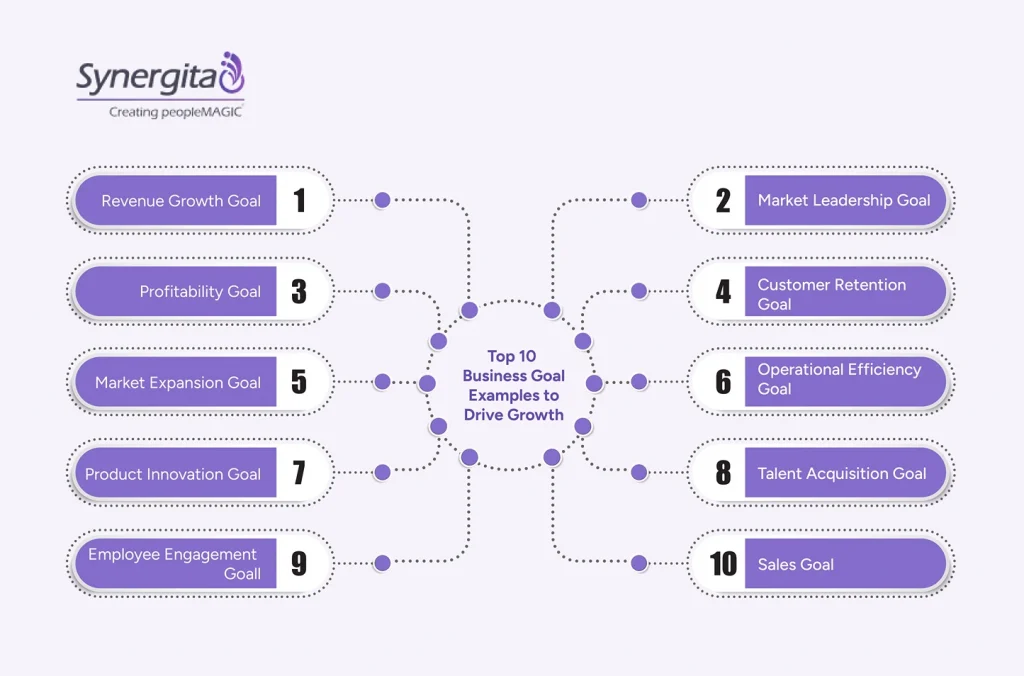
Category 1: Financial Business Goals
1. Revenue Growth Goal
Goal: Achieve $50 million in annual recurring revenue by December 31, 2026
Why is it important:
A growth in revenue shows your product is well-positioned for the market, attracting investors who can accelerate your expansion and provide the resources to reinvest in your business. This goal applies to every business, especially for SaaS companies, B2B service providers, and product businesses scaling from a $25M-$30M baseline to the next milestone.
Key metrics to track:
- Monthly recurring revenue (MRR)
- Average contract value (ACV)
- Revenue per employee
- Year-over-year growth rate
Supporting Objectives:
- Acquire 500 new enterprise customers with an average contract value of $75K
- Expand existing customer accounts by 30% through upselling
- Launch 2 new product tiers, capturing the mid-market segment
- Reduce customer acquisition cost from $8K to $5K
2. Profitability Goal
Goal: Achieve operating profitability with 15% EBITDA margin by Q4 2026
Why is it important
Profitability shows your business model actually works, not just burn cash. It also creates financial freedom and helps businesses make strategic investments without the constant need for fundraising rounds. This goal is critical for companies transitioning from the “growth-at-all-costs” mindset to a sustainable, profitable business, which investors always demand.
Key metrics to track:
- EBITDA margin percentage
- Operating expenses as % of revenue
- Gross margin
- Cash burn rate
Supporting Objectives:
- Reduce sales and marketing expenditure from 50% to 40% of revenue
- Improve gross margin from 65% to 75% through vendor renegotiation
- Eliminate the bottom 20% of unprofitable customer segments
- Automate 40% of operational processes to reduce headcount needs
Category 2: Market and Customer Business Goals
3. Market Expansion Goal
Goal: Establish presence in 3 new geographic markets (EMEA, APAC, LatAm) by Q3 2026
Why is it important
Geographic expansion diversifies your revenue streams, reduces regional economic risk, and sustains growth as your domestic market starts to saturate. This is how regional players become global powerhouses.
Key metrics to track:
- Revenue from new markets as % of total
- Number of customers per region
- Market penetration rate
- Sales cycle length by region
Supporting Objectives:
- Hire regional sales directors in London, Singapore, and São Paulo by Q1
- Achieve $5M combined revenue from new markets by year-end
- Localize product for 5 languages with regional compliance
4. Market Leadership Goal
Goal: Become the top 3 market leader in enterprise project management software by analyst rankings
Why is it important
Market leadership creates a powerful flywheel. It drives inbound demand, enables premium pricing power, and makes customer acquisition dramatically easier because buyers default to category leaders when making purchase decisions. Being in the top three completely transforms your sales motion.
Key metrics to track:
- Analyst ranking position (Gartner, Forrester)
- Market share percentage
- Brand awareness scores
- Consideration set inclusion rate
Supporting Objectives:
- Secure “Leader” quadrant placement in Gartner Magic Quadrant
- Achieve 25% aided brand awareness among target ICPs
- Generate 1,000+ G2 reviews with 4.5+ star average
- Win 10 competitive deals against current market leaders
5. Customer Retention Goal
Goal: Achieve 95% gross revenue retention and 120% net revenue retention
Why is it important
High retention compounds your growth exponentially, reduces your dependency on expensive customer acquisition, and validates you’ve achieved real product-market fit. According to Bain & Company research, increasing customer retention rates by just 5% can increase profits by 25% to 95%. This shows customer retention can fuel your business growth.
Key metrics to track:
- Gross retention rate (GRR)
- Net retention rate (NRR)
- Customer lifetime value (LTV)
- Churn rate by segment
Supporting Objectives:
- Reduce churn from 10% to 5% through proactive success management
- Increase average account expansion from 5% to 25% annually
- Implement health scoring to identify at-risk accounts 60 days early
- Achieve 90% customer satisfaction score (CSAT) on renewals
Category 3: Operational Excellence Goals
6. Operational Efficiency Goal
Goal: Increase operational efficiency by 30%, measured by revenue per employee
Why is it important:
Operational efficiency directly drives profitability, scalability, and competitive advantage in your market. Companies with high revenue per employee can outspend competitors on R&D and talent acquisition while maintaining better margins. It’s the difference between growing sustainably and hitting a ceiling where every new dollar of revenue requires proportional headcount.
Key metrics to track:
- Revenue per full-time employee
- Process cycle time
- Automation rate
- Error/defect rate
Supporting Objectives:
- Automate 50% of manual data entry and reporting tasks
- Reduce the average sales cycle from 90 to 60 days
- Implement AI-powered customer support, handling 40% of tickets
7. Product Innovation Goal
Goal: Launch 3 market-differentiating features that drive 20% increase in new customer acquisition
Why is it important
Product innovation prevents commoditization in crowded markets, creates defensible competitive moats that competitors can’t easily replicate, and generates organic PR and word-of-mouth momentum. Innovative products sell themselves through customer advocacy rather than expensive marketing campaigns.
Key metrics to track:
- Features launched on schedule
- Feature adoption rate
- Win rate improvement
- Customer satisfaction with new features
Supporting Objectives:
- Ship AI-powered analytics dashboard by Q2
- Launch mobile app with 10K downloads in first month
- Deliver enterprise SSO and advanced permissions by Q3
- Achieve 60% adoption of new features within 90 days of launch
Category 4: Talent & Culture Goals
8. Talent Acquisition Goal
Goal: Build a world-class 200-person team while maintaining 90%+ retention and 50% diverse workforce
Why is it important
The quality of talent in your organization and their alignment with strategy determine how efficiently your plans are executed. A McKinsey study shows that companies in the top quartile for racial and ethnic diversity are 35% more likely to have financial returns above their industry median. Building diverse, high-performing teams provides a competitive advantage that directly impacts your bottom line.
Key metrics to track:
- Headcount vs. hiring plan
- Time-to-hire (average days)
- Offer acceptance rate
- Diversity percentages (gender, ethnicity)
- Employee retention rate
Supporting Objectives:
- Hire 75 employees across engineering, sales, and customer success
- Reduce time-to-hire from 75 to 45 days
- Achieve 50% diverse candidate slates for all roles
- Maintain 90%+ retention rate through competitive comp and culture
Suggested Reading: How to Align Workforce with Company’s Strategy
9. Employee Engagement Goal
Goal: Achieve ‘Best Place to Work’ status with 85+ employee Net Promoter Score (eNPS)
Why is it important
Engaged employees are more productive, deliver superior customer experiences, and become powerful brand ambassadors who attract top talent. According to Gallup research, engaged teams are 21% more profitable, yet only 31% of U.S. employees report being engaged at work. This creates a massive competitive opportunity for companies that get engagement right.
Key metrics to track:
- Employee Net Promoter Score (eNPS)
- Employee satisfaction survey scores
- Voluntary turnover rate
- Internal promotion rate
Supporting Objectives:
- Launch quarterly all-hands meetings with transparent metrics sharing
- Implement a manager training program with 100% participation
- Achieve 90% favorable response on “I would recommend working here.”
- Promote 25% of employees internally vs. external hiring
Category 5: Sales Goals
Example 10: Sales Goal
Goal: Build and maintain 4x sales pipeline coverage with 30% win rate
Why is it important
Predictable pipeline helps businesses forecast revenue accurately and ensures consistent deal flow quarter after quarter. The 4x coverage ratio provides a buffer for inevitable deal slippage and lost opportunities. Teams that build their sales strategy using an OKR management system and follow disciplined pipeline management hit their numbers regularly.
Key metrics to track:
- Pipeline coverage ratio
- Win rate percentage
- Average deal size
- Sales cycle length
Supporting Objectives:
- Generate 400 qualified opportunities totaling $100M pipeline
- Increase the win rate from 20% to 30% through better qualification
- Reduce the sales cycle from 120 to 90 days
- Achieve 90% forecast accuracy on quarterly commits
Suggested Reading: 20+ Sales OKRs Examples to Drive Growth
Final Takeaway
Setting effective business goals separates high-performing companies from the ones that are struggling. The 10 examples in this guide give you a comprehensive framework for 2026 and beyond.
You can start with 3 goals for your company from different categories that address your biggest strategic gaps. Use the template provided to structure each goal with clear metrics, supporting objectives, and ownership, and review progress regularly.
If you are looking for a structured system for goal setting and tracking, Synergita’s AI-powered OKR platform can help. It allows you to set, cascade, and track business goals with real-time dashboards that highlight progress and risks. Start your 14-day free trial today and turn your goals into outcomes.

Frequently Asked Questions
Early-stage startups should prioritize product-market fit goals (customer acquisition, retention metrics), cash runway extension, and foundational team building. Revenue growth matters, but sustainable unit economics and customer validation matter more in the first 1-2 years.
Businesses should set 3-5 company-level business goals. Setting more than 5 goals dilutes focus and resources. Each goal should have 3-5 supporting objectives. Small teams with less than 20 people should limit to 3 goals, while larger organizations can manage up to 5.
An effective business goal is specific, measurable, and time-bound. Instead of vague intentions like “Increase revenue,” it clearly defines a target, a deadline, and success metrics so that teams know what to work toward.
Businesses should adjust goals only when external factors (market disruption, competitive threats, economic shifts) render them obsolete. You should review goals quarterly and course-correct objectives and tactics, but keep annual goals stable unless circumstances demand change.