
Why do some employees consistently perform well while others struggle despite having the right skills and experience? Is it always about employee skills or the way their performance is managed?
In many organizations, employees are unsure of what is expected of them which affects their performance. HR professionals and managers provide feedback too late, and annual performance reviews are not enough to make continuous improvement. A Gallup study of 18,665 U.S. employees shows only 47% of employees agree they know what the leadership from them is.
Without clear direction and consistent support, even talented employees can lose focus. Understanding the key characteristics of performance management is the first step toward building a workforce that stays engaged, accountable, and aligned with business goals.
In this guide, we explore the top 10 characteristics of performance management that separate high-performing teams from those that struggle to deliver results.
| TL;DR: – High-performing organizations set clear goals, define measurable performance standards, and align individual contributions with business objectives. – Continuous feedback, fair evaluations, and timely recognition create a culture of accountability, engagement, and sustained performance. – Including coaching and career development into the performance discussion helps employees grow and improve retention and productivity. – Modern performance management systems streamline the performance management with ongoing feedback, and key insights. |
| Table of Contents 1. What are the Top 10 Characteristics and Features of Performance Management 2. Successful Performance Management Success Checklist: Mistakes to Avoid 3. Final Takeaway 4. Frequently Asked Questions |
What are the Top 10 Characteristics and Features of Performance Management
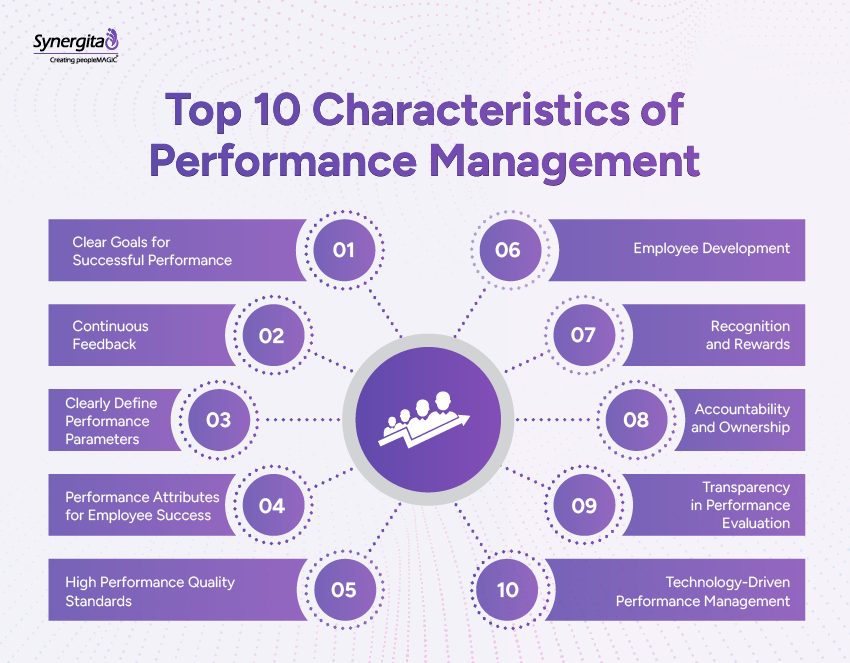
These characteristics build the foundation of a performance management system that supports employee growth, accountability, and business success.
1. Clear Goals for Successful Performance
Employees cannot achieve their goals if they do not clearly understand what is expected of them. Clear, well-communicated goals are the foundation of effective performance management.
McKinsey research highlights that when organizations strengthen purpose alignment, helping employees clearly understand how their work contributes to broader organizational goals, engagement and performance improve significantly.
Connecting individual roles to business outcomes helps shift employees from task execution to meaningful, goal-driven performance. When priorities are clear, employees know where to focus their efforts, managers spend less time explaining expectations, and teams achieve better results.
2. Continuous Feedback
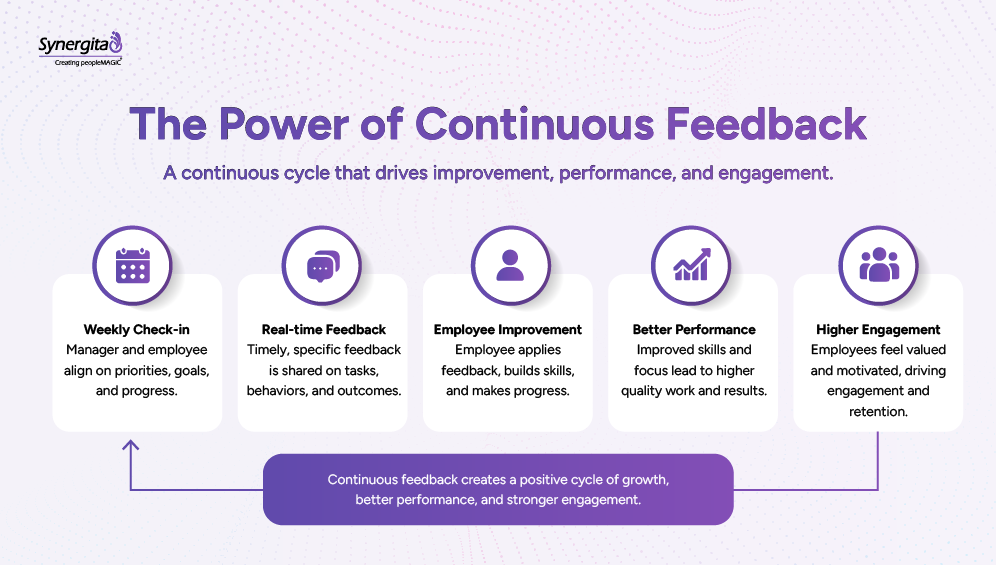
Annual reviews focus on past performance, while continuous feedback helps employees make timely improvements and stay aligned with their goals.
Gallup’s 2024 research shows that only 31% of U.S. employees are engaged at work, with most workers remaining not engaged or actively disengaged. The report also says organizations can improve engagement through ongoing feedback and accountability.
Top feedback practices in high-performing organizations include:
- Regular one-on-one check-ins between managers and direct reports
- Real-time feedback tied to specific projects or behaviors
- Peer input through structured 360-degree feedback cycles
3. Clearly Defined Performance Parameters
Performance parameters are the measurable standards that define what is good performance. Employees are more likely to trust performance evaluations when they are based on clearly defined criteria rather than individual opinions.
Relevant performance parameters vary by role, but typically include:
- Productivity indicators: Output volume, task completion rates, response times
- Quality benchmarks: Error rates, client satisfaction scores, rework frequency
- Behavioral expectations: Collaboration, communication, adherence to values
For instance, a sales representative may be evaluated on quota attainment, pipeline conversion, and customer retention, while a software engineer may be assessed on code quality, sprint completion, and collaboration. Defining role-specific metrics ensures employees are measured against expectations that reflect their actual responsibilities.
4. Performance Attributes for Employee Success
Beyond measurable outputs, successful performance management evaluates how employees work, the underlying behaviors and attributes that determine long-term contribution.
Core performance attributes organizations value most include:
- Accountability: Taking ownership of outcomes, not just activities
- Adaptability: Responding effectively to changing priorities and environments
- Collaboration: Contributing to team performance, not just individual metrics
- Initiative: Identifying problems and acting without being prompted
To assess these attributes fairly, organizations need a clear and consistent approach. Competency frameworks and behavioral assessments help managers evaluate employees based on defined standards, not just completed tasks.
5. High Performance Quality Standards
Organizations that maintain high-performance quality standards achieve more predictable results, stronger client outcomes, and less rework.
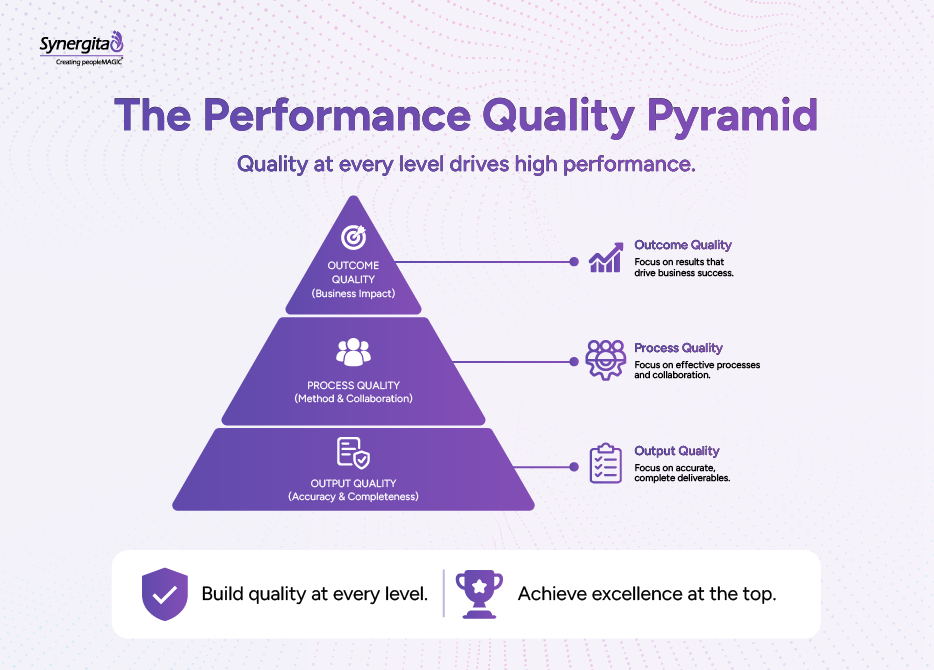
Defining performance quality means distinguishing between:
| Dimension | What It Measures |
| Output quality | Accuracy, completeness, and the standard of work delivered |
| Process quality | How work is approached, method, rigor, and collaboration |
| Outcome quality | The actual impact of the work on business goals |
High standards are easier to maintain when employees receive ongoing guidance. Regular feedback helps them identify issues early, improve their work, and consistently deliver quality results.
6. Employee Development
Performance management is about more than measuring results. It should also help employees learn new skills, grow in their roles, and reach their full potential. High-performing organizations embed development into the performance cycle itself:
- Personalized development plans tied to role expectations and career aspirations
- Coaching and mentoring are integrated into regular check-ins, rather than limited to training events.
- Internal mobility opportunities should be based on employees’ skills, strengths, and demonstrated performance.
When employees can see how strong performance leads to new roles and career growth, they are more motivated to perform well and stay with the organization.
For example, a customer support executive who consistently exceeds service quality goals can undergo a structured development plan that includes product training, mentoring, and leadership responsibilities before moving into a team lead role. Connecting performance discussions to visible career opportunities helps employees understand how today’s results influence tomorrow’s growth.
7. Recognition and Rewards
McKinsey Research shows that up to 55% of employee engagement is driven by non-financial recognition alone, making it one of the most cost-effective levers leaders have. Recognition from a direct manager consistently ranks as the most impactful form, above peer recognition and company-wide awards.
Effective recognition programs combine:
- Monetary rewards: Bonuses, merit increases, spot awards tied to specific achievements
- Non-monetary recognition: Public acknowledgment, extra responsibility, flexibility, and career opportunities
- Timely delivery: Recognition delivered soon after the desired behavior is significantly more effective than delayed praise.
8. Accountability and Ownership
Accountability ensures employees take ownership of goals, monitor progress consistently, and follow through on agreed commitments. Organizations build accountability into performance management through:
- Goal reviews: Scheduled check-ins where progress is assessed against agreed milestones
- Performance dashboards: Visible, real-time data on individual and team progress
- Documentation practices: Maintaining written records of goals, feedback, and outcomes creates a clear performance trail.
Accountability is more effective when built into the performance management framework through clear goals, regular reviews, and transparent tracking. This ensures consistency across teams and turns accountability into a daily practice rather than an occasional expectation.
Consider a product launch involving marketing, sales, and engineering teams. When milestones, owners, and progress updates are visible to everyone, delays are identified early, responsibilities remain clear, and teams spend less time resolving misunderstandings after deadlines have passed.
9. Transparency in Performance Evaluation
Unfair performance appraisals can damage employee trust, even if managers have good intentions. In a recent survey by Reflective among 1,000 U.S. employees, they found 85% of people admitted they would consider leaving their company for unfair performance review
An effective performance appraisal should include modern methods and these features:
- Consistent evaluation criteria applied across teams and roles.
- Documented feedback processes that create an evidence-based record.
- 360 degree feedback (manager, peer, self-assessment) to reduce individual bias.
- Clear communication of how ratings connect to compensation and career outcomes.
When employees trust the process and understand how decisions are made, performance conversations become more productive and focused on growth.
Suggested Reading: Modern Performance Appraisal Methods for Today’s Workforce
10. Technology-Driven Performance Management
High-performing organizations recognize that performance evaluation is not a one-time process. It must evolve continuously to reflect changing business priorities, employee needs, and organizational goals.
Agile performance management practices include:
- Dynamic goal adjustment: Revising objectives mid-cycle when business context changes, not waiting for year-end
- Real-time visibility: Managers and employees can see goal progress without waiting for a formal review
- Analytics and reporting: Data-driven insights identify patterns in performance, engagement, and attrition risk.
Performance management software like Synergita simplifies this process by allowing managers to update goals, capture feedback, monitor progress, and identify employees who need additional support. It also keeps data accessible instead of being scattered across spreadsheets.

Successful Performance Management Checklist: Common Mistakes to Avoid
Use this checklist to audit your current approach before the next review cycle.
| Area | Common Mistake | What to Do Instead |
| Goal Setting | Vague or conflicting objectives | Set measurable goals tied to business outcomes and track progress in real time. |
| Feedback | Relying solely on annual reviews | Schedule regular manager check-ins and build real-time feedback into the workflow. |
| Performance Criteria | Inconsistent evaluation standards | Define clear performance parameters and apply standardized appraisal criteria across all roles. |
| Employee Development | Evaluating without developing | Turn review insights into development actions, link performance data to skill gaps and growth plans. |
| Recognition | Overlooking achievements | Recognize specific behaviors linked to real outcomes |
| Accountability | Unclear ownership of goals | Track progress using dashboards and scheduled goal reviews |
| Evaluation Fairness | Bias and opaque decision-making | Use 360-degree feedback and documented criteria to make every evaluation evidence-based. |
| Process Agility | Static goals that outlive their relevance | Review and adjust goals as priorities shift |
| Technology | Manual and fragmented processes | Use a performance management platform that centralizes appraisals, feedback, and goal tracking in one place. |
Even small improvements across these areas can significantly enhance employee engagement, accountability, and overall performance. Avoiding these common pitfalls helps build a performance management system that drives clarity, engagement, development, and long-term business results.

Final Takeaway
Successful performance management depends on consistently applying the characteristics discussed throughout this guide rather than treating them as standalone initiatives. Clear goals, regular feedback, meaningful development, transparent evaluations, and the right technology help build a process that improves employee performance over time.
If you’re ready to build a performance management process that delivers measurable results, explore Synergita. Its AI-powered performance reviews, continuous feedback and employee development recommendations help HR teams and managers create a more effective performance management.
Start your free trial to experience a smarter, more transparent approach to performance management.
Frequently Asked Questions
Effective performance management is characterized by clear goal-setting, continuous feedback, defined performance parameters, employee development, recognition, accountability, transparency, and agility. These characteristics ensure individual work aligns with organizational outcomes and drives consistent, measurable improvement across teams.
The 5 C’s of performance management are: Clarity (clear goals and expectations), Communication (regular feedback), Coaching (employee development), Consistency (fair, standardized evaluation), and Culture (a performance-driven environment where accountability and recognition are embedded).
The 4 pillars of an effective performance management system are: Goal Alignment (connecting individual objectives to business strategy), ongoing Feedback (ongoing performance conversations), Employee Development (closing skill gaps and building careers), and Recognition (reinforcing high-performance behaviors consistently).
An effective performance management system combines aligned goals, regular feedback, consistent evaluation criteria, development opportunities, and technology that centralizes the process. It is continuous, transparent, and designed to improve both employee performance and business outcomes simultaneously.
A performance criteria are the specific standards used to measure employee performance in a role. It defines what success looks like by setting clear expectations around quality, output, behavior, and outcomes. Well-defined criteria help ensure fair and consistent performance evaluations.
Performance management components are the core building blocks of an effective performance system. These typically include goal setting, regular feedback, performance evaluation, employee development, and recognition. Together, they ensure performance is tracked, improved, and aligned with organizational objectives.