
A top performer resigns, projects slow down, hiring costs rise, and key business knowledge is lost. For many organizations, these problems happen when they struggle to keep their best employees engaged and committed. This is why talent retention is important.
Keeping skilled employees engaged and committed helps organizations stay productive, maintain a strong workplace culture, and grow steadily over time. When employees leave frequently, it can slow down work, lower team morale, and increase the cost of hiring and training new people.
A strong talent management strategy helps organizations reduce attrition, preserve critical expertise, strengthen workplace culture, and build a workforce that supports sustainable business growth.
Reducing employee turnover begins by understanding why skilled employees choose to stay in a company instead of looking for other opportunities.
| TL;DR: Talent retention helps organizations keep their best employees, reducing turnover costs while improving productivity, stability, and long-term business performance. Companies that successfully retain employees don’t depend on just one solution. They focus on a mix of career growth opportunities, fair pay, and well-trained managers to keep employees engaged and committed. |
| Table of Contents 1. What is talent retention and why is it important? 2. Why talent retention is important in modern organizations 3. Talent retention strategies that improve employee retention 4. Talent retention program checklist: common mistakes to avoid 5. Real-world examples of successful talent retention 6. Final takeaway 7. Frequently asked questions |
What is talent retention and why is it important?
Talent retention refers to an organisation’s ability to retain high-performing and critical employees by creating the conditions that encourage long-term engagement, growth, and commitment. Effective talent retention reduces voluntary turnover, protects institutional knowledge, and supports business continuity.
Retention rarely depends on a single factor. It is built through consistent employee engagement, fair recognition, and a workplace culture that makes people want to stay.
Why is talent retention important
Every time a talented employee leaves, organizations risk losing critical expertise, disrupting workflows, and slowing productivity.
Retaining talent protects three things at once:
- Continuity of skills, client relationships, and institutional knowledge.
- Budget is also a major factor because hiring and training a new employee usually costs much more than investing in keeping an existing employee engaged and satisfied
- Productivity improves when teams stay stable because experienced employees work faster and more efficiently than teams that are constantly onboarding new hires.
What is the difference between talent retention vs employee retention
Talent retention and employee retention are used interchangeably; however, they focus on different aspects of workforce management.
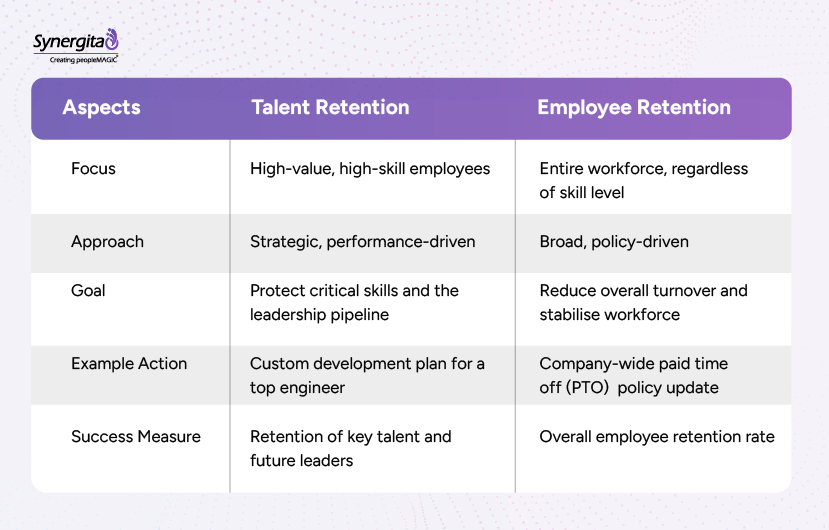
Employee retention and talent retention both support workforce stability, but talent retention focuses specifically on retaining high-performing and high-potential employees.
Why talent retention is important in modern organizations
Talent retention directly impacts productivity, reduces turnover costs, strengthens workplace culture, and supports long-term business growth.
1. The rising cost of employee turnover
Turnover costs add up quickly when you consider factors such as recruiting expenses, onboarding time, lost productivity, and the impact on the remaining team members.
According to Gallup research, replacing an employee can cost anywhere from half to twice their annual salary. For example, in a 100-person company with an average salary of $50,000, these costs can quickly add up to hundreds of thousands of dollars each year.
Beyond the financial cost, employee turnover can also slow down projects and lower team morale. When people leave, the remaining team members have to take on extra work, which can lead to stress and reduced motivation.
2. Retaining talent drives business growth
Stable teams deliver work faster because they already understand the systems, customers, and processes. New employees usually need time to learn and reach full productivity, while experienced team members can work more efficiently and avoid delays by using their knowledge and shortcuts built over time.
Retaining talent also protects:
- Productivity stability across project cycles
- Knowledge retention, especially in technical or client-facing roles
- Employer brand strength, since low turnover signals a healthy workplace to future candidates.
3. Role of talent retention in competitive markets
The competition for skilled employees is especially high in IT, fast-growing startups, and service industries, where changing jobs is easy. In such fields, having a strong talent retention strategy is not just an HR task; it becomes a real competitive advantage.
Companies that integrate talent acquisition and retention strategies are more successful at attracting the right people and retaining them over the long term.
4. Employee engagement and workplace culture
Employees who stay tend to invest more in the team around them. They mentor newer hires, build trust across departments, and reinforce a culture where people feel recognized rather than replaceable.
Gallup’s research found that companies with highly engaged employees experience a 51% reduction in turnover, making engagement programs one of the most measurable retention levers for HR teams.
5. Strong employer branding
High retention rates send a strong signal to candidates. Many job seekers review employer ratings, LinkedIn activity, employee testimonials, and word-of-mouth feedback before applying.
A reputation for retaining people gives a company a real edge in hiring without spending more on recruiting.
Talent retention strategies that improve employee retention
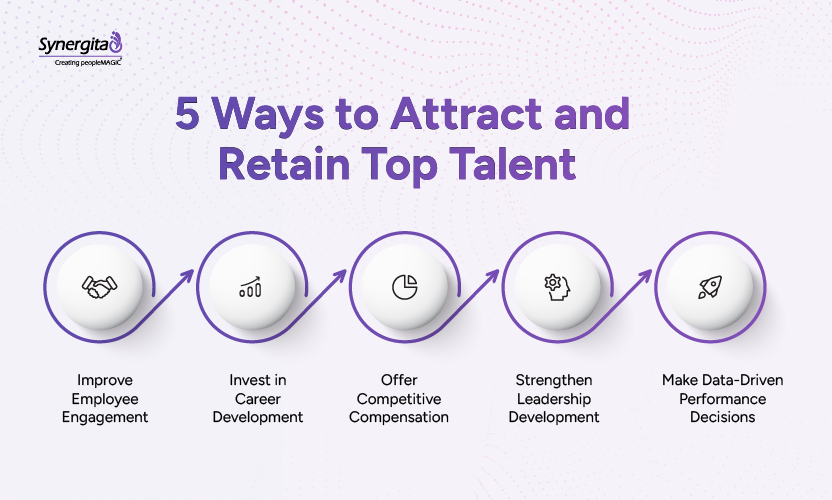
Retention begins during recruitment, when companies set realistic job expectations and hire candidates whose skills, values, and career goals align with the role. Once employees join, regular feedback, fair rewards, and career development opportunities help keep them engaged over the long term.
1. Improve employee engagement
Recognition and continuous feedback consistently rank among the top reasons employees choose to stay. Build both into a routine rather than treating them as occasional gestures.
Effective tactics include:
- Conduct quarterly pulse surveys.
- Hold monthly one-on-one check-ins.
- Recognize contributions publicly and promptly.
2. Invest in career development
Employees who can’t see a future at a company start looking elsewhere. Training programs and internal mobility give people a reason to grow in place rather than grow out.
HR teams can support career development by:
- Creating clear career paths for key roles
- Offering internal job opportunities to the right employees
- Holding quarterly career conversations between managers and employees
- Tracking participation in learning and development programs
3. Offer competitive compensation
Salary benchmarking ensures compensation stays fair and aligned with the market, while flexible benefits help address real employee needs that often influence their decision to stay or leave.
4. Strengthen leadership development
Managers shape day-to-day employee experience more than any policy document. Research shows that managers account for at least 70% of the variance in employee engagement scores across business units.
Training managers in emotional intelligence and structured feedback delivery directly reduces attrition on their teams. Organizations with skilled and supportive managers are better positioned to retain talent and build stronger, more engaged teams.
5.Data-driven performance decisions
Declining participation in engagement activities, fewer one-on-one meetings, inconsistent performance, and fewer internal job applications are early indicators of retention risk. Using AI-powered performance management tools makes it easier to track these issues and take proactive steps before employee disengagement happens. These tools also track retention metrics including:
- Voluntary turnover rate
- High-performer retention rate
- Internal promotion rate
- Employee engagement score
- Manager effectiveness scores
- Time-to-productivity for new hires
Suggested Reading: How to Engage the Disengaged Employees
Talent retention program checklist: common mistakes to avoid
Avoiding common mistakes in talent retention is as important as implementing the right strategies. Here are the common mistakes to avoid.
☐ Failing to provide clear career growth opportunities.
☐ Offering compensation below market standards.
☐ Ignoring employee feedback and concerns.
☐ Overlooking employee recognition and rewards.
☐ Promoting managers without leadership training.
☐ Creating unclear job roles and performance expectations.
☐ Neglecting work-life balance and employee well-being.
☐ Using a one-size-fits-all approach to employee engagement.
☐ Waiting until employees resign to address retention issues.
☐ Treating talent acquisition and retention as separate HR functions.
Addressing these mistakes early helps organizations build a stronger, more engaged workforce and significantly improve long-term talent retention.
Real-world examples of successful talent retention
Many organizations have improved employee loyalty and reduced turnover by investing in career growth, strong leadership, and a positive workplace culture.
For example:
Companies such as Microsoft encourage continuous learning, helping employees build long-term careers without leaving the organization. Microsoft has launched ongoing learning and development with Viva Learning.
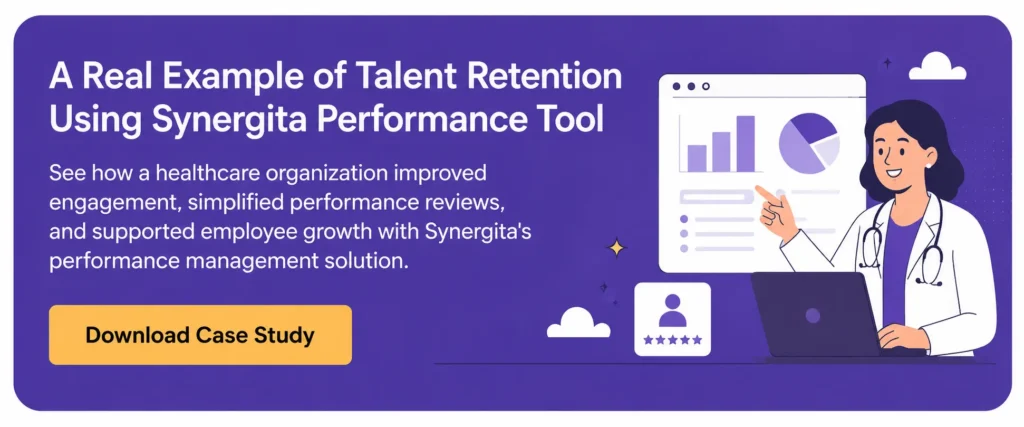
A healthcare organization strengthened its talent management practices by implementing Synergita’s performance management solution. They simplified performance reviews, adopted continuous feedback, and supported employee development to improve workforce engagement and created a better foundation for long-term talent retention.
Final takeaway
Talent retention isn’t a one-time initiative. It’s an ongoing commitment to fair compensation, real career growth, trained managers, and a culture where skilled employees choose to stay.
Companies that build structured retention programs spend less on hiring, protect institutional knowledge, and outpace competitors stuck in a constant cycle of replacement. Retention challenges usually develop gradually and become visible only when employees begin to disengage or leave.
Organizations that take retention seriously rely on regular feedback, performance conversations, and engagement insights to identify early signs of disengagement. AI-powered performance management platforms such as Synergita provide these features in one system, making it easier to act before employees decide to leave.
Try Synergita free for 14 days.
Frequently Asked Questions
Talent acquisition focuses on attracting and hiring new employees, while talent retention focuses on keeping existing skilled employees engaged and committed. Companies that treat both as one connected strategy build stronger long-term workforce stability.
The 5 C’s are commonly defined as Career, Competence, Care, Connection, and Culture. Together they represent the core areas HR teams should address to reduce voluntary turnover among skilled employees.
The 4 pillars typically cited are compensation, career development, work-life balance, and leadership quality. Weakness in any one pillar tends to drive attrition even when the others are strong.
Talent retention rate is calculated by dividing the number of employees who stayed for a full period by the total number employed at the start of that period, then multiplying by 100. Most companies track this quarterly alongside voluntary turnover rate for a fuller picture.
Yes, retention challenges vary significantly by industry, with tech, healthcare, and fast-growing startups typically facing the highest competition for skilled talent. Industries with tighter labor markets usually need more aggressive retention strategies than slower-moving sectors.
Yes, HR platforms that track engagement, automate feedback cycles, and flag attrition risk early give HR teams a measurable edge over reactive, exit-interview-only approaches. Continuous performance tracking tools like Synergita help managers catch disengagement signals months before resignation.